
Short-Term Rental Injuries | Georgia
Hurt at an Airbnb or VRBO? Start With Clear Answers.
A plain-language guide from Slam Dunk Attorney on injuries at short-term and vacation rentals across metro Atlanta and Georgia.
By Peter F. Jaraysi · Published October 26, 2026
Short-Term Rental Injuries in Georgia: Who Is Responsible and What to Do Next
Short-term rental injuries happen when a guest is hurt at a home, condo or cabin booked through Airbnb, VRBO or a similar site. In Georgia, the owner or occupier may be responsible when it fails to use ordinary care to keep the property safe. This guide explains how that works, what evidence matters and what to do in the first days. Slam Dunk Attorney represents people hurt in these situations across metro Atlanta and Georgia, from our office in Duluth.
If a fall, pool accident or dog bite at a rental left you hurt, you don't have to sort out the host, the insurers and the deadlines alone. Our team can talk it through with you. Talk it through with our team — the first consultation is free, confidential, and carries no obligation.
What Counts as a Short-Term Rental Injury in Georgia
A short-term rental injury is harm a guest suffers because of an unsafe condition or a careless act at a rental booked for a few nights or weeks. Platforms connect guests with privately owned homes, condos, cabins and apartments. Often, the owner is not on site.
An invitee is someone the owner brings onto the property for a lawful purpose, such as a paying guest. Georgia’s owner duty law says an owner or occupier who invites people onto premises must use ordinary care to keep the premises and approaches safe.
Not every injury means someone is at fault. A rental injury usually involves a condition that should have been fixed, a warning that should have been given, or a known danger that was ignored. A step no one could have anticipated is different from a loose railing a host had been told about.
Our firm handles premises liability, slip and fall, negligent security, dog bite, catastrophic injury and wrongful death claims that arise at rentals. For the general standard, see our premises liability guide.
Common Causes of Injuries at Vacation Rentals
Most serious rental injuries fall into a few groups. Each group points to different evidence and a different party who may have had control.
Pools and hot tubs are a frequent concern. Missing or broken barriers, slick pool decks and no supervision around water can turn a short visit into a serious injury. Georgia’s slip-and-fall prevention guidance names removing obstructions, addressing spills and keeping walkways clear as basic prevention steps.
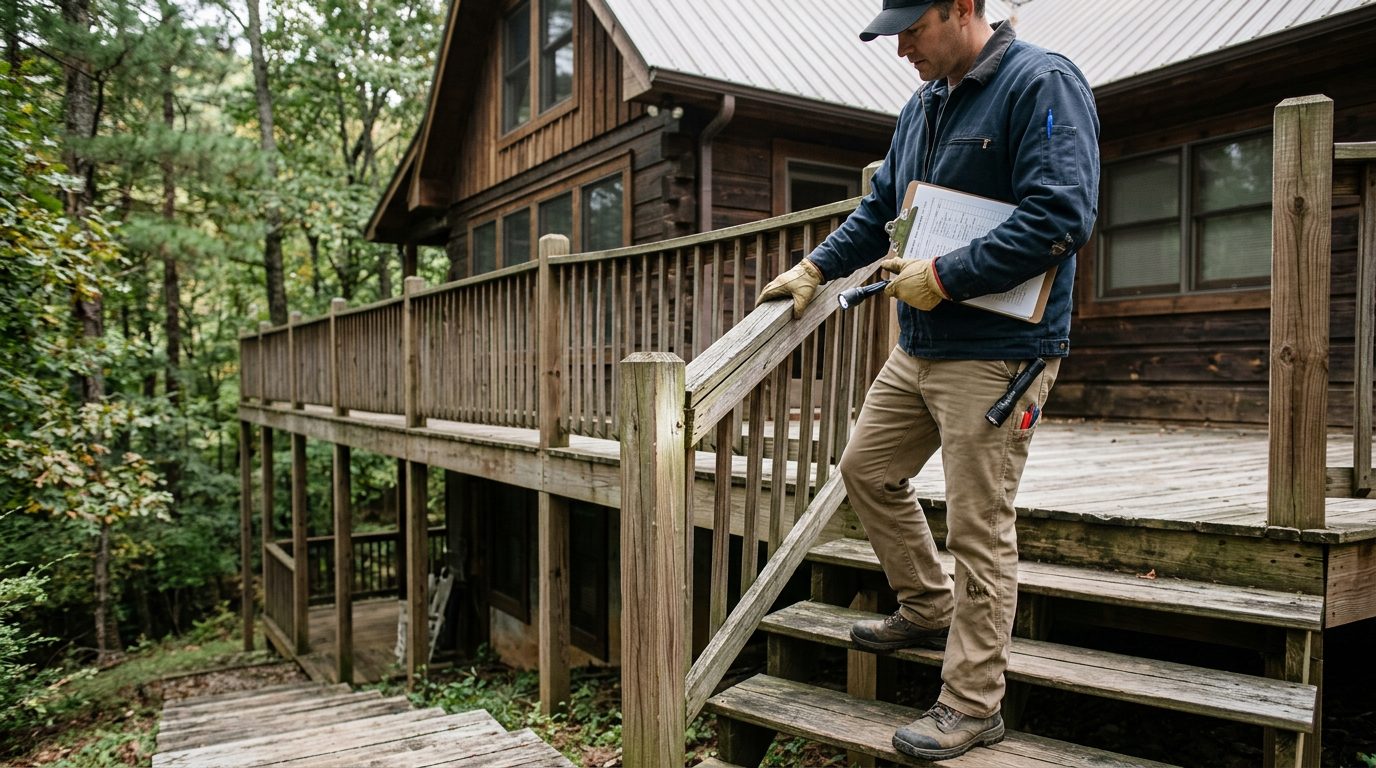
Stairs, railings, balconies and loft ladders cause another large share of harm. A wobbly railing, a rotted deck board or a ladder with no guard can give way under normal use. Poor lighting on stairs and walkways makes these hazards worse at night.
Slips on wet floors, loose rugs and uneven outdoor paths are also common. These claims turn on whether the owner knew or should have known about the hazard.
Dog bites happen when a host keeps a dog that is not controlled. Georgia’s animal liability law ties liability to careless management or letting an animal go at liberty. See our dog bite page for details.
Negligent security involves broken locks, broken gates, unlit parking areas and known criminal activity the owner ignored.
Who Can Be Responsible for a Short-Term Rental Injury
The property owner or occupier is usually the first party to look at. An occupier is someone who controls the property day to day, even if they do not own it.
A host who is not the owner may share responsibility. So may a property manager or co-host who controlled repairs, cleaning or guest access. Who held control is often the key question.
Contractors who did repair, installation or inspection work can also be responsible. Under Georgia law, an employer is liable for a contractor’s negligence in listed situations. One example is when the employer keeps the right to direct how the work is done. The Title 51 code sets out those situations.
Security companies can be responsible when they took on the job of protecting a property and failed to do it with reasonable care.
Landlord rules add another layer. Under Georgia’s landlord tort rule, a landlord that fully gives up possession is generally not responsible for the tenant’s negligence. That landlord still remains responsible for defective construction and for failing to keep the premises in repair. How a stay was set up affects how this rule applies.
Platforms such as Airbnb and VRBO have their own terms. Their role in a claim depends on the facts and the policies involved.
The Owner’s Duty of Reasonable Care
Georgia requires owners to use ordinary care to keep a rental reasonably safe for invited guests. Ordinary care means the care an ordinarily prudent person would use in similar circumstances. In general, ordinary diligence is the degree of care that ordinarily prudent persons exercise under the same or similar circumstances, and the absence of such diligence is termed ordinary negligence, as Georgia’s definition of ordinary diligence states.
In practice, reasonable care means inspecting the property, repairing known problems, and warning guests about hazards that cannot be fixed right away. It also means acting on repeat complaints.
There is a difference between an owner who actually knew about a hazard and one who should have found it through a reasonable inspection. Both can matter. Evidence of notice includes guest complaints in reviews or messages, repair requests, earlier incident reports and maintenance records.
The injured person usually has to show that the hazard caused the injury and that the owner failed its duty. Our premises liability guide covers this standard in more detail.
Georgia also reduces recovery by the injured person’s share of fault. Under O.C.G.A. § 51-12-33 as quoted in Quynn v. Hulsey, damages drop by the plaintiff’s percentage of fault. A plaintiff who is 50 percent or more responsible recovers nothing.
Insurance, Platforms and Why Coverage Doesn’t Decide Your Rights
Insurance answers how a claim gets paid. It does not decide whether you have a claim.
Hosts often carry homeowner, landlord or short-term rental liability policies. Platforms may also offer host protection programs, and their terms vary. Coverage limits and exclusions can change how a claim is valued, so the policies in play need a close look.
In many cases, you will deal with an insurer directly. Insurers may ask for a recorded statement, medical records and signed authorizations. Read what you are signing before you sign it.
An early offer from an insurer is not a full evaluation of your claim. Medical costs and long-term effects may not be fully known in the first weeks. Take time to understand the offer before accepting it.
Not sure what your next step is?
Talk it through with our team — the first consultation is free, confidential, and carries no obligation.
The 7-Day Rule and Local Rental Regulations
The “7-day rule” is a nickname people use for local limits on how short some rentals can be.
Local ordinances, permits, registration requirements and occupancy limits can matter. They can show what the owner was required to do. Whether a particular rule applies depends on the property’s location and the rule in effect at the time.
Bring the rental address and your booking details. Those facts help identify which local rules may apply to the property.
Catastrophic Injuries and Wrongful Death at Rentals
A fall, a pool accident or a dog attack can cause injuries that change a person’s life. These include spinal cord injury and paralysis, traumatic brain injury, amputation and severe burns. Georgia’s falls injury prevention program reports data on fall-related injuries, including traumatic brain injuries.
These injuries often require long-term medical care, rehabilitation, home changes and planning for lost income. Those needs shape how a claim is evaluated. Our catastrophic injuries page describes these cases in more depth.
When a guest dies, Georgia law allows certain family members to bring a wrongful death claim. Under Georgia’s wrongful death statute, the surviving spouse or, if there is no surviving spouse, a child or children may recover for the homicide of the spouse or parent the full value of the life of the decedent, as shown by the evidence. A personal representative may also recover funeral and medical expenses tied to the death.
Families should keep medical bills, death certificates, photos of the property and records of the incident. Learn more on our wrongful death page.
Injuries That Are Hard to Prove and How Documentation Helps
Some injuries are hard to prove because symptoms appear late. Concussions, soft tissue injuries, internal injuries and some spinal injuries may not show up for hours or days.
That is why prompt medical evaluation matters. Even a fall that seems minor can lead to a serious injury that shows up later.
A gap between the incident and treatment gives an insurer a reason to dispute the cause. Medical records should connect your symptoms to the rental accident in clear terms.
Practical documentation helps. Keep dated photos and video of the hazard, the booking confirmation, messages with the host, and names of witnesses. Write a timeline of what happened while your memory is fresh.
What to Do Right After a Short-Term Rental Injury
Get medical care first, even if your injuries seem minor. Follow the treatment plan and keep every appointment record.
Report the incident to the host or platform in writing. Keep copies of every message, report and confirmation.
Photograph the hazard before it is repaired. Keep the shoes or clothing you wore at the time.
Collect names and contact details for witnesses, other guests and any police or first responders who came to the scene.
Keep a daily log of pain, limits on activity, missed work and out-of-pocket costs. Think carefully before posting about the incident or your physical activity on social media.
Avoid recorded statements or signing releases with an insurer until you understand what they cover.
Georgia Deadlines: The Two-Year Filing Period
Georgia generally requires a personal injury lawsuit to be brought within two years after the right of action accrues. That rule comes from O.C.G.A. § 9-3-33.
Some circumstances change the timing. Under the general rule, the period is subject to exceptions “as otherwise provided in this article”; for example, O.C.G.A. § 9-3-99 pauses the limitations period for a crime victim’s tort claim that arises out of the facts and circumstances of an alleged crime committed in Georgia, from the date of the alleged crime until the prosecution has become final or otherwise terminated. That pause may not exceed six years, except as otherwise provided in Code Section 9-3-33.1, under O.C.G.A. § 9-3-99.
Wrongful death claims follow their own rules, so families should act quickly. Waiting can also hurt any claim. Evidence disappears, repairs happen, witnesses move and records get harder to obtain.
If a fall, pool accident or dog bite at a rental left you hurt, you don't have to sort out the host, the insurers and the deadlines alone. Our team can talk it through with you. Talk it through with our team — the first consultation is free, confidential, and carries no obligation.
Frequently Asked Questions About Short-Term Rental Injuries
What happens if I get injured at an Airbnb?
Get medical care first, then report the injury to the host or platform in writing. Preserve photos, messages and records, because a claim usually starts with identifying who controlled the property.
What injuries are hard to prove?
Concussions, soft tissue injuries and delayed-symptom injuries are often harder to prove. Prompt medical evaluation and clear records that link symptoms to the rental accident help.
Can I sue the host directly?
Many claims start with an insurance claim, and some lead to a lawsuit. The right path can be decided only after reviewing the facts.
How long do I have to file?
Georgia generally allows two years to file a personal injury lawsuit (O.C.G.A. § 9-3-33; Kenneth B. Cameron v. Jmp Pizza, Inc (2026)). Some circumstances can change that period.

Talk With Our Team About Your Rental Injury
If you were hurt at a rental in Lawrenceville, Johns Creek, Alpharetta, Marietta, Norcross, Kennesaw, Dunwoody or Atlanta, you may be facing hard questions. You may be dealing with a host, insurers, medical bills and deadlines all at once. Our lawyers, including Peter F. Jaraysi and Brian D. Wright, review these claims and explain your options in plain language. Our first consultation is free, confidential and carries no obligation to continue. To reach us, visit our contact page and request a free case review.
You can also learn more on our city pages, such as the Atlanta personal injury page and the Lawrenceville personal injury page.
Attorney advertising. This page is general information, not legal advice, and no particular outcome can be promised. The responsible lawyer for this page is Peter F. Jaraysi of Slam Dunk Attorney, Duluth, Georgia. Contact information is at slamdunkattorney.com/contact-us.
How We Help Injured Guests and Visitors
Plain-Language Guidance
We explain the process in everyday terms so you can make informed decisions about your situation.
Careful Documentation
Our team helps you organize photos, messages, booking records and medical paperwork from the start.
Advocacy for Your Recovery
We focus on protecting your rights while you concentrate on your health and your family.
Compassionate Support
Serious injuries affect every part of life. We listen first and take the time to understand your needs.
Don't Wait to Preserve Evidence
Photos, text messages, booking confirmations, listing screenshots and medical records can be lost or become harder to gather over time. Save what you have now, even if you are not sure yet what it means.
Steps to Take After a Rental Injury
Get Medical Care
Your health comes first. Get evaluated promptly, even if your symptoms seem minor, and follow your providers' instructions.
Report the Injury in Writing
Notify the host or the booking platform in writing and keep a copy of everything you send and receive.
Preserve Your Records
Keep photos of the property and the hazard, messages, receipts, the listing page and any incident reports.
Talk With Our Team
Share what happened with us for a free, confidential review of your situation and your questions.