
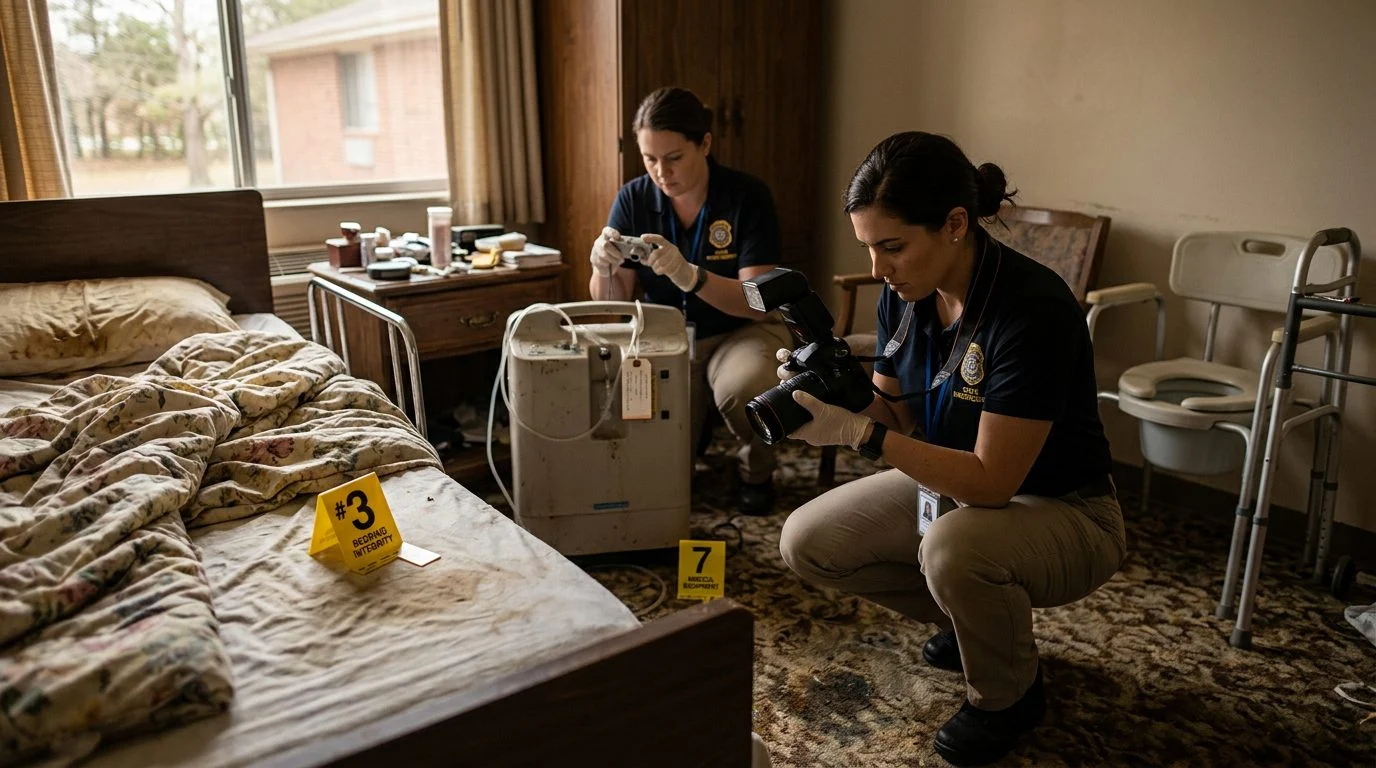
Nursing Home Abuse | Duluth, Georgia
When Someone You Love Is Hurt in Care, You Deserve Straight Answers
Our team focuses on helping families across metro Atlanta understand what they are seeing and what options may be available, with a confidential conversation first.
By Peter F. Jaraysi · Published November 12, 2026
If you are wondering how to spot nursing home abuse, start with changes you can see. Unexplained injuries, sudden shifts in behavior, and missed care are the clearest warning signs. Once something looks wrong, more than one party may be named in a Georgia claim, not just the facility.
Why Identifying the Right Parties Matters Early
Knowing who may be responsible early helps you protect the evidence a claim depends on. Families usually notice a problem before they know who caused it. Staffing schedules, incident reports, and medication logs can change or disappear over time.
Start by writing down what you see, with dates and times. Keep copies of letters, bills, and notes the facility gives you. You can also ask for records. Under Georgia law, a provider must furnish a requested record within 30 days of receiving the request, when the request comes with the required authorization (O.C.G.A. § 31-33-2). Residents also have a right to inspect their own records unless that is medically contraindicated (O.C.G.A. § 31-8-108).
If you are acting for a parent who cannot speak for themselves, this can feel like a heavy load. You don’t need every answer today.
If you are watching a loved one in a Georgia facility and something seems wrong, our team can talk through what you have seen and who may be responsible. Talk it through with our team — the first consultation is free, confidential, and carries no obligation.

How to Spot Nursing Home Abuse and Neglect
The most useful warning signs are injuries no one explains, sudden changes in how a resident acts, and care that doesn’t happen. Watch for these signs:
- Physical: unexplained bruises, cuts, burns, broken bones, pressure sores, dehydration, or unusual weight loss.
- Behavioral: withdrawal, fear of a particular staff member, agitation, or changes in sleep or mood.
- Financial and paperwork: missing cash or property, changed bank or insurance details, or documents signed without explanation.
- Neglect: soiled bedding, missed medications, poor hygiene, or call lights left unanswered for long periods.
A single sign does not prove abuse. Patterns and timing matter. A bruise that appears after one aide’s shift, then again later, tells you more than one bruise on one day.
Georgia law also requires a facility to report a significant change in a resident’s health to people the resident chooses, within a reasonable time (O.C.G.A. § 31-8-108). If no one told you about a serious change, write that down. Resident rights groups also describe protections such as freedom from mental and physical abuse (The Consumer Voice).
The Nursing Home Facility and Its Licensed Operator
The licensed facility is usually the first party a family considers. Georgia defines a long-term care facility as an intermediate care home, skilled nursing home, or intermingled home that the state regulates and licenses (O.C.G.A. § 31-8-102). Each resident must receive care with reasonable care and skill, in compliance with applicable laws and regulations (O.C.G.A. § 31-8-108).
The company that holds the license and runs the building is often named alongside the facility. Licensing records and your own documents can show who ran the building. The state’s Department of Community Health describes how nursing homes are overseen and how concerns can be reported (Georgia Department of Community Health).
Corporate Owners, Parent Companies, and Management Companies
A parent or management company can be named when it had real control over staffing, budgets, or policies. Many nursing homes are owned through several layers of companies. Who controlled what is usually a question of records, not labels.
Georgia’s Supreme Court addressed employer responsibility in Quynn v. Hulsey (2020). It held that the old rule ending an employer’s own claims after it admitted responsibility for its driver is gone (Quynn v. Hulsey).
Georgia also divides fault by share. Damages apportioned to each liable person are that person’s own liability, not joint, and not subject to contribution (O.C.G.A. § 51-12-33). That is why each party’s real role in the harm matters.
Individual Caregivers, Nurses, and Administrators
Individual staff who directly harm a resident can be named alongside the facility. Georgia law makes an employer liable for torts its servant commits within the scope of the business, whether by negligence or voluntarily (O.C.G.A. § 51-2-2).
Employers can also face direct claims. An employer must use ordinary care not to hire or keep an employee it knew or should have known posed a risk of harm, when that harm was reasonably foreseeable (Munroe v. Universal Health Services). A negligent supervision claim needs enough evidence that the employer knew or should have known of the employee’s tendencies (Novare Group v. Sarif). In Beasley v. A Better Gas Co. (2004), the court said, in passing, that an injured person may bring a claim against a company for negligently training an employee (Beasley v. A Better Gas).
These cases turn on what the employer knew. Prior complaints or incidents can matter a great deal. A supervisor’s own decisions can matter too, when records show a known risk went unaddressed. A worker who hits or threatens a resident presents a different kind of claim than a general staffing shortfall. The facts decide which applies.
Staffing Agencies, Contractors, and Outside Medical Providers
Agency staff, contract physicians, and outside vendors can share responsibility for their own care. Many facilities rely on temporary or traveling workers from staffing agencies. Georgia law says an employer generally is not responsible for torts of an employee who runs an independent business and is not under the employer’s immediate direction and control (O.C.G.A. § 51-2-4). So who directed a worker’s shift can shape who is named.
Contracted physicians, therapists, pharmacies, and equipment vendors may also be responsible when their own care falls below accepted standards. Medication errors, improper wound care, and failure to respond to a known medical change are common examples.
Practical records can show who did what. Look for the agency name on paperwork, the staff name on shift logs, and the medication administration record. A records request can help show who gave which care, and when.
Not sure what your next step is?
Talk it through with our team — the first consultation is free, confidential, and carries no obligation.
How Georgia Fault and Time Rules Shape a Claim
Georgia reduces an award by the injured person’s share of fault, and bars recovery at 50 percent or more. The judge reduces damages in proportion to the plaintiff’s percentage of fault (O.C.G.A. § 51-12-33).
Time limits also apply. Georgia’s general rule for actions for injuries to the person is two years after the right of action accrues (O.C.G.A. § 9-3-33).
Is the company or the individual caregiver responsible?
Both can be named when the facts support it. Each liable party’s share is assessed separately.
How long do you have to file?
Georgia generally allows two years for injury claims. The clock starts when the right of action accrues.
What if the resident was partly at fault?
Georgia reduces damages by the person’s share of fault. A person who is 50 percent or more responsible receives no damages (O.C.G.A. § 51-12-33; Quynn v. Hulsey (2020)).
Talk Through Your Situation With Our Team
If you are watching a parent or relative in a Georgia facility, you may be asking whether, and from whom, your family can seek accountability. You don’t have to sort that out alone. Our lawyers at Slam Dunk Attorney, in Duluth, Georgia, can talk through the signs you’ve noticed and the records you can gather. Peter F. Jaraysi is the responsible lawyer for this page. Your first consultation is free, confidential, and carries no obligation to continue. Reach out to our team to start that conversation.
This page is general information, not legal advice. Responsible lawyer: Peter F. Jaraysi, Slam Dunk Attorney, Duluth, Georgia. Contact: slamdunkattorney.com/contact-us.
How We Approach Your Situation
Confidential Conversations
What you share with our lawyers is kept confidential, so you can talk openly about your family member's care.
Careful Review of Records
Our lawyers look at the facts, including medical and facility records, to understand what happened and who may be responsible.
Families Included
We keep you informed and listen to your concerns, because the people closest to a resident often know the most.
Free First Consultation
Our initial consultation is free, confidential and comes with no obligation to continue.
If Someone Is in Immediate Danger
If a resident is in immediate danger or needs urgent medical care, call 911 first. Once they are safe, contact us to talk about what you have observed.
Steps Families Often Take
Write Down What You Notice
Record dates, times, injuries, changes in behavior and the names of staff involved while the details are still fresh.
Keep Copies of Important Papers
Hold on to admission paperwork, care plans, bills and any letters or incident reports you receive from the facility.
Ask for the Records
Medical and facility records help show what care was provided and what was missed. Our team can help you understand what to request.
Talk With Our Lawyers
A free, confidential consultation gives you a chance to share your concerns and learn how our firm may be able to help.