
Premises Liability | Duluth, Georgia and Metro Atlanta
When a Hazard Was Hard to Miss, the Key Question Is What the Owner Knew or Should Have Known
A plain-language guide to constructive knowledge in Georgia premises liability cases, from Slam Dunk Attorney.
By Peter F. Jaraysi · Published November 1, 2026
“I didn’t know” does not automatically end a premises claim in Georgia. The real question is often whether the owner knew about the hazard, or whether it should have known through reasonable care. That difference is the heart of a constructive knowledge question in a Georgia premises liability case.
Many people hear this line right after a fall. A manager says nobody reported the spill. A property manager says the stair rail was fine last week. The statement sounds final, but in many cases it is where the legal analysis begins. This guide explains how Georgia law frames that answer, in plain terms, so you can understand what the owner’s words may and may not settle.
What “I Didn’t Know” Means in a Georgia Premises Claim
The owner’s claim of ignorance is often the start of the legal question, not the end of it. Premises liability is the responsibility a property owner can have when an unsafe condition on its property hurts someone who is allowed to be there.
The idea is simple. An owner or occupier who controls a space has to take reasonable steps to keep it safe. That can include a store, an apartment building, an office, a restaurant, or a short-term rental. The owner’s personal awareness is one piece of the picture. The condition itself, how long it was there, and what the owner did about it are others.
It depends on the facts. Two owners can both say they never saw a hazard, and the legal result can still differ. The details of how the hazard formed and how long it stayed matter a great deal.
If you were hurt and the owner says it never knew about the hazard, we can talk through what that answer means for your situation in a free, confidential initial consultation. Talk it through with our team — the first consultation is free, confidential, and carries no obligation.
The Duty a Property Owner Owes a Visitor Under Georgia Law
An owner who invites people onto its property must use ordinary care to keep the premises and approaches safe. That is the core rule under O.C.G.A. § 51-3-1. The statute says an owner is liable for injuries caused by its failure to use ordinary care in this way.
The statute covers people who come onto the property by express or implied invitation for a lawful purpose. A customer shopping in a store is one example. A guest visiting a rental home is another. A delivery driver on a business errand may also fit.
Georgia treats other visitors differently. A licensee is a person who is not a customer, a servant, or a trespasser, has no contractual relation with the owner, and is allowed onto the property merely for his own interests, convenience, or gratification, according to O.C.G.A. § 51-3-2. The same section says an owner is liable to a licensee only for willful or wanton injury.
That difference matters. Your status on the property can change the standard that applies. A person who was invited for business usually stands in a different place than a neighbor who wandered onto a lot.
Actual Knowledge Versus Constructive Knowledge
Actual knowledge means the owner really knew about the hazard. Constructive knowledge means the owner did not personally know, but should have known through reasonable care.
Actual knowledge is easier to describe. The owner saw the spill, got a call about it, or caused it. A repair ticket that says “stair tread loose” shows the owner was told. A staff member who mopped up a leak earlier that morning also shows knowledge of a hazard.
Constructive knowledge asks a different question. Would a reasonable inspection have found the condition? If the hazard sat in plain view long enough, an inspection should have caught it.
Take a produce spill on a grocery aisle. Suppose lettuce and water sat on the tile for twenty minutes. Several employees walked past it during that time. A court may ask whether a reasonable store would have noticed and cleaned it up. The store may say it never knew. The question still remains whether it should have known.
Georgia courts often frame these questions around what the owner knew or should have known. The exact test depends on the facts and the stage of the case.
How Constructive Knowledge Is Usually Shown
Constructive knowledge is usually shown through facts about the hazard itself. The most common question is how long the condition was there before the fall. This is often called time of existence.
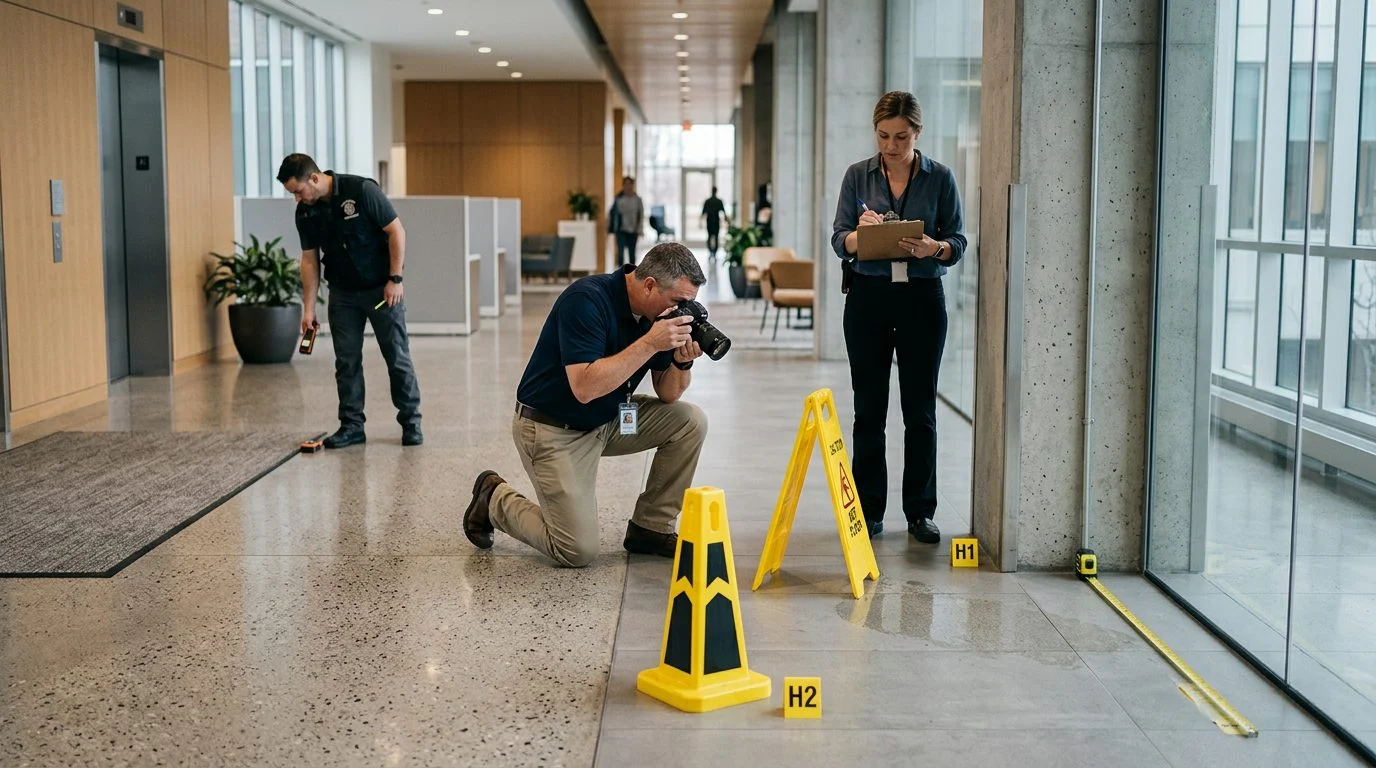
A visitor usually cannot see the owner’s mind. So the visitor’s proof tends to focus on the physical condition. Photos taken soon after the fall can show the spill, the broken step, or the missing light. Witness statements can describe how the area looked a short time before the injury.
A recurring problem also matters. If the same spot on a restroom floor stays wet again and again, an owner may be found to know about the condition. Repeated complaints about the same loose stair are another example.
Who created the hazard matters too. When the owner or its employees caused the condition, the knowledge question is often simpler. A staff member who dropped the item and walked away is one example. A contractor who left a trip hazard during a job may also fit, depending on the facts.
The strength of these points depends on the details. Timing, lighting, and the location of the hazard all shape what a reasonable owner would have seen.
Inspection Routines, Complaints, and Records
Inspection logs, cleaning schedules, maintenance tickets, and prior complaints can show what an owner knew or should have known. These records often answer the constructive knowledge question directly.
A cleaning log that shows no floor check for three hours is one example. A maintenance ticket that describes the same broken railing a month earlier is another. Each record helps show what the owner was told and what it did next.
Short-term and vacation rental owners and managers face the same question. Guest messages, repair requests, and reviews can mention an unsafe condition before an injury. A message that says a deck board is loose may matter a lot. So may a repair request that sat open for weeks.
Surveillance video and incident reports can also show how long a condition existed. Video may show the spill for several minutes before anyone came by. An incident report may show whether staff responded after the fall.
These records are often kept by the owner or its manager. That is why early requests to preserve them can matter. Waiting can lead to lost video or deleted messages.
Comparative Fault and Your Own Role in the Fall
Georgia reduces damages by the injured person’s share of fault. If a person is 50 percent or more responsible, that person recovers nothing. Under O.C.G.A. § 51-12-33, when an injured person is to some degree responsible for the injury or damages claimed, the judge reduces the damages awarded to that person in proportion to his or her percentage of fault. The statute says the judge reduces the award in proportion to the plaintiff’s percentage of fault.
Under the same statute, damages apportioned among liable persons are each person’s own liability. They are not joint liability.
Many people worry that their own distraction or choice to walk through a clearly marked spill will decide everything. Whether you noticed the hazard is a separate question. Whether the owner should have noticed it is another. Both are weighed on the facts, including what you saw, how bright the area was, and how the condition looked.
Not sure what your next step is?
Talk it through with our team — the first consultation is free, confidential, and carries no obligation.
Common Hazards Where This Defense Comes Up
Wet floors, broken or uneven stairs, poor lighting, and worn walkways are among the most common conditions in these claims. Each one can raise the same knowledge question.
A wet floor in a restaurant may have been there for a short time, or for much longer. A missing handrail on a staircase in an apartment building may have been broken for months. A dim parking lot may have had burned-out lights for weeks. A cracked walkway may have been visible on every trip past it.
These examples are general. They show where time of existence, inspection records, and recurring problems tend to matter. They are not predictions about any particular case.
For the broader picture of premises liability and the injuries it can cause, read our premises liability guide for Georgia. It covers more examples and how these claims are structured.
Deadlines and What to Preserve Now
Georgia generally gives an injured person two years to bring a personal injury action. O.C.G.A. § 9-3-33 states that rule. A Georgia Court of Appeals opinion quotes the same statute text in Cameron v. JMP Pizza, Inc..
Other deadlines can apply in some situations. Because the timing depends on the facts, it helps to act early.
Start with simple steps. Take photos of the hazard and the scene as soon as you safely can. Write down names and contact details for anyone who saw the fall. Save the incident report, medical records, receipts, and the shoes or clothing you wore.
Write a timeline while your memory is fresh. Note what the owner or staff said, and when. Record how long you think the condition was there, and why you think so.
Quick answers
Does “I didn’t know” end a premises claim in Georgia?
No, not automatically. The question can also be whether the owner should have known through reasonable care.
What is constructive knowledge?
It means an owner should have known about a hazard, even if it did not personally see it. Time the hazard existed is often central.
How long do I have to file?
Georgia generally allows two years for personal injury actions under O.C.G.A. § 9-3-33. Other deadlines can apply in some situations.
Talk With Our Team About Your Fall
If an owner told you it had no idea about the hazard that hurt you, you may be deciding whether that answer closes the question. Our team can review what you remember and what records may exist. Peter F. Jaraysi is the responsible lawyer for this page.
You can start with a free, confidential initial consultation, with no obligation to continue. Slam Dunk Attorney is based in Duluth, Georgia, and represents people hurt on property across metro Atlanta and Georgia, including Atlanta and Lawrenceville. To reach the firm, visit our contact page.
Disclaimer: This page is general information about Georgia law, not legal advice. Reading it does not create an attorney-client relationship. Responsible lawyer: Peter F. Jaraysi, Slam Dunk Attorney, Duluth, Georgia. Contact: slamdunkattorney.com/contact-us.
What Often Shapes a Constructive Knowledge Question
Actual knowledge
Did the property owner or manager know about the hazard, for example through a report, a complaint or a prior incident?
The records
Maintenance logs, incident reports, video and work orders can help show what was done and when.
Don't Assume You Have No Case
Many people believe a claim fails because they did not know the hazard was there or did not see who created it. Knowledge questions depend on the specific facts, so talk with our team about what happened before you assume anything.
Helpful Details to Gather If You Can
Photos and video
Pictures of the hazard, the location and surrounding conditions can be useful later, especially if they were taken soon after the incident.
Names of witnesses
People who saw the condition or the fall can provide details about how the hazard looked and how long it appeared to be there.
Incident and medical records
Keep any incident report, urgent care or hospital paperwork, and receipts related to your injury.
Your own account
Write down what you remember while it is fresh, including the time of day, the weather and what the lighting was like.