
Truck Accident Evidence | Georgia
What Evidence Matters Most in Your Truck Accident Claim
Strong evidence builds strong claims. Learn what to preserve and how it supports your case.
By Peter F. Jaraysi · Published September 28, 2026
Evidence in Truck Accident Claims: What to Preserve and Why It Matters
Evidence is the foundation of any truck accident claim—it establishes what happened, who was at fault, and what compensation you deserve. Without strong evidence, even a serious injury claim can falter. The good news: you can start collecting critical evidence immediately after the crash, before details fade or disappear.
This guide walks you through the types of evidence that matter most in Georgia truck accident cases, what to do in the first hours after an accident, and why early preservation can make the difference between a strong claim and a weak one.
If you've been hit by a truck and you're trying to figure out what to preserve and how to build your claim, people in your situation reach out to us regularly—let's talk about what happened. Talk it through with our team — the first consultation is free, confidential, and carries no obligation.

Why Evidence Matters in Truck Accident Claims
Evidence is what proves your case—it shows the court, an insurance company, or a jury exactly what happened and who bears responsibility. Strong evidence supports fair compensation for your injuries and damages; weak evidence invites the other side to deny liability or minimize what they owe you.
Here’s the critical part: evidence can fade, disappear, or be altered over time. Photographs blur or get deleted. Witnesses move away or forget details. Dashcam footage gets overwritten. Maintenance records disappear. The longer you wait, the more evidence you lose. Insurance companies and defendants know this—they’ll challenge weak evidence and exploit gaps in your documentation.
Scene Evidence: What to Collect Immediately
The accident scene is your first and most important source of evidence. If you’re able and safe to do so, start collecting information right away.
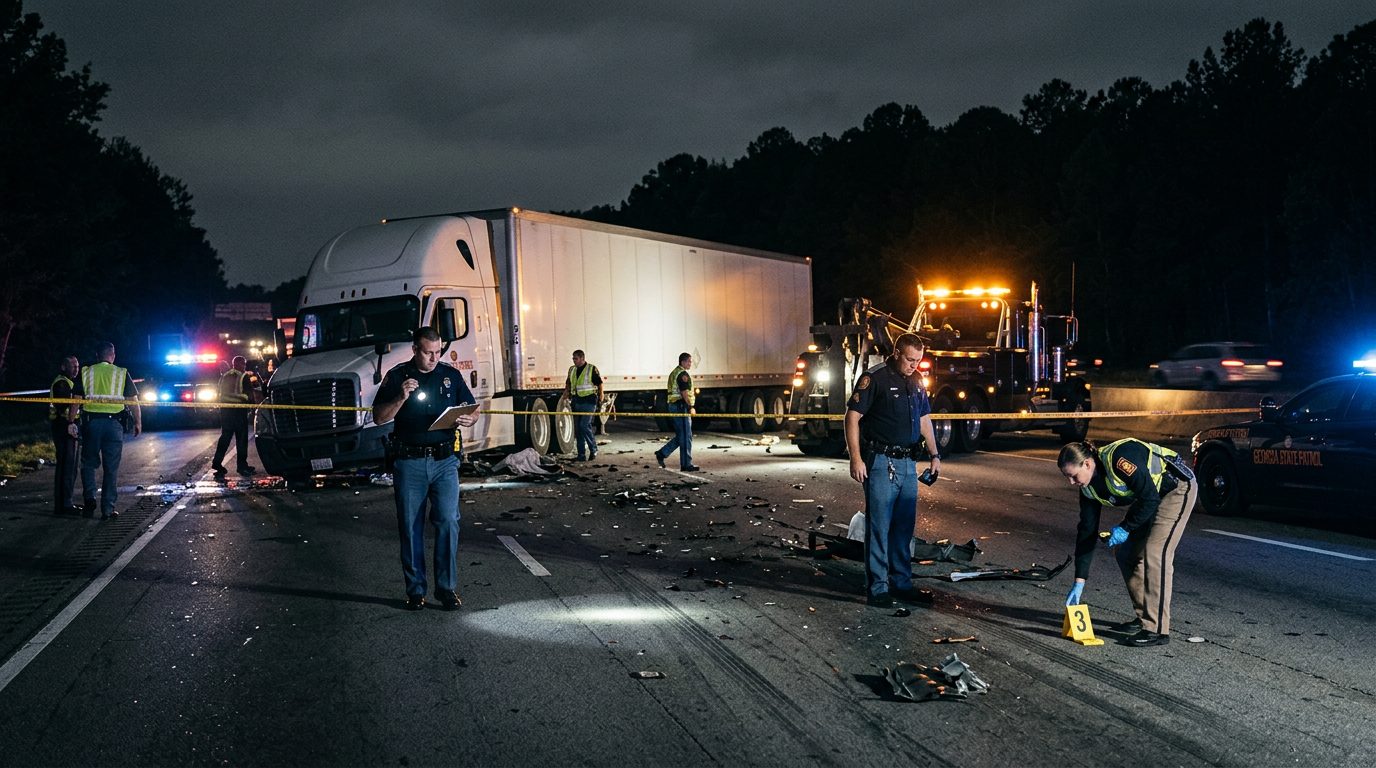
Photographs and video are essential. Take pictures of:
- All vehicle damage (wide shots and close-ups of both vehicles)
- Road conditions (wet, dry, debris, potholes, construction)
- Traffic signals and signs visible from the accident location
- The debris field (broken glass, vehicle parts, cargo spillage)
- Weather conditions (rain, fog, glare, darkness)
- Skid marks or tire tracks
- Final resting positions of both vehicles
- The surrounding area (nearby businesses, traffic patterns, lighting)
Video is even better than still photos—it captures movement, lighting, and context that photos miss.
Witness contact information is gold. Get names, phone numbers, email addresses, and physical addresses from anyone who saw the accident. Ask what they saw, and jot down their brief account. Witnesses who speak while memory is fresh carry far more weight in court than those interviewed weeks later.
Police report details matter. Get the officer’s name, badge number, the responding agency, the report number, and the date and time of the report. The police report is often the first official record of the accident, though it may contain errors or omissions you’ll need to correct later.
Your own notes are valuable. Write down the time of day, lighting conditions, traffic volume, what you remember about the truck’s movement, and your immediate physical condition. Date and time your notes—they become part of your evidence record.
Preserve the scene if it’s safe. Don’t move vehicles or clean up debris until police have documented everything. The positions of the vehicles, skid marks, and debris tell a story about how the accident happened.
Truck-Specific Evidence
Truck accidents are more complex than car crashes because commercial vehicles carry federal regulations, maintenance obligations, and driver-hour restrictions that can reveal negligence.
Truck identification is your starting point. Write down the trucking company name (usually on the side of the cab), the DOT number (a unique federal identifier), the license plate, and any unit number visible on the truck. This information lets your attorney locate the company’s records.
Driver information matters. Get the driver’s name, commercial driver’s license (CDL) number, and the name of the trucking company or owner. Ask whether the driver was on duty at the time of the accident—this affects liability and insurance coverage.
Cargo details can be relevant. What was the truck hauling? Was it properly secured? Unsecured or overloaded cargo can cause accidents or worsen injuries. The bill of lading (shipping document) is evidence.
Maintenance records are crucial. Federal law requires trucking companies to maintain detailed logs of vehicle maintenance, repairs, and inspections. These records can show whether the truck was properly maintained or whether a mechanical failure (brake failure, tire blowout, steering problem) contributed to the crash. Your attorney can demand these records through legal discovery.
Electronic logging device (ELD) data is a game-changer. Federal law requires commercial trucks to record hours of service using ELDs—digital devices that track when the driver is working, driving, or resting. ELD data can prove that a driver was fatigued, driving too long without a break, or violating federal hours-of-service rules. Hours-of-service violations are evidence of negligence independent of the accident itself.
Dashcam or onboard video from the truck itself can be decisive. Many commercial trucks have forward-facing or multi-angle cameras that record continuously. This footage can show the driver’s actions, speed, and behavior immediately before the crash. Your attorney can request this video through discovery.
Medical and Injury Evidence
Your medical records are the proof that the truck accident caused your injuries and establish the severity of your harm.
Emergency room or urgent care records document your injuries immediately after the accident. These records create a strong causal link between the crash and your medical condition. Delays in seeking care can weaken injury claims, so get evaluated as soon as possible.
Doctor’s notes and diagnoses from ongoing treatment show the extent of your injuries and your recovery timeline. These records are critical—they establish that your injuries are real, serious, and caused by the accident.
Imaging and test results (X-rays, CT scans, MRI reports) provide objective evidence of injury. A broken bone or torn ligament documented on imaging is far harder to dispute than your word alone.
Prescription records show what medications your doctors prescribed for accident-related pain, inflammation, or other symptoms. These records support the severity of your condition.
Physical therapy or rehabilitation records document your recovery process and any lasting limitations. If you’re still in therapy months after the accident, that’s powerful evidence of ongoing harm.
Keep receipts for all accident-related medical expenses: doctor visits, emergency care, medications, medical equipment, transportation to appointments, and over-the-counter pain relievers. These receipts support your damages claim.
Documentation and Records Evidence
Beyond the scene and medical care, gather and preserve all paperwork related to the accident and your recovery.
Insurance information includes your own policy, the truck company’s policy information, and any communications with insurers. Keep copies of all emails, letters, and claim forms.
Repair estimates and invoices document the cost of damage to your vehicle. Even if you don’t repair the vehicle, get an estimate—it’s evidence of the accident’s force and impact.
Wage loss documentation proves that you missed work because of the accident. Provide pay stubs showing your normal income, and get a letter from your employer stating the dates you missed work and any lost wages or benefits.
Communications matter. Save text messages, emails, or letters from the other driver, witnesses, insurance adjusters, or anyone involved in the accident. These communications can reveal admissions of fault or contradictions in the other side’s story.
Your own records are underrated. Keep a dated journal describing your pain, physical limitations, emotional impact, and recovery progress. Be specific: “Pain in lower back increased after physical therapy; couldn’t sleep more than 4 hours” is stronger evidence than “I hurt.”
Not sure what your next step is?
Talk it through with our team — the first consultation is free, confidential, and carries no obligation.
Expert Evidence and Investigation
As your claim develops, expert witnesses can analyze and interpret evidence in ways that strengthen your case.
Accident reconstruction experts are engineers who analyze the physics of the crash, vehicle damage patterns, road conditions, and other factors to determine how the accident happened, vehicle speeds, and impact angles. Their analysis often proves decisive in determining fault.
Truck maintenance experts can review the truck’s maintenance records and identify whether mechanical failure played a role in the accident.
Medical experts can testify about the severity of your injuries, the necessity of your treatment, and long-term effects. They translate medical jargon for a jury and explain why your injuries are serious.
Hours-of-service experts can analyze ELD data to show whether the driver was fatigued, violated federal driving-hour limits, or broke other regulations. This evidence often proves negligence on its own.
Your attorney typically retains these experts during the claims process—you don’t need to hire them yourself.
What NOT to Do: Evidence Mistakes
Mistakes early on can cripple your claim. Avoid these common pitfalls:
- Do not clean up or repair the vehicle before photos are taken and documented. The damage pattern is evidence.
- Do not delete text messages, emails, or social media posts related to the accident. Even if they seem unhelpful, they’re evidence.
- Do not post about the accident on social media. Statements can be taken out of context and used against you.
- Do not sign anything or make a recorded statement without understanding what you’re agreeing to. Insurance adjusters may ask you to sign forms that limit your rights.
- Do not delay seeking medical care. Gaps in treatment weaken injury claims and give the other side ammunition to argue your injuries aren’t serious.
- Do not assume the police report is complete or accurate. It may contain errors or omissions. You can request a copy and correct inaccuracies.
Preserving Evidence: Legal Holds and Requests
Once you contact an attorney or file a claim, the trucking company has a legal obligation to preserve evidence. This is critical because trucking companies routinely destroy or “lose” evidence if they think they can get away with it.
An attorney can send a preservation letter to the trucking company demanding that it keep all maintenance records, driver logs, dashcam footage, ELD data, communications, and other evidence related to your accident. This letter creates a legal duty—failure to preserve evidence can result in court sanctions or an adverse inference (the court may assume the missing evidence would have helped you).
Early preservation prevents evidence from being lost, destroyed, or deleted “accidentally.” It also signals to the trucking company that you’re serious about your claim.
How an Attorney Helps Gather and Use Evidence
You don’t have to gather evidence alone. Attorneys have tools and authority to access evidence that individuals cannot obtain.
Discovery is the legal process of requesting evidence from the other side. Your attorney can use depositions (recorded questioning of the truck driver, company employees, and witnesses), interrogatories (written questions the other side must answer under oath), and document requests to demand maintenance records, ELD data, dashcam footage, and communications.
Attorneys know what evidence trucking companies are required by federal law to maintain—and they know how to demand it. If a company refuses or claims records don’t exist, your attorney can file a motion with the court to compel production or argue that the missing evidence supports an adverse inference against the defendant.
Your attorney can also hire accident reconstruction experts, medical experts, and other specialists to analyze evidence and strengthen your case. They understand Georgia law and how evidence is presented in settlement negotiations or court. They can challenge weak or misleading evidence from the other side and ensure your strongest evidence is front and center.
FAQ
What’s the most important evidence in a truck accident case?
Dashcam or eyewitness evidence showing the truck driver’s actions immediately before the crash, combined with medical records proving your injuries, forms the strongest foundation for a claim.
How long do trucking companies have to keep maintenance records?
Federal regulations require commercial trucking companies to maintain maintenance records for as long as the vehicle is in service, plus additional time; your attorney can specify the exact retention period and demand compliance.
Can I use photos I took at the accident scene as evidence?
Yes—photos you took immediately after the accident are admissible evidence and often carry significant weight because they capture the scene before anything changes.
What if the truck driver admits fault at the scene?
Write down exactly what the driver said, including the date, time, and any witnesses. This is evidence of an admission, though Georgia’s comparative fault law means fault can be shared even if the driver admits responsibility.
Should I post about my accident on social media?
No. Anything you post can be screenshotted, taken out of context, and used against you to minimize your injuries or contradict your claim.
What if I didn’t get the truck driver’s information at the scene?
The police report should contain the driver’s information. If it doesn’t, your attorney can use discovery to obtain it from the trucking company or insurance carrier.
If you’ve been hit by a truck and you’re trying to figure out what to preserve and how to build your claim, people in your situation reach out to us regularly. Contact us for a free consultation to discuss what evidence you have and how we can help you pursue fair compensation.
Key Evidence Types in Truck Accident Cases
Dashcam & Eyewitness Video
Video showing the truck driver's actions immediately before the crash is among the strongest evidence. This includes dashcam footage from your vehicle, nearby vehicles, traffic cameras, or business security systems.
Medical Records & Treatment Documentation
Medical evidence proving your injuries directly connects the accident to your harm. Gather emergency room records, imaging, specialist visits, and ongoing treatment—this forms the foundation of your damages claim.
Truck Maintenance & Inspection Records
Federal regulations require commercial trucking companies to maintain detailed maintenance logs. Brake failures, tire defects, and mechanical neglect are often revealed in these records and can prove negligence.
Driver Logs & Hours-of-Service Records
Federal law mandates that truck drivers log their hours. Violations—such as driving beyond legal limits—can show fatigue or recklessness and are critical to establishing fault.
How We Help You Gather & Preserve Evidence
Immediate Evidence Preservation
We know what to request and when. Truck companies and insurers routinely destroy or limit access to evidence. Early legal action protects your right to critical records.
Federal Compliance Records
We understand federal trucking regulations and know how to obtain maintenance logs, inspection reports, and driver qualification files that often reveal negligence.
Scene & Accident Reconstruction
We work with investigators and experts to document the accident scene, vehicle damage, and road conditions—building a clear picture of how the crash happened.
Witness Identification & Statements
We locate and preserve statements from eyewitnesses, emergency responders, and other parties who can testify about what they saw.
Act Quickly: Evidence Disappears
Dashcam footage is often overwritten within days. Truck maintenance records may be destroyed or altered. The sooner you involve an attorney, the sooner we can issue preservation notices and secure the evidence that matters.
Common Questions About Truck Accident Evidence
What if I don't have video of the crash?
Video strengthens a case, but it's not required. Medical records, police reports, witness statements, truck maintenance failures, and driver violations can all build a compelling claim.
How long must trucking companies keep records?
Federal regulations require commercial trucking companies to maintain maintenance and inspection records. We know how to request and obtain these documents to support your claim.
Can I get the truck driver's phone records?
Cell phone use while driving is often discoverable in litigation. We pursue this evidence through the legal process to show distraction or negligence.
What happens if the truck company says records are lost?
Destruction of evidence can be addressed in court. We document what should exist and hold companies accountable for failing to preserve it.