
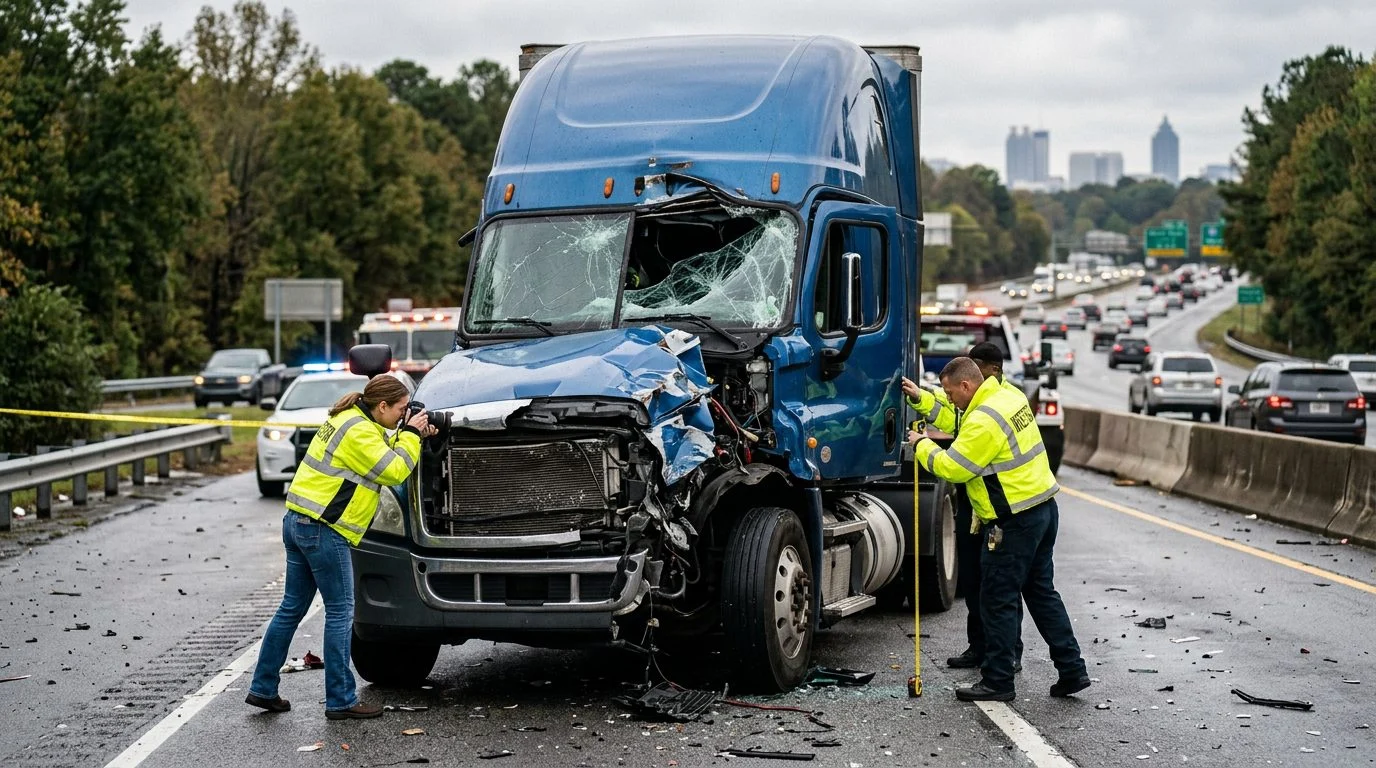
Semi Truck Accidents in Duluth, Georgia
Hurt in a Semi Truck Crash? Learn Who May Be Responsible.
A crash with a commercial truck often involves more parties and more paperwork than a typical collision. Our team can help you sort out the details.
By Peter F. Jaraysi · Published November 18, 2026
A semi truck crash can change your life in one afternoon, and it often leaves you asking who is at fault.
Short answer: the truck driver and the trucking company can be held responsible, and so can other parties, such as a cargo loader, a maintenance shop or a parts maker. Georgia law reduces recovery for shared fault and sets a two-year deadline for injury claims. If you were hurt or lost someone, a truck accident attorney in Gwinnett County can review the facts with you.
What a Semi Truck Accident Claim Covers and Who It Is For
A semi truck accident claim is a personal injury or wrongful death claim that comes from a crash with a tractor-trailer or other large commercial truck.
It’s for people hurt in that kind of crash, including drivers, passengers, pedestrians and motorcyclists. It’s also for families who lost a loved one. Crashes on Interstate 85 and State Route 316 in Gwinnett County are examples of the roads where these claims arise.
Truck crashes differ from car crashes in important ways. A loaded tractor-trailer is much heavier than a passenger car, so it needs more distance to stop. More companies and people also play a role in running the truck, from the carrier to the crew that loaded it.
Some truck crashes cause catastrophic injuries, including spinal cord injury, traumatic brain injury, amputation and severe burns. A spinal cord injury can cause lasting physical impairment, which is one reason early review of the facts matters.
If a semi truck crash has left you or someone you love hurt, our team can review who may be responsible and what deadlines apply. Talk it through with our team — the first consultation is free, confidential, and carries no obligation.
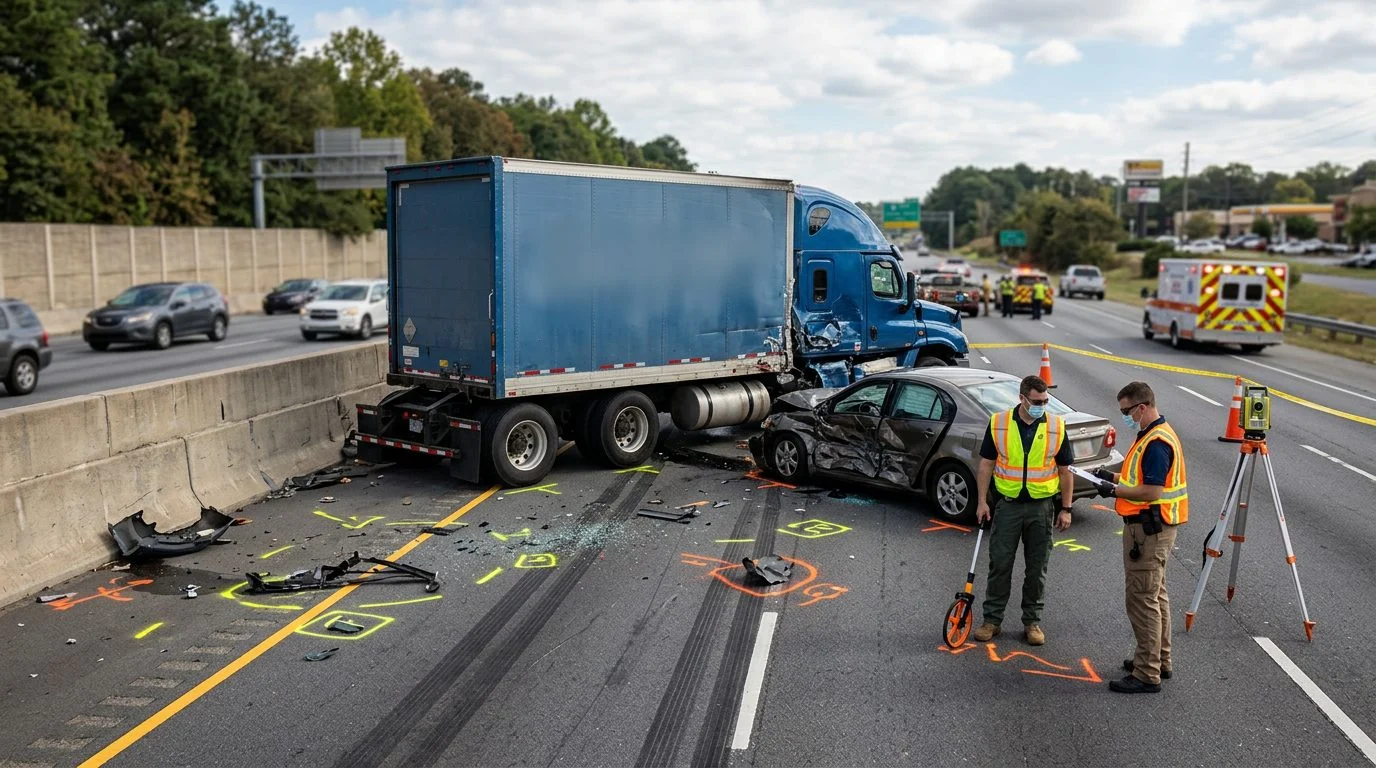
Who Can Be Held Responsible in a Georgia Truck Crash
More than one party can be held responsible in a Georgia truck crash, and each party’s role is looked at separately.
- The driver. Speeding, following too closely, distraction and impaired driving are examples of driving conduct that can contribute to a crash.
- The trucking company. Under O.C.G.A. § 51-2-2, a business is liable for torts committed by its servant by its command or in the prosecution and within the scope of its business.
- The company’s own decisions. Claims for negligent hiring, training, supervision and retention focus on the company’s own conduct. Under Quynn v. Hulsey, claims for negligent hiring, training, supervision, and retention are based on the alleged negligent acts of the employer.
- A broker that chose the carrier. In Montgomery v. Caribe Transport II, the U.S. Supreme Court held that a state-law negligent hiring claim against a broker for choosing an unsafe carrier is not blocked by federal law.
- Others. Leasing companies that own the truck, cargo loaders, maintenance shops and parts makers can each play a role when their work or product contributed to the crash.
Georgia doesn’t lump every liable party into one shared total. Under O.C.G.A. § 51-12-33, each liable party answers for its own share, and the fault of others who contributed is considered.
Evidence That Shows Fault in a Semi Truck Crash
Proof in a semi truck crash often comes from records the trucking company must keep, along with the crash scene itself. Federal trucking rules set many of those duties.
- Duty status records. Carriers must require drivers to record their duty status for each 24-hour period. Electronic logging devices (ELDs) are one way to do this, and manual logs are allowed only in limited cases (duty status rules).
- Post-crash testing. Federal post-accident testing rules require alcohol and drug testing after a crash that causes a death, and after a crash where someone immediately receives medical treatment away from the scene or a vehicle must be towed, if the truck driver receives a citation for a moving traffic violation from the crash (within 8 hours for alcohol testing, 32 hours for drug testing).
- Driver qualification file. The carrier keeps this file while the driver works there and for three years afterward (driver qualification rules). It can include the driver’s application and driving record.
- Maintenance records. Inspection and repair records must be kept for 1 year where the truck is housed, and for 6 months after it leaves the carrier’s control.
- The scene. The police crash report, photos, witness statements and any dashcam or nearby business video can all matter. Georgia crash investigation procedures describe how crashes are documented.
Some of these records have short minimum keep times.
Georgia Deadlines and Fault Rules That Shape a Claim
Georgia’s general deadline for personal injury claims is two years after the right of action accrues, with a one-year period for injuries to reputation and a four-year period for claims involving loss of consortium (O.C.G.A. § 9-3-33; Kenneth B. Cameron v. Jmp Pizza, Inc (2026)).
- Two years for injuries. Under O.C.G.A. § 9-3-33, actions for injuries to the person must be brought within two years after the right of action accrues. Claims involving loss of consortium (the loss of a spouse’s companionship) have four years.
- Wrongful death. Wrongful death is a separate kind of claim, so the date of the crash and the family’s situation both need review.
- Shared fault. Under O.C.G.A. § 51-12-33, damages are reduced in proportion to your share of fault. If you are 50 percent or more responsible, you cannot recover damages.
- Early statements. Insurance adjusters work for insurers. Think carefully before giving a recorded statement or signing a release, since their questions may focus on your share of fault.
How the Process Works After You Contact the Firm
The process starts with a free first consultation, then moves to a review of the crash, your injuries and the insurance information.
- Free first consultation. La consulta inicial es gratuita, confidencial y sin compromiso de continuar. (The first consultation is free, confidential and carries no obligation to continue.) You can reach our contact page to start.
- Case review. We go over how the crash happened, your medical care and the insurance information.
- Records requests. Letters can ask the trucking company to keep logs, inspection files and maintenance records.
- Investigation. This may include reviewing medical records, contacting witnesses and, where needed, accident reconstruction.
- Claim presentation. We present the claim and negotiate with insurers, including preparing a demand package.
- Filing suit if needed. If a fair resolution isn’t reached, a lawsuit is filed in the appropriate Georgia court before the legal deadline.
The length of each step varies with the crash, the injuries and the parties involved. Case costs and expenses may be your responsibility. The firm explains the fee and cost terms before you decide whether to move forward.
Why Work With Slam Dunk Attorney for a Gwinnett Truck Crash
Slam Dunk Attorney is a personal injury law firm based in Duluth, Georgia, and it represents people hurt in truck and other crashes across metro Atlanta and Georgia.
Peter F. Jaraysi is the responsible lawyer for this page. Brian D. Wright is also one of the firm’s lawyers. Our team of assistants and office staff handles intake, records requests and client updates.
The firm handles car, truck, motorcycle, pedestrian, dog bite, premises liability, slip and fall, negligent security, nursing home abuse, wrongful death, catastrophic injury, rideshare and short-term rental injury matters.
Its work covers Gwinnett County communities such as Lawrenceville and Duluth, along with Norcross, Dunwoody, Marietta, Alpharetta, Johns Creek and Kennesaw.
We explain the claim, the deadlines and your options in plain language at each stage. Truck claims often involve trucking companies and their insurers, so clear communication about records and fault matters from the start.
Not sure what your next step is?
Talk it through with our team — the first consultation is free, confidential, and carries no obligation.
Common Questions About Semi Truck Accident Liability
Questions about truck crash liability usually come down to who was at fault, who employed the driver, and when a claim must be filed.
Can I sue the trucking company if the driver was an independent contractor?
Whether the company can be held responsible depends on the facts, including how the driver was hired and controlled. This is one of the points reviewed in a free consultation.
Do I need a police report?
A crash report helps document what happened, but it is only one piece of evidence. Photos, witness statements and trucking records can matter too.
What if I was partly at fault?
Georgia reduces your damages by your share of fault. If you are 50 percent or more responsible, you cannot recover damages under O.C.G.A. § 51-12-33.
What if a family member died in the crash?
Under O.C.G.A. § 51-4-2, a surviving spouse, or children if there is no spouse, may recover the full value of the decedent’s life as shown by the evidence.
Is the first consultation free?
Yes, the first consultation is free, confidential and carries no obligation to continue.
If a semi truck crash has left you or someone you love hurt, our team can review who may be responsible and what deadlines apply, starting with a free consultation.
Parties That May Be Involved in a Semi Truck Crash
The Truck Driver
The driver's conduct, such as fatigue, distraction, or violations of traffic rules, is often examined after a crash.
The Trucking Company
The company that operates the truck may have responsibilities related to hiring, training, supervision, and scheduling.
Maintenance and Repair Providers
Brake, tire, and equipment problems can sometimes trace back to a maintenance or repair decision.
Cargo Loaders and Other Drivers
Improperly secured loads or the actions of other motorists can also play a part in how a crash happened.
Be Careful What You Say
Insurance adjusters may contact you soon after a crash. Before giving a recorded statement or signing anything, talk with someone who can review your situation.
Steps That Can Help Protect Your Claim
Get Medical Care
Seek prompt evaluation, even if your injuries seem minor. Some injuries appear hours or days later.
Document the Scene
Photos of the vehicles, the roadway, visible injuries, and any nearby signs can be valuable later.
Keep Your Records
Save the crash report, medical bills, pay stubs, and notes about missed work and daily limitations.
Talk With Our Team
Our team can explain your options and help identify the evidence that may matter in your case.