
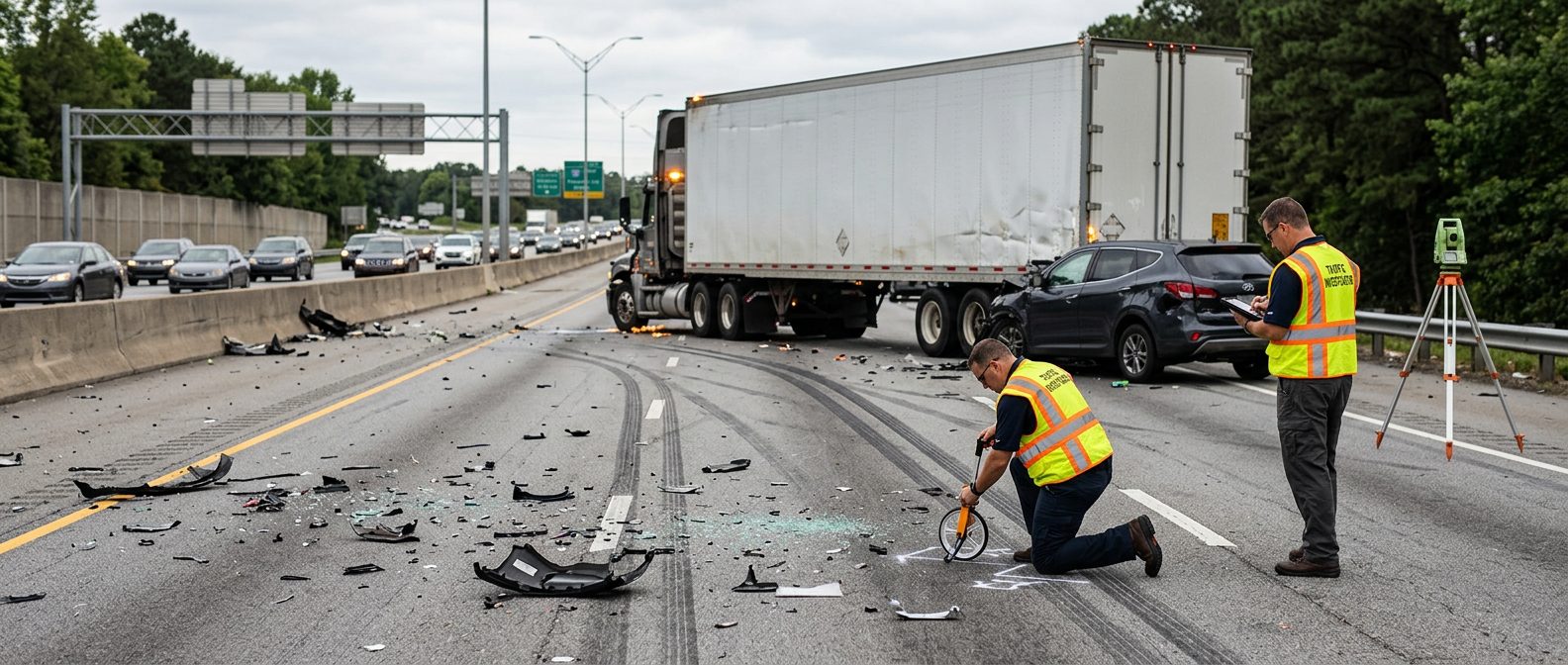
Truck Accidents | Georgia
Partial Fault in a Truck Accident? You May Still Recover.
Georgia law allows you to claim damages even if you share some responsibility. Learn how comparative fault works and what your claim might be worth.
By Peter F. Jaraysi · Published September 28, 2026
Can I Sue for a Truck Accident if I’m Partially at Fault in Georgia?
Yes. Georgia’s comparative negligence rule lets you recover damages even if partially responsible. You must be less than 50% at fault to recover. Your compensation is reduced by your percentage of fault.
This rule applies to truck accidents across Georgia. Most truck accidents involve multiple contributing factors. Even if you made a mistake, the truck driver or company may still bear significant responsibility.
If you were partly involved in a truck accident but believe the driver or company also bears responsibility, you may still have a valid claim—and many people in your situation reach out to discuss what happened. Talk it through with our team — the first consultation is free, confidential, and carries no obligation.
Georgia’s Comparative Negligence Rule
Georgia follows a modified comparative negligence system. You can recover damages even when you share some blame.
Here’s how it works: if you’re 20% at fault with $100,000 in damages, you recover $80,000. If you’re 49% at fault, you recover 51% of damages. Your recovery shrinks by your percentage of responsibility.
Georgia law recognizes that most accidents involve shared responsibility. The comparative negligence rule balances this reality fairly. You deserve compensation proportional to the other party’s fault.
The 50% Bar: Your Threshold
If you’re 50% or more at fault, you cannot recover damages. This is the “50% bar”—a strict threshold. At exactly 50-50 fault, you recover nothing.
But if you’re 49% at fault, you recover 51% of damages. The line is clear. You must prove you were less than 50% responsible. In truck accident cases, this burden is manageable because truck drivers have special legal duties.
Partial fault is common. What matters is whether your responsibility falls below that 50% threshold. Don’t assume one mistake destroys your claim—it doesn’t.
How Fault Is Determined in Truck Accidents
Determining fault in a truck accident is more complex than in typical car collisions. Truck drivers have special legal duties.
Insurance adjusters and courts examine several factors:
- Driver conduct: Was either driver speeding, distracted, or violating traffic laws?
- Truck driver duties: Did the driver comply with federal hours-of-service regulations? Was cargo loaded properly? Did the driver conduct required inspections?
- Vehicle maintenance: Were brakes, tires, and lights in safe condition?
- Road conditions: Did weather, road surface, or visibility contribute?
- Evidence: Police reports, witness statements, vehicle damage, phone records, dashcam footage, and expert reconstruction all matter.
Truck drivers must follow federal hours-of-service rules to prevent fatigue. They must load cargo safely and secure it properly. They must inspect vehicles regularly. Courts consider these duties when assigning fault.
Your actions are weighed equally. If you were speeding or distracted, that matters. So does whether the truck driver was in your blind spot, whether cargo was improperly loaded, or whether the truck traveled at unsafe speed.
Common Scenarios: Partial Fault in Truck Accidents
Real truck accident cases often involve shared responsibility.
You were speeding, but the truck driver was also speeding and failed to maintain safe distance. Both parties contributed. Your speed may be 30% of fault; the driver’s speed and failure to maintain distance may be 70%.
You changed lanes without signaling, but the truck driver was in your blind spot and didn’t check mirrors. You made a mistake, but so did the driver. Fault might be split 35-65.
You were distracted momentarily, but the truck was improperly loaded, causing it to jackknife. Your inattention is one factor. The improper loading—a federal violation—is another. The company’s failure may outweigh your distraction.
You ran a red light, but the truck driver was fatigued and didn’t brake in time. You violated traffic law. The fatigued driver operating an 80,000-pound vehicle also violated law. Fault may be shared.
In each scenario, you may still recover. The question is whether your responsibility is less than 50%.
Why Partial Fault Doesn’t Eliminate Your Claim
Truck accidents are rarely one-sided. Multiple factors usually contribute. Even if you made a mistake, the truck driver or company may have had a duty to avoid the crash.
Georgia law recognizes that injured people shouldn’t lose recovery simply because they weren’t 100% blameless. The comparative negligence rule exists because real accidents are complicated. Both parties can be negligent. Both can contribute to the collision. Both can share responsibility.
When you’re injured, you shouldn’t lose your right to recover because you weren’t perfect. The law asks: did the other party bear responsibility too? If yes, and if their responsibility exceeds yours, you have a claim.
Not sure what your next step is?
Talk it through with our team — the first consultation is free, confidential, and carries no obligation.
What Happens During a Truck Accident Claim With Partial Fault
After a truck accident, the insurance company investigates and assigns fault percentages. You have the right to dispute their assessment.
Here’s the typical process:
- Investigation: The adjuster reviews the police report, photos, witness statements, and vehicle damage.
- Fault assignment: The adjuster assigns a percentage to each party.
- Your response: If you disagree, provide additional evidence or dispute their conclusion.
- Negotiation: Your attorney can present evidence that reduces your percentage or increases the other party’s.
- Litigation: If settlement fails, the case may go to trial. A judge or jury determines fault based on all evidence presented.
You’re not stuck with the insurance company’s initial assessment. You can fight it with evidence, witness testimony, and expert analysis.
Protecting Your Recovery: Steps to Take
What you do immediately after a truck accident affects how fault is determined later.
- Don’t admit fault: Avoid saying “I’m sorry” or “It was my fault.” Stick to facts.
- Gather information: Collect witness contact information. Take photos of the scene, vehicle damage, road conditions, and traffic signs.
- Seek medical attention: Get examined by a doctor promptly, even if you feel okay. Document all injuries and treatment.
- Report to police: File a police report and obtain a copy.
- Preserve evidence: Save dashcam footage, phone records, vehicle maintenance records, and communications with the other party.
- Avoid social media: Don’t post about the accident online.
- Don’t speak to the other party’s insurance: Without legal guidance, don’t give recorded statements to their insurance company.
These steps protect your claim and help your attorney build a strong case.
When to Speak With an Attorney
If you believe you were partially responsible but the truck driver or company also bears fault, an attorney can evaluate your claim early.
Early legal guidance helps you avoid statements or actions that could increase your assigned fault percentage. An attorney can investigate the truck driver’s conduct, the company’s safety practices, and vehicle maintenance records. They can identify evidence that reduces your responsibility or increases the other party’s.
You don’t need to be 100% blameless to have a valid claim. Many people injured in truck accidents in Georgia were partially involved and recovered compensation. The question isn’t whether you’re perfect—it’s whether the other party bears responsibility too.
See our guide on truck driver negligence in Georgia to understand what duties truck drivers must follow. Learn more about how truck accident damages are calculated and what evidence matters in truck accident cases.
FAQ
Can I recover damages if I was 40% at fault for a truck accident in Georgia?
Yes. If you’re 40% at fault, you recover 60% of your damages. You’re below the 50% bar and have a valid claim.
What if the insurance company says I was 50% at fault?
You can dispute that assessment. If evidence shows you were 49% or less at fault, you may recover. Legal representation helps challenge the insurance company’s calculation.
Do truck drivers have different legal duties than regular drivers?
Yes. Truck drivers must comply with federal hours-of-service regulations, load cargo safely, and conduct vehicle inspections. Courts consider these duties when determining fault.
What evidence is most important in determining fault?
Police reports, witness statements, vehicle damage patterns, phone records, dashcam footage, and expert accident reconstruction all matter. Physical evidence often speaks louder than either party’s account.
Should I speak with an attorney before accepting a settlement offer?
Yes, especially if partial fault is involved. An attorney can evaluate whether the settlement fairly reflects your damages and the other party’s responsibility.
If you were partly involved in a truck accident but believe the driver or company also bears responsibility, you may have a valid claim. Many people in your situation reach out to discuss what happened. Early legal guidance protects your recovery. Contact Slam Dunk Attorney for a free case review to understand your options.
Key Point: Georgia's Comparative Fault Rule
Under Georgia law, you can recover damages as long as you are less than 50% at fault. If you're found 40% responsible, you recover 60% of your damages. The other party's insurance may dispute your level of fault—that's where clear evidence and legal representation matter.
How Partial Fault Claims Work
Fault Is Determined by Evidence
Police reports, witness statements, vehicle damage, traffic camera footage, and accident reconstruction help establish who was responsible for the crash. Insurance adjusters and courts weigh this evidence to assign a percentage of fault to each party.
You Can Dispute the Insurance Company's Assessment
If the other driver's insurer claims you were 50% or more at fault, you have the right to challenge that finding. Evidence that shows you were 49% or less at fault can support your recovery claim.
Your Recovery Is Reduced by Your Percentage of Fault
If your damages total $100,000 and you're found 30% at fault, you recover $70,000. The reduction is proportional to your share of responsibility.
Truck Accidents Often Involve Complex Liability
Commercial trucks, multiple vehicles, and severe injuries can complicate fault determination. Professional investigation and legal guidance help ensure your percentage of fault is fairly assessed.
Why Representation Matters in Partial Fault Cases
Protect Your Rights
Insurance companies may overstate your fault to reduce their payout. We investigate the facts and challenge unfair assessments on your behalf.
Build a Strong Evidence Record
We gather police reports, medical records, witness statements, and expert analysis to support your claim and demonstrate your actual level of responsibility.
Handle Negotiations
We communicate with the other party's insurance company, present evidence clearly, and advocate for fair compensation based on your actual fault percentage.
Explain Your Options
We help you understand how Georgia's comparative fault rule applies to your specific accident and what recovery you may be entitled to pursue.