
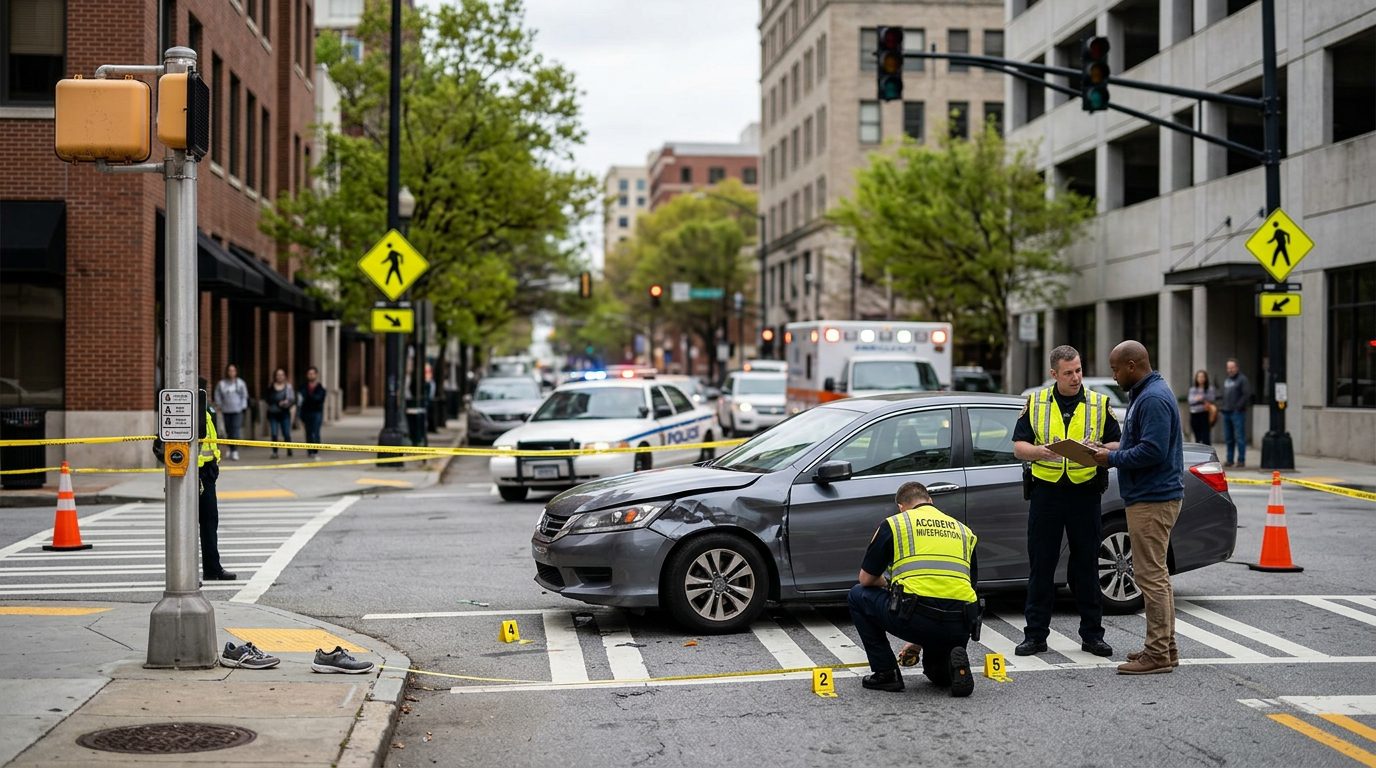
Pedestrian Accidents | Duluth, Georgia
What Happens to a Driver That Hits a Pedestrian in Georgia?
A plain-language guide to the steps after a pedestrian crash, what the driver's duties are, and how fault and injuries are looked at in a claim. Our team focuses on helping injured people across metro Atlanta and Georgia.
By Peter F. Jaraysi · Published October 23, 2026
What happens to a driver that hits a pedestrian? Criminal charges are possible in some cases. Fault is decided by what each person did, not by the fact that someone was struck. If you are the driver, or a family member of one, the shock of the moment can make it hard to think clearly. This guide follows the order in which these steps usually unfold.
What the Driver Must Do at the Scene
Stopping, checking on the pedestrian, and calling for help come first. Those early choices shape everything that follows.
Call 911 even if the pedestrian says they feel fine. Police and medical help need to be sent, and a report needs to be made. Leave the injured person where they are unless the scene is unsafe. Moving someone can cause more harm.
Stick to facts. Describe what you saw and what you did. Avoid guessing about blame. Statements made at the scene can be repeated later.
Document what you can. Photograph the vehicle, the road, the lighting, crosswalk markings, and any signs. Write down witness names and phone numbers, the time, and the weather. Details fade fast, and they often matter later.
Talk it through with our team — the first consultation is free, confidential, and carries no obligation.

How the Police Investigation Unfolds
Officers usually take statements, record injuries and vehicle damage, and write a crash report. They may also issue traffic citations.
Georgia requires a driver to stop and stay stopped for a pedestrian crossing within a crosswalk when the pedestrian is in the driver’s half of the roadway, or is approaching and within one lane of that half, under O.C.G.A. § 40-6-91.
Video can matter a lot. Traffic cameras, nearby businesses, and dashcams may record the crash. If you have your own footage, keep the original file and don’t edit it.
A traffic citation and a civil fault finding are separate questions. Each one is decided on its own, under its own rules.
Is the Driver Always at Fault?
Fault depends on what each person did.
Georgia uses modified comparative fault, or shared fault. A judge reduces damages by the injured person’s percentage of fault. If that share is 50 percent or more, the injured person cannot recover damages, under O.C.G.A. § 51-12-33.
Pedestrian conduct that can matter includes stepping suddenly into the path of a vehicle that cannot stop in time. It also includes crossing the road away from a crosswalk. A pedestrian crossing outside a crosswalk must yield to vehicles already on the road, unless he has already, and under safe conditions, entered the roadway, under O.C.G.A. § 40-6-92.
Driver conduct that can matter includes speeding, distraction, impairment, and failing to yield in a crosswalk. Every driver must use due care to avoid colliding with a pedestrian on the roadway, under O.C.G.A. § 40-6-93. Georgia’s Supreme Court addressed how this shared-fault framework works in Quynn v. Hulsey.
For the wider picture, read our pedestrian accidents guide.
What the Injured Pedestrian Can Pursue
The injured pedestrian can bring a civil claim for damages, separate from any criminal case. Georgia law allows recovery when someone breaks a legal duty and causes damage, under O.C.G.A. § 51-1-6.
Georgia law separates general damages from special damages. General damages are presumed to flow from a wrongful act, and they need no proof of an amount. Special damages actually flow from the act, and they must be proved, under O.C.G.A. § 51-12-2.
Timing matters. The general rule for injuries to the person is two years, under O.C.G.A. § 9-3-33. If criminal prosecution is pending, the time limit can be paused. Don’t assume the clock has stopped.
Serious injuries, such as spinal cord injuries, traumatic brain injuries, and amputations, often involve long recovery and ongoing care. The value of a claim depends on medical records, evidence, and how fault is divided.
Insurance: What the Driver Should Do
Prompt notice helps keep the claim process moving.
The same agency explains the Safety Responsibility Law. That law covers what happens when a crash-damage claim is not satisfied.
Liability policies have dollar limits per person and per accident. A serious injury can cost more than those limits. Any amount above the insurance may come from the driver personally.
Be careful with recorded statements and signed releases. Wait until you understand your coverage and the injured person’s medical situation.
Who Can Be Held Responsible After a Crash?
Whether charges apply depends on the facts of the crash. Facts that often matter include impairment, whether the driver stayed at the scene, and how seriously the pedestrian was hurt.
Some crashes lead only to traffic citations. Leaving a crash scene and impaired driving are separate issues. Either one can lead to charges.
Statements to police and posts on social media can affect any criminal matter. Talking with a lawyer before giving detailed statements is a reasonable step to consider.
Criminal and civil matters move on separate tracks. A driver may face one, both, or neither, and each has its own process.
Not sure what your next step is?
Talk it through with our team — the first consultation is free, confidential, and carries no obligation.
When the Pedestrian Dies
If the pedestrian dies, the surviving spouse may bring a wrongful death claim, or, if there is no surviving spouse, the child or children may bring it. Georgia law allows recovery of the full value of the decedent’s life, as shown by the evidence, under O.C.G.A. § 51-4-2.
When death results from a crime or from criminal or other negligence, the personal representative may also recover funeral, medical, and other necessary expenses resulting from the injury and death, under O.C.G.A. § 51-4-5.
A criminal case, if one is filed, moves separately from the family’s civil claim. Families often handle police contacts, insurance calls, and funeral planning all at once. Writing down each contact and keeping copies of paperwork can make that load easier to carry.

Next Steps After This Crash
If you are asking what happens to a driver that hits a pedestrian, the first hours matter most. The most useful steps are simple and practical:
- Stop, check on the pedestrian, and call 911.
- Photograph the scene and write down witness details.
- Report the crash to your insurer promptly.
- Keep records of medical bills, repair estimates, and messages about the crash.
- Be careful about what you post on social media.
Frequently Asked Questions
What happens to a driver that hits a pedestrian?
The driver must stop and call for help. Civil fault depends on what each person did, and criminal charges depend on the facts.
Is the driver always at fault when they hit a pedestrian?
No. Georgia weighs what each person did, and a pedestrian can share fault under O.C.G.A. § 51-12-33.
Can a driver go to jail for hitting a pedestrian in Georgia?
Criminal charges turn on specific facts, such as impairment and whether the driver stayed at the scene. Some crashes lead only to traffic citations.
How long does a pedestrian have to file a claim in Georgia?
For most injury claims, the general rule is two years under O.C.G.A. § 9-3-33.
If you were injured in this crash, or a family member was, our team at Slam Dunk Attorney can talk those questions through with you. Our free, confidential initial consultation comes with no obligation to continue. Contact our office to start that conversation.
Disclaimer: This page is general information, not legal advice. Responsible lawyer: Peter F. Jaraysi, Slam Dunk Attorney, Duluth, Georgia. Contact: slamdunkattorney.com/contact-us.
How our team can help after a pedestrian crash
Clear explanations
We explain what the driver's obligations were, what the police report may show, and what questions still need answers.
Careful review of the facts
We look at the crash scene, witness accounts, medical records and insurance information to understand what happened.
Important: speak with a lawyer before giving a statement
Insurance adjusters may ask you for a recorded statement soon after a crash. Talking with a lawyer first can help you understand what to say and what to hold back while you are still recovering.
Key questions people ask after a pedestrian crash
What should the driver do at the scene?
Leaving the scene raises separate legal questions that depend on the facts.
Can the pedestrian share responsibility?
Georgia law looks at what each person did before and during the crash. Each situation is different, and the answer depends on the facts.
What if the injuries are serious?
Serious injuries can affect work, daily life and long-term health. Early medical care and a clear record of your treatment matter.