
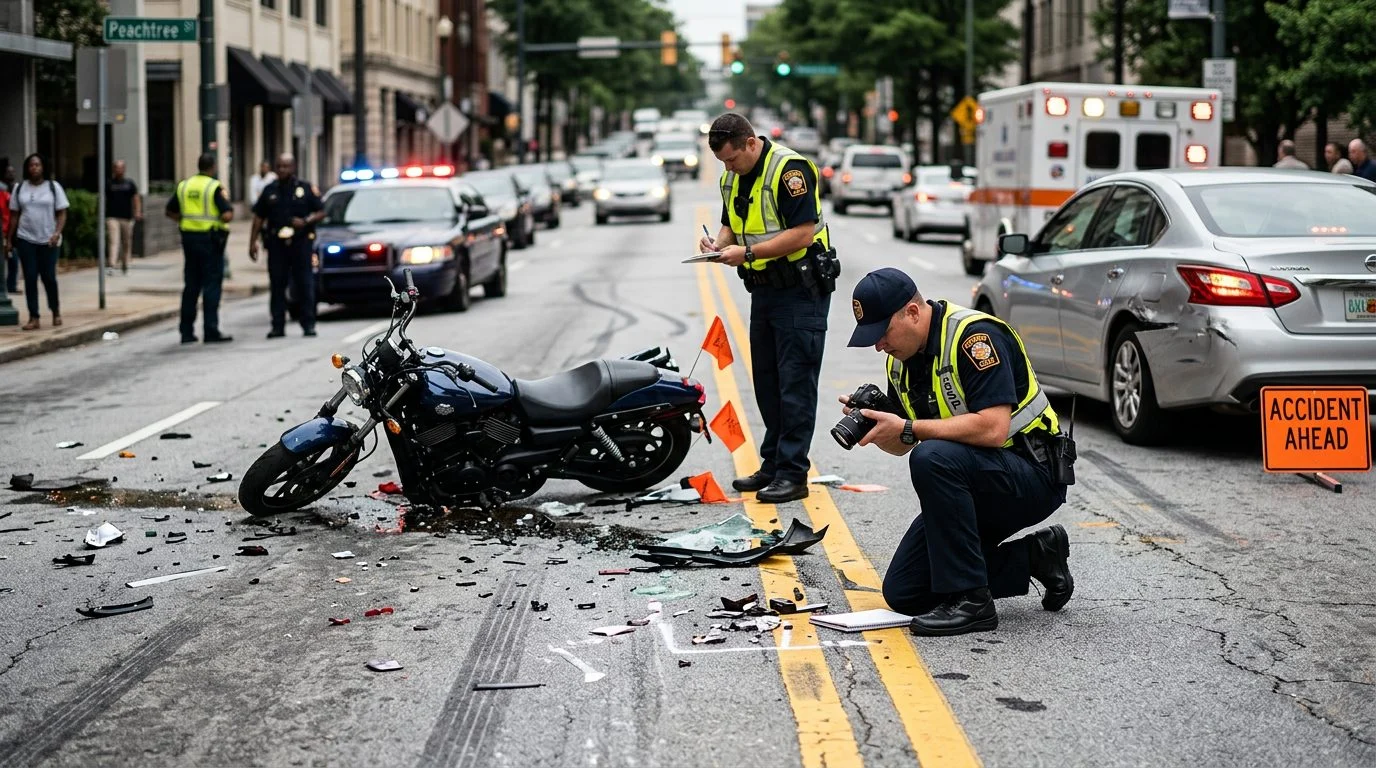
Motorcycle Accidents | Duluth, Georgia
Georgia Motorcycle Accident Settlement Negotiation Tips
An insurance offer can feel final when you are still recovering. Learn what to protect, what to avoid, and how our team can help you talk with the insurer on your terms.
By Peter F. Jaraysi · Published November 1, 2026
The first steps after a Georgia motorcycle crash are to get to safety, get checked by a medical professional, and protect the facts. Those early steps build the record that later settlement negotiations rely on.
If you’re looking for motorcycle accident settlement negotiation tips and strategies in Georgia, you may still be hurting. You may be dealing with appointments, a damaged bike, and calls from insurance adjusters. This guide covers what to do first, in plain language, and why each step matters. It can’t tell you how your own claim will turn out. Every claim turns on its own facts.
Your First Priority: Safety and Medical Evaluation at the Scene
Get to safety if you can, call 911, and get medical care even if you feel fine. Police and medical responders create the first official record of the crash and of your condition.
Adrenaline can hide pain. Some injuries, including concussions and internal injuries, may not show symptoms for hours or days. A same-day medical check gives you a record of how you felt right after the crash.
Ask the responding officer for the police report number before you leave. The report is an official record of the crash, and you’ll need that number to request a copy later.
Georgia law requires motorcycle riders to wear protective headgear that meets state standards. Under O.C.G.A. § 40-6-315, no person shall operate or ride upon a motorcycle unless he or she is wearing protective headgear which complies with standards established by the commissioner of public safety; that Code section shall not apply to persons riding within an enclosed cab or motorized cart, nor to a person operating a three-wheeled motorcycle used only for agricultural purposes. Keep your helmet and gear. Don’t clean, repair, or throw them away until you’ve taken photos.
If a crash has left you hurt and juggling bills and adjuster calls, you don't have to face the next steps alone. Contact us for a free, confidential first consultation. Talk it through with our team — the first consultation is free, confidential, and carries no obligation.
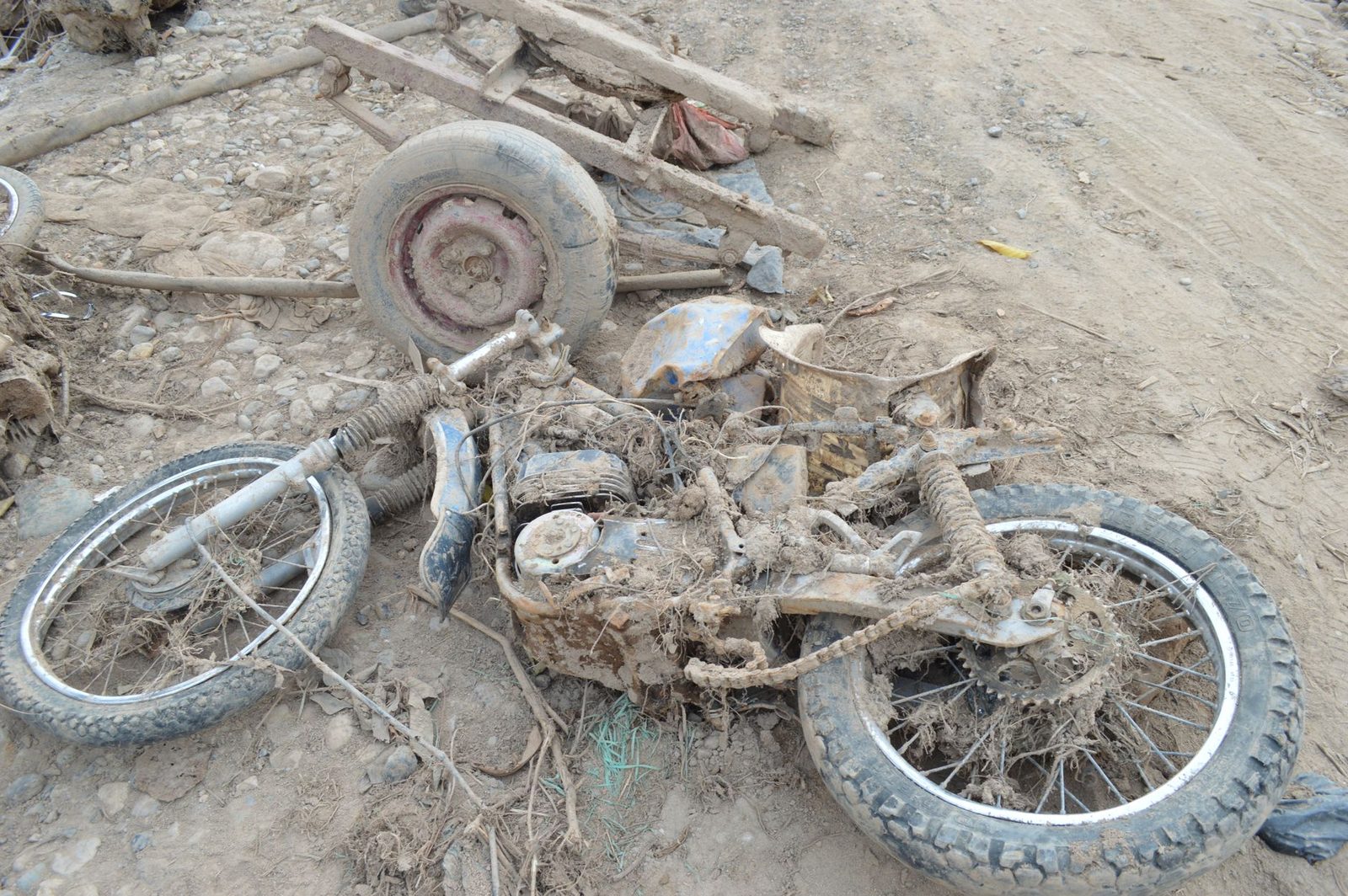
Documenting the Scene While the Details Are Fresh
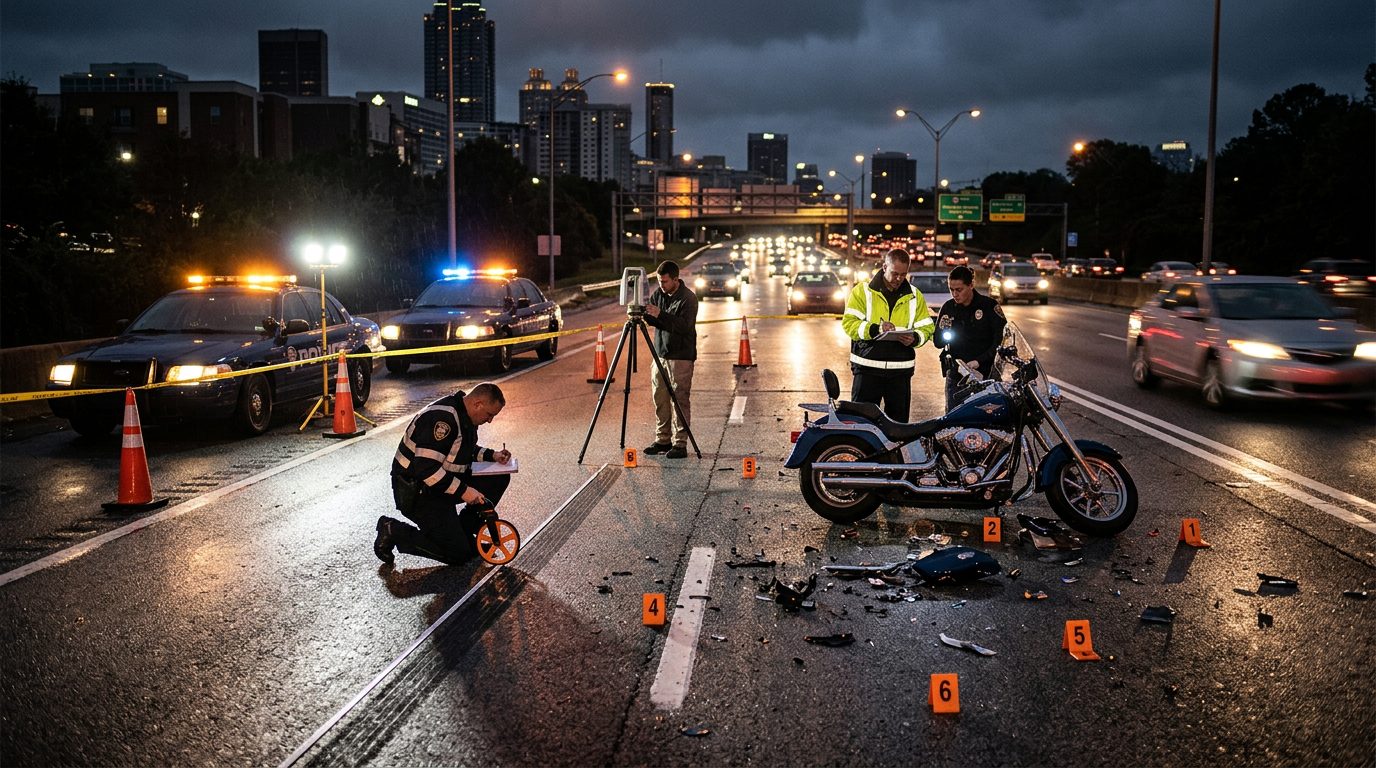
Photos, witness names, and a written timeline are the records to start on the day of the crash. Memories fade fast. Small details often become the points that get disputed later.
Take photos from several angles. Capture vehicle positions, road conditions, traffic signals, skid marks, debris, and any visible injuries. Photograph your motorcycle and damaged gear before any repairs or disposal.
Collect names and phone numbers for drivers, passengers, and witnesses. Write down what each person said about how the crash happened. Stay calm and avoid arguing at the scene.
Then write a private timeline of what you remember. Note the time of day, the weather, the lighting, and the speed limit on that road. Label it as prepared for your own records, and update it as new details come back to you.
Following Through on Medical Care and Keeping Records
Keep every appointment and follow the treatment plan your doctor gives you. Insurers often question gaps in care. Missed visits can make an injury look less serious than it is.
Tell each provider exactly how the crash happened and where you hurt. An accurate medical chart becomes part of the record your claim relies on.
Keep copies of bills, prescriptions, equipment receipts, and mileage to appointments. Track missed work and reduced hours, too.
Georgia law limits medical expense damages to the reasonable value of medically necessary care, treatment, or services. The judge or jury decides that amount. See O.C.G.A. § 51-12-1.1. Some riders receive treatment under a letter of protection. That means the provider agrees to wait for payment from any settlement or judgment. Under the same statute, the letter, itemized charges, and referral details can be requested in a claim. Keep a copy of any letter you sign.
Handling Calls From Insurance Adjusters
Report the crash to your own insurer, and share basic facts without guessing about fault. The Georgia Office of the Commissioner of Insurance advises promptly notifying police and your insurer, and avoiding statements that admit responsibility (Georgia Office of the Commissioner of Insurance auto claim tips).
Be careful about giving a recorded statement to the other driver’s insurer. Wait until you understand your injuries before you agree to one.
Don’t sign medical authorizations, releases, or settlement papers until you know the full extent of your injuries. Ask questions before you sign anything.
Keep a log of every adjuster call, with the date, the person’s name, and what was discussed. If the at-fault driver has no insurance, your own policy may include uninsured or underinsured motorist coverage. The Insurance Information Institute explains how these coverages play a role in accident claims.
Protecting Your Deadlines and Evidence
Georgia generally gives two years to file a personal injury lawsuit. Under O.C.G.A. § 9-3-33, that clock starts when the right of action accrues. A spouse’s loss of consortium claim follows a four-year period under the same statute.
Claims against the State of Georgia follow a different path. See O.C.G.A. § 50-21-26. Ask early whether a state agency could be involved in your crash.
Ask your body shop to keep damaged parts. Request that repair records and any available vehicle data be preserved where possible.
Don’t delete social media posts, and don’t post about the crash, your activities, or your injuries. Posts can be used against you in a claim.
How These First Steps Affect a Later Settlement Negotiation
Settlement talks usually rest on documents. Medical records, bills, wage records, photos, and a clear account of the crash form the core of most negotiations. These motorcycle accident settlement negotiation tips come down to one idea: keep the record accurate from day one.
Negotiators split damages into two groups. Economic damages cover bills and lost income. Non-economic damages cover pain, limits on daily life, and loss of enjoyment. Georgia law says general damages are presumed to flow from a wrong and need no proof of an exact amount. Special damages must be proved (O.C.G.A. § 51-12-2). Bills and lost wages usually fall into the special group, so you’ll need records for them.
Georgia uses modified comparative fault. Under O.C.G.A. § 51-12-33, damages are reduced by the injured person’s share of fault. If that share is 50 percent or more, the person recovers nothing. Insurers look for any share of fault they can assign. A precise, consistent account matters.
Georgia also has an avoidance rule. Under O.C.G.A. § 51-11-7, a plaintiff who could have avoided the harm by ordinary care cannot recover. O.C.G.A. § 51-11-7 reads: “If the plaintiff by ordinary care could have avoided the consequences to himself caused by the defendant’s negligence, he is not entitled to recover. In other cases the defendant is not relieved, although the plaintiff may in some way have contributed to the injury sustained.” Talks can move quickly or slowly, based on the injuries, the insurers, and whether the claim settles before or after a lawsuit. No one can predict an outcome from general information.
Not sure what your next step is?
Talk it through with our team — the first consultation is free, confidential, and carries no obligation.
Talk Through Your Situation With Slam Dunk Attorney
If you were hurt on a motorcycle, or you’re helping a loved one through a hospital stay and insurance calls, you don’t have to sort it out alone. Slam Dunk Attorney is based in Duluth, Georgia. The firm represents riders and passengers across metro Atlanta, including Atlanta, Lawrenceville, and Johns Creek.
For a broader look at these claims, read the motorcycle accidents guide. The fees and case costs guide explains how those money questions work.
How long do I have to file a lawsuit after a motorcycle accident in Georgia?
Georgia generally allows two years for a personal injury lawsuit under O.C.G.A. § 9-3-33.
Does Georgia require motorcycle riders to wear helmets?
Yes. Georgia law states that no person shall operate or ride upon a motorcycle without wearing protective headgear which complies with standards established by the commissioner of public safety (O.C.G.A. § 40-6-315), and that the Code section does not apply to persons riding within an enclosed cab or motorized cart or to a person operating a three-wheeled motorcycle used only for agricultural purposes.
What if I was partly at fault for the crash?
Georgia reduces damages by your share of fault. You recover nothing if your share is 50 percent or more, under O.C.G.A. § 51-12-33 (Quynn v. Hulsey (2020)).
If a crash has left you hurt and juggling bills and adjuster calls, you don’t have to face the next steps alone. Contact us for a free, confidential first consultation, with no obligation to continue.
This page is general information, not legal advice. Responsible lawyer: Peter F. Jaraysi, Slam Dunk Attorney, Duluth, Georgia. Contact: https://slamdunkattorney.com/contact-us/
Negotiation Tips to Keep in Mind
Keep a detailed record
Save the crash report, photos, medical bills, pharmacy receipts, and records of lost work time. Organized documentation gives the insurance company a clear picture of your losses.
Follow your medical care
Attend follow-up appointments and tell your providers about every symptom, including ones that seem minor. Gaps in treatment can be used to question how serious your injuries were.
Be careful with recorded statements
An adjuster may ask for a recorded statement soon after the crash. Speak with a lawyer first so your words are not taken out of context later.
Do not rush an early offer
Early offers are often made before the full extent of an injury is known. Take time to understand your medical prognosis before you respond.
Communicate in writing
Keep a written trail of calls, emails, and letters with the insurer. Note dates, names, and what was said.
Let a lawyer handle the back-and-forth
Negotiation with an insurer takes patience and persistence. Our team can handle the communication while you focus on getting better.
Warning: Think Before You Sign
Before you accept any settlement, review the release carefully.
How the Negotiation Process Usually Works
1. Gather your information
Collect the police report, insurance details, medical records, and proof of expenses so your claim is documented from the start.
2. Present your claim
A demand letter outlines your injuries, treatment, and losses. It sets the starting point for discussions with the insurer.
3. Evaluate offers carefully
Compare any offer against your current and expected medical needs, lost income, and other losses before you decide how to respond.
4. Decide with full information
You choose whether to accept, counter, or pursue other steps. Our team will explain your options in plain language so you can make an informed decision.