

Motorcycle Accidents | Duluth, Georgia
Understanding the Numbers After a Motorcycle Crash
Crash statistics can show the bigger picture for riders in Georgia. Our team at Slam Dunk Attorney helps injured riders and their families in metro Atlanta understand what to do next.
By Peter F. Jaraysi · Published October 21, 2026
Motorcycle Accident Statistics and What to Do First in Georgia
Motorcycle accident statistics show how often crashes happen and how often riders are hurt or killed. They cannot tell you what will happen in your own case. If you were hurt on a bike in Georgia, the first steps matter most: get medical care, report the crash, document the scene, and keep records. This guide covers those steps. It also explains what the numbers measure and what they leave out.
If you’re helping a loved one who was hurt on a bike, the steps are the same. You may be the one gathering facts while someone else recovers.
If you or someone you love was hurt on a motorcycle in Georgia and you're not sure what comes next, our team can talk it through in a free, confidential first consultation, with no obligation to continue. Talk it through with our team — the first consultation is free, confidential, and carries no obligation.

Start With Medical Care, Even If the Injuries Seem Minor
Get medical care as soon as possible, even if you feel fine. Call 911 when anyone is hurt, and tell the dispatcher where the crash happened. Some injuries don’t cause obvious symptoms right away. An evaluation still matters when the rider feels okay.
Get help quickly if you notice numbness, weakness, confusion, a severe headache, or trouble breathing. Those signs can point to injuries that need urgent treatment. Don’t wait to see whether they go away.
Keep every appointment and follow the treating provider’s instructions. A gap in treatment can make it harder later to connect your symptoms to the crash. Keep copies of discharge papers and follow-up plans. Those papers show what you were told to do and when.
Call the Police and Get the Crash Report
Call the police so the crash is written up by an officer. An officer can document the scene, the vehicles, and any statements made at the time. That early record can matter later, even when the crash seems minor at first.
After the crash, ask the responding agency for the report number. Then request a copy of the crash report. Read it closely for names, dates, locations, and vehicle details. If something is wrong, ask how to request a correction.
Write down the officer’s name and badge number. Keep these details with your other crash notes in one place. A single folder or phone note works well.
Document the Scene Before Anything Is Moved
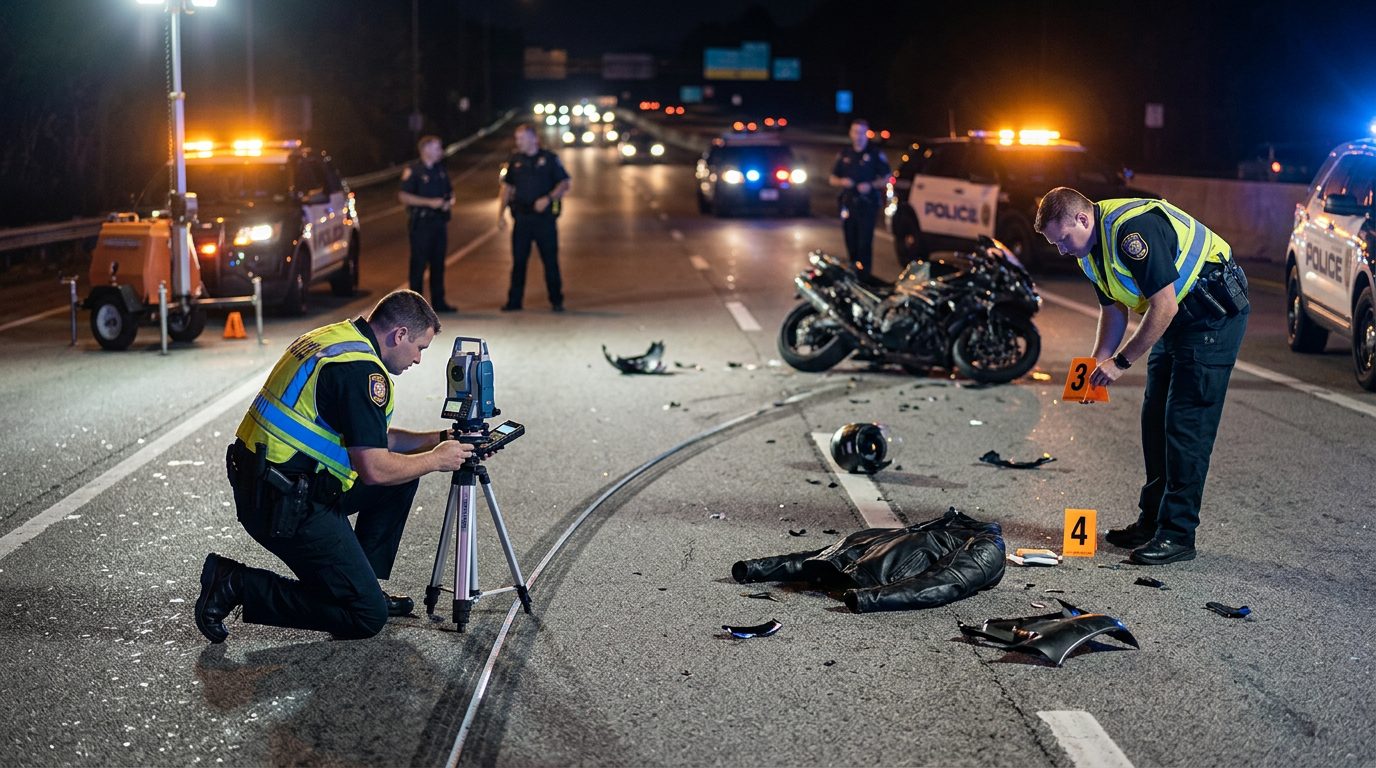
Photograph the scene before anyone moves the bike or the vehicles, if it’s safe to do so. Take pictures of the motorcycle, every vehicle involved, skid marks, debris, traffic signals, lane markings, the road surface, the weather, and any visible injuries.
Also write down the crash location, your direction of travel, and the time of day. Note nearby road signs while you can still see them. Small details, like which lane you were in, are easy to forget within days.
Early photos matter because conditions change. A sign can be replaced, a guardrail repaired, or a road resurfaced within hours or days. Photos taken at the scene show what was there at the time of the crash.
Save your helmet and riding gear. Don’t throw away damaged gear, even if it looks beyond repair. Gear can show how the crash happened, and it may be part of the story later. Keep it in a safe place, away from the garage.
Collect Information From Drivers, Witnesses, and Insurers
Exchange information with the other driver. Get names, phone numbers, insurance company, policy number, driver’s license number, and license plate number. If the other driver agrees, photograph their insurance card and license.
Witnesses often leave the scene quickly. When it’s safe, get each witness’s name and phone number. A witness can describe what happened in their own words, which can support your account later.
Ask whether a dashcam, a nearby business, or a traffic camera may have recorded the crash. Tell the responding officer about any camera you find. Ask about it early, since footage can be overwritten or erased over time.
Keep a Written Record of Treatment, Time Off Work, and Costs
Start a simple journal the day of the crash. Note your pain level, symptoms, daily limits, and emotional changes, such as trouble sleeping or fear of riding. Date every entry. A dated record shows how the crash affected you over time.
Keep every bill, prescription receipt, and record of mileage to appointments. Save pay stubs or a letter from your employer showing missed work. Keep these in one folder, paper or digital.
Georgia law treats costs in specific ways. Necessary expenses from an injury can be part of the damages, under O.C.G.A. § 51-12-7. Special damages, such as medical bills and lost pay, must be proved, under O.C.G.A. § 51-12-2. Medical expenses are limited to the reasonable value of medically necessary care, under O.C.G.A. § 51-12-1.1. Good records make each of these points easier to show.
Not sure what your next step is?
Talk it through with our team — the first consultation is free, confidential, and carries no obligation.
Think Carefully Before Giving a Recorded Statement or Signing Insurance Forms
Think before you give a recorded statement or sign any insurance form. An adjuster may call soon after the crash and ask for one. You don’t have to answer on the spot. You can ask for time to think it over.
On a recorded call, stick to facts you know. Don’t guess about speed, fault, or how hurt you are. Early guesses can be questioned later, especially when injuries are still developing and the medical picture isn’t clear.
Read every release or settlement form before you sign. Some forms end your right to seek more compensation for the crash. Ask questions about any term you don’t understand, and keep a copy of what you sign.
Georgia uses comparative fault rules. Under O.C.G.A. § 51-12-33, damages are reduced in proportion to the injured person’s percentage of fault. A person who is 50 percent or more responsible for the injury cannot receive damages under that section. That’s why the way a crash is described matters. Depending on the facts, shared fault can change the outcome, so early statements deserve care.
What Motorcycle Accident Statistics Show, and What They Do Not
Motorcycle accident statistics count crashes, injuries, and deaths that government agencies record and group together. Those groups describe patterns across many crashes. They don’t predict what will happen in one rider’s case.
Several Georgia agencies publish local data. The Georgia Department of Driver Services 2019 Motorcycle Traffic Safety Facts sheet contains Georgia motorcycle crash and fatality statistics. The Georgia Department of Public Health motor vehicle crashes page presents Georgia data on crash deaths, hospitalizations, and emergency-room visits. The Governor’s Office of Highway Safety 2021 overview reports the number and trend of suspected serious crash injuries in Georgia, including Atlanta-region trends. The National Highway Traffic Safety Administration (NHTSA) also publishes national crash data.
Treat each release as a snapshot of a specific year. Newer releases come out over time, so the most recent report from each agency is the one to use. Statistics on helmet use and injury severity can shift from year to year.
Statistics don’t say why a particular crash happened, who was at fault, or what your injuries will mean for you. Those questions turn on the specific crash and your medical care. Georgia’s helmet rule is set in state law. Under O.C.G.A. § 40-6-315, a rider must wear protective headgear that meets state standards. A motorcycle without a windshield also requires an approved eye-protective device, under subsection (b). Under O.C.G.A. § 40-6-315, no person shall operate or ride upon a motorcycle unless he or she is wearing protective headgear that complies with standards established by the commissioner of public safety. Also, no person shall operate or ride upon a motorcycle that is not equipped with a windshield unless he or she is wearing an eye-protective device of a type approved by the commissioner of public safety. This Code section does not apply to persons riding within an enclosed cab or motorized cart, or to a person operating a three-wheeled motorcycle used only for agricultural purposes.
Know Georgia’s Time Limits and Talk With a Lawyer About Your Situation
Georgia generally gives two years to file a personal injury lawsuit. The rule is in O.C.G.A. § 9-3-33. Claims involving loss of consortium have four years under the same statute. Those deadlines start from when the right to sue arises, so the date of the crash is a good place to start your timeline.
Other deadlines can apply when a government entity may be involved. A claim against a municipal corporation, such as a city, must be presented in writing to its governing authority within six months, under O.C.G.A. § 36-33-5. A tort claim against the state requires written notice within 12 months of the date the loss was discovered or should have been discovered, under O.C.G.A. § 50-21-26. A city or state vehicle can be part of a crash, so don’t assume the two-year rule covers every case.
Waiting can make evidence harder to gather. Photos fade, witnesses move, and records can get lost. Many people choose to learn their options early, while the details are still fresh.
If you or someone you care about was hurt in a motorcycle crash, the firm’s lawyers can review what happened. Peter F. Jaraysi is the responsible lawyer at Slam Dunk Attorney in Duluth, Georgia, and the firm’s lawyers offer a free, confidential first consultation with no obligation to continue. The firm serves riders across metro Atlanta and Georgia. Contact the firm to ask for a free case review.
Frequently Asked Questions
What do motorcycle accident statistics measure?
They count crashes, injuries, and deaths that agencies record and group together. They don’t predict the outcome of one person’s case.
How long do I have to file a motorcycle accident lawsuit in Georgia?
Georgia generally gives two years for personal injury lawsuits. Claims against government entities can have shorter written-notice deadlines.
Is a helmet required for motorcycle riders in Georgia?
Yes. Georgia law requires protective headgear that meets state standards, with limited exemptions.
Should I give a recorded statement to an adjuster?
You don’t have to give one right away. Stick to facts you know and read any form before you sign it.
Ask about your deadlines early.
Disclaimer: This page is general information, not legal advice. Responsible lawyer: Peter F. Jaraysi, Slam Dunk Attorney, Duluth, Georgia. Contact details are on the firm’s contact page.
How We Work With Injured Riders
Plain-Language Answers
We explain the legal process and your options in clear terms, without jargon, so you can make informed decisions.
Focused Advocacy
Our lawyers work to protect your rights and pursue fair compensation for medical bills, lost income and pain and suffering.
Serving Metro Atlanta and Georgia
From Duluth and Lawrenceville to Alpharetta, Marietta and across Georgia, we meet clients where they are.
Compassion for Your Family
Serious crashes affect more than the rider. We take time to listen to the people who are affected too.
Statistics Describe Groups, Not Your Case
Crash counts and injury rates show trends across many accidents. They do not predict how your own situation will turn out. Every motorcycle crash has its own facts, and the best way to understand yours is to talk through the details with a lawyer.
Early Steps After a Motorcycle Crash in Georgia
Get Medical Care
Even if you feel okay, see a doctor promptly. Some injuries, including head and spinal injuries, may not show symptoms right away.
Document the Scene
If you are able, take photos of the vehicles, roadway, weather, skid marks and any visible injuries. Write down what you remember while it is fresh.
Gather Witness Information
Names and phone numbers of drivers, passengers and bystanders can be important later. Keep copies of police reports and insurance information.
Talk With a Lawyer First
Before giving a recorded statement to an insurance company, speak with our team. We can explain what to expect and help you protect your claim.