
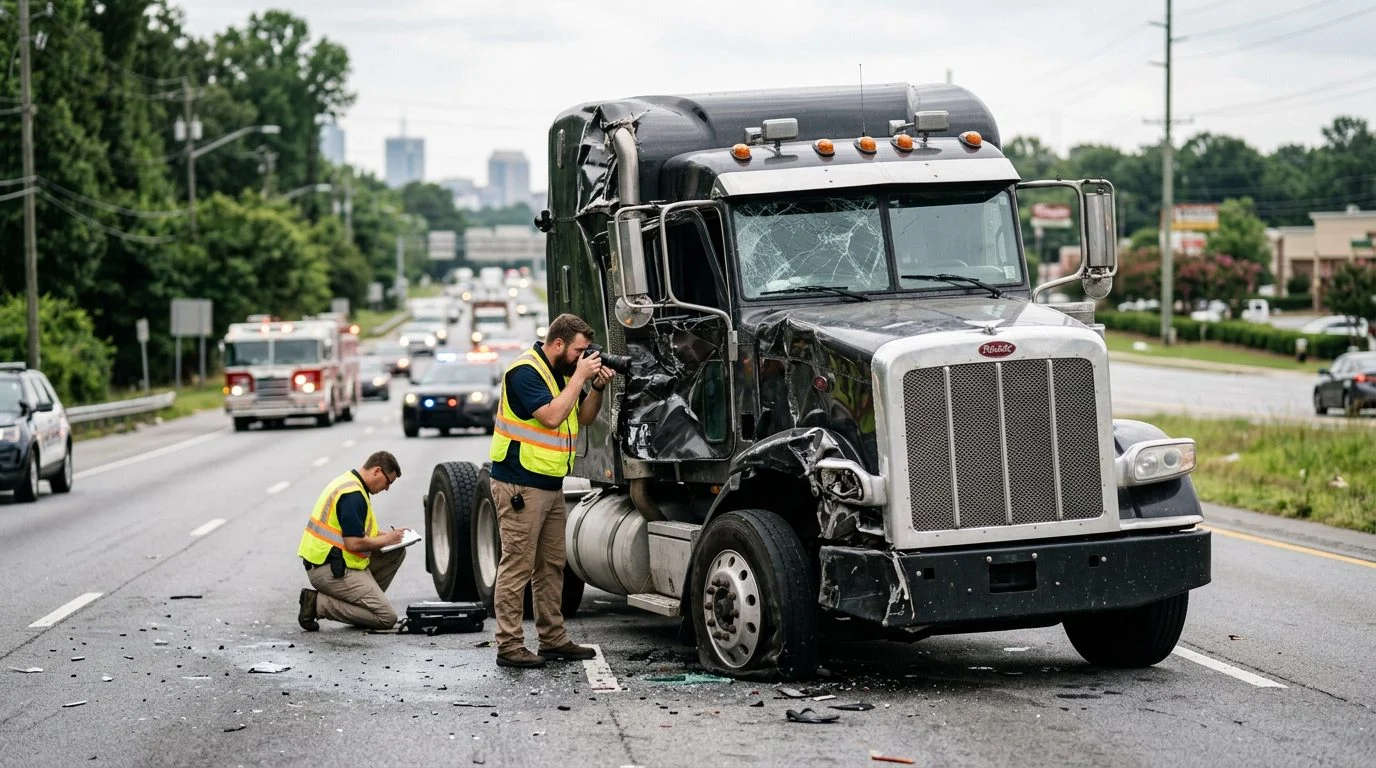
Truck Accidents | Duluth, Georgia
What Does a Semi Truck Settlement Look Like in Georgia?
Every crash carries its own facts, and the questions below can help you see what shapes a claim and where to start.
By Peter F. Jaraysi · Published November 19, 2026
If a semi truck hit you or someone you love, you may be asking how much a settlement could be. There is no single number that answers that for every case.
A settlement is built from the injuries, who was at fault, and the insurance that applies. Here is what goes into a claim’s value under Georgia law, and how a claim usually moves forward.
Why There Is No Single Number for a Semi Truck Settlement
No single number predicts a semi truck settlement, because each claim turns on its own facts.
Published averages for truck settlements vary widely. They group crashes with different injuries, fault findings, and insurance. An average from those cases can’t tell you what your injuries or your insurer’s coverage are worth.
Three questions shape most claims. How serious are the injuries, and how long will they last? Who caused the crash, and how is fault divided? What insurance is available to pay? Those answers change from one crash to the next.
A more useful question than “what did a typical case pay?” is “what factors shape this claim’s value?” The sections below cover those factors.
If a semi truck crash left you with medical bills and calls from an insurer, you don't have to face it alone, and our team can review the details of your situation at no cost. Talk it through with our team — the first consultation is free, confidential, and carries no obligation.

What a Semi Truck Settlement Is Made Of
A settlement usually pays for two kinds of damages: economic losses and non-economic losses.
Economic damages are losses you can count. They include past and future medical bills, lost income, lost earning capacity, rehabilitation, and damage to a vehicle or motorcycle. Georgia law treats necessary injury expenses as a legitimate part of the damages estimate (O.C.G.A. § 51-12-7).
Non-economic damages cover pain and suffering, emotional distress, and loss of enjoyment of life. They are harder to measure, so they are often the most disputed part of a claim.
Wrongful death claims follow different rules. A surviving spouse, or if there is none, a child or children, may recover “the full value of the life of the decedent, as shown by the evidence” (O.C.G.A. § 51-4-2). When death results from a crime or from criminal or other negligence, the personal representative of the deceased may recover necessary funeral, medical, and other expenses (O.C.G.A. § 51-4-5).
Factors That Shape the Value of a Truck Accident Claim
Three factors carry the most weight: how serious the injuries are, how fault is divided, and what insurance applies.
Injury severity. Catastrophic injuries usually mean longer treatment, higher future care needs, and more complex medical evaluation. That includes traumatic brain injury, spinal cord injury and paralysis, amputation, and severe burns. MedlinePlus describes spinal cord injuries by their causes, symptoms, severity, and resulting physical impairments. That is one reason detailed medical records matter.
Fault. Georgia uses modified comparative fault. Under O.C.G.A. § 51-12-33, a judge reduces damages in proportion to the injured person’s share of fault. Someone who is 50 percent or more responsible for the injury or damages claimed receives no damages. How fault is split often depends on the facts.
Insurance. Georgia’s Office of Commissioner of Insurance and Safety Fire publishes insurance requirements for businesses, including those that bear on trucking coverage. More than one policy can apply, such as a commercial trucking policy and umbrella coverage. The coverage in place can limit what is actually collectible.
More than one party. A claim can involve more than the driver. Under O.C.G.A. § 51-2-2, a business is liable for torts its servant commits within the scope of the business. In Quynn v. Hulsey, the Supreme Court of Georgia described negligent hiring, training, supervision, and retention claims as based on the employer’s own alleged negligent acts. Under O.C.G.A. § 51-12-33, each liable party’s share is its own liability, not joint liability.
How Federal Trucking Rules Can Affect Evidence in a Claim
Federal trucking rules create records that often matter in a semi truck case. Drivers must follow hours-of-service limits. Under 49 C.F.R. § 395.3, a driver of a property-carrying commercial motor vehicle may not drive after 14 consecutive hours on duty that follow 10 consecutive hours off duty. Driving is also not permitted once more than 8 hours of driving time pass without a 30-minute break, subject to listed exceptions.
Drivers record their duty status. 49 C.F.R. § 395.8 bars any false report about duty status. It also bars tampering with an electronic logging device so that it does not accurately record required data.
Records can disappear. Under 49 C.F.R. § 395.8, a motor carrier must keep records of duty status for at least 6 months from receipt. Under 49 C.F.R. § 379.3, after the required retention periods end, companies may destroy records at their discretion, but this does not excuse compliance with the lawful requirements of any other governmental body prescribing longer retention periods. That is why early requests matter.
The police crash report is a starting point. The GDOT crash reporting page explains how Georgia police crash reports are obtained. The Georgia Department of Transportation’s Accident Reporting System is the official system used to collect Georgia crash data. Vehicle inspection records, dashcam video, and electronic logging device data can also be lost or overwritten early, so reviewing a claim promptly matters.
Settling or Going to Court: How a Claim Usually Moves Forward
A semi truck claim usually moves from insurer notice to investigation, a demand, negotiation, and, if talks stall, a lawsuit.
A settlement is a voluntary agreement. Whether to accept an offer is the injured person’s decision, made with the facts of their own case in view.
Early offers can carry timing terms. For a written offer on a motor vehicle collision claim prepared with an attorney’s help, O.C.G.A. § 9-11-67.1 requires a payment date not less than 40 days from receipt of the offer. Under O.C.G.A. § 9-11-67.1(b)(2), the offer must also include medical or other records in the offeror’s possession, incurred as a result of the subject claim, that are sufficient to allow the recipient to evaluate the claim.
Georgia generally sets a two-year deadline for injury lawsuits under O.C.G.A. § 9-3-33. The clock starts when the right of action accrues, so timing matters early.
If Medicare paid for treatment, the CMS Medicare Secondary Payer overview says a conditional payment must be repaid when a settlement, judgment, award, or other payment is made. Federal law takes precedence over state laws and private contracts.
Steps That Protect a Semi Truck Claim While It Is Open
The steps that help most are prompt medical care, careful records, and caution with insurers.
Get a medical evaluation soon after the crash, and follow the treatment plan. Gaps in care can be used to argue that injuries were not serious.
Keep records. Save medical bills, proof of lost work, pay stubs, photos, the crash report number, and notes on every insurer call, including the date and what was said. Write down what you remember soon after the crash, while details are fresh.
Be careful with recorded statements and early settlement papers. They can shape the claim before its full value is known.
If Medicare is involved, the CMS reporting guidance says a beneficiary, through an attorney or otherwise, must notify Medicare when a claim is made against a liability insurer. That notice can be given by reporting the case in the MSP Recovery Portal or by contacting the Benefits Coordination & Recovery Center.
Not sure what your next step is?
Talk it through with our team — the first consultation is free, confidential, and carries no obligation.

Talking Through Your Semi Truck Claim With Our Team
If you’re dealing with a semi truck crash now, you may be in pain, missing work, and taking calls from an insurance adjuster. You may also be caring for someone else. That is a hard place to be, and you don’t have to sort it out alone.
Our lawyers at Slam Dunk Attorney, in Duluth, Georgia, represent people hurt in truck, car, and motorcycle crashes. We serve Lawrenceville, the Atlanta metro area, and clients across Georgia.
Our first consultation is free, confidential, and carries no obligation to continue.
Frequently Asked Questions
How much is a semi truck settlement?
There is no single amount. Value depends on the injuries, how fault is divided, and the insurance that applies.
How long do I have to file a semi truck lawsuit in Georgia?
Georgia generally gives two years for injury lawsuits under O.C.G.A. § 9-3-33. The clock starts when the right of action accrues.
Can I sue the trucking company as well as the driver?
A claim can name the driver and the business when the facts support it. Under O.C.G.A. § 51-2-2, a business is liable for torts its servant commits within the scope of the business.
Is Georgia a comparative fault state?
Yes, Georgia uses modified comparative fault. Under O.C.G.A. § 51-12-33, a plaintiff who is 50 percent or more responsible for the injury or damages claimed is not entitled to receive any damages.
If you want to talk through your crash, your injuries, and any offers you’ve received, reach out through our contact page for a free case review.
Disclaimer: This page is general information, not legal advice. Peter F. Jaraysi is the responsible lawyer for this page at Slam Dunk Attorney in Duluth, Georgia. Contact details are on our contact page. Each case turns on its own facts, and no particular outcome can be promised.
What Shapes a Semi Truck Claim
Injury severity
Medical records, treatment plans and the long-term effects of a crash help show the full impact on your life.
Crash records
Police reports, photos, driver logs and maintenance records can all become part of the picture after a collision.
Insurance coverage
Commercial trucks often carry several layers of coverage, and understanding which policies may apply matters.
Lost income and daily life
Time away from work, lost earning capacity and changes to family life are all part of how a claim is understood.
Be Careful With Early Statements
Insurance adjusters for trucking companies may contact you quickly. Speaking with a lawyer before giving a recorded statement or signing any release can help you protect your position.
Why Semi Truck Cases Are Different
Size and force
A loaded semi carries far more weight than a passenger vehicle, which often leads to serious and complex injuries.
Company involvement
Trucking companies, drivers and shippers may each play a role, and their records can be central to the case.
Multiple policies
Several insurance policies may be involved, which can make the claim process more layered than a typical car accident.
Catastrophic injuries
Spinal cord injuries, traumatic brain injuries, amputations and burns often require long-term planning and careful documentation.