
Motorcycle Accidents | Duluth, Georgia
Understanding the Motorcycle Accident Case Process in Georgia
A plain-language guide to each stage of a motorcycle injury claim, from the first call to resolution, and how Slam Dunk Attorney can help you move forward.
By Peter F. Jaraysi · Published October 21, 2026
The motorcycle accident case process in Georgia usually moves through a set of stages. It starts with a consultation, then moves into investigation, an insurance claim, and negotiation. If those talks don’t resolve the case, it may become a lawsuit that ends in mediation or trial. This guide explains each stage in plain language. It’s written for the spouse, adult child, or friend helping an injured rider. Many people start researching while the rider is still in the hospital or recovering. That’s a hard place to be. Here’s what usually comes next, and which Georgia deadlines and fault rules matter most. For broader background, read our motorcycle accident claims guide.
What steps does a motorcycle accident case follow from the first consultation through settlement or trial in Georgia?
A Georgia motorcycle accident case usually moves through five stages. These are the first consultation, investigation, the insurance claim and settlement demand, negotiation, and, if needed, a lawsuit with discovery, mediation, and possibly trial. Some cases end during negotiation.
The stages overlap. Investigation starts before the consultation ends, and talks with an insurer can begin while medical care continues. Timing varies with the injuries, the insurers involved, and the court calendar. A rider with a broken collarbone and a short recovery moves very differently from a rider with a spinal cord injury who needs long treatment. Medical care often sets the pace.
Each rider’s path is different, and the specific steps depend on the facts. The sections below walk through each stage and the rules that shape it.
If a loved one was hurt in a motorcycle crash, you don't have to face the process alone. Our team offers a free, confidential consultation with no obligation to continue. Talk it through with our team — the first consultation is free, confidential, and carries no obligation.

How does the first consultation work for a motorcycle accident case?
The first consultation is a conversation about what happened and what the rider faces now. The lawyer asks for the crash date, the location, and the injuries. You’ll also be asked about medical treatment so far and any contact with insurance companies.
Bring what you have, even if it’s incomplete. A police report number helps. So do photos of the scene and vehicles, medical bills, discharge papers, and letters from insurers. Write down the rider’s helmet and gear details too. Georgia requires riders to wear protective headgear that meets state standards, under O.C.G.A. § 40-6-315. For more on that rule, see our helmet laws page.
The consultation is free and confidential. It carries no obligation to continue. You can ask questions and decide next steps after hearing the facts.
What evidence and investigation happen early in a motorcycle crash claim?
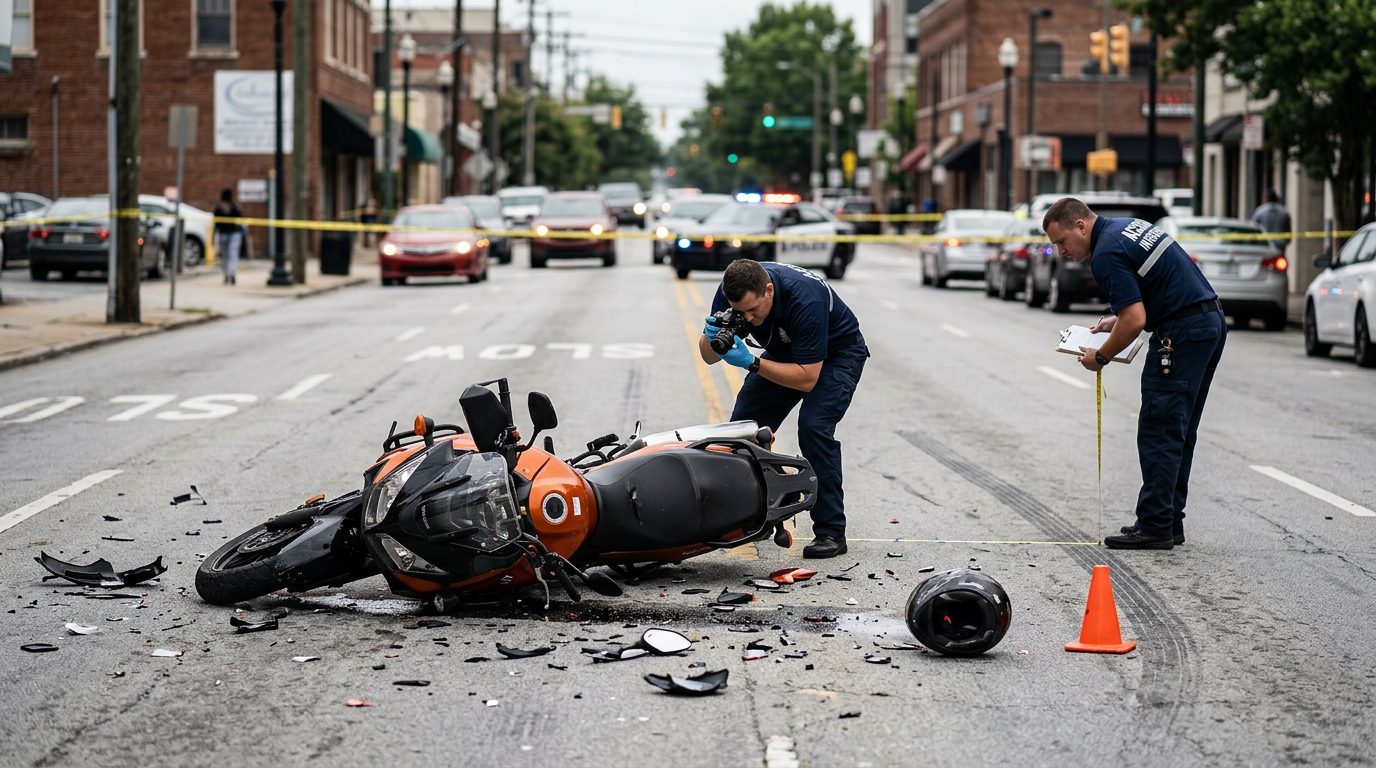
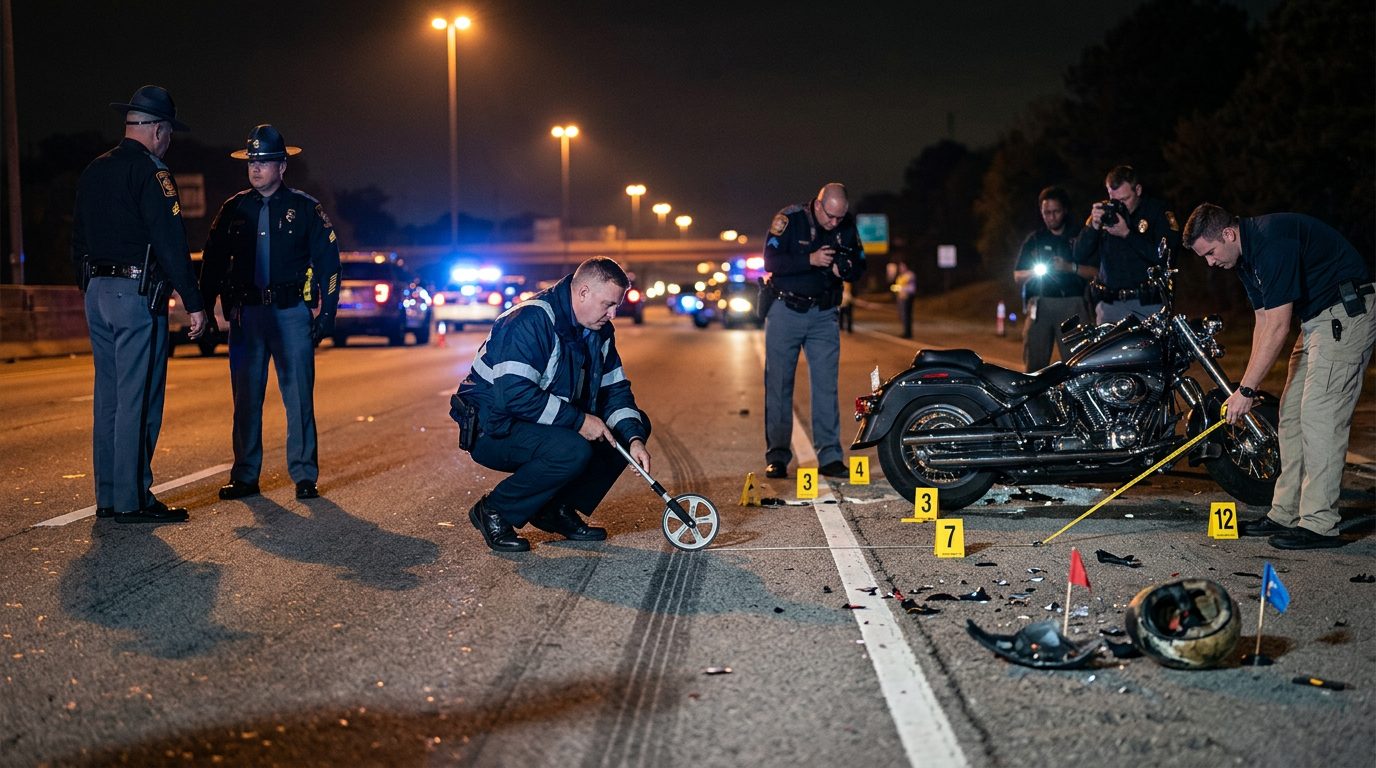
Early investigation focuses on preserving evidence and showing how the crash happened. Evidence can disappear quickly, so the first weeks matter. Key items include the motorcycle, the helmet and gear, and the rider’s phone records. Dashcam or surveillance footage and vehicle event data may also matter where they exist. Ask before repairing or selling the motorcycle, because it may be evidence.
Investigators use the crash report, witness statements, and scene measurements to build a timeline. Together, these show where each vehicle was and how it moved.
Medical records carry the injury story. A clear treatment history links the injury to the crash. This matters most for catastrophic injuries. The Administration for Community Living notes that traumatic brain injuries can result from external forces, including automobile accidents. Gaps in treatment can make an injury harder to tie to the crash. Keep every appointment and keep copies of records. See also our traumatic brain injury page.
How does the insurance claim and settlement demand stage work in Georgia?
The claim usually starts with the at-fault driver’s liability insurer. The rider’s own policy may also matter. Georgia requires auto policies to include uninsured motorist coverage, under O.C.G.A. § 33-7-11. That coverage pays an insured for bodily injury, death, or injury to or destruction of the insured’s property sustained from the owner or operator of an uninsured motor vehicle. O.C.G.A. § 33-7-11 reads: “(a)(1) No automobile liability policy or motor vehicle liability policy shall be issued or delivered in this state to the owner of such vehicle or shall be issued or delivered by any insurer licensed in this state upon any motor vehicle then principally garaged or principally used in this state unless it contains an endorsement or provisions undertaking to pay the insured damages for bodily injury, loss of consortium or death of an insured, or for injury to or destruction of property of an insured under the named insured’s policy sustained from the owner or operator of an uninsured motor vehicle, within limits exclusive of interests and costs which at the option of the insured shall be.” Some policies also carry underinsured motorist coverage. The policies and the facts decide which coverage applies.
Insurers may ask for a recorded statement or an early medical release. The injured person doesn’t have to answer those requests without guidance. A rider or family member can ask questions first.
Once the facts are gathered, a written settlement demand is prepared. It summarizes who was at fault, the injuries, the treatment, and the losses. This is the first formal request for payment.
What are the Georgia time limits and fault rules that shape a motorcycle accident case?
Georgia generally requires injury lawsuits to be filed within two years after the right of action accrues. Fault rules can also reduce a recovery. A rider who is 50 percent or more responsible for the injury cannot recover damages (O.C.G.A. § 51-12-33; Quynn v. Hulsey, 310 Ga. 473 (2020)). Those rules often shape a motorcycle case from the start.
The general deadline for injuries to the person is two years after the right of action accrues, under O.C.G.A. § 9-3-33. That statute sets four years for loss of consortium claims. Wrongful death claims follow their own rules.
Fault works like this. Under O.C.G.A. § 51-12-33, the trier of fact, often a jury, sets the rider’s percentage of fault. The judge then reduces the award by that share. At 50 percent or more, the rider receives nothing. Each liable party pays only its own share, not a joint amount.
Another rule asks whether the rider could have avoided the harm. Under O.C.G.A. § 51-11-7, a plaintiff who could have avoided the consequences with ordinary care is not entitled to recover. Fault disputes are common in motorcycle cases, and early evidence shapes how each side argues them.
When does a motorcycle accident case move into a lawsuit, discovery, and trial?
A case becomes a lawsuit when a complaint is filed in the proper Georgia court. This often happens when talks don’t reach a fair resolution and a deadline is approaching. Filing a lawsuit does not mean the case will go to trial.
Discovery follows. Each side asks written questions, requests documents, and takes depositions. A deposition is sworn testimony given outside the courtroom. Parties and witnesses may both be deposed.
Mediation is a common step before trial. A neutral person helps both sides talk through the case. A case can resolve at any point. Trial is the final stage, when a judge or jury decides the disputed issues. This guide makes no prediction about how any case will turn out.
Not sure what your next step is?
Talk it through with our team — the first consultation is free, confidential, and carries no obligation.
How do the costs, fees, and settlement payout work in a Georgia motorcycle accident case?
The first consultation is free and confidential, with no obligation to continue. Fee terms and case costs are separate topics, so ask about both at the start. Any fee arrangement may still leave the client responsible for court costs and case expenses.
Medical bills affect payouts. Georgia limits medical expense damages to the reasonable value of medically necessary care, under O.C.G.A. § 51-12-1.1. Some providers treat an injured person under a letter of protection, which promises payment from any settlement or judgment. Under the same statute, that letter, itemized charges, and referral details can be relevant and discoverable.
Under O.C.G.A. § 51-12-1.1, special damages for medical and healthcare expenses are recoverable only as provided in that section, and special damages such as medical bills and lost pay must be proved under O.C.G.A. § 51-12-2. General damages are presumed to flow from the wrongful act. Under O.C.G.A. § 51-12-2: (a) General damages are those which the law presumes to flow from any tortious act; they may be recovered without proof of any amount. (b) Special damages are those which actually flow from a tortious act; they must be proved in order to be recovered. Liens and reimbursement claims may also affect how a settlement is divided, and these are discussed with the client.
What should a family do next if a loved one was hurt in a motorcycle crash?
Start with the rider’s medical care and a simple record of what happened. Then have the facts reviewed against the deadlines and documents that apply. If you’re helping from a hospital room or a recovery bed, this process can feel like too much. You didn’t choose the crash, and you didn’t choose this paperwork either.
If the crash was fatal, Georgia law lets a surviving spouse recover for the homicide of a spouse or parent. If there is no surviving spouse, the children may recover. The recovery is measured as the full value of the decedent’s life, as shown by the evidence. Under O.C.G.A. § 51-4-2, the surviving spouse or, if there is no surviving spouse, a child or children, either minor or sui juris, may recover for the homicide of the spouse or parent the full value of the life of the decedent, as shown by the evidence.
Frequently asked questions
How long does the motorcycle accident case process take in Georgia?
Timing varies with the injuries, the insurers, and the court calendar. No single timeline applies to every case.
Is the first consultation free?
Yes. The first consultation is free and confidential, with no obligation to continue.
How long do I have to file a motorcycle injury lawsuit in Georgia?
Georgia generally requires injury lawsuits to be filed within two years after the right of action accrues, under O.C.G.A. § 9-3-33.
If a loved one was hurt in a motorcycle crash, you don’t have to work through the process alone. Request a free case review with our team to go over the deadlines and steps that may apply.
Disclaimer: This page is general information, not legal advice. Responsible lawyer: Peter F. Jaraysi, Slam Dunk Attorney, Duluth, Georgia. Contact details are on the contact page.
The Key Steps in a Georgia Motorcycle Accident Case
1. Initial Contact and Case Review
You share what happened, where it happened, and what injuries or losses you have experienced. Our team reviews the details with you so you understand your options before any decisions are made.
2. Investigation and Evidence Gathering
We work to collect the police report, photographs, witness information, medical records, and other documents that describe the crash and your injuries.
3. Insurance Communication and Negotiation
We handle communication with insurance companies on your behalf and present your claim. Many motorcycle cases are resolved during this stage, though timing depends on the facts and the insurers involved.
4. Litigation When Needed
If a fair resolution cannot be reached through negotiation, we discuss filing a lawsuit, what that process involves, and how the court calendar can affect the timeline.
How Our Team Supports You Throughout Your Case
Plain-Language Updates
We explain each step and each decision in terms you can follow, so you always know where your case stands.
Protecting Your Claim
We help you avoid common missteps that insurers may use to reduce or deny a claim.
Organized Documentation
We track medical bills, records, and correspondence so nothing important is overlooked.
Serving Metro Atlanta and Georgia
We represent riders across Gwinnett, Fulton, Cobb, and surrounding communities, including Duluth, Lawrenceville, Johns Creek, Alpharetta, Marietta, Norcross, Kennesaw, and Dunwoody.
Be Careful With Insurance Adjusters
An insurance adjuster may ask for a recorded statement soon after a crash. Speak with a lawyer before giving one, and avoid posting about the accident or your injuries on social media.