
Uber and Lyft Accidents | Duluth, Georgia
Hurt in an Uber Driver Accident? Here's What Comes Next
Our team helps people across metro Atlanta understand their options after a rideshare crash, one step at a time.
By Peter F. Jaraysi · Published November 11, 2026
When an Uber driver is in an accident, the first question is what the app was doing at the moment of impact. Was the driver logged off, waiting for a ride request, or carrying a trip? Georgia law ties insurance to those periods.
In short, the coverage in place for that app phase matters most, and each at-fault party answers for its own share of fault. The details depend on the facts, so this guide walks through them in the order they usually come up.
Why the Answer Depends on the Moment of the Crash
An Uber driver’s crash is handled differently depending on the app’s status when it happens. Under O.C.G.A. § 33-1-24, transportation network company services include the period a driver is logged on to the company’s digital network and available to accept a ride request until the driver is logged off, and the period a driver accepts a ride request until the driver completes the transaction or the ride is complete, whichever is later. O.C.G.A. § 33-1-24 defines the services period as the time a driver is logged on and available for ride requests until the driver logs off, except for the time from accepting a ride request until the driver completes the transaction or the ride is complete, whichever is later.
In practice, there are three phases to sort out:
- App off. The driver is not logged on. The driver’s own auto insurance may be involved.
- App on, waiting. The driver is logged on and available, but has not accepted a ride.
- Trip in progress. The driver has accepted a ride request and is driving a passenger or heading to pick one up.
Timestamps, trip records, and the crash report show which phase applies. Don’t assume coverage from a general summary. For the broader picture, read our rideshare accident guide.
If you were hurt in a crash with an Uber driver, you don't have to sort out the insurance questions alone. Contact our team for a free, confidential first consultation. Talk it through with our team — the first consultation is free, confidential, and carries no obligation.
How Uber’s Insurance Works in Each Phase
During the accepted-ride period, the rideshare company must carry at least $1 million per occurrence for death, personal injury, and property damage. That period runs from acceptance until the driver completes the transaction or the ride is complete, whichever is later, under O.C.G.A. § 33-1-24.
A coverage limit is the most a policy will pay. It is not a promised payment to anyone. Your actual recovery depends on your injuries, the other insurance involved, and the fault rules discussed below.
Personal auto insurers may exclude coverage under the owner’s policy for any loss or injury that happens while the driver is logged on to the app or while the driver is providing rideshare services, including during a trip. If the driver’s own required insurance has lapsed or ceased to exist, which policies may apply to a claim depends on the specific facts involved.
Your own policy can matter too.
Insurers can also ask for trip timing. Within 15 days of a personal insurer’s request, the company must provide the accident time and the log-on and log-off times for the 12 hours before and after the crash.
Who Can Be Held Responsible After an Uber Crash
The at-fault driver can generally be sued in a negligence claim. Negligence means failing to use reasonable care, such as distracted driving or running a red light. Other people may share responsibility too.
A passenger, a pedestrian, or another motorist may have a claim against the at-fault driver. That claim can run against the driver’s liability insurer, depending on the policies in force.
Uber is a harder question. Under O.C.G.A. § 40-1-201, a ride share network service is not liable for a driver’s operation of a personal car. That protection applies only if the service itself was not negligent and meets the statute’s conditions, including a background check of each driver at least once every two years.
A company can also face claims for its own fault. Georgia requires an employer to use ordinary care not to hire or keep an employee it knew or should have known posed a risk of harm. See Munroe v. Universal Health Services. Whether that applies to a particular driver is a question for the specific facts.
In some crashes, a vehicle owner or a maintenance provider may also be involved. Those questions turn on the records in each case.
Georgia’s Fault Rules and How They Affect a Claim
Georgia cuts your recovery by your own share of fault, and you cannot recover at all if you are 50 percent or more responsible. Under O.C.G.A. § 51-12-33, damages are reduced in proportion to your percentage of fault.
Fault can be shared among several people. The jury or judge must consider the fault of everyone who contributed to the injury, even people who were not named in the lawsuit. The same statute says each at-fault person’s share is that person’s own liability. It is not joint liability, and it is not subject to contribution.
Be careful at the scene and afterward. Don’t admit fault, and understand what a recorded statement means before you give one to an insurer. Your words can be used to assign percentages of fault later.
What to Document and Do After a Crash With an Uber Driver
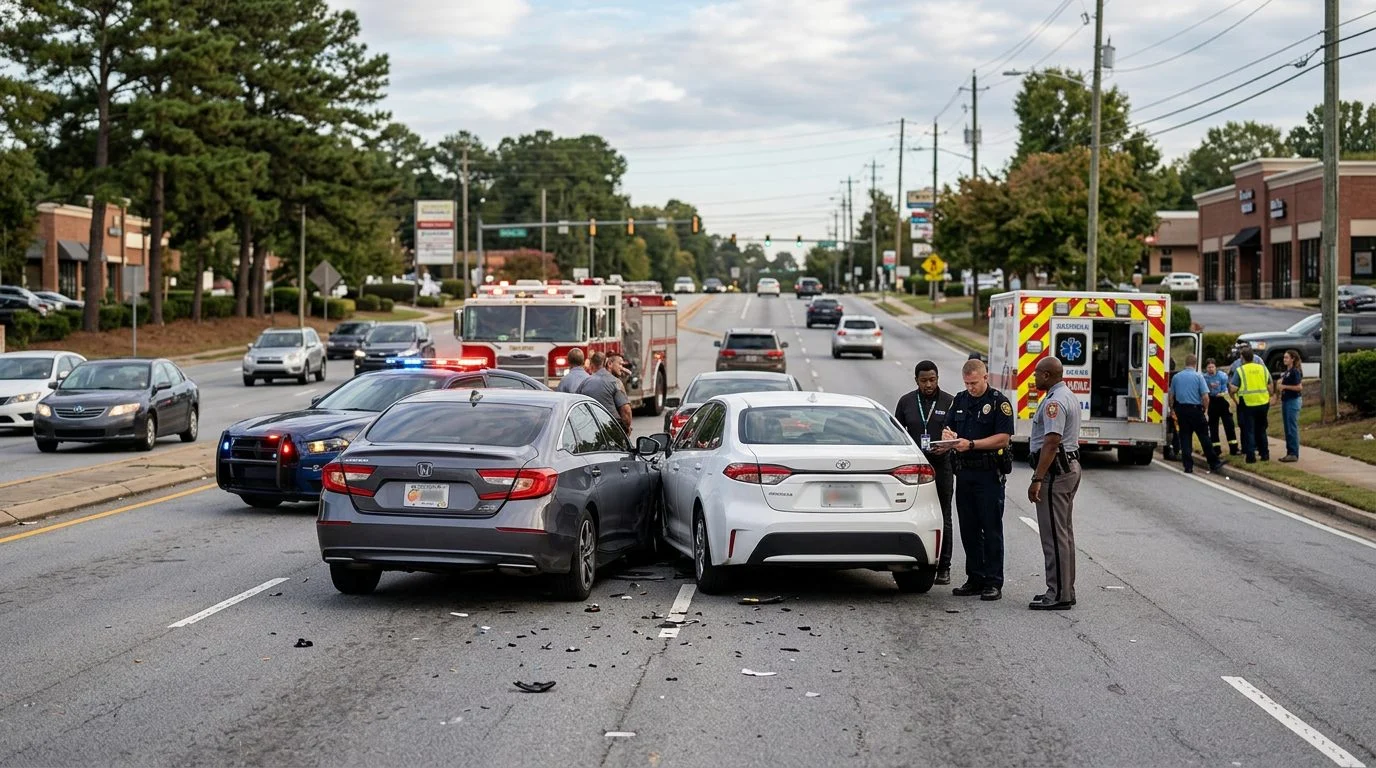
Start with safety. Check for injuries, move to a safe spot if you can, and call for help if anyone is hurt. Georgia requires a driver in a crash causing injury, death, or $500 or more in property damage to give immediate notice. Under O.C.G.A. § 40-6-273, that notice goes to the local police within a city, or to the county sheriff or state patrol outside one.
Then gather records:
- The police report number and the name of the responding agency.
- The Uber driver’s name, the vehicle details, and the trip information shown in the app.
- Photos of vehicle damage, the scene, traffic signals, and visible injuries, taken from several angles.
- Names and contact details for witnesses.
- A written log of symptoms, medical visits, and missed work.
- Receipts and any messages with the driver or insurers.
Avoid posting details about the crash on social media. Those posts can be used to question your account.
The app data matters most. It shows which phase applies, and that phase controls which coverage may respond.
Deadlines and Why Timing Matters
For most injury claims in Georgia, the deadline is two years after the right of action accrues. Under O.C.G.A. § 9-3-33, loss of consortium claims have four years.
If a city or state vehicle was involved, the notice steps come much sooner. For a city, a written claim generally must be presented within six months of the event, under O.C.G.A. § 36-33-5. For the state, written notice is due within 12 months of the date the loss was discovered or should have been discovered, under O.C.G.A. § 50-21-26.
When a crash causes a death, the surviving spouse or, if there is no spouse, the children may recover for the homicide. The measure is the full value of the decedent’s life, as shown by the evidence, under O.C.G.A. § 51-4-2. Family timing questions should be reviewed early.
Evidence also fades. App logs, camera footage, and vehicle data can be overwritten or lost.
Not sure what your next step is?
Talk it through with our team — the first consultation is free, confidential, and carries no obligation.

Getting a Free Case Review
A free case review is the most direct way to see how trip status, insurance layers, and Georgia fault rules apply to your crash. You may be dealing with injuries, a damaged car, or the loss of a family member, and you did not choose any of it.
Trip records, the crash report, and your medical timeline are the facts that can change the answer. Our Georgia overview covers the state-wide picture, and our Lawrenceville page covers local context.
The initial consultation is free, confidential, and carries no obligation to continue.
If you’re ready to talk through your crash, contact Slam Dunk Attorney and our team will review what happened with you.
This page is general information, not legal advice. It was prepared under the responsibility of Peter F. Jaraysi, a lawyer with Slam Dunk Attorney in Duluth, Georgia. Contact the firm through its contact page.
How We Can Help
Plain-language answers
We explain how the app's status at the time of the crash can affect the insurance questions in your case.
Free, confidential first consultation
Our initial consultation is free, confidential and comes with no obligation to continue.
Support for you and your family
Our team keeps you informed and handles the paperwork so you can focus on recovering.
Serving Georgia communities
We represent people injured in rideshare accidents across metro Atlanta and throughout Georgia, including Duluth, Lawrenceville, Alpharetta and Marietta.
Keep Your Records Together
Save your trip details, photos of the scene, the names of any witnesses, and every medical visit and bill. Be careful about posting about the crash online, and speak with a lawyer before giving a recorded statement to any insurance company.
Steps to Take After an Uber or Lyft Crash
Get medical care
See a doctor even if you feel fine. Some injuries, such as concussions and soft tissue damage, may appear later.
Document the scene
Take photos, get the other driver's details, and write down what you remember while it is fresh.
Note the app status
Record whether the driver was logged in, waiting for a request, or on a trip, since this shapes which coverage may apply.
Talk with our team
Contact Slam Dunk Attorney for a free, confidential consultation to review what happened and what questions to raise next.