
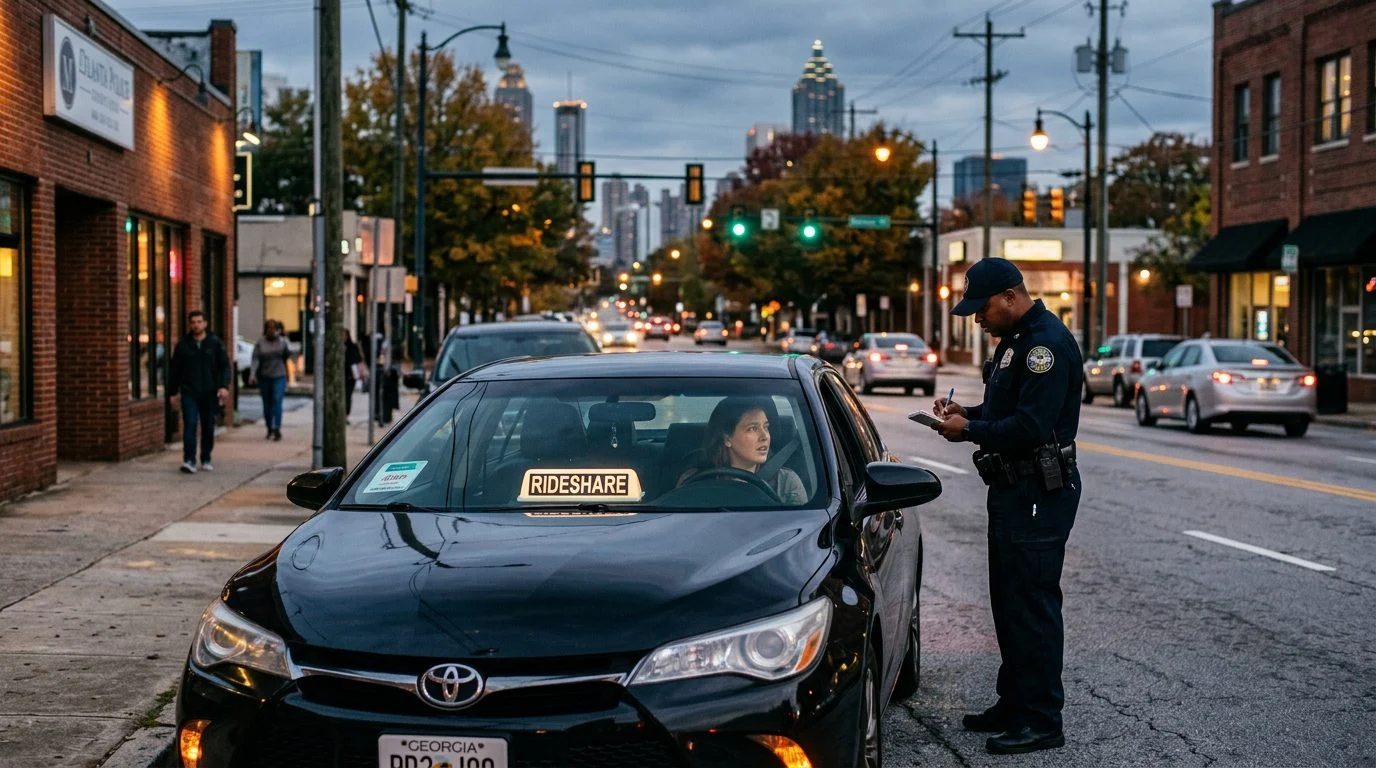
Rideshare Accidents | Duluth, Georgia
Hurt in an Uber or Lyft Crash? Start With Clear Answers
Rideshare claims involve more parties, more paperwork and more questions than most car cases. Here is how the process typically works in Georgia, so you can make informed decisions.
By Peter F. Jaraysi · Published November 16, 2026
How much can you sue Uber for? There is no set number. A rideshare claim’s value depends on who was at fault, which insurance applies, and how serious the injuries and losses are. This guide explains those factors under Georgia law, so you can understand what a claim may include.
Short Answer: Why No One Can Give You a Set Number
No one can give you a set number, because a rideshare claim’s value depends on several facts. Those facts change from case to case.
Fault comes first. Georgia reduces damages by the injured person’s share of fault, and it bars recovery at 50 percent or more (O.C.G.A. § 51-12-33 (Quynn v. Hulsey (2020))). Insurance comes next. The policies that apply can shift based on what the app was doing when the crash happened.
Then come medical treatment, time away from work, and how the injury changes daily life. In short, the answer depends on the facts of your crash. Early choices matter too. Gaps in treatment and missing records can make losses harder to prove. This page can’t predict the outcome of any one case, and two accidents that look alike can lead to very different claims.
If an Uber or Lyft crash has left you facing medical bills and insurance calls, you don't have to sort it out alone. Our team offers a free, confidential first consultation with no obligation to continue. Talk it through with our team — the first consultation is free, confidential, and carries no obligation.
Who You Can Sue After an Uber or Lyft Accident
The at-fault driver is the most direct target. That driver may drive for Uber or Lyft, or may be another motorist on the road.
Georgia law also limits suits against the rideshare company itself. Under Georgia’s ride share network law, a ride share network service is not liable for a driver’s operation of a personal car just because it runs the app. That protection applies only if the company itself was not negligent or involved in criminal misconduct. It also depends on the company meeting its other legal duties, including background checks on each driver at least once every two years. Because the protection has conditions, the company’s own conduct can change the analysis.
Other parties may matter too. Another driver or a third party whose negligence contributed to the crash may share responsibility. https://www.legis.ga.gov/api/document/docs/default-source/joint-features-document-library/t51-(v39)-pdf.pdf
How Uber’s Insurance Coverage Depends on App Status
Insurance for a rideshare crash usually turns on whether the driver was logged on to the company’s digital network and available to accept a ride request, until logged off, or was providing rides (O.C.G.A. § 33-1-24). Georgia’s transportation network company law ties required coverage to that period, and requires at least $1 million for death, personal injury, and property damage per occurrence during the time a driver accepts a ride request until the driver completes the transaction or the ride is complete, whichever is later (O.C.G.A. § 33-1-24).
The app usually moves through four stages: app off, logged on and waiting for a request, en route to a passenger, and on a trip. The exact timeline can decide which policy responds, so it matters early.
A driver’s personal auto policy may not cover rideshare driving. The same statute lets a personal insurer exclude any and all coverage for any loss or injury that occurs while a driver is logged on to a transportation network company’s digital network or while a driver provides transportation network company services. Industry researchers note that personal auto policies typically exclude commercial rideshare use (Insurance Information Institute).
Your own uninsured or underinsured motorist coverage may matter if the at-fault driver has too little insurance. Your own uninsured or underinsured motorist coverage pays damages from the owner or operator of an uninsured motor vehicle, within limits exclusive of interests and costs that you may choose, and the policy must offer it; a vehicle is not treated as uninsured when its owner or operator has deposited security under Code Section 40-9-32 in the required amounts (O.C.G.A. § 33-7-11).
Document app status early.
What Damages Can Be Claimed in Georgia
In an injury claim, losses are often described in two broad categories: economic losses, such as medical bills and lost wages, and noneconomic losses, such as pain and suffering. Economic damages include medical bills, lost wages, and future care costs. Special damages, such as medical expenses, must be proved (O.C.G.A. § 51-12-2). Medical costs are limited to the reasonable value of medically necessary care (O.C.G.A. § 51-12-1.1).
Noneconomic damages cover harm that is harder to price. These can include pain and suffering and emotional distress (PMC review). Emotional harm usually sits alongside a physical injury. If the entire injury is to someone’s feelings, Georgia sets no fixed measure of damages, and punitive damages are not allowed (O.C.G.A. § 51-12-6).
Punitive damages are a separate category. Georgia law awards them to punish, penalize, or deter a defendant, not to compensate the injured person (O.C.G.A. § 51-12-5.1). They depend on the conduct involved.
Catastrophic injuries change the scope of a claim. A spinal cord injury, traumatic brain injury, amputation, or severe burn can bring long-term care needs and lost earning ability. Future economic losses may be reduced to present value (O.C.G.A. § 51-12-13).

Factors That Shape the Value of a Rideshare Claim
Fault is the first factor. Under Georgia’s modified comparative fault rule, a plaintiff’s own share of fault reduces the award (O.C.G.A. § 51-12-33; Quynn v. Hulsey (2020)). A plaintiff who is 50 percent or more responsible cannot recover damages (O.C.G.A. § 51-12-33).
Timing is the second factor. Georgia generally requires a personal injury suit within two years after the right of action accrues (O.C.G.A. § 9-3-33). Some claims, such as loss of consortium, have a four-year period under the same statute.
Insurance limits matter as well. A policy may not cover all of your losses. Medical liens and reimbursement claims may also need to be resolved from any recovery.
Strong records help. Keep the police report, app trip records, photos, medical records, and witness names. Write down what happened while you still remember it.
Why a Settlement Offer Is Not the Amount You Keep
A settlement offer is a gross figure. Attorney fees, case costs, and medical liens can reduce what reaches the injured person. Under Georgia law, medical charges can be subject to letters of protection and related disclosures (O.C.G.A. § 51-12-1.1).
If a fee is paid from a recovery, the client may still be responsible for court costs and case expenses. Ask how those are handled before you decide anything.
An early offer may not account for future treatment or long-term losses. Accepting an offer usually ends the claim, so take time to understand the full picture first.
Not sure what your next step is?
Talk it through with our team — the first consultation is free, confidential, and carries no obligation.
Talk With Our Team About Your Rideshare Accident
If you’re managing an injury, a hospital stay, or a family member’s care, the questions about money can feel overwhelming. You may be trying to understand your options while dealing with insurance calls. Our team at Slam Dunk Attorney in Duluth, Georgia, can review the facts of your crash with you.
Our firm offers a free first consultation. It is confidential and carries no obligation to continue. To learn more, visit our contact page. For background on the broader topic, see our rideshare accident guide and our Atlanta rideshare accident page.
Common Questions
Is it easy to sue Uber?
It is rarely simple. Fault, insurance stage, and deadlines all need proof.
How long do I have to file?
Georgia generally requires a personal injury suit within two years after the right of action accrues.
Can I sue for emotional distress?
Emotional harm can be part of a claim. If the entire injury is emotional, Georgia sets no fixed measure and bars punitive damages.
Will I keep the full settlement?
Attorney fees, case costs, and medical liens can reduce what you receive.
Responsible lawyer: Peter F. Jaraysi, Slam Dunk Attorney, Duluth, Georgia. Contact us through our contact page. This page is general information, not legal advice.
What to Expect When You Reach Out
A Free First Consultation
The initial consultation is free, confidential, and carries no obligation to continue.
Plain-Language Answers
Our lawyers explain your options without legal jargon, so you know what each step involves.
Support for Your Family
Our team helps you organize records, insurance correspondence and medical paperwork while you focus on recovering.
Serving Metro Atlanta and Georgia
From our Duluth office, we represent injured people across metro Atlanta and throughout Georgia.
Protect Your Records Early
Keep photos of the scene and your injuries, save your ride receipts and app screenshots, and write down what you remember while it is still fresh. Avoid posting about the crash or your injuries on social media.
Why Rideshare Claims Can Be Complicated
Who Was Driving
The answer may depend on whether the app was on, whether a passenger was in the vehicle, and which driver was involved.
Multiple Insurance Policies
Rideshare companies and drivers may carry different types of coverage, and each policy can have its own requirements.
Other Drivers and Vehicles
Crashes often involve other cars, trucks or motorcycles, and each party may have a separate insurer and story.
Time-Sensitive Evidence
Dashcam footage, app data and witness accounts can be harder to obtain as time passes.
Talk With Our Team About Your Rideshare Accident
Related practice areas
- What happens if you get into an accident in a rideshare?
- Who Is Responsible for Serious Property Injury in Georgia?