
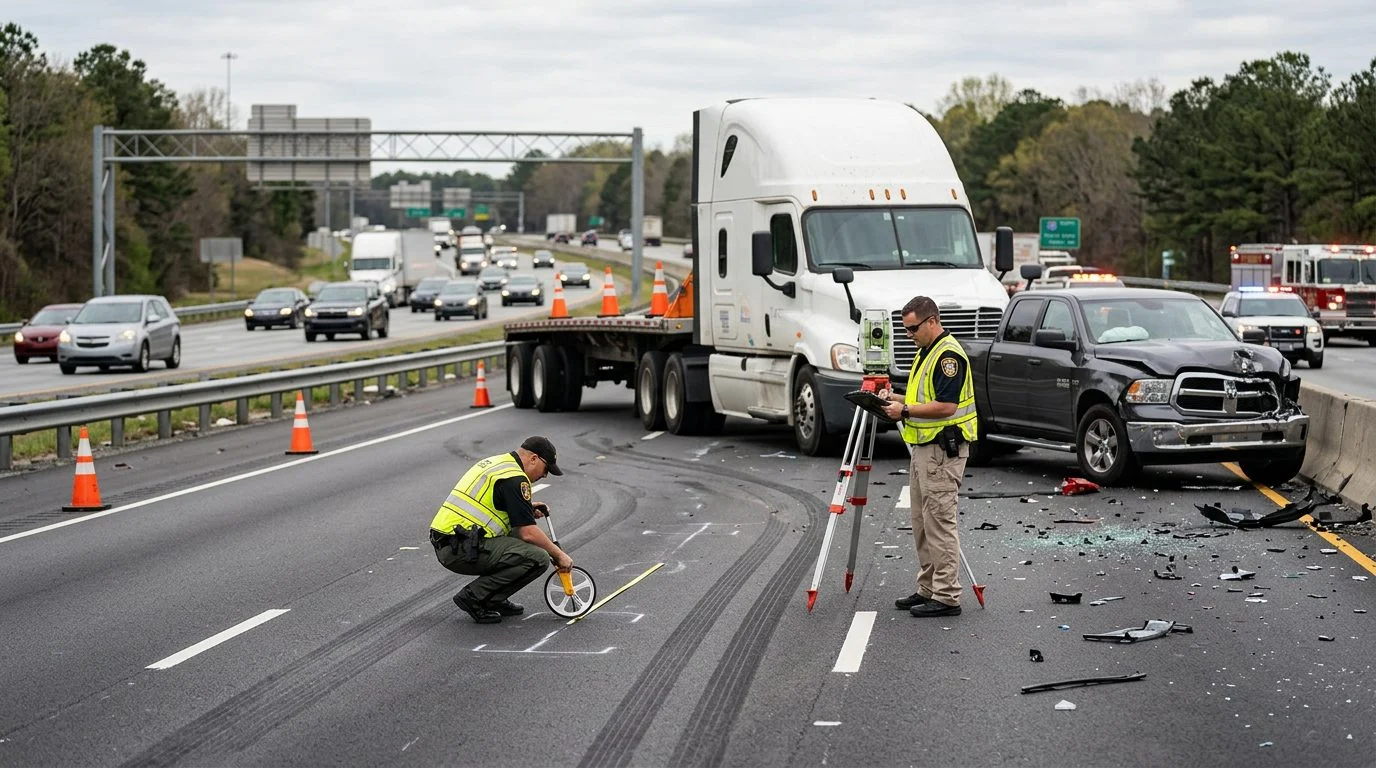
Truck Accidents | Duluth, Georgia and Metro Atlanta
Hurt in a Truck Crash? Find Out Whether You Can Sue the Trucking Company
Trucking companies can be held responsible in some crashes. Our team in Duluth, Georgia helps injured people understand their options after a serious collision. Your first consultation is free, confidential, and comes with no obligation to continue.
By Peter F. Jaraysi · Published October 30, 2026
Yes, in many cases you can sue a trucking company after a catastrophic truck crash in Georgia. The company may answer for its driver’s negligence, for its own decisions, or for both. This page explains how that works, which records often matter, and how Georgia’s deadlines and fault rules apply.
Yes, in Many Cases the Trucking Company Can Be Named in a Georgia Lawsuit
A trucking company can often be named as a defendant when its driver or its own conduct helped cause a serious truck crash. The driver is rarely the only party with insurance, money, or records tied to the claim. Company logs, hiring files, and dispatch decisions can all point to who is responsible.
This question comes up for two groups. The first is the person who was hurt. The second is a family member after a death. Under O.C.G.A. § 51-4-5, when there is no person entitled to bring an action for the wrongful death of a decedent under Code Section 51-4-2 or 51-4-4, the administrator or executor of the decedent may bring a wrongful death action for the benefit of the next of kin.
Catastrophic injuries change a person’s life in lasting ways. Examples include spinal cord injury and paralysis, traumatic brain injury, amputation, and severe burns. MedlinePlus paralysis overview explains that paralysis is a loss of muscle function and can follow a spinal cord injury. These injuries often need long treatment, so the full picture takes time to form.
The sections below cover how responsibility reaches the company, the federal rules that shape the evidence, and the deadlines that apply.
If a tractor-trailer crash left you or someone you love with a serious injury, our team can talk through whether the trucking company may share responsibility. Talk it through with our team — the first consultation is free, confidential, and carries no obligation.

What Happens When a Company Truck Hits Your Car
After a company truck crash, the claim usually moves quickly through the carrier’s insurer. Early steps decide which records survive. Police may respond, the driver may give a statement, and the company’s insurer may open a file.
Insurers often call early. What you say in those calls can shape how the claim is described later. Think carefully before you give an account, and write down what you remember while it is fresh.
Insurance is often central to these claims. The company’s policy may be the main source of payment for serious injuries, so the coverage picture matters from the start.
Records are the most urgent part. Federal record-keeping rules let carriers keep records electronically, as long as the stored copy accurately reproduces the original. Some minimum retention periods are short. A written request to preserve evidence should go out early.
Fault is decided case by case, based on the facts of the crash.
Vicarious Liability: When the Employer Answers for Its Driver
Vicarious liability means an employer can be held responsible for a worker’s negligence when the worker was doing the employer’s work. Georgia’s statute says a person is liable for torts committed by a servant by the person’s command or in the prosecution and within the scope of the business. That holds whether the tort was negligent or voluntary. See O.C.G.A. § 51-2-2.
Scope of employment is the key question. The question is whether the driver was working at the time. Was the driver on a delivery, following a dispatch, carrying a company load, or under company direction? Logs, bills of lading, and dispatch messages often show where the driver was and what the driver was doing.
This rule matters because the company can be a party even if it did nothing wrong directly. When the driver was working for the company, the company can be legally answerable for the crash. That is one reason the carrier’s insurer often gets involved early.
Whether a claim reaches the employer turns on the employment and driving facts. Each case needs its own review.
Direct Negligence by the Trucking Company
Direct negligence claims focus on the company’s own decisions, not only the driver’s actions. These claims can apply alongside vicarious liability, so a company may face both.
Warning signs can include prior violations, a poor driving record, or a weak screening process.
A 2026 ruling from the U.S. Supreme Court is also relevant. In Montgomery v. Caribe Transport II, the Court held that a state-law negligent-hiring claim against a broker that selected an unsafe carrier falls within a federal safety exception. That exception saves the claim from preemption. The case involved a broker, not a carrier, but it shows these state claims can move forward.
Federal Safety Rules and What Violations Can Show
Federal trucking rules put duties on carriers. Violations of those rules can serve as evidence in a claim. The Federal Motor Carrier Safety Regulations cover hours of service, driver files, inspections, and testing.
Under 49 C.F.R. § 390.11, whenever part 325 of subchapter A or this subchapter prescribes a duty for a driver or imposes a prohibition on the driver, the motor carrier must require the driver to observe it. The company can be answerable for rules it was supposed to enforce.
Several rules come up often. A carrier must keep a driver qualification file for each driver. It must keep that file while the driver works there and for three years after (49 C.F.R. § 391.51). Carriers must require drivers to record duty status, and keep those records for at least six months from receipt (49 C.F.R. § 395.8).
Under 49 C.F.R. § 382.303, employers must test surviving commercial drivers for alcohol and controlled substances after a crash involving a death, if the driver was performing safety-sensitive functions, whether or not anyone was cited. Under 49 C.F.R. § 382.303, an employer must test each surviving driver of a commercial motor vehicle operating on a public road in commerce as soon as practicable after the occurrence. Alcohol testing applies if the accident involved a loss of human life, or if the driver receives a citation within 8 hours of the occurrence for a moving traffic violation arising from the accident and the accident involved bodily injury to a person who immediately receives medical treatment away from the scene, or disabling damage to a motor vehicle requiring it to be towed away. Controlled-substance testing applies under the same conditions when the citation is received within thirty-two hours of the occurrence. An alcohol test not given within two hours requires a recorded reason. Attempts stop after eight hours. Controlled-substance testing has a 32-hour window (49 C.F.R. § 382.303).
A judge or jury weighs whether a violation contributed to the crash.
Owner-Operators, Leased Trucks, and the Independent Contractor Question
A trucking company can still be named when a driver is called an owner-operator. The label alone does not decide who controls the work. Georgia law generally does not make an employer responsible for an independent employee who runs an independent business and is not under the employer’s immediate direction and control. See O.C.G.A. § 51-2-4.
That rule puts control at the center. A driver who must take the company’s loads, follow its schedule, and use its trailers looks very different from one running an independent business.
Lease agreements can also change which companies may be named. Useful records include the lease, dispatch and control arrangements, insurance certificates, and the company’s operating authority. Each one helps show who had the power to direct the driver.
The working relationship matters more than the title.
Not sure what your next step is?
Talk it through with our team — the first consultation is free, confidential, and carries no obligation.
Other Parties Who May Share Responsibility
More than one party can share fault for a single truck crash. Georgia divides the fault among them. Other possible parties include another driver, a maintenance or repair contractor, a cargo loader, or a parts maker.
Georgia uses modified comparative fault. Under O.C.G.A. § 51-12-33, damages are reduced in proportion to the injured person’s share of fault. A plaintiff who is 50 percent or more responsible for the injury recovers no damages.
Damages are apportioned among the liable people according to each person’s fault. They are not joint liability, and they are not subject to contribution. Each liable person owes its own apportioned share.
The trier of fact considers the fault of everyone who contributed to the injury. That includes people who were not, or could not have been, named as parties. Because fault can be divided this way, identifying every contributor early shapes the full picture of available insurance.
Evidence That Can Establish the Trucking Company’s Responsibility
The strongest evidence usually comes from the company’s own records. Logs, driver files, inspection and maintenance records, and dispatch messages are the core documents.
Electronic logging device data and records of duty status can show hours driven, rest breaks, and on-duty time.
The driver qualification file can show the hiring screen, the driving record, and the annual review. Maintenance and inspection records for the tractor and trailer, including brake and tire records, can show whether known defects were fixed. Motor carriers must keep driver vehicle inspection reports for three months from the date the written report was prepared (49 C.F.R. § 396.11); the rules do not apply to a driveaway-towaway operation, a private motor carrier of passengers (nonbusiness), or a motor carrier operating only one commercial motor vehicle.
Dispatch communications, bills of lading, delivery schedules, event data, and onboard camera footage can add context where they exist. Photos, witness statements, the police report, and medical records tie the injuries to the crash.
Because some retention periods are short, a written preservation request should go out early.
Filing Deadlines and Why Timing Matters in Georgia
Georgia generally requires a personal injury lawsuit to be brought within two years after the right of action accrues. See O.C.G.A. § 9-3-33. The same statute gives loss of consortium claims four years.
Timing matters for practical reasons. Trucking records have short required retention periods, so evidence can be lost while a family focuses on medical care. Catastrophic injuries also take time to understand. The Brain Trauma Foundation notes that traumatic brain injuries can range from mild to catastrophic, so the full effect may take time to become clear.
Deadlines and exceptions depend on the facts of each case. That is why the timeline should be reviewed early.
Talk With Peter F. Jaraysi About Your Truck Crash Questions
A trucking company can be named in many Georgia crash claims. The answer turns on employment, control, and records. If you are unsure, a review of your crash can help sort out who may share responsibility.
Peter F. Jaraysi is the responsible lawyer for this page. The firm’s lawyers represent people across metro Atlanta and Georgia. When our team reviews a truck crash, we look at the driver’s employment, the carrier’s records, and every other party that may have contributed. Our catastrophic injuries guide covers the injuries discussed above in more detail.
The first consultation is free and confidential, with no obligation to continue.
Common Questions
Can I sue a trucking company after a truck crash in Georgia?
In many cases, yes. The company may be responsible when its driver or its own conduct contributed to the crash.
How long do I have to file?
Georgia generally requires a personal injury lawsuit within two years after the right of action accrues.
Does my own fault stop my claim?
Georgia reduces damages by your share of fault. Recovery is barred if you are 50 percent or more responsible (O.C.G.A. § 51-12-33; Quynn v. Hulsey (2020)).
What records matter most?
Driver logs, qualification files, inspection reports, and dispatch records often matter most.
If a tractor-trailer crash has left you or someone you love facing a long recovery, reach out to Peter F. Jaraysi and our team through our contact page to talk through your next steps.
Attorney advertising. This page is general information, not legal advice. Responsible lawyer: Peter F. Jaraysi, Slam Dunk Attorney, Duluth, Georgia. Contact details are on our contact page.
How our firm can help after a truck crash
We review the crash facts
We look at the crash report, photos, and other records to understand how the collision happened.
We look beyond the driver
Truck cases can involve the driver, the trucking company, and others. We examine each party's role in the crash.
We explain your options
We discuss your situation in plain language and keep you informed as your case moves forward.
You can focus on recovering
Serious injuries take time to heal. Our team handles the legal work so you can focus on your health and your family.
Act early to protect important evidence
Crash evidence such as photos, witness contact information, and vehicle details can be lost over time. If you were hurt in a truck crash, reach out as soon as you are able so important information can be preserved.
Common questions about truck crash claims
Who can be responsible?
Responsibility can involve the truck driver, the trucking company, and other parties. Every case depends on its own facts.
What evidence matters?
Crash reports, photos, witness statements, medical records, and maintenance or driving records can all play a role.
What if I was partly at fault?
Georgia law addresses situations where more than one person contributed to a crash. Our team can explain how that may apply to you.
How do I document my losses?
Keeping copies of medical treatment, bills, and records of missed work helps show the impact of the crash.