

Truck Accidents | Duluth, Georgia
How Truck Driver Fatigue Is Proven After a Crash in Georgia
Driver logs, electronic data and company records can show whether a truck driver had been awake too long. Here is how that evidence is gathered and compared.
By Peter F. Jaraysi · Published November 1, 2026
Fatigue evidence after a truck crash has to show the driver was too tired to drive safely. Lawyers usually prove this with a timeline. The timeline shows when the driver worked, drove, and rested in the days before the crash. Each entry is tested against federal rules and against records the driver did not control. Truck driver fatigue evidence Georgia claims depend on is built from several sources at once. This page explains each source, what it can show, and where its limits are.
What Fatigue Evidence Has to Show After a Truck Crash
Fatigue evidence has to show that a driver’s ability was impaired, or likely to become impaired, by fatigue. Federal rules bar a driver from operating a commercial vehicle when fatigue or another cause makes that unsafe (49 C.F.R. § 392.3). A motor carrier may not require or permit that driving. It must also make sure drivers follow the federal duties (49 C.F.R. § 390.11). So fatigue becomes a question of how the driver and the company followed the rules.
Proof usually starts with a timeline of the days before the crash. It marks when the driver went on duty, when the driver drove, and when the driver rested. The evidence then falls into a few groups: the federal rules, the driver’s logs, supporting business records, crash data, medical records, and the carrier’s practices. Each group either supports the timeline or raises questions about it. For the broader picture, read our guide to catastrophic injury claims in Georgia.
If your crash involved a big rig and you wonder whether the driver had been on the road too long, our team can talk it through, and your first consultation is free and confidential. Talk it through with our team — the first consultation is free, confidential, and carries no obligation.
Federal Hours-of-Service Rules as the Yardstick
The federal hours-of-service rules set the limits that a driver’s actual activity is measured against. A driver may not drive without first taking 10 consecutive hours off duty. A driver also may not drive after 14 consecutive hours that begin when the driver comes on duty. Inside that window, a driver may drive a total of 11 hours (49 C.F.R. § 395.3).
A separate break rule applies during the driving day. Weekly limits also apply. A driver may not drive after 60 hours on duty in 7 consecutive days, or after 70 hours in 8 consecutive days. Which limit applies depends on whether the carrier runs trucks every day of the week.
One broken rule can change the whole timeline. A driver who starts a run before taking the required 10 hours off has broken the rule from the start. Lawyers look for breaks like this one. Then they check whether other records confirm them. The rules are a baseline. The surrounding records show what actually happened.
Electronic Logging Devices and Records of Duty Status
An electronic logging device records a driver’s driving time and duty status. Its record is usually one of the first documents reviewed. The device rules apply to devices used to record hours of service (49 C.F.R. § 395.20). Carriers subject to the requirements of this part, except private motor carriers of passengers (nonbusiness) as defined in § 390.5 of this subchapter, must require each driver to record duty status for each 24-hour period (49 C.F.R. § 395.8). The record shows off duty, sleeper berth, driving, and on duty not driving.
Drivers must review their logs, correct errors, and certify that the entries are true (49 C.F.R. § 395.30). Each change must be annotated. A carrier may not coerce a driver into a false certification. It may not alter the original hours-of-service information either. A log edited many times, or edited late, invites close questions. Lawyers compare the certified log with the original data where it exists.
The log is a starting point, not the final word. A clean-looking log can still conflict with a fuel receipt or a GPS trace. Older crashes may involve paper logs instead. The rules that apply depend on the date and the type of operation.
Supporting Documents That Test the Driver’s Logs
Supporting documents are business records that can confirm or contradict what the log says. Carriers must keep records such as dispatch records, trip records, and expense receipts tied to on-duty time that is not driving (49 C.F.R. § 395.11). Bills of lading, toll receipts, fuel purchases, and messages between driver and dispatcher can also help.
Location is where mismatches often show up. Suppose a log places a driver resting in one state. A fuel receipt and a toll record, though, place the truck hundreds of miles away at the same hours. That gap points to a logging problem or to a question that needs an answer. GPS and telematics data can show speed, stops, and route. Lawyers line that data up against the rest periods the driver claimed.
Some trucks also record engine data, such as speed and braking. Whether that data exists for a given crash depends on the equipment and whether it was saved.
Crash Timing, the Driver’s Account, and Reconstruction
Crash timing and physical evidence help test when a driver’s shift began and how long the driver had been awake. Time-stamped data and the sequence of events can narrow that window. A timeline built this way may show the driver had been working longer than the logs suggest.
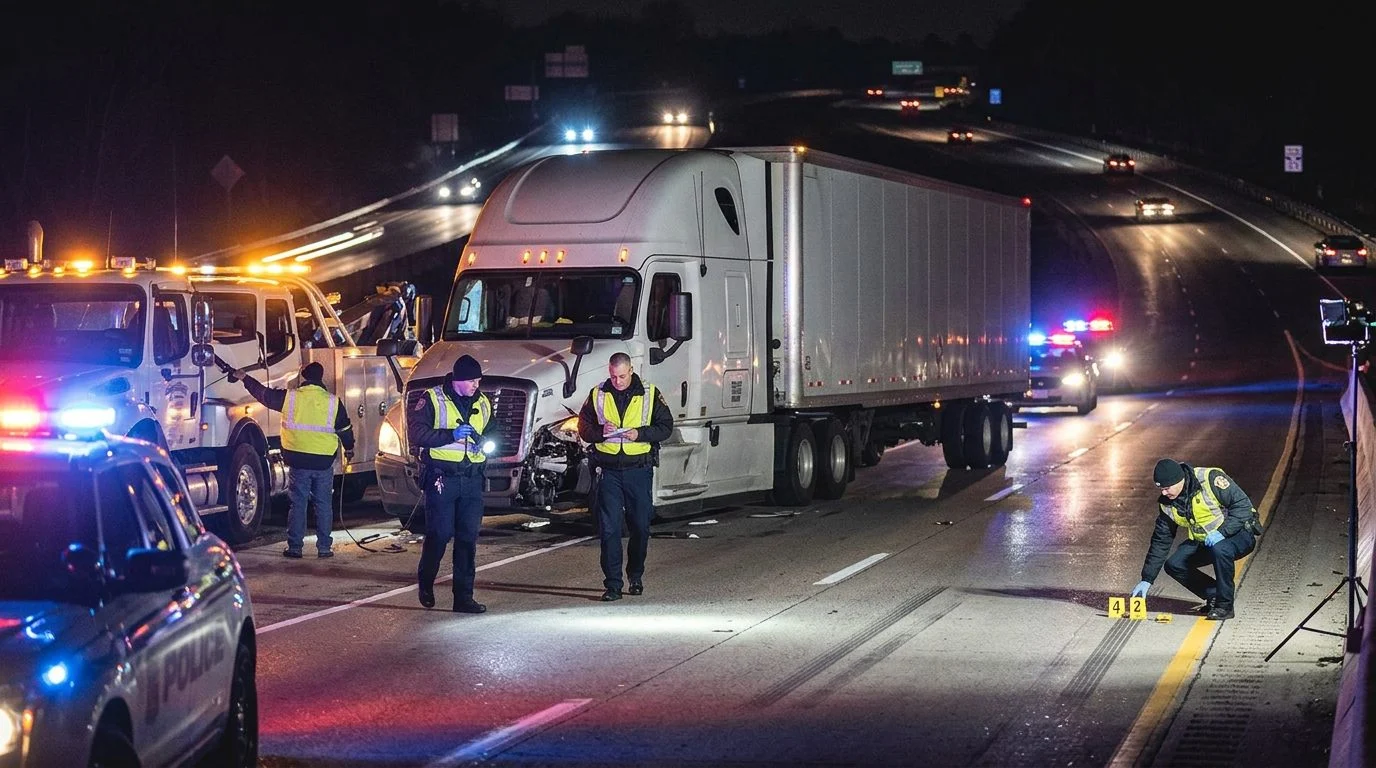
Accident reconstruction is the work trained professionals do to study what happened on the road. They review skid marks, where vehicles came to rest, damage, and electronic data. The goal is to see whether the driver’s reported actions match the physical evidence. If a driver says they braked early, the marks and damage should fit that account.
Statements matter too. A driver may speak at the scene, to police, or to the carrier. Lawyers compare those words with the logs and dispatch messages. An account that changes over time draws close attention. The timeline is built from many sources. No single record carries the whole picture.
Medical Records, Sleep Conditions, and Medications
Medical records can show sleep conditions and medications that may affect alertness. Those facts become part of the timeline. Obstructive sleep apnea is one example. Some medicines can cause drowsiness, so reviewers look at what the driver was taking before the crash.
After a serious crash, testing matters too. As soon as practicable after a crash involving a commercial motor vehicle operating on a public road in commerce, federal rules require the employer to test its surviving drivers for alcohol and controlled substances. If an alcohol test is not given within two hours, the employer must keep a record of why. It must stop trying after eight hours. For controlled substances, the cutoff is 32 hours.
The driver’s medical exam file is another source. Medical examiners must keep these files for at least three years (49 C.F.R. § 391.43).
Injured people’s medical records connect the injuries to the crash. Paralysis is a loss of muscle function that can result from spinal cord injuries (MedlinePlus on paralysis). Traumatic brain injuries can range from mild to catastrophic (Brain Trauma Foundation guidance).
Not sure what your next step is?
Talk it through with our team — the first consultation is free, confidential, and carries no obligation.
Carrier Practices: Dispatch Pressure, Supervision, and Prior Violations
A trucking company’s own practices can be part of the fatigue proof. Federal rules require the carrier to make sure drivers follow the hours and duties in those rules (49 C.F.R. § 390.11). To meet the safety fitness standard, carriers must demonstrate they have adequate safety management controls in place that function effectively to reduce the risk associated with the use of fatigued drivers (49 C.F.R. § 385.5).
Dispatch schedules can be central. If a delivery schedule could not be met without driving past allowed hours, that pressure may show up in dispatch messages and load assignments. Lawyers also review prior hours-of-service violations, roadside inspections, and safety ratings for the carrier and the driver.
The Georgia Supreme Court addressed employer liability in Quynn v. Hulsey.
For how these cases are handled in the metro area, see our Atlanta catastrophic injury page.
Why Early Preservation of Evidence Matters
Early requests matter because electronic records can be lost or overwritten over time. Carriers must generally keep records of duty status and supporting documents for at least six months from the date of receipt (49 C.F.R. § 395.8).
A preservation letter is a written request that the carrier keep specific records tied to the crash. Losing or destroying evidence is called spoliation.
Georgia’s general deadline for personal injury lawsuits is two years after the right of action accrues; claims for injuries to reputation have only one year, and claims for loss of consortium have four years (O.C.G.A. § 9-3-33). Earlier action helps keep records in hand. For how evidence is presented if a case moves forward, see our guide to catastrophic injury cases going to trial.
How Fatigue Evidence Fits a Catastrophic Injury Claim
Fatigue evidence matters most when it links the driver’s condition to the injuries and the crash. The timeline explains how the crash happened. Medical records show how the injuries occurred and how they affect daily life. Medical providers document these effects over time.
Catastrophic injuries include spinal cord injuries that can lead to paralysis, traumatic brain injuries, and amputations. For readers whose injuries involve the spinal cord, our page on incomplete spinal cord injury claims in Georgia covers that area in more detail.
Outcomes depend on the facts, the evidence available, and how Georgia law applies to the case. Fatigue proof is one part of that picture, not the whole of it.
Talk With Our Team About Your Truck Crash
If a truck crash left you or a family member seriously hurt, the logs and business records may need to be requested quickly. Our team at Slam Dunk Attorney can review the crash, the timeline, and the records that may exist. Your first consultation is free, confidential, and without obligation. Contact our team to talk through your truck crash.
Disclaimer: This page gives general information. It is not legal advice or a promise of any particular result. Peter F. Jaraysi is the responsible lawyer for this page. Slam Dunk Attorney is based in Duluth, Georgia, and represents people hurt in car, truck, and other accidents across metro Atlanta and Georgia.

Frequently Asked Questions
How do lawyers prove truck driver fatigue evidence Georgia cases require?
They build a timeline of the driver’s work, driving, and rest. Then they compare it with logs and independent business records.
How long must carriers keep driver logs?
Carriers must generally keep records of duty status and supporting documents for at least six months from the date of receipt, under 49 C.F.R. § 395.8.
How long do I have to file a personal injury lawsuit in Georgia?
Georgia’s general deadline is two years after the right of action accrues; claims for injuries to reputation have only one year, and loss-of-consortium claims have four years, under O.C.G.A. § 9-3-33.
What Fatigue Evidence Can Show
Hours on Duty
Records of when a driver started, stopped and was actively working can reveal long shifts and limited breaks.
Logs Compared With Other Records
Paper or electronic logs are compared with fuel receipts, tolls, dispatch messages and GPS data to test whether they match what happened on the road.
Safety and Compliance Files
Company training, safety policies and prior violations can show how the carrier monitored driver hours and rest.
A Clear Timeline
Putting these records in order helps show what the driver was doing in the hours and days before the crash.
Important: Records Can Disappear
Trucking companies and drivers may not keep every record forever, and electronic data can be overwritten. If you were hurt in a truck crash, speaking with a lawyer early helps protect important evidence.
Types of Records Often Reviewed
Driver Logs
Duty status records and supporting documents that show driving time, on-duty time and rest periods.
Electronic Data
Engine, GPS and onboard device data that can help confirm when a truck was moving and when it stopped.
Business Records
Dispatch notes, payroll, fuel purchases, toll receipts and delivery schedules that can be checked against the logs.
Witness and Scene Evidence
Photos, police reports and statements that help describe the driver's condition and the crash itself.