
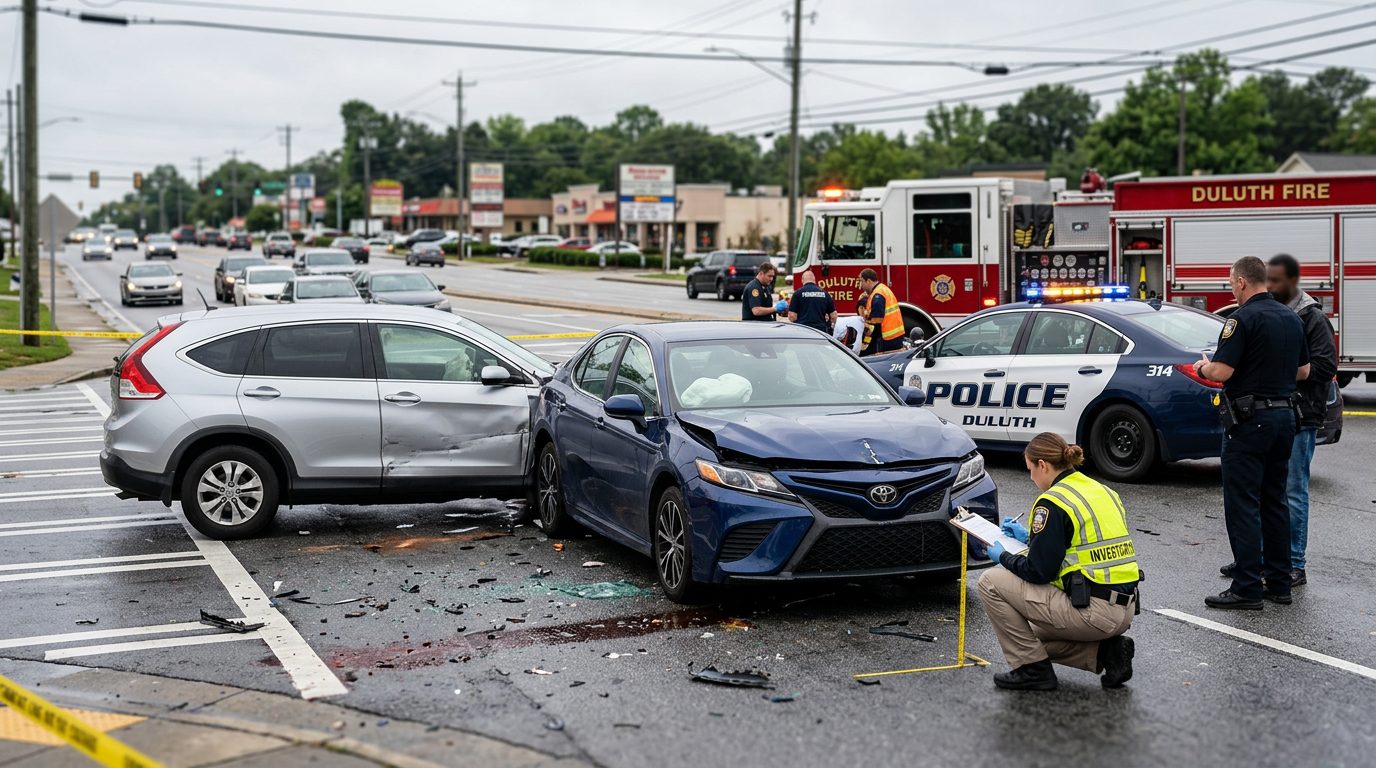
Car Accident Lawyer in Duluth, GA
MVC or MVA? Making Sense of the Words After a Crash
Police reports, insurance forms and news stories often use short labels for car crashes. Here is what those terms mean and why the details of your crash matter more than the label.
By Peter F. Jaraysi · Published October 24, 2026
MVC and MVA are two abbreviations for the same kind of event. MVC means motor vehicle crash. MVA means motor vehicle accident. In practice, the difference is mostly the wording.
What MVC and MVA stand for
MVC stands for motor vehicle crash, and MVA stands for motor vehicle accident. Both terms cover a collision involving at least one car, truck, motorcycle, or other motor vehicle. Readers often ask what is the difference between MVC and MVA when both appear in the same file. The answer is usually nothing about the event itself. Writers pick one term based on habit, training, or the form in front of them. A sentence that describes the impact and location tells you more than the abbreviation alone. Treat MVC or MVA as a label for the crash, not as a finding about anyone.
If the paperwork in front of you is hard to read, you don't have to sort it out alone. Our team can walk through it with you in a free, confidential consultation. Talk it through with our team — the first consultation is free, confidential, and carries no obligation.

Why some writers say crash and others say accident
Researchers and clinicians have debated this wording. A 2002 article by A.E. Stewart, indexed on PubMed, argues that “motor vehicle crash” should replace “motor vehicle accident” in clinical and research writing. The main concern is that “accident” can suggest no one caused the event. Some people prefer “crash” for that reason.
Most police, insurance, and medical forms use whichever term their template or agency adopted. So the abbreviation on a form is a convention. It is not a finding about fault or how serious the crash was.
Fault gets decided on the facts. Under O.C.G.A. § 51-12-33, a person’s damages are reduced by their own share of fault. A person who is 50 percent or more responsible recovers nothing.
Where you are likely to see MVC and MVA
You’ll most often find MVC or MVA on police crash reports, emergency room and EMS records, and insurance letters. Each source uses them a little differently.
- Police crash reports. The abbreviation can appear in a header, a case-number line, or the narrative.
- ER, urgent care, and EMS records. “MVC” is common shorthand for why a patient arrived. It is usually followed by a list of injuries or symptoms.
- Insurance letters. Either term may appear in the subject line or in adjuster notes.
Medical staff write quickly, so one chart may use MVC in one spot and a longer description in another. If you don’t recognize an abbreviation, ask the records office or the hospital what the entry means. Write down the exact sentence so you can point to it.
Are MVA and DMV the same thing?
No. DMV stands for Department of Motor Vehicles, a general name for a state agency that handles driver licenses and vehicle records. MVA is also the name of Maryland’s Motor Vehicle Administration, which is one reason people mix the two up. MVA can carry other meanings in other fields, so the surrounding text matters.
Context settles most questions. Georgia’s agencies have their own names, so a Georgia crash report is not an MVA-agency document unless its text says so. The Georgia Office of the Commissioner of Insurance and Safety Fire explains the rules, including minimum coverage limits.
What “serious” or “severe” means in a crash record
Neither MVC nor MVA carries a severity level. Words like “serious” or “severe” describe injuries or medical findings. Severity shows up in medical records, imaging reports, and treatment notes. These papers describe the diagnosis, the tests, and the care that followed. Injuries such as spinal cord injury, traumatic brain injury, severe burns, and amputation are documented this way. The chart shows the medical picture, not the abbreviation.
The medical file also matters under Georgia damages law. Under O.C.G.A. § 51-12-1.1, medical expenses are limited to the reasonable value of medically necessary care, treatment, or services. Under O.C.G.A. § 51-12-2, special damages must be proved to be recovered. General damages may be recovered without proof of any amount.

What to do if these terms appear in your paperwork
Start by gathering every document that uses MVC or MVA. Include the crash report, ER or EMS paperwork, and any insurance letters. Note the dates and report or claim numbers on each one.
Next, copy the sentences that use the abbreviations. Keep the originals, too. Clear copies make your questions easier to ask.
Timing matters. Georgia generally requires a personal-injury lawsuit to be filed within two years after the right of action accrues, under O.C.G.A. § 9-3-33, as quoted in a Georgia appellate opinion. The exact date depends on the facts of each case.
What is the difference between MVC and MVA?
Very little. Both describe a motor vehicle collision, and the wording is a matter of convention.
Does the abbreviation decide who is at fault?
No. Fault is decided on the facts of the crash, not on the abbreviation.
Is MVA the same as DMV?
No. DMV is a general term for a state motor vehicle agency, while MVA also names Maryland’s agency.
If the paperwork is still confusing, you don’t have to work through it alone. Peter F. Jaraysi and the firm’s lawyers at Slam Dunk Attorney, in Duluth, Georgia, offer a free, confidential first consultation with no obligation to continue. Bring your crash report, ER paperwork, and letters, and request a free consultation.
Attorney advertising. Responsible lawyer: Peter F. Jaraysi, Slam Dunk Attorney, Duluth, Georgia. Contact: Slam Dunk Attorney contact page. This page is general information, not legal advice.
Why the wording can feel confusing
Many labels, one event
Forms and reports use different shorthand for the same kind of crash, so a label alone rarely tells the whole story.
Details carry the weight
Where the crash happened, who was involved, what was said at the scene and what the records show are what a careful review looks at.
Plain-language answers
Our team explains each term and each document in everyday language, so you know what you are signing and what it means.
Measured, respectful guidance
We understand that a crash is stressful. We focus on clear information and steady support while you decide what comes next.
Terms you may see after a crash
MVC: Motor Vehicle Collision
A common shorthand for a crash involving one or more motor vehicles. Many reports and insurance forms use this term.
MVA: Motor Vehicle Accident
Often used interchangeably with MVC. Choosing one label over the other does not change what happened on the road.
Crash or accident report
The official record of a crash, usually prepared by the responding agency. Review it carefully and ask questions about anything that looks inaccurate.
Insurance claim
A request to an insurer for review of a loss. Insurance paperwork may use its own abbreviations, so confirm what each one refers to.
Do not let a label decide your story
Reports, claim forms and conversations may use MVC, MVA or other shorthand. Check that the facts in any document you sign match what happened, and ask for a copy of anything you sign.