
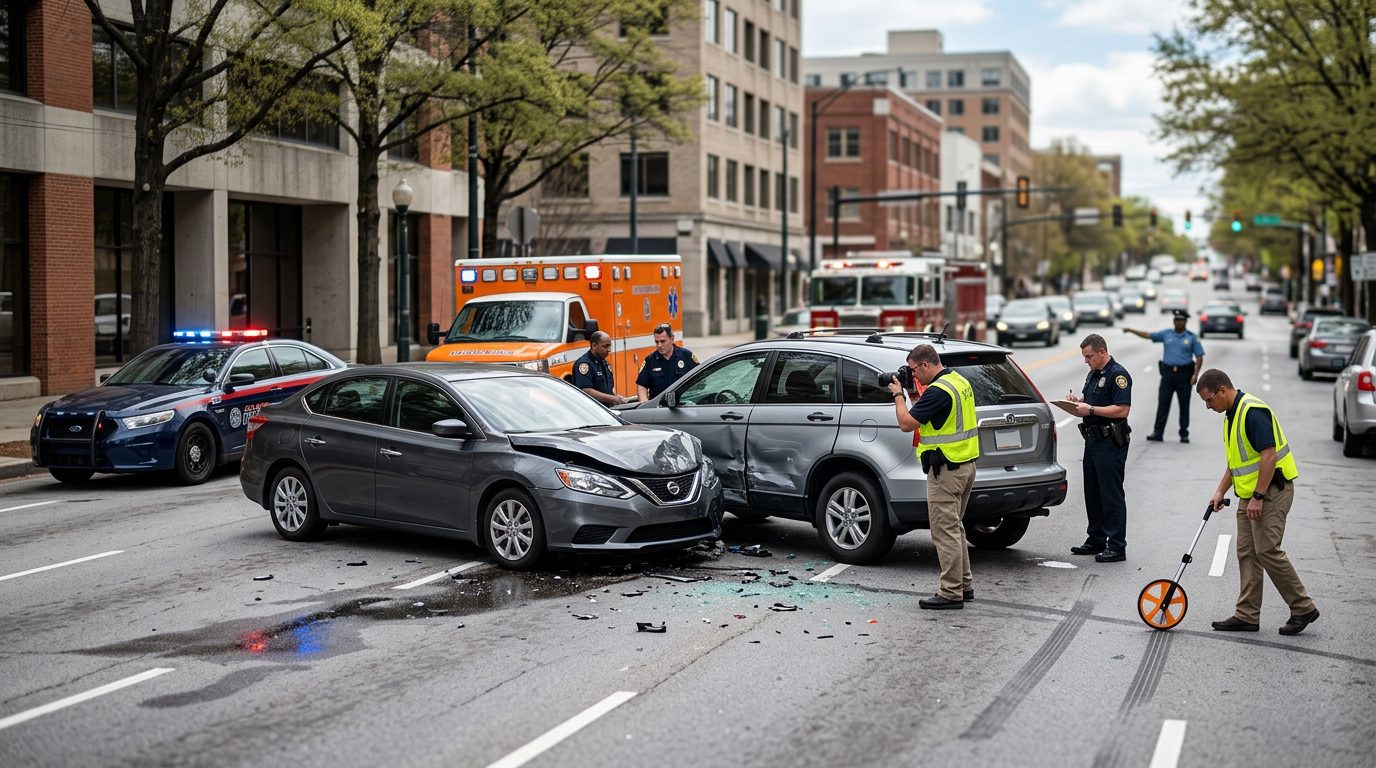
Car Accidents Atlanta
Hurt in a Car Accident? Know Your Rights & Next Steps
Clear guidance on what to do after a crash, how Georgia law protects you, and how we can help you recover.
By Peter F. Jaraysi · Published September 15, 2026
Car Accidents in Atlanta: What to Do After a Crash & How We Help
Every day, thousands of vehicles travel Atlanta’s major corridors—I-75, I-85, and I-285. With that volume comes risk. Car accidents happen constantly across metro Atlanta, and when they do, the decisions you make in the first hours matter enormously for your health, your claim, and your future.
This guide walks you through what to do after an accident, your rights under Georgia law, and how Slam Dunk Attorney helps accident victims in Atlanta navigate insurance claims and pursue the compensation they deserve.
Not sure what your next step is?
Talk it through with our team — the first consultation is free, confidential, and carries no obligation.

Car Accidents Happen Every Day in Atlanta—Here’s What You Need to Know
Atlanta’s highways are among the busiest in the Southeast, and rear-end collisions, multi-vehicle pile-ups, and intersection crashes are routine occurrences during rush hour and on major corridors. Whether you’re on I-285 during morning commute, merging on I-75 northbound, or navigating a busy intersection in Alpharetta or Johns Creek, the risk of a serious accident is real.
Immediate steps after your accident:
-
Move to safety. If you can, move your vehicle out of traffic. Turn on hazard lights. If you’re unable to move or feel unsafe, stay in your vehicle with doors locked.
-
Call 911. Report the accident to police. Even minor-seeming crashes should be documented by law enforcement.
-
Seek medical attention. Some injuries—neck strain, concussions, internal injuries—don’t show symptoms immediately. Get checked by a doctor or emergency room, even if you feel fine.
-
Document the scene. Take photos of vehicle damage, road conditions, traffic signals, and visible injuries. Get the names, phone numbers, and insurance information of other drivers and witnesses.
-
Report to your insurance company. Georgia law requires you to report accidents to your insurer within a reasonable timeframe.
The first hours set the foundation for your entire claim. Medical records, police reports, and photos become critical evidence later.
Your Rights After a Car Accident in Atlanta
Georgia operates under an at-fault insurance system, which means the driver responsible for causing the accident is liable for damages. The at-fault driver’s insurance company must compensate you for your losses.
What you can recover:
- Medical bills and ongoing treatment costs
- Lost wages and lost earning capacity
- Pain and suffering
- Property damage (vehicle repair or replacement)
- In severe cases, permanent disability or disfigurement
The statute of limitations matters. You have two years from the date of the accident to file a lawsuit in Georgia. If you don’t file within two years, you lose your right to pursue compensation through the courts. This is why acting promptly—even if you’re still healing—is important.
Georgia’s comparative fault rule allows you to recover damages even if you share some responsibility for the accident, as long as you’re less than 50% at fault (O.C.G.A. § 51-12-33; Quynn v. Hulsey, 310 Ga. 473 (2020)). Your recovery is reduced by your percentage of fault (O.C.G.A. § 51-12-33; Quynn v. Hulsey, 310 Ga. 473 (2020)). For example, if you’re awarded $100,000 but found 20% at fault, you receive $80,000.
Uninsured and underinsured motorist (UM/UIM) coverage protects you if the at-fault driver has no insurance or insufficient coverage. This coverage pays your medical bills and lost wages when the other driver can’t. If you have UM/UIM coverage, it becomes a critical resource in hit-and-run accidents or when the liable driver is uninsured.
Why Insurance Companies Don’t Always Have Your Interests in Mind
Insurance companies are businesses. Their goal is to minimize payouts, not to maximize your recovery. Understanding their tactics helps you protect yourself.
Common insurance company strategies:
-
Low initial offers. Early settlement offers are often 30–50% below what your claim is actually worth. They’re counting on you to accept quickly while you’re stressed and in pain.
-
Recorded statements. Adjusters ask you to give a recorded statement “for the file.” What you say can be used against you. Anything you say can be twisted or taken out of context.
-
Liability disputes. Even when fault is clear, insurers may dispute liability to delay payment or pressure you into a lower settlement.
-
Pressure to settle fast. “We have a limited-time offer” or “this is our best and final” are common lines. They’re designed to rush you into a decision.
Having an attorney levels the playing field. Insurance companies take claims more seriously when a lawyer is involved. They know you’re not going to accept a lowball offer, and they adjust their strategy accordingly.
What Happens in an Atlanta Car Accident Claim
Investigation. We gather police reports, medical records, witness statements, and photographs. We may hire accident reconstructionists or engineers to establish how the crash occurred and who was at fault.
Liability determination. We analyze the evidence to establish fault. In Atlanta’s heavy traffic, liability isn’t always obvious—we dig into traffic patterns, signal timing, weather, and driver behavior to build a clear picture.
Damage assessment. We calculate your total losses: current and future medical care, lost income, pain and suffering, and any permanent effects. We work with your doctors to understand the full scope of your injuries.
Negotiation. We send a demand letter to the at-fault driver’s insurance company outlining liability, damages, and the compensation we’re seeking. Most cases settle during negotiation. We push for fair value while keeping you informed every step.
Litigation. If the insurance company refuses a fair settlement, we file a lawsuit and prepare your case for trial. We handle all court filings, depositions, and courtroom work.
Throughout the process, you focus on recovery. We handle the legal work and all communication with insurance companies.
Types of Car Accidents We Handle in Atlanta
Rear-end collisions are among the most common accident types on Atlanta highways. Research from the Insurance Institute for Highway Safety (IIHS) shows that rear-end crashes frequently result in neck and spine injuries, even at moderate speeds. These injuries can develop over weeks or months.
Multi-vehicle pile-ups on I-285, I-75, and I-85 create complex liability and insurance issues. When three or more vehicles are involved, determining who hit whom and who bears responsibility requires careful investigation.
Intersection crashes at busy Atlanta intersections often involve red-light violations, failure to yield, or misjudged turning. Traffic camera footage and witness statements are critical.
Hit-and-run accidents leave you without the at-fault driver’s insurance information. Your uninsured motorist coverage becomes essential. We help you navigate the claims process and identify the fleeing driver if possible.
Commercial and delivery vehicle accidents involve larger vehicles, commercial insurance policies, and sometimes employer liability. These cases require in-depth knowledge.
Rideshare accidents (Uber, Lyft) involve multiple insurance policies—the driver’s personal policy, the rideshare company’s coverage, and sometimes additional layers. We untangle who pays what.
Not sure what your next step is?
Talk it through with our team — the first consultation is free, confidential, and carries no obligation.
Medical Care and Documentation After Your Atlanta Car Accident
See a doctor immediately. Even minor accidents can cause injuries that don’t show symptoms right away. Whiplash, concussions, and internal injuries can develop over hours or days. A medical record created on the day of your accident is powerful evidence that your injuries are real and caused by the crash.
Keep detailed records. Document every medical appointment, prescription, therapy session, and expense. Note dates, providers, treatments, and how the injury affects your daily life. These records directly support your claim for damages.
Delayed injuries matter. If symptoms appear weeks after the accident, see a doctor and inform them of the accident. Medical providers can often link delayed symptoms to the trauma of the crash. This documentation protects your claim.
Don’t skip follow-up care. Insurance companies scrutinize gaps in treatment. If you stop seeing a doctor for weeks, then resume, adjusters may argue your injuries weren’t serious. Consistent medical care strengthens your case.
How Slam Dunk Attorney Helps Atlanta Car Accident Victims
We handle every aspect of your car accident claim so you can focus on healing.
Free case review. We listen to your story, explain your rights, and outline your options—with no obligation and no pressure.
Insurance company communication. We handle all contact with adjusters. You don’t have to negotiate, explain yourself repeatedly, or worry about saying the wrong thing.
Investigation and evidence gathering. We obtain police reports, medical records, witness statements, and accident scene photos. We work with medical providers and specialists as needed.
Medical provider coordination. We manage liens with your healthcare providers and work to resolve medical bills fairly so more of your settlement goes to you.
Strategic negotiation. We develop a settlement strategy tailored to your injuries, losses, and circumstances. We push for fair value and know when to walk away from inadequate offers.
Litigation support. If settlement talks stall, we file a lawsuit and prepare your case for trial. We handle depositions, discovery, and courtroom representation.
Clear communication. You receive regular updates on your case’s progress. We explain the process, answer your questions, and set realistic expectations.
What to Expect When You Contact Us
Your first consultation is free. We review your accident, injuries, and claim with no obligation. You’ll understand your rights and next steps.
No fees unless we recover for you. You may still be responsible for court costs and case expenses. We work on a contingency basis—you pay attorney fees only if we secure a settlement or verdict in your favor. You may still owe certain case costs (like court filing fees or expert witness fees); we’ll discuss this clearly upfront.
Transparent communication. We explain timelines, processes, and realistic outcomes. No surprises, no pressure.
Regular updates. As your case progresses, we keep you informed. You’re never left wondering what’s happening.

Frequently Asked Questions
How long do I have to file a car accident claim in Georgia?
You have two years from the accident date to file a lawsuit; however, don’t wait—evidence fades and memories fade quickly, so contact us as soon as possible after your accident (O.C.G.A. § 9-3-33; Cameron v. JMP Pizza, Inc. (2026)).
What if I was partially at fault for the accident?
Georgia’s comparative fault rule allows you to recover even if you’re partially responsible, as long as you’re less than 50% at fault; your recovery is reduced by your percentage of fault (O.C.G.A. § 51-12-33; Quynn v. Hulsey, 310 Ga. 473 (2020)).
What should I do if the other driver doesn’t have insurance?
Your uninsured motorist (UM) coverage protects you; we help you file a claim against your own policy and pursue all available compensation.
Do I need an attorney for a car accident claim?
While you can handle a claim alone, insurance companies take claims more seriously when represented by an attorney, and you’re more likely to recover fair compensation with legal guidance.
How long does a car accident claim take?
Most claims settle within 3–6 months; complex cases or those requiring litigation may take longer—we’ll give you a realistic timeline based on your specific situation.
If you’ve been injured in a car accident in Atlanta, you have the right to pursue compensation for your medical bills, lost wages, and pain and suffering. Many people in your situation—dealing with injuries, insurance companies, and uncertainty about what comes next—reach out to Slam Dunk Attorney for a free consultation. Request a free case review today, or call us to discuss your accident and your options.
What to Do Right After a Car Accident
Check for Injuries & Call 911
Your safety and the safety of others comes first. Move to a safe location if possible, and call emergency services if anyone is hurt or the scene is unsafe.
Document the Scene
Take photos of vehicle damage, road conditions, traffic signs, and the other driver's vehicle and license plate. Note the date, time, weather, and road conditions.
Exchange Information
Get the other driver's name, phone number, address, insurance company, policy number, and vehicle details. Ask for a police report number if officers respond.
Report to Your Insurance
Notify your insurance company promptly. Stick to the facts and avoid admitting fault or making statements beyond what you observed.
Don't Delay—Evidence Matters
Memories fade and physical evidence can disappear. The sooner you reach out, the sooner we can help preserve crucial details and protect your rights.
How Slam Dunk Attorney Helps You
We Handle the Legal Work
You focus on recovery while we manage claims, negotiate with insurers, and explore all available options for fair compensation.
Clear Explanation of Your Rights
We explain Georgia law in plain language so you understand your options and what to expect at each stage.
Direct Access & Responsive Support
You get straightforward communication from our team—no runaround, just honest guidance when you need it.
We Listen to Your Story
We take time to understand what happened to you and how the accident has affected your life and recovery.
Common Questions About Car Accident Claims
How Long Do I Have to File a Claim?
Georgia law sets a two-year deadline from the accident date to file a lawsuit (O.C.G.A. § 9-3-33; Cameron v. JMP Pizza, Inc. (2026)). However, don't wait—evidence and witness memories fade quickly. Contact us as soon as possible after your accident.
What If I Was Partially at Fault?
Georgia's comparative fault rule means you may still recover compensation even if you share some responsibility for the accident (O.C.G.A. § 51-12-33; Quynn v. Hulsey, 310 Ga. 473 (2020)). The amount may be reduced based on your percentage of fault (O.C.G.A. § 51-12-33; Quynn v. Hulsey, 310 Ga. 473 (2020)).
What Costs Might I Owe?
If we represent you, we work on a contingency basis—no fees unless there is a recovery. You may still owe certain case costs (such as medical records, expert fees, or filing fees) depending on your agreement with us.
What Damages Can I Recover?
You may be entitled to compensation for medical bills, lost wages, vehicle repair or replacement, pain and suffering, and other losses. We evaluate your specific situation to identify all available claims.