
Car Accidents | Duluth, Georgia
Car Accident Negligence in Georgia: A Plain Guide
Learn what negligence means after a crash, what evidence matters, and how our team at Slam Dunk Attorney can help you understand your options.
By Peter F. Jaraysi · Published October 22, 2026
What is considered auto negligence? A driver is negligent when they fail to use the care a reasonably careful driver would use in the same situation. The focus is on what the driver did or failed to do, not on whether the crash was intended.
If you were hurt in a crash, or you are helping someone who was, this question can feel urgent and confusing. This guide explains the basics in plain words. It covers what a claim must show, common examples, how traffic tickets fit in, and how Georgia’s fault rule works. For the bigger picture, read our car accident guide.
What auto negligence means in plain terms
Under O.C.G.A. § 51-1-2, ordinary diligence is that degree of care which is exercised by ordinarily prudent persons under the same or similar circumstances. Georgia law describes this as ordinary diligence. O.C.G.A. § 51-1-2 also states that the absence of such diligence is termed ordinary negligence.
Negligence is about carelessness. A driver doesn’t have to mean to cause harm. Some crashes happen even when no one was careless, such as a sudden hazard that no driver could have avoided.
If you were hurt and aren't sure whether the other driver's actions count, our team can talk through your crash with you in a free, confidential consultation. Talk it through with our team — the first consultation is free, confidential, and carries no obligation.

The four elements a negligence claim must show
Each one has to connect to the next.
Duty. Every driver owes other people on the road a duty to drive with ordinary care. Georgia law lets an injured person recover for breach of a legal duty if they suffer damage from it (O.C.G.A. § 51-1-6).
Breach. The driver fails that duty through action or inattention, such as speeding or looking away from the road.
Causation. The breach must lead to the crash and the injuries. Insurers often dispute this link, especially when an injury may have existed before the crash.
Damages. The injured person must have real losses, such as medical bills, lost wages, and pain. Georgia separates general damages, which the law presumes from a wrongful act, from special damages, which must be proved (O.C.G.A. § 51-12-2).
Here is a short example. A driver glances at a text and rear-ends the car stopped ahead at a red light on a busy Gwinnett County road. The glance is the breach. The impact is the crash it caused. The neck injury and missed work are the damages.
Common examples of negligent driving
Common examples of negligent driving include distraction, speeding, following too closely, failing to yield, and driving while impaired. Each one is a failure to use ordinary care on the road.
- Distracted driving. Phone use, eating, or other inattention pulls eyes and attention away from traffic.
- Speeding or driving too fast for conditions. Rain, fog, construction, or heavy traffic can make a normal speed unsafe.
- Following too closely. Tailgating leaves little room to stop and often causes rear-end collisions.
- Failing to yield. Running a red light or stop sign, or cutting into another lane, can cause a side or head-on impact.
- Impaired driving. Alcohol, drugs, or fatigue can slow reactions and judgment.
These examples are not proof of fault on their own. Each one has to be tied to what happened in your crash.
How traffic-law violations are used as evidence
A police citation is one piece of evidence, not the whole case. It can help show what happened, but it doesn’t decide a claim by itself. The crash report, witness accounts, vehicle damage, and road conditions all matter too.
A driver who got a ticket may still raise other facts. For example, they may argue the other driver was also at fault, or that the road was wet. The full set of facts gets reviewed.
Georgia’s 2025 change on seat belts shows how a single fact can affect evidence. Under O.C.G.A. § 40-8-76.1, the failure of an occupant of a motor vehicle to wear a seat safety belt may be considered in any civil action as evidence admissible on the issues of negligence, comparative negligence, causation, assumption of risk, or apportionment of fault or for any other purpose, and it may be evidence used to diminish any recovery for damages arising out of the ownership, maintenance, occupancy, or operation of a motor vehicle. A court may still exclude it.
Georgia’s comparative fault rule and why it matters
Georgia uses modified comparative fault (O.C.G.A. § 51-12-33; Quynn v. Hulsey, 310 Ga. 473 (2020)). Your own share of fault lowers what you can recover. If you are 50 percent or more responsible, you can’t recover any damages (O.C.G.A. § 51-12-33; Quynn v. Hulsey, 310 Ga. 473 (2020)).
Under O.C.G.A. § 51-12-33, the jury or judge decides your percentage of fault, and you cannot receive any damages if you are 50 percent or more responsible for the injury or damages claimed. The award is reduced by that percentage. Damages are then assigned to each liable person by that person’s share, and they are not joint. One person doesn’t pay another’s share.
Georgia also has an avoidance rule. Under O.C.G.A. § 51-11-7, a plaintiff who by ordinary care could have avoided the consequences to himself caused by the defendant’s negligence is not entitled to recover for them.
That is why clear records of the crash matter from the start.
Records and facts that help show negligence
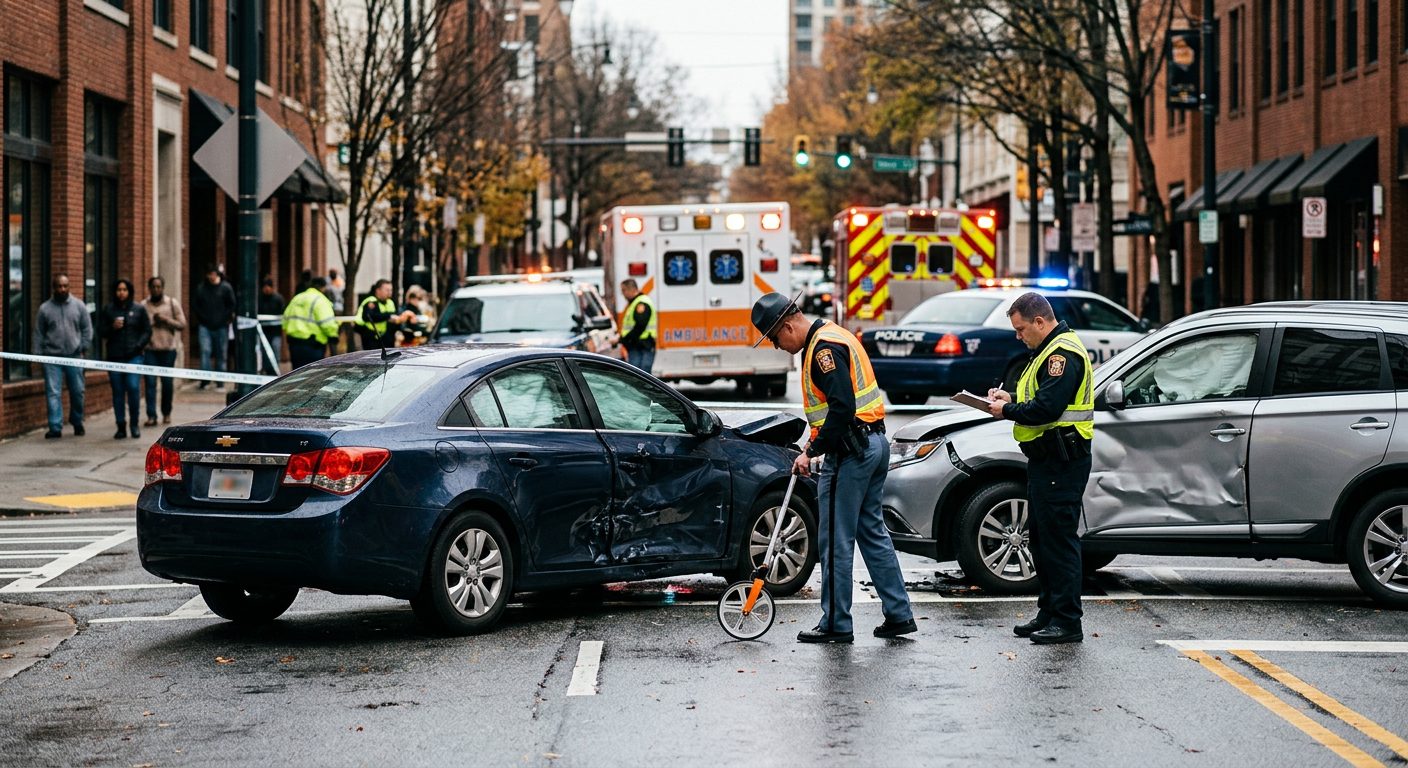
The most useful records are the crash report, photos, witness details, and medical records. Gather them early, because memories fade and vehicles get repaired.
- Crash report. The officer’s notes, diagram, and any citations.
- Photos and video. Vehicle damage, the scene, road conditions, and traffic signals.
- Witness details. Names, phone numbers, and what each person saw. Dashcam or nearby business video may exist, so ask about it early.
- Medical records. Records that link your injuries to the crash, starting with the first treatment.
Georgia’s insurance regulator advises notifying police and your insurer promptly, collecting identifying information, and avoiding statements that admit responsibility (Georgia OCI auto claim tips). Georgia generally requires an action for injuries to the person to be brought within two years after the right of action accrues; injuries to reputation have a one-year limit, and loss of consortium claims have four years (O.C.G.A. § 9-3-33). Check that date early.
Is every car crash automatically negligence?
Can I still recover if I was partly at fault?
Possibly. Georgia reduces damages by your share of fault. If you are 50 percent or more responsible, you can’t recover (O.C.G.A. § 51-12-33; Quynn v. Hulsey, 310 Ga. 473 (2020)).
How long do I have to file an injury claim in Georgia?
Georgia generally allows two years after the claim arises for most injury claims. Loss of consortium claims have a four-year period.
Does a seat belt affect a Georgia injury claim?
It can. Under a 2025 Georgia law, failing to wear a seat belt may be used as evidence in a civil case, though a court may still exclude it.
Not sure what your next step is?
Talk it through with our team — the first consultation is free, confidential, and carries no obligation.

Talk with our team about what happened to you
If you’re sorting through a crash you didn’t choose, you don’t have to work out the legal questions alone. You may be recovering, handling medical bills, or helping a family member through it. Insurance calls can start before you feel ready.
Slam Dunk Attorney is based in Duluth, Georgia. The firm represents people hurt in car, truck, motorcycle, pedestrian, and rideshare crashes across metro Atlanta and Georgia. The first consultation is free and confidential, with no obligation to continue. Peter F. Jaraysi is the responsible lawyer for this page.
If you were hurt and aren’t sure whether the other driver’s actions count, our team can talk through your crash with you in a free, confidential consultation at the firm’s contact page.
This page is general information, not legal advice. Responsible lawyer: Peter F. Jaraysi, Slam Dunk Attorney, Duluth, Georgia. Contact: slamdunkattorney.com/contact-us.
How We Work With Car Accident Clients
Plain-language answers
We explain the legal process in everyday terms so you know what to expect at each step.
Confidential first consultation
Your first consultation is free, confidential, and comes with no obligation to continue.
Support for you and your family
Jaraysi and Brian D.
Serving Georgia communities
We represent people hurt in crashes across metro Atlanta and throughout Georgia, including Duluth, Lawrenceville, Alpharetta, Marietta and Dunwoody.
Be Careful With Insurance Calls
An insurance adjuster works for the insurance company, not for you.
Evidence That Helps Explain What Happened
Photos and video
Pictures of vehicle damage, the roadway, traffic signals, skid marks and your injuries can capture details that fade quickly.
Police and crash reports
The official report records the parties, witnesses and officer observations at the scene. Request a copy as soon as it is available.
Medical records
Keep every visit note, test result, prescription and bill. Your treatment history shows how the crash affected your health.
Witness and contact details
Names and phone numbers of drivers, passengers and bystanders can be valuable if memories or accounts differ later.