
Gwinnett County Fatal Car Accidents | Wrongful Death
Lost a Loved One in a Gwinnett County Crash? You Don't Have to Sort Out the Next Steps Alone
Plain-language guidance for families after a fatal car accident, from a personal injury firm based in Duluth, Georgia. Your first consultation is free, confidential, and comes with no obligation to continue.
By Peter F. Jaraysi · Published October 21, 2026
What to Know After a Fatal Car Accident in Gwinnett County
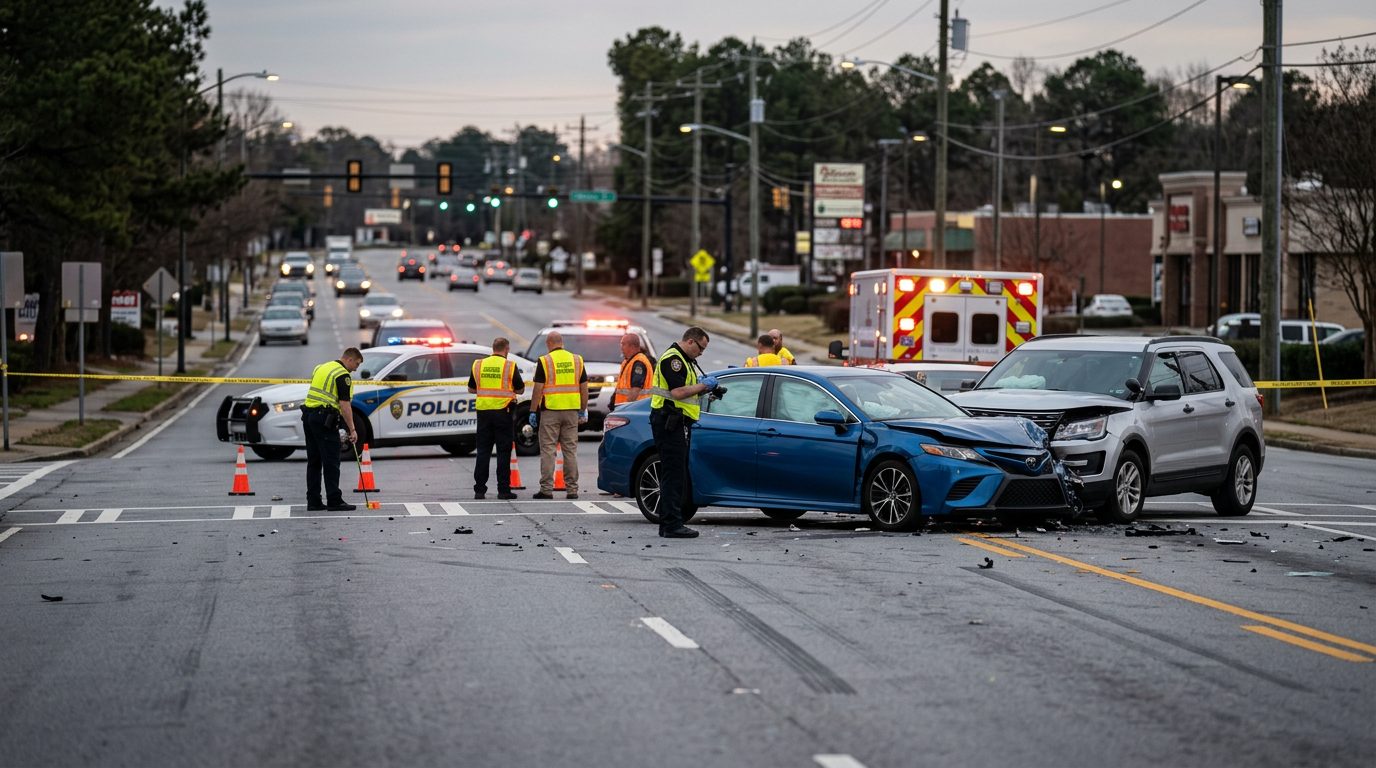
A fatal car accident in Gwinnett County today can bring police questions, hospital calls, funeral planning, and insurance calls all at once. Georgia law allows certain family members to bring a wrongful death claim when someone else’s negligence causes a death. This guide explains the first steps in plain words. It is written for spouses, adult children, parents, friends, and anyone who was hurt or driving in the crash.
Georgia sees many of these losses. The Insurance Institute for Highway Safety reports that Georgia had 1,403 motor-vehicle crash deaths in 2024, or 12.5 deaths per 100,000 people (IIHS state-by-state fatality statistics).
Slam Dunk Attorney is a personal injury firm based in Duluth, Georgia. It represents people hurt in car, truck, motorcycle, pedestrian, and rideshare crashes, and in wrongful death matters across metro Atlanta and Georgia.
If your family lost someone in a crash in Gwinnett County, you don't have to sort out the next steps alone, and our team can talk through your options at no cost. Talk it through with our team — the first consultation is free, confidential, and carries no obligation.

Immediate Steps Families Can Take After the Crash
The first steps are simple: learn which agency investigated, get the report number, and track every contact and cost. Writing things down now saves confusion later.
- Confirm the investigating agency. That may be county police, the sheriff, or the Georgia State Patrol. Ask for the incident or report number.
- Keep a contact log. List hospital staff, medical examiner contacts, funeral home details, and any case numbers.
- Save evidence. Keep texts, photos, dashcam or phone video, and the names of any witnesses.
- Keep receipts. Save bills for medical care, funeral costs, transportation, and other out-of-pocket expenses.
- Track insurance contacts. The other driver’s insurer may call early. Write down the adjuster’s name, company, and what was discussed.
Early calls are hard to take back. Families often feel pressure to answer quickly while they are still in shock. You can speak with a lawyer before giving any recorded statement about the claim.
Are Car Accident Reports Public Record in Georgia?
Crash reports are generally available from the agency that investigated the crash. Some details may be restricted while a case is still open.
A typical report lists the date, time, and location, the drivers and vehicles involved, any citations, and the officer’s observations. Ask the investigating agency how to request a copy. Keep in mind that officers often gather more facts after the scene. The report is a starting point, not the final word on who was at fault. Photos, witness statements, and insurance records can matter just as much.
Who Can Bring a Wrongful Death Claim in Georgia?
A surviving spouse may bring a wrongful death claim. If there is no surviving spouse, the children may bring it. O.C.G.A. § 51-4-2 says the spouse or children may recover the full value of the decedent’s life, as shown by the evidence. If the surviving spouse recovers, that spouse must receive no less than one-third of the recovery.
If no one has that right to sue, the administrator or executor may bring the action for the next of kin (O.C.G.A. § 51-4-5). When a death results from a crime or from criminal or other negligence, the personal representative can also recover funeral, medical, and other necessary expenses.
Georgia’s general deadline for injury claims is two years after the right of action accrues (O.C.G.A. § 9-3-33). Under O.C.G.A. § 9-3-33, except as otherwise provided in that article of the Georgia Code, actions for injuries to the person generally must be brought within two years after the right of action accrues. Other provisions, including possible tolling while a related criminal case is pending, may affect that deadline, so families should talk with our lawyers about their specific timing.
Who May Be Responsible in a Fatal Crash
Responsibility depends on how the crash happened, and more than one party can be involved.
- Other drivers. Every driver must exercise due care to avoid colliding with a pedestrian on the roadway (O.C.G.A. § 40-6-93).
- Commercial trucks. Drivers and the companies that employ or contract with them may share responsibility. The Georgia Governor’s Office of Highway Safety publishes Georgia large-truck crash data on who is affected by these crashes.
- A personal auto policy may exclude coverage while a driver is logged on. Georgia also limits when a rideshare network service is liable for a driver’s operation (O.C.G.A. § 40-1-201).
- Uninsured drivers. Georgia auto policies must include coverage for injuries caused by an uninsured motorist (O.C.G.A. § 33-7-11).
- Government vehicles. A claim against the state requires written notice within 12 months of when the loss was discovered or should have been (O.C.G.A. § 50-21-26). Flag this early.
Fault can also be shared. Under O.C.G.A. § 51-12-33, damages are reduced by the injured person’s share of fault. A person who is 50 percent or more responsible recovers nothing.
What the Claim Process Generally Looks Like
A typical claim moves from a consultation to investigation, then to insurers, and to a lawsuit only if needed.
- Free, confidential consultation. The first consultation is free, confidential, and without obligation to continue. We review the facts, the crash report, and your questions.
- Investigation. We gather records, review insurance coverage, and look at every party who may be liable.
- Presenting the claim. The claim goes to insurers, followed by negotiation where that makes sense.
- Filing suit if needed. If a fair resolution is not reached, a lawsuit must be filed before the deadline runs out.
How long each step takes depends on the number of parties, the insurance involved, and the records. No particular result is promised.
Not sure what your next step is?
Talk it through with our team — the first consultation is free, confidential, and carries no obligation.
Why Families Work With Slam Dunk Attorney
Slam Dunk Attorney is a personal injury firm in Duluth, Georgia. It handles fatal and serious crash matters across metro Atlanta and Georgia.
- Crash types covered. The firm handles car, truck, motorcycle, pedestrian, and rideshare crashes, plus wrongful death matters.
- Responsible lawyer. Peter F. Jaraysi is the responsible lawyer for this page. The firm’s lawyers, including Brian D. Wright, are supported by assistants and office staff.
- Plain language. We explain each step in everyday words and answer questions about what comes next.
- Clear organization. Each case is organized around the type of crash, so families can see how the rules apply to their loss.
Frequently Asked Questions About Fatal Crashes in Gwinnett County
Are all car accidents public record?
Crash reports are generally available from the investigating agency. Some details may be restricted while a case is open.
How long does a family have to act?
Georgia’s general deadline for injury claims is two years, under O.C.G.A. § 9-3-33 (Cameron v. JMP Pizza, Inc. (2026)). Your timing depends on your specific facts, so talk with a lawyer early.
Can a family still claim if the at-fault driver was uninsured?
Possibly. Georgia requires auto policies to include uninsured motorist coverage, so the family’s own policy may apply.
Does Georgia reduce compensation if the victim shared fault?
Yes. Damages are reduced by the injured person’s percentage of fault, and recovery is barred at 50 percent or more (O.C.G.A. § 51-12-33; Quynn v. Hulsey, 310 Ga. 473 (2020)).
Should we talk to the other driver’s insurance company?
Speak with a lawyer first. Early statements can be hard to correct later.
Can we sue a rideshare driver’s company after a fatal crash?
Possibly. Georgia limits when a rideshare network service is liable, so the trip, the app status, and the company’s conduct all matter.

Talk With Our Team About Your Family’s Situation
If you are reading this while planning a funeral or waiting on a police report, you are carrying a lot. Our team can review the crash report, the timing rules, and the questions in front of your family. Slam Dunk Attorney is based in Duluth, Georgia. Peter F. Jaraysi is the responsible lawyer for this page. To request a free consultation, use our contact page, or call to ask for a free case review.
What Families Often Need to Handle First
Protect the Evidence
Crash reports, photos, witness names, and vehicle records can be hard to recover later. Keep what you have and tell your lawyer early.
Gather Important Records
Medical reports, funeral invoices, and insurance letters all matter. Keep copies in one place so nothing gets lost during a hard time.
Track Every Notice
Insurance companies, police offices, and medical providers may each send updates. Note what arrives and when it arrives.
Support the Family
Grief, funeral planning, and daily responsibilities can be overwhelming. Lean on people you trust and let a lawyer handle the legal questions.
Be Careful With Insurance Calls
Insurance adjusters may contact the family soon after a crash. Before giving a recorded statement or signing any document, consider speaking with a lawyer first.
Common Questions Families Ask
How Do I Get the Crash Report?
The investigating agency usually prepares a crash report. Some details may be restricted while an investigation is still open, so ask your lawyer what is currently available.
What Is a Wrongful Death Claim?
In general terms, a wrongful death claim is brought after a death caused by someone else's wrongful conduct. Your lawyer can explain how it applies to your family's situation.
What About Bills Before a Case Ends?
Families often face funeral, medical, and daily expenses before any matter is resolved. Save every receipt and invoice and share them with your lawyer.
Should We Talk to Investigators?
Speak accurately and calmly. If you are unsure what to say or how a question might affect your family, ask a lawyer before answering in detail.