
Truck Accidents
Multi-Vehicle Truck Accident Claims in Georgia
When multiple vehicles collide, liability and recovery become complex. Slam Dunk Attorney helps you navigate the process and pursue fair compensation.
By Peter F. Jaraysi · Published October 04, 2026
A multi-vehicle truck accident happens when a truck collides with two or more other vehicles, or when a chain-reaction crash involves a truck as one of several parties. These collisions are far more complex than two-vehicle accidents because multiple insurance policies, competing liability claims, and injured parties all intersect at once.
If you or someone you care for is caught in this situation, understanding how liability works, what evidence matters, and when to seek legal guidance can make a real difference in protecting your rights.
What Is a Multi-Vehicle Truck Accident?
A multi-vehicle truck accident is a collision involving a truck and at least two other vehicles, or a chain-reaction crash where a truck plays a role in the sequence of impacts.
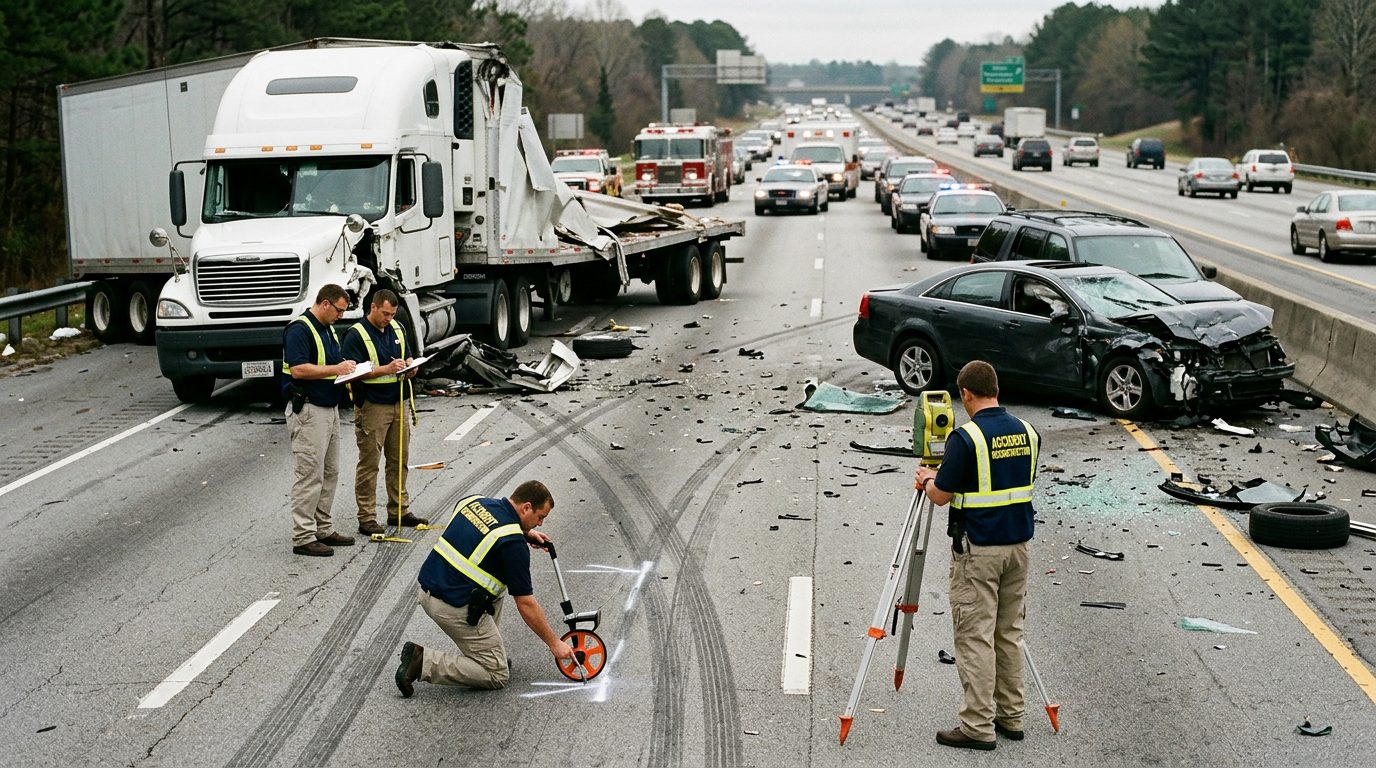
Common scenarios include highway pileups during rush hour, interstate chain reactions triggered by sudden braking or weather, and intersection or parking lot collisions where a truck strikes multiple smaller vehicles. Trucks are often central to these crashes because of their size, weight, longer stopping distance, and large blind spots. When a truck is involved, the force of the impact is typically greater, and the damage spreads across more vehicles.
The key difference from a two-vehicle accident is complexity. With multiple parties, determining who caused what becomes harder. Each driver may blame another. Insurance companies compete over who pays first. Injured people have different injuries and different losses. And the rules about sharing fault change when more than two people are involved.
If you're sorting through what happened in a multi-vehicle truck crash and wondering whether you have a claim, reach out—people in this situation contact us regularly to understand their options. Talk it through with our team — the first consultation is free, confidential, and carries no obligation.
How Is Liability Determined in a Multi-Vehicle Accident?
Fault in a multi-vehicle accident isn’t automatically split equally among all parties.
Georgia follows modified comparative negligence, which means each party’s percentage of fault is determined separately based on their own actions. Under O.C.G.A. § 51-12-33, you can recover damages even if you are partially at fault—as long as you are 49 percent or less responsible for the accident. If you are 50 percent or more at fault, you recover nothing.
In a multi-vehicle crash, investigators examine:
- The truck driver’s role: Did the truck initiate the crash by unsafe lane changes, failure to brake, or excessive speed? Or was the truck struck by another vehicle and then pushed into others?
- Other drivers’ actions: Did other vehicles follow too closely, make sudden stops, or change lanes unsafely?
- The truck company’s liability: Is the company responsible for driver negligence, poor vehicle maintenance, or unsafe cargo loading?
- Evidence patterns: Police reports, witness statements, vehicle damage patterns, skid marks, traffic camera footage, and electronic data from the truck’s onboard systems all tell the story of what happened.
Federal regulations also matter. Truck drivers must follow Department of Transportation (DOT) and Federal Motor Carrier Safety Administration (FMCSA) rules about hours of service, vehicle maintenance, and cargo securing. Violation of these rules can establish negligence independent of state law.
What Injuries and Damages Are Common in Multi-Vehicle Crashes?
Multi-vehicle accidents often produce more severe injuries than two-vehicle collisions because of repeated impacts and the risk of being trapped between vehicles.
Common injuries include whiplash, broken bones, spinal injuries, internal bleeding, and traumatic brain injury. Some injuries don’t appear until hours or days after the crash. Medical expenses mount quickly: emergency care, hospitalization, surgery, ongoing physical therapy, and specialist visits. If injuries prevent you from returning to work, you may recover lost wages and, in serious cases, lost earning capacity.
You can also recover for property damage—vehicle repair or replacement—and non-economic damages like pain and suffering, emotional distress, and reduced quality of life.
What Should You Do Immediately After a Multi-Vehicle Accident?
Your first priority is safety.
- Move to safety if possible; turn on hazard lights; call 911 if anyone is injured.
- Do not admit fault or apologize to other drivers or their representatives. Anything you say can be used against you later.
- Exchange information with all drivers: names, phone numbers, addresses, insurance details, and vehicle information.
- Document the scene: Take photos of all vehicle damage, road conditions, traffic signs, weather, and the overall layout. Note the time.
- Get witness contact information: Names and phone numbers of people who saw the accident.
- Report to police: File a police report and get the report number. Do not rely on other drivers to report it.
- Seek medical attention: Even if you feel fine, get evaluated by a doctor. Some injuries appear later.
- Notify your insurance company, but do not give a recorded statement without legal advice.
Why Multi-Vehicle Accidents Are More Complex to Resolve
Multi-vehicle accidents create layers of complexity that two-vehicle crashes don’t have.
Each vehicle typically has its own insurance policy. Determining which policy pays first—and how much each pays—can take months. Insurance companies may dispute fault and refuse to settle. Subrogation (where one insurer pursues another to recover what it paid) can delay your settlement further.
Georgia law gives you two years from the date of the accident to file a lawsuit. Under O.C.G.A. § 9-3-33, this deadline is strict. Missing it means losing your right to sue, no matter how strong your claim.
If another driver was uninsured or underinsured, recovering full compensation becomes harder. You may need to rely on your own uninsured motorist coverage, which often has lower limits.
When Should You Contact a Lawyer After a Multi-Vehicle Accident?
You should reach out to a lawyer immediately if anyone was seriously injured or killed. You should also contact one if:
- You are uncertain about fault or the other driver disputes responsibility.
- The other driver was uninsured or underinsured.
- An insurance company is pressuring you to settle quickly.
- Your injuries are significant and will require ongoing care.
- You are being blamed for the accident and worry your claim will be denied.
- Multiple parties are involved and the situation feels overwhelming.
Early legal guidance protects your rights while evidence is fresh and before you make statements that could hurt your claim.
Not sure what your next step is?
Talk it through with our team — the first consultation is free, confidential, and carries no obligation.
How a Lawyer Can Help with Your Multi-Vehicle Accident Claim
A lawyer can investigate the accident by gathering police reports, witness statements, traffic camera footage, and electronic data from the truck. They work with accident reconstructionists if needed to establish who caused the crash.
They handle communication with multiple insurance companies, protecting your rights during negotiations. They document your damages—medical records, bills, pay stubs, proof of lost wages—and build a case for fair compensation. If the insurance companies won’t settle fairly, they file a lawsuit and represent you through trial.
Georgia Law and Multi-Vehicle Accident Claims
Under Georgia’s modified comparative negligence rule, you can recover even if you are partially at fault, as long as you are less than 50 percent responsible. Your recovery is reduced by your percentage of fault.
You have two years from the accident date to file a lawsuit. This deadline is firm and applies to all personal-injury claims in Georgia.
Truck accidents often involve federal DOT and FMCSA regulations. Violation of these rules can establish negligence and strengthen your claim.
Frequently Asked Questions
Can I recover damages if I am partially at fault in a multi-vehicle accident in Georgia?
Yes, as long as you are 49 percent or less at fault, you can recover damages reduced by your percentage of fault.
How long do I have to file a lawsuit after a multi-vehicle accident in Georgia?
You have two years from the date of the accident to file a personal-injury lawsuit.
What if the truck driver was uninsured in a multi-vehicle accident?
You may be able to recover through your own uninsured motorist coverage, though limits are often lower than standard liability coverage.
Who determines fault in a multi-vehicle accident?
Police, insurance companies, and ultimately a judge or jury determine fault based on evidence like police reports, witness statements, vehicle damage, and electronic data.
Should I settle quickly after a multi-vehicle accident?
No. Multi-vehicle accidents are complex, and early settlement offers often undervalue your claim. Consult a lawyer before accepting any settlement.
If you’re navigating the aftermath of a multi-vehicle truck accident in Georgia and trying to figure out who is responsible and what your next step should be, we’re here to help you understand your options. Reach out to discuss your situation—our team regularly works with people in exactly this position.
Act quickly after a multi-vehicle accident
Evidence disappears, memories fade, and Georgia's statute of limitations applies. The sooner you contact us, the sooner we can preserve critical evidence—vehicle damage, witness statements, police reports, and traffic camera footage—that supports your claim.
What happens in a multi-vehicle truck accident claim
Determining fault and liability
Multi-vehicle accidents often involve multiple at-fault parties. We investigate police reports, vehicle damage, witness testimony, and accident reconstruction to identify all responsible parties and their insurers.
Recovering damages
Damages may include medical bills, lost wages, vehicle repair or replacement, pain and suffering, and other losses. We work to recover compensation from all liable parties and their insurance coverage.
Handling comparative fault
Georgia law allows recovery even if you share some responsibility for the accident. We present evidence of other parties' negligence to minimize your fault and maximize your recovery.
Managing multiple insurers
Coordinating claims across several insurance companies is time-consuming and complex. We handle negotiations, documentation, and settlement discussions so you can focus on recovery.
Why choose Slam Dunk Attorney for your truck accident claim
Thorough investigation
We gather evidence from the scene, police records, witnesses, and vehicle data to build a strong case.
Clear communication
We explain your options in plain language and keep you informed every step of the way.
Direct access
You work with our team—not a voicemail. We're available to answer your questions.
Focused on your recovery
We handle the legal work so you can concentrate on healing and getting your life back on track.
Common questions about multi-vehicle truck accidents
Can I recover damages if I'm partially at fault?
Yes. Georgia law allows you to recover damages as long as you are 49 percent or less at fault. Your recovery is reduced by your percentage of fault.
How long do I have to file a claim?
Georgia law sets a two-year deadline from the date of the accident to file a personal-injury lawsuit. Acting promptly protects your rights and preserves evidence.
Who pays for my medical treatment while the claim is pending?
Your own health insurance or medical payments coverage typically covers treatment initially. We work to recover those costs from the at-fault parties' insurance.
What if the truck driver was working for a company?
Employers can be liable for accidents caused by their employees. We identify all responsible parties, including employers, to maximize your recovery options.
How we work with you
We represent clients on a no-fees basis unless there is a recovery. You may still be responsible for court costs and case expenses. We discuss all fees and costs upfront so you understand what to expect.
Ready to move forward with your claim?
Related practice areas
- Truck Accident Lawyers in Duluth & Metro Atlanta, GA
- Truck Accidents in Lawrenceville
- Truck Accidents in Johns Creek