
Pedestrian Accidents in Atlanta
Hit by a Car? Here's What to Do Next
A clear roadmap for pedestrian accident claims in Georgia—from the scene to recovery.
By Peter F. Jaraysi · Published September 28, 2026
How Pedestrian Accident Claims Work in Atlanta, Georgia
Being hit by a car as a pedestrian is frightening and disorienting. After the immediate shock, many people don’t know what comes next—how to file a claim, what insurance will cover, or how long the process takes. This guide walks you through pedestrian accident claims in Georgia step-by-step, so you understand what to expect and can make informed decisions about your case.
If you're navigating a pedestrian accident in Atlanta or the surrounding area, understanding your next steps can feel overwhelming—many people in your situation reach out to discuss what happened and what their options are. Talk it through with our team — the first consultation is free, confidential, and carries no obligation.

What Happens After a Pedestrian Accident in Atlanta
Your first priority after a pedestrian accident is safety and medical care. If you’re injured, call 911 or ask someone nearby to call. Move to a safe location if you can do so without worsening your injury. Once emergency responders arrive, they’ll assess your condition and transport you to a hospital if needed.
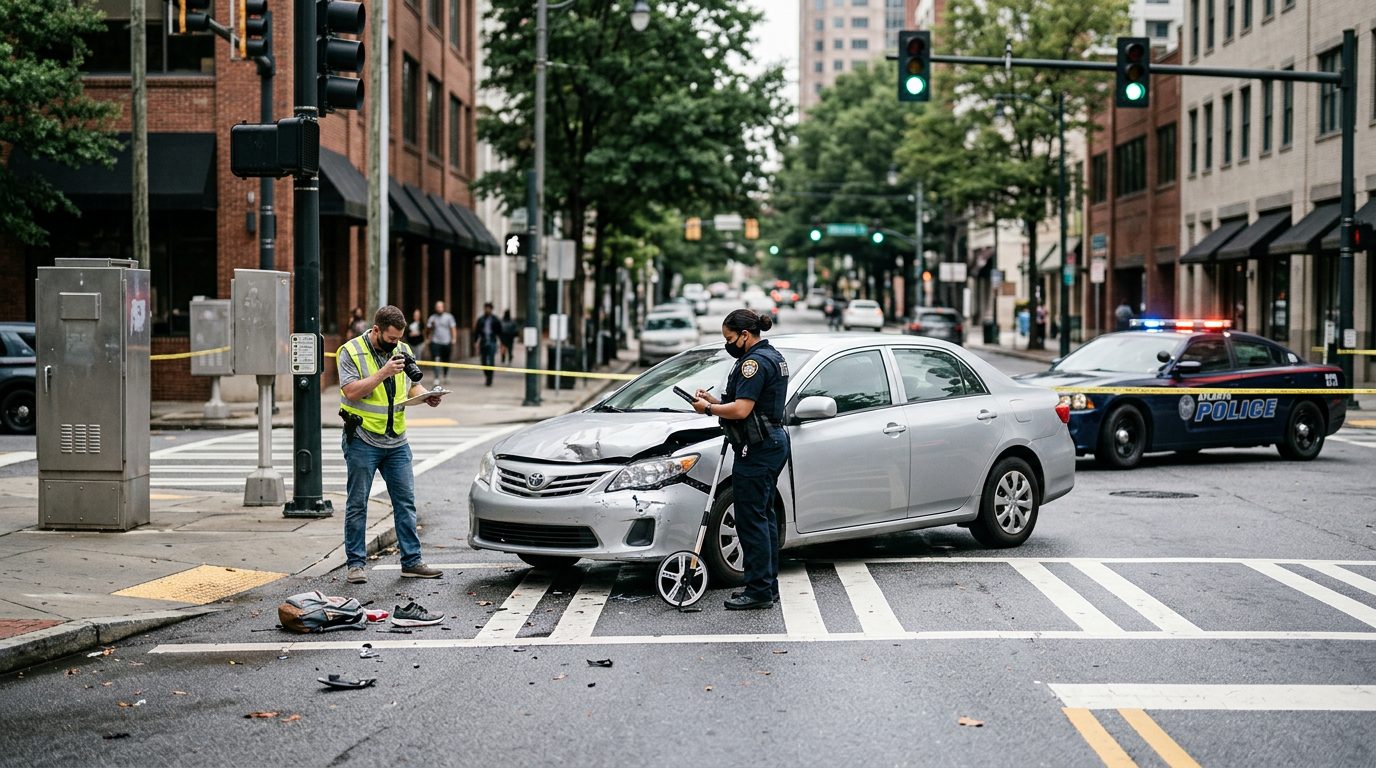
Getting a police report is critical. Ask the responding officer for the report number and the non-emergency line to obtain a copy. The police report creates an official record of the accident, including the date, time, location, weather, vehicle information, driver statements, and the officer’s initial observations about fault. Insurance companies require this report to process your claim, and it becomes a key piece of evidence if your case proceeds to negotiation or court.
At the scene, if you’re able, gather information: take photos of the accident location, vehicle damage, traffic signals, street conditions, and your injuries. Get the driver’s name, phone number, address, insurance company and policy number, driver’s license number, and vehicle license plate. Ask nearby witnesses for their names and contact information—their accounts of what happened can be invaluable if the driver disputes fault.
Seek medical attention promptly, even if you think your injuries are minor. Some injuries—like head trauma, internal bleeding, or soft-tissue damage—don’t always show symptoms immediately. Medical records create a documented link between the accident and your injuries, which is essential to your claim. Keep all medical bills, prescription receipts, imaging reports, and provider notes. These documents establish the extent of your injury and the cost of treatment, which directly affects what your claim is worth.
Understanding Pedestrian Accident Liability in Georgia
Georgia follows a modified comparative fault rule, which means you can recover damages even if you share some responsibility for the accident, but your recovery is reduced by your percentage of fault—and if you’re 50% or more at fault, you recover nothing. This is a critical protection for pedestrians.
Under Georgia law, drivers have a duty to exercise reasonable care to avoid hitting pedestrians. This includes obeying traffic signals, watching for pedestrians in crosswalks and intersections, and adjusting speed in areas where pedestrians are likely. Pedestrians, in turn, have a duty to obey traffic signals, use crosswalks where available, and not suddenly step into traffic. When a pedestrian accident occurs, fault is determined by comparing each party’s conduct against these duties.
Common driver violations in pedestrian accidents include:
- Running a red light or stop sign
- Failing to yield to a pedestrian in a crosswalk
- Speeding or driving too fast for conditions
- Distracted driving (texting, eating, adjusting the radio)
- Driving under the influence of alcohol or drugs
- Failing to maintain control of the vehicle
- Turning without checking for pedestrians
Common pedestrian violations include:
- Crossing against a traffic signal
- Crossing outside a designated crosswalk
- Stepping into traffic without looking
- Walking in the roadway when a sidewalk is available
- Being in the roadway at night without reflective clothing
If both you and the driver bear some responsibility, Georgia’s comparative negligence law reduces your recovery by your percentage of fault. For example, if you’re awarded $100,000 in damages but found 20% at fault, you recover $80,000. The key is that you must be less than 50% at fault to recover anything; if you’re 50% or more at fault, you recover nothing.
Insurance companies often use comparative fault arguments to reduce settlement offers. Understanding how Georgia law applies to your specific facts—what the police report says, what witnesses observed, and what the traffic signals showed—helps you evaluate whether an insurance company’s offer is fair or if it undervalues your claim.
Types of Damages in Pedestrian Accident Claims
Damages are the financial losses you’re entitled to recover because of the accident. Georgia law recognizes several categories:
Medical expenses include hospital bills, emergency room costs, surgery, imaging, physical therapy, medications, and any ongoing or future medical treatment related to your injuries. If your injuries require long-term care—such as ongoing physical therapy, home health care, or future surgeries—your claim should account for those future costs as well.
Lost wages cover income you lost while recovering from your injuries. If your injuries prevent you from returning to work, you may also recover loss of earning capacity—the difference between what you would have earned if you hadn’t been injured and what you can now earn given your limitations.
Pain and suffering compensates you for physical pain, emotional distress, anxiety, sleep disruption, and loss of enjoyment of life caused by your injuries. This is harder to quantify than medical bills, but it’s a legitimate part of your damages. Serious pedestrian injuries often result in chronic pain, scarring, mobility limitations, and psychological effects that deserve compensation.
Property damage covers the cost of replacing or repairing personal property destroyed or damaged in the accident—such as a phone, glasses, or clothing.
In cases where a pedestrian is killed, wrongful death damages may be available to the family. These include funeral and burial costs, loss of the deceased’s income, and the family’s loss of companionship and support.
The Pedestrian Accident Claim Process in Georgia
Understanding the claim process helps you know what to expect and when.
Step 1: Notify the Insurance Company. Contact the at-fault driver’s insurance company and report the accident. Provide your name, contact information, the date and location of the accident, a brief description of what happened, and the police report number. The insurance company will assign a claims adjuster to your case.
Step 2: File Your Claim. The adjuster will ask you to submit a formal claim, along with copies of the police report, medical records, bills, and any photos or witness statements you have. Be factual and thorough, but don’t admit fault or speculate about things you didn’t see. Stick to what you know.
Step 3: Investigation. The insurance company investigates the accident. This includes reviewing the police report, interviewing witnesses, examining the vehicles, and assessing your medical records. The adjuster may also request a recorded statement from you. You have the right to decline or to have an attorney present during this statement.
Step 4: Liability Determination. The insurance company determines whether the driver is liable (at fault) for the accident. If liability is clear, the process moves forward. If liability is disputed, the process may slow down or stall while the insurance company gathers more information.
Step 5: Damages Negotiation. Once liability is established, the insurance company and you (or your attorney) negotiate the value of your claim. The insurance company will make an initial settlement offer. This offer is often lower than the true value of your claim, especially if your medical treatment is still ongoing. Waiting until your medical treatment is complete and your full damages are documented typically results in a better outcome.
Step 6: Settlement or Litigation. If you and the insurance company agree on a settlement amount, you sign a release and receive payment. If you can’t agree, your case may proceed to litigation, where a judge or jury decides the outcome.
Insurance Coverage in Pedestrian Accidents
Liability coverage on the at-fault driver’s auto insurance policy is the primary source of recovery in most pedestrian accidents. This coverage pays for injuries and property damage the driver causes to others. Georgia requires all drivers to carry liability insurance, but coverage limits vary. If the driver’s liability limits are low and your damages are high, you may not recover the full value of your claim.
Uninsured and underinsured motorist (UIM) coverage on your own auto policy is a critical safety net. If the at-fault driver has no insurance or insufficient insurance, your UIM coverage may pay for your injuries up to your policy limits. Many pedestrians don’t realize they have this coverage or don’t understand how it works. If you’re a pedestrian without a vehicle, check whether you’re covered under a family member’s auto policy or a household policy.
Your own health insurance will likely pay for your medical treatment. However, health insurance companies often have a right to recover (called subrogation) from your settlement if you receive one. This means if your health insurance pays $50,000 in medical bills and you settle your claim for $100,000, the health insurance company may demand repayment from your settlement proceeds. Understanding these interactions is important to calculating your net recovery.
Insurance limits matter significantly. If you’re hit by a driver with only the state minimum liability coverage and your injuries are serious, the driver’s insurance may not cover your full damages. This is why UIM coverage on your own policy—if you have one—can be the difference between full recovery and a shortfall.
Not sure what your next step is?
Talk it through with our team — the first consultation is free, confidential, and carries no obligation.
Timeline for Resolving a Pedestrian Accident Claim in Georgia
How long a pedestrian accident claim takes depends on several factors: the severity of your injuries, the clarity of liability, the insurance company’s responsiveness, and whether the case settles or goes to court.
Simple cases with clear liability and minor injuries may settle within 3 to 6 months. The insurance company investigates quickly, liability is obvious, and damages are straightforward to calculate.
Moderate to serious cases typically take 6 months to 2 years. Your medical treatment may continue for weeks or months. The insurance company may dispute liability or undervalue your damages, requiring negotiation or additional investigation. If the case doesn’t settle, it may proceed to litigation, which adds time.
Complex cases—such as those involving significant injuries, disputed liability, multiple parties, or uninsured drivers—may take 2 years or longer, especially if litigation is necessary.
Georgia’s statute of limitations for personal injury claims, including pedestrian accidents, is two years from the date of the accident. This means you have two years to file a lawsuit. If you don’t file within this window, you lose the right to sue. This deadline is absolute; missing it bars your claim forever. If settlement negotiations are ongoing as the deadline approaches, filing a lawsuit may be necessary to preserve your rights, even if you hope to settle before trial.
Don’t rush to settle early. Insurance companies sometimes offer quick settlements at low amounts, hoping you’ll accept before you fully understand your injuries or damages. Waiting until your medical treatment is complete, your doctors have provided a prognosis, and you have a clear picture of your long-term needs typically results in a higher settlement. An early low-ball offer is often a sign that your claim is worth more than the insurance company is initially willing to pay.
Common Challenges in Pedestrian Accident Claims
Pedestrian accident claims often face obstacles that can delay resolution or reduce recovery.
Disputed liability is common. The driver may claim you stepped into traffic suddenly or crossed against the signal. The insurance company may argue comparative fault to reduce its payout. If witnesses support your account, this strengthens your position. If witness accounts conflict or are unavailable, liability may be harder to prove.
Insurance companies undervaluing injuries happens frequently. Adjusters may argue that your injuries aren’t as serious as your medical records suggest, or that your medical treatment was excessive. They may offer a settlement that covers your past medical bills but underestimates your pain and suffering or future care needs.
Delays in investigation or settlement occur when the insurance company moves slowly, requests repeated information, or disputes liability without clear reason. These delays can frustrate you and prolong your uncertainty.
Disagreements about medical causation arise when the insurance company argues that your injuries weren’t caused by the accident or that pre-existing conditions, not the accident, are responsible for your current symptoms. Your medical records and provider statements are crucial to establishing that the accident caused your injuries.
Uninsured or underinsured drivers create a significant challenge. If the at-fault driver has no insurance or minimal coverage, the driver’s policy won’t cover your full damages. Your UIM coverage, if you have it, becomes your primary source of recovery. If you don’t have UIM coverage, your recovery options are limited.
When to Talk to a Pedestrian Accident Lawyer
You don’t need a lawyer for every pedestrian accident claim, but certain situations make legal representation valuable.
Serious injuries or significant medical bills warrant a consultation. If your injuries require hospitalization, surgery, ongoing therapy, or long-term care, the value of your claim is likely substantial enough that professional representation can help you recover more than you would negotiate alone.
Unclear or disputed liability is a red flag. If the police report doesn’t clearly state who was at fault, if the driver disputes responsibility, or if witnesses give conflicting accounts, a lawyer can investigate, gather evidence, and build a strong case on your behalf.
The insurance company is not cooperating. If the adjuster is unresponsive, repeatedly requests the same information, or refuses to acknowledge liability without justification, an attorney can apply pressure and move the process forward.
You’re offered a settlement that seems too low. If the insurance company’s offer doesn’t account for your full medical expenses, lost wages, pain and suffering, or future care needs, a lawyer can evaluate the offer, negotiate on your behalf, and help you understand what your claim is truly worth.
The driver was uninsured or underinsured. Navigating UIM coverage, subrogation, and coordination with your own insurance is complex. A lawyer can ensure you recover the maximum available under your policy.
Many people in your situation—injured as a pedestrian and unsure what their claim is worth or how to handle the insurance company—find it helpful to discuss their case with someone who handles these claims regularly. A free consultation lets you understand your options without obligation.

FAQ
How long do I have to file a pedestrian accident claim in Georgia?
Georgia’s statute of limitations for personal injury claims is two years from the date of the accident. You must file a lawsuit within this window or lose the right to sue.
Can I recover damages if I was partially at fault for the pedestrian accident?
Yes. Georgia’s comparative negligence law allows you to recover damages as long as you’re less than 50% at fault; if you’re 50% or more at fault, you recover nothing. Your recovery is reduced by your percentage of fault.
What if the driver who hit me doesn’t have insurance?
If you have uninsured motorist coverage on your own auto policy, it may cover your injuries. If you don’t have this coverage, your recovery options are limited, though you may still sue the driver directly.
Should I accept the insurance company’s first settlement offer?
Rarely. Initial offers are often low. Wait until your medical treatment is complete and your full damages are documented before evaluating or accepting an offer.
What evidence do I need to prove a pedestrian accident claim?
The police report, medical records, photos of the accident scene and your injuries, witness statements, the driver’s insurance information, and your documentation of lost wages and expenses all strengthen your claim.
If you’ve been hit by a car in Atlanta, Duluth, Lawrenceville, Johns Creek, Alpharetta, Marietta, Norcross, Kennesaw, Dunwoody, or elsewhere in Georgia, you’re dealing with injury, medical bills, and uncertainty about what comes next. Contact us for a free case review so you can understand what your claim may be worth and what your options are.
The Essential Steps After a Pedestrian Accident
Immediate Actions at the Scene
Move to safety if possible. Call 911 to report the accident and request medical help. Get the driver's name, phone number, address, insurance information, and vehicle details. Take photos of the scene, vehicle damage, road conditions, and your injuries. Write down the names and contact information of any witnesses.
Seek Medical Care and Document Everything
Get a medical evaluation right away, even if you feel fine—some injuries appear later. Keep all medical records, bills, prescriptions, and receipts. Document your recovery process, including time off work and ongoing treatment. Report the accident to the driver's insurance company, but do not accept a settlement offer without legal review.
Preserve Evidence and Build Your Claim
Obtain the police report once filed. Collect any surveillance video from nearby businesses or traffic cameras. Keep a record of lost wages, transportation costs, and other out-of-pocket expenses. Do not post about the accident on social media, as it may be used against you.
Understand Your Rights and Next Steps
Georgia law allows you to pursue a claim for medical expenses, lost income, pain and suffering, and other damages. You have a limited time window to file a lawsuit. An attorney can evaluate your case, negotiate with insurers, and protect your rights throughout the process.
Time Matters
Georgia's statute of limitations sets a deadline for filing a pedestrian accident lawsuit. Waiting too long can cost you the right to pursue compensation. The sooner you act, the better we can preserve evidence and build a strong claim.
Why You Need Legal Help After a Pedestrian Accident
Insurance Companies Protect Their Interests, Not Yours
Adjusters work to minimize payouts. They may pressure you to settle quickly or deny valid claims. An attorney levels the playing field and ensures your rights are protected.
Complex Rules Govern Your Claim
Georgia's comparative negligence law, damage caps, and procedural requirements are intricate. A lawyer navigates these rules so you don't leave money on the table.
We Calculate What You Actually Deserve
Damages include medical bills, future care, lost wages, pain and suffering, and more. We ensure all losses—present and future—are accounted for in your claim.
We Handle the Heavy Lifting
From gathering evidence and negotiating with insurers to filing court documents, we manage every step so you can focus on healing.
Common Questions About Pedestrian Accident Claims
Can I recover damages if I was partly at fault?
Yes. Georgia's modified comparative fault law allows you to recover damages even if you share some responsibility—as long as you are less than 50% at fault; if you are 50% or more at fault, you recover nothing. Your recovery is reduced by your percentage of fault.
What damages can I claim?
You may recover medical expenses, emergency care, surgery, rehabilitation, lost wages, loss of earning capacity, pain and suffering, emotional distress, scarring or disfigurement, and other losses caused by the accident.
How much does it cost to hire an attorney?
We work on a contingency fee basis: no fees unless there is a recovery. You may still owe case costs such as filing fees, expert witness fees, and investigation expenses, which are typically deducted from your recovery.
How long does a pedestrian accident claim take?
Timeline varies. Some cases settle within months; others take longer if litigation is necessary. We work efficiently while ensuring your claim is fully valued and properly resolved.
You Don't Have to Navigate This Alone
Related practice areas
- Pedestrian Accidents in Atlanta
- Pedestrian Accidents in Lawrenceville
- Pedestrian Accidents in Johns Creek
- Protect Your Assets After a Pedestrian Accident in Georgia