
Pedestrian Accidents | Georgia Law
Comparative Fault in Georgia Pedestrian Accidents
You may still recover even if you were partly at fault. Here's how Georgia's comparative fault rule works.
By Peter F. Jaraysi · Published September 25, 2026
How Comparative Fault Works in Georgia Pedestrian Accidents
You can recover damages in a pedestrian accident even if you were partially at fault—as long as you’re less than 50% responsible. If you’re 50% or more at fault, Georgia’s comparative fault law bars your claim entirely. If your share is below that, the law doesn’t bar your claim; instead, it reduces your recovery by your percentage of fault. Understanding this rule is crucial if you’re uncertain whether a pedestrian accident is worth pursuing.
If you were hit as a pedestrian and aren't sure whether your own actions affect your right to recover, you're not alone—people in that exact position reach out to us regularly to understand their options. Talk it through with our team — the first consultation is free, confidential, and carries no obligation.

What Is Comparative Fault in Georgia?
Georgia follows a modified comparative negligence rule that allows injured people to recover damages even when they bear some responsibility for their own injury. Under O.C.G.A. § 51-12-33, the core principle is straightforward: your fault doesn’t automatically disqualify you from recovery. Instead, the law weighs both parties’ conduct and adjusts your award accordingly.
The key threshold is the 50% bar. If you are 49% or less at fault, you can recover, though your damages are reduced by your percentage of fault. If you are 50% or more at fault, you cannot recover any damages. This rule means that in many pedestrian accidents—where both the pedestrian and driver may have acted carelessly—the injured person still has a legal path to compensation.
The 50% Rule: How It Affects Your Pedestrian Accident Claim
Here’s how the 50% rule works in practice. If you are found to be 49% or less at fault, Georgia law allows you to recover damages. If you are 50% or more at fault, you cannot recover. Your recovery amount is then reduced by your percentage of fault.
For example, imagine you’re hit by a car while crossing against the pedestrian signal, but the driver was speeding and had time to avoid you. A court or jury might find you 30% at fault and the driver 70% at fault. If your total damages are $100,000, you would receive $70,000 (your $100,000 award reduced by your 30% fault). This reduction happens automatically—you don’t have to negotiate it away.
The 50% rule reflects Georgia’s recognition that real-world accidents are often messy. Both parties may have made mistakes. The law doesn’t punish you for your mistake by denying recovery entirely; it simply adjusts the amount to match your share of responsibility.
How Fault Is Determined in Pedestrian Accidents
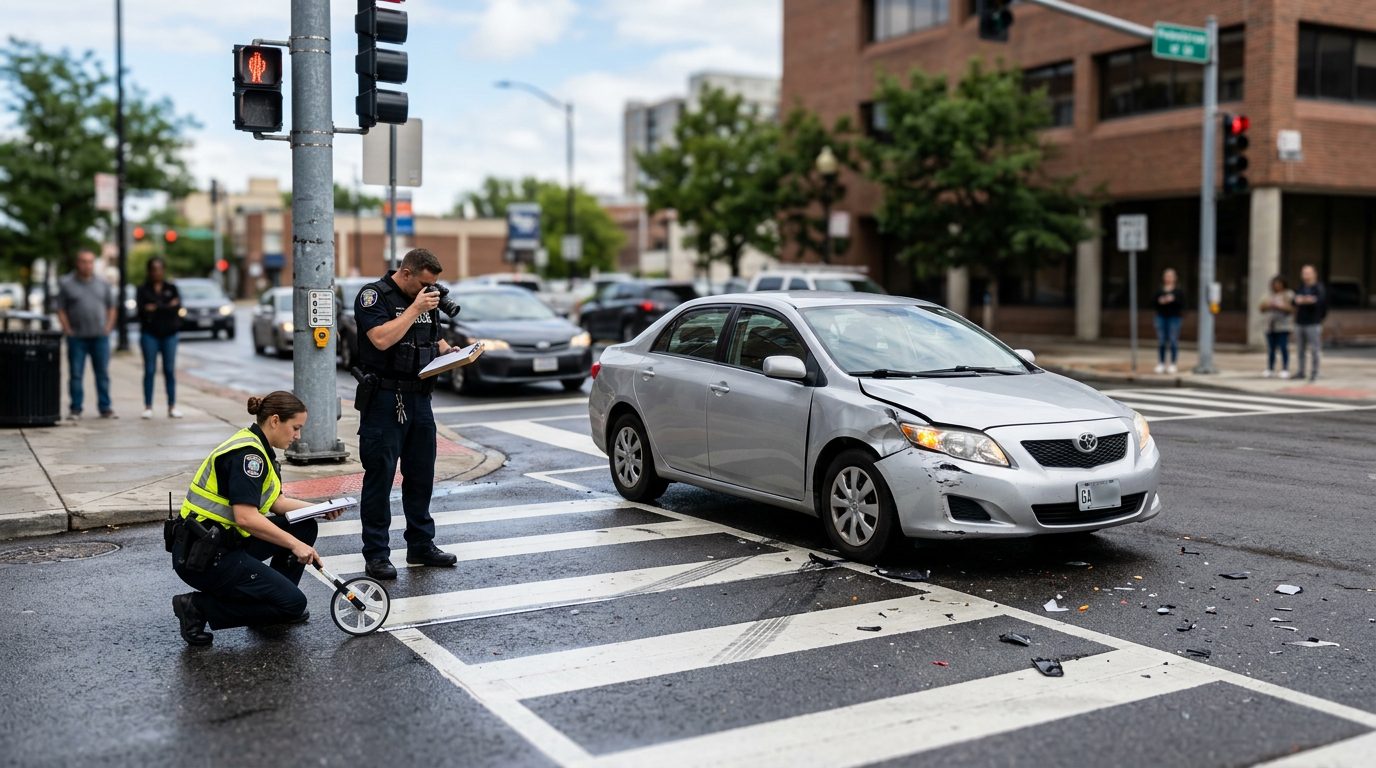
Fault determination isn’t guesswork. It’s based on investigation, evidence, and the legal duties each party owed. Pedestrians have a legal duty to use crosswalks where available, obey traffic signals, and exercise reasonable care for their own safety. Drivers have a legal duty to maintain a safe speed, keep a proper lookout for pedestrians, and obey traffic laws.
When determining fault, investigators and decision-makers examine:
- Police reports documenting the scene, statements, and any citations issued
- Witness statements from people who saw the accident
- Traffic law violations by either party (running a red light, jaywalking, speeding, distracted driving)
- The conduct of both parties leading up to the collision
Neither party’s violation automatically means 100% fault. A driver who ran a red light may still argue the pedestrian was jaywalking and should have been more alert. A pedestrian crossing against the signal may still argue the driver was speeding and could have stopped. Both arguments may have merit, and both may be weighed by a judge or jury.
Common Scenarios: Shared Fault in Pedestrian Accidents
Real pedestrian accidents often involve shared responsibility. Here are common scenarios:
Pedestrian in crosswalk, driver speeding or distracted. You’re crossing legally in a marked crosswalk, but the driver was speeding or looking at their phone. The driver bears primary fault, but if you were also distracted (on your phone, not paying attention), you might share some fault.
Pedestrian jaywalking, driver had time to avoid. You crossed outside a crosswalk, but the driver had a clear view and time to brake or swerve and chose not to. Fault may be shared, with the driver bearing significant responsibility for failing to avoid a foreseeable hazard.
Pedestrian on phone, driver also failed to yield. You were distracted, but the driver also violated a traffic law or failed to keep a proper lookout. Both parties’ negligence contributed to the crash.
Pedestrian crossing against signal, driver failed to keep lookout. You crossed against the signal, but the driver wasn’t watching the road carefully. Fault is shared.
In each scenario, comparative fault analysis asks: What did each party do? What were their duties? How did their conduct contribute to the injury? The answers determine the percentage split.
Why Comparative Fault Matters to Your Case
Comparative fault directly affects whether you can recover and how much you receive. You may still recover even if you bear some responsibility—that’s the critical difference from an all-or-nothing liability rule. Your fault percentage directly reduces your award dollar-for-dollar, so accurate fault determination is essential to your recovery.
Insurance companies and defendants often argue for higher pedestrian fault to reduce their payout. An adjuster might claim you were 60% at fault (above the 50% bar, blocking recovery entirely) when the evidence supports only 30%. Without challenge, you accept a lower settlement or no recovery at all.
Accurate fault determination requires evidence, investigation, and sometimes legal advocacy. Your account of what happened, witness statements, police findings, and expert analysis all matter. The initial fault determination by an insurance adjuster is not final—it can be challenged and revised through negotiation or litigation.
Not sure what your next step is?
Talk it through with our team — the first consultation is free, confidential, and carries no obligation.
What Happens Next: Understanding Your Options
Comparative fault is determined through investigation, negotiation, or trial. After a pedestrian accident, an insurance adjuster will assess fault and make an initial offer. That conclusion is not binding on you. You have the right to challenge their fault determination if you believe it’s unfair or unsupported by evidence.
If you disagree with the adjuster’s fault finding, you can provide additional evidence, witness statements, or expert analysis to support your position. Many cases are resolved through negotiation once both sides have a clearer picture of the evidence. Others proceed to trial, where a judge or jury makes the final fault determination.
Legal guidance can help ensure your side of the story is heard and fairly weighed. An attorney can investigate the accident, gather evidence, interview witnesses, and present your account to the insurance company or court. This advocacy often results in a more accurate—and more favorable—fault determination than you could achieve alone.
FAQ
Can I recover if I was jaywalking when hit by a car in Georgia?
Yes, if the driver also bears responsibility—for example, if they were speeding or failed to keep a proper lookout. Your jaywalking doesn’t automatically bar recovery; it may reduce your award if you’re found to be 49 percent or less at fault, but if you’re 50 percent or more at fault, you recover nothing.
What does it mean if I’m found 40% at fault for a pedestrian accident?
You can recover 60% of your damages (your award reduced by your 40% fault). If your total damages are $50,000, you’d receive $30,000.
Can I challenge an insurance company’s fault determination?
Yes. The adjuster’s initial finding is not final. You can provide evidence, witness statements, or expert analysis to dispute their conclusion and negotiate a fairer fault split.
How does comparative fault affect a wrongful death pedestrian claim?
The same comparative fault rule applies. If the pedestrian who died was less than 50% at fault, their estate or surviving family members can recover, reduced by the pedestrian’s percentage of fault; if the pedestrian was 50% or more at fault, they recover nothing. An attorney can evaluate whether an exception applies.
What evidence is most important in determining pedestrian accident fault?
Police reports, witness statements, traffic camera footage, traffic law violations, and the physical evidence at the scene (skid marks, vehicle damage, pedestrian injuries) all carry weight.
If you were hit as a pedestrian and aren’t sure whether your own actions affect your right to recover, you’re not alone—people in that exact position reach out to us regularly to understand their options. Contact Slam Dunk Attorney for a free case review and let our team explain how Georgia’s comparative fault rule applies to your specific situation.
Key Point
In Georgia, being partly at fault doesn't automatically prevent you from recovering damages. What matters is whether your share of fault is less than 51%. If you were found 50% or more at fault, you cannot recover under Georgia law.
How Comparative Fault Works in Georgia
You Can Recover If You're Less Than 50% at Fault
Georgia's comparative fault rule allows pedestrians to recover damages even if they share some responsibility for the accident—as long as their fault doesn't exceed 50%.
Your Award Is Reduced by Your Percentage of Fault
If you're found 30% at fault, your total recovery is reduced by 30%. If damages are $100,000, you'd receive $70,000.
Common Pedestrian Fault Factors
Jaywalking, ignoring traffic signals, walking while distracted, or failing to use a crosswalk may be considered. However, the driver's conduct—speeding, distracted driving, failure to yield—is also weighed.
The Driver's Conduct Still Matters
Even if you jaywalked, the driver may still bear significant fault if they were speeding, not paying attention, or failed to keep a proper lookout and could have avoided the collision.
What You Should Know
Fault Is Determined by Evidence
Police reports, witness statements, traffic camera footage, and accident reconstruction may all be used to determine each party's share of responsibility.
You Have Legal Protection
Georgia law recognizes that pedestrians are vulnerable road users. Drivers have a duty to exercise reasonable care to avoid hitting pedestrians, even in situations where the pedestrian may have been partly negligent.
Documentation Is Critical
Gather photos, medical records, witness contact information, and any available video. These materials help establish what happened and who was at fault.
Don't Assume You Can't Recover
Many pedestrians believe they have no claim if they were jaywalking or crossed against the signal. That's not how Georgia law works. A free case review can clarify your situation.
Ready to Discuss Your Pedestrian Accident?
Related practice areas
- Pedestrian Truck Accidents Georgia: Why They’re Different