

Shared Blame After a Motorcycle Crash? Know Where You Stand
Insurance companies often point to a rider's choices. Here is how Georgia's shared-fault approach works and what to do before you say anything on the record.
By Peter F. Jaraysi · Published November 8, 2026
Under Georgia’s modified comparative fault rule, you can still recover damages for a motorcycle accident even if you were partly at fault, but your damages are reduced in proportion to your percentage of fault, and you are not entitled to any damages if you are 50 percent or more responsible for the injury (O.C.G.A. § 51-12-33).
What Is Comparative Fault in Georgia?
Georgia’s modified comparative fault rule allows you to recover damages even if you bear some responsibility for the accident. Your recovery is reduced by your percentage of fault, but you can still collect—unless you are found to be 50% or more at fault.
Here’s a concrete example: if a jury determines that damages total $10,000 but you were 30% at fault, you recover $7,000 (the $10,000 reduced by your 30% share). If you are found 50% or more responsible, you cannot recover anything (O.C.G.A. § 51-12-33; Quynn v. Hulsey (2020)). This threshold is called the “50% bar,” and it’s the line between a valid claim and no recovery at all.
Courts and juries examine what each person did (or failed to do) that contributed to the accident, regardless of whether they were riding a motorcycle or driving a car.
If you're unsure whether your own actions in the accident might bar your claim, understanding Georgia's comparative fault rule is the first step—and we can help you evaluate your specific situation. Talk it through with our team — the first consultation is free, confidential, and carries no obligation.

How Comparative Fault Applies to Motorcycle Accidents
Fault in a motorcycle accident is determined by comparing the actions of all parties involved. Courts consider the fault of everyone who contributed to the injury, not just the person you’re suing.
Common factors that influence fault determination include:
- Speed (were you or the other driver exceeding the limit or driving too fast for conditions?)
- Lane position (were you in a safe lane, or did you drift or swerve?)
- Following distance (did you maintain a safe distance, or were you too close?)
- Visibility (were you visible to the other driver, or were you in a blind spot?)
- Traffic violations (did either party run a red light, fail to signal, or break another rule?)
- Road conditions (was the road wet, icy, or poorly lit?)
- Attention (was either driver or rider distracted, fatigued, or impaired?)
Under O.C.G.A. § 51-12-33, the trier of fact shall determine the percentage of fault of the plaintiff, and the judge shall reduce the amount of damages otherwise awarded to the plaintiff in proportion to his or her percentage of fault (O.C.G.A. § 51-12-33). If you were speeding, not visible, or in an unsafe position, a court or jury may assign you some percentage of fault even if the other driver also bears responsibility.
Why Comparative Fault Matters in Your Motorcycle Accident Claim
Insurance adjusters are trained to assign you some percentage of fault to reduce what they pay. This is standard practice, not a reflection of truth. The other party’s insurer may claim you were speeding, not visible enough, or in a blind spot—even if those claims are weak or unsupported by evidence.
Understanding Georgia’s comparative fault rule helps you evaluate whether a settlement offer is fair (O.C.G.A. § 51-12-33; Quynn v. Hulsey (2020)). If an adjuster offers you $5,000 and claims you were 40% at fault, you can push back if the evidence does not support that percentage. Even if you were partially at fault, you may still have a valid and valuable claim for the other party’s share of responsibility.
Disputes over fault percentage are common and often require investigation, evidence, and negotiation. The difference between being assigned 20% fault and 40% fault can mean thousands of dollars in your pocket or lost to the insurance company.
How Fault Is Determined in Motorcycle Accident Cases
Fault determination involves multiple sources of evidence and perspective:
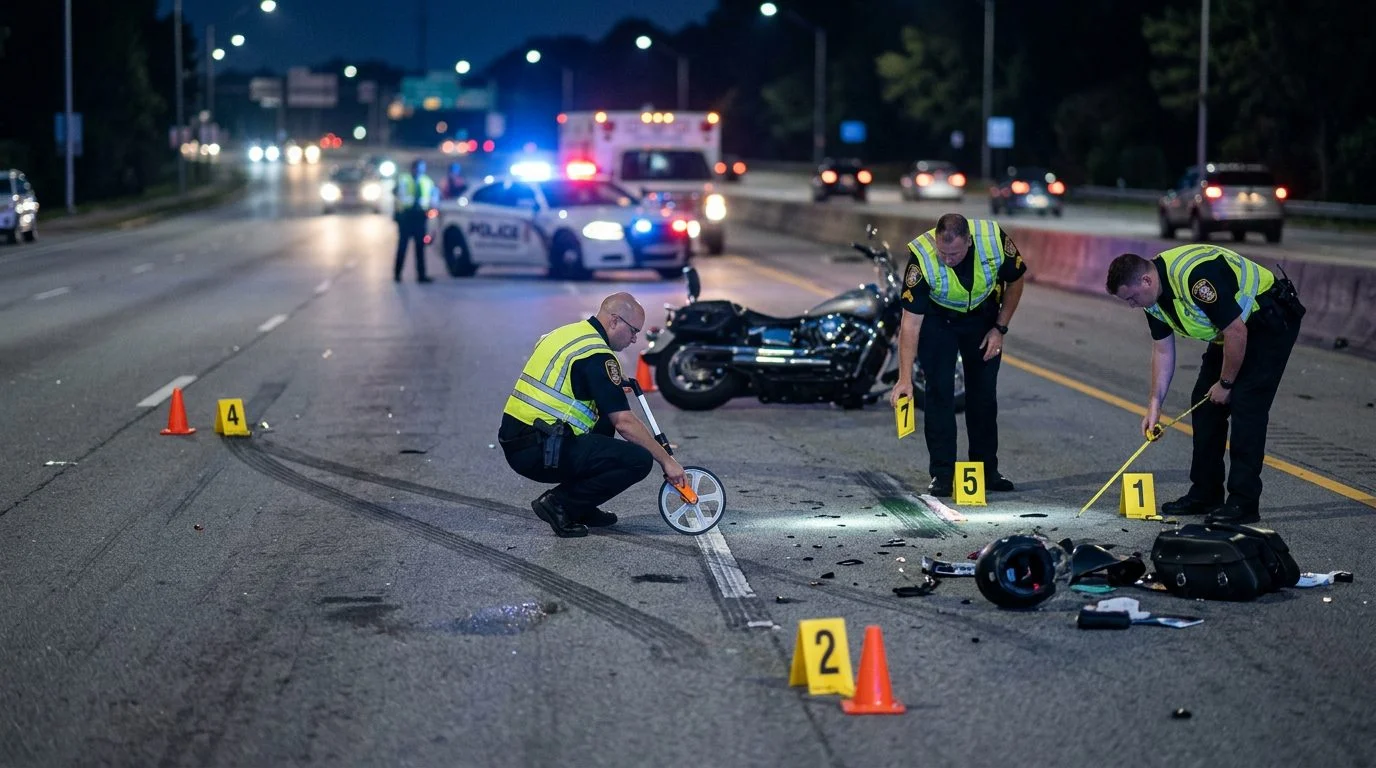
Police accident reports document the scene, witness statements, and sometimes an officer’s opinion on fault. However, a police report is not the final word. Officers may not have all the facts, and their conclusions can be wrong or incomplete.
Insurance companies review the police report, photos, vehicle damage, medical records, and statements from both parties. They use this information to assign a fault percentage, but their goal is to minimize their payout—not to find truth.
Eyewitness accounts can support or contradict the police report. A neutral witness who saw the accident unfold may provide crucial details that shift the fault analysis.
Accident reconstruction professionals analyze skid marks, vehicle positions, impact patterns, and physics to determine how the accident likely occurred. These professionals are often brought in when liability is disputed or unclear.
Traffic laws and safety regulations inform fault analysis. For example, Georgia law requires motorcyclists to wear protective headgear, and how a helmet-related issue affects a claim depends on the facts of each case.
Your own statements to police and insurers become part of the record. What you say immediately after the accident can help or hurt your claim, which is why it’s important to be careful and accurate.
Common Scenarios: Comparative Fault in Motorcycle Accidents
Rear-end collision: The driver who hits you from behind is typically at fault. However, if you braked suddenly without reason or your brake lights were not working, some fault may attach to you.
Left-turn accident: The driver turning left across your path is often primarily at fault, but if you were speeding, not visible, or in an unsafe lane position, fault may be shared.
Lane-change accident: The driver changing lanes is usually at fault for failing to check blind spots or signal. If your motorcycle was speeding or in an unexpected position, however, some fault may be assigned to you.
Intersection accident: Fault depends on traffic signals, right-of-way rules, and visibility. Both parties’ actions are examined. If you ran a red light or failed to yield, you may bear significant fault even if the other driver was also negligent.
What Evidence Supports Your Position on Fault
To challenge an insurance adjuster’s fault assessment or to support your claim at trial, gather and preserve:
- Police report and accident scene photos showing vehicle positions, damage, road conditions, and any traffic control devices
- Witness statements from people who saw the accident, including their contact information
- Medical records documenting your injuries (injuries can indicate impact direction and severity)
- Motorcycle damage and repair estimates showing the point of impact and damage pattern
- Traffic camera or dashcam footage if available from nearby businesses or other vehicles
- Cell phone records showing whether the other driver was distracted before the crash
- Maintenance records proving your motorcycle was in safe working condition
- Your own account of what happened, documented early and consistently
The more evidence you have, the stronger your position in negotiations with the insurance company or at trial.
Not sure what your next step is?
Talk it through with our team — the first consultation is free, confidential, and carries no obligation.
How Comparative Fault Affects Settlement and Trial
If you disagree with the fault percentage, you can dispute it and demand a higher settlement.
At trial, a jury decides the percentage of fault for each party based on evidence and jury instructions. Your attorney can present evidence and arguments to minimize your assigned fault percentage. Even a small difference—say, 20% versus 30%—can mean a significant difference in the money you recover.
For example, if damages are $50,000 and the jury assigns you 20% fault, you recover $40,000. If the jury assigns you 30% fault, you recover $35,000. That’s a $5,000 difference based on a 10-percentage-point shift in fault.
Should I Hire a Lawyer to Handle Comparative Fault Issues?
An attorney can gather evidence to support your version of events and challenge the other party’s claims. Insurance adjusters are trained to assign fault in ways that reduce their payout; a lawyer levels the playing field.
If the insurer’s fault assessment seems unfair, a lawyer can push back with evidence and legal argument. Some motorcycle accident claims are resolved through negotiation, and a lawyer can explain how that process works in your situation.
Next Steps If You Are Facing a Comparative Fault Dispute
Do not admit fault or sign anything without understanding the language. Gather and preserve all evidence: photos, witness contact information, medical records, repair estimates. Keep a written account of the accident while details are fresh, and request a copy of the police report to review for accuracy.
If the insurance company’s fault assessment seems wrong, do not accept it immediately. Consider speaking with a lawyer before accepting a settlement offer, especially if the adjuster is pushing you to settle quickly or assigning you a high percentage of fault.
FAQ: Comparative Fault in Motorcycle Accidents
Can I recover damages if I was partially at fault for the motorcycle accident?
Yes, you may still recover as long as you were less than 50 percent responsible, and any award is reduced by your percentage of fault. Your recovery is reduced by your percentage of fault (O.C.G.A. § 51-12-33; Quynn v. Hulsey (2020)).
What percentage of fault bars recovery in Georgia?
If you are found 50% or more at fault, you cannot recover any damages under Georgia law (O.C.G.A. § 51-12-33; Quynn v. Hulsey (2020)).
How can comparative fault come up in an injury claim?
A higher assigned fault percentage means a lower payout for you.
Can helmet use come up in a motorcycle injury claim?
Questions about helmet use in a motorcycle claim depend on the facts of each case, and our team can review the details of yours.
Can a lawyer help me dispute the insurance company’s fault assessment?
Yes. A lawyer can investigate the accident, gather evidence, and negotiate with the insurance company to challenge an unfair fault assignment.
If you’re unsure whether your own actions in the accident might bar your claim, or if an insurance adjuster is assigning you a fault percentage that doesn’t match what happened, we can help you understand your rights and evaluate your specific situation. Reach out to discuss your motorcycle accident and what comparative fault means for your case.
How our team approaches shared-fault motorcycle cases
Facts first
We review the crash report, photos, video and medical records to build a clear picture of what happened.
Plain-language answers
We explain how fault questions may affect your situation in terms you can understand, without jargon.
Insurers handled for you
We can communicate with adjusters so you do not have to answer difficult questions alone.
Consultation with no obligation
Our first consultation is free, confidential and comes with no obligation to continue.
Be careful before admitting fault
Casual remarks at the scene, social media posts and recorded statements to an insurer can be used to question your account. Speak with a lawyer before giving a recorded statement or signing anything.
Common concerns after a motorcycle crash
Worried you were partly to blame?
Many riders assume any share of blame ends their claim. Our lawyers can review the facts of your crash and explain your options.
What evidence can matter
Photos, dash-cam footage, witness contact details, and medical records can all shape how a crash is understood. Preserve what you have.
Adjusters calling early
Insurance representatives often reach out quickly. You can ask for a lawyer to handle those conversations while you focus on recovering.