
Pedestrian and Car Accidents | Duluth, Georgia
Nearly Hit by a Car? Here's How to Think Through Your Options
A close call can leave you shaken, sore, and unsure what comes next. Our team at Slam Dunk Attorney is here to listen and explain your options in plain language.
By Peter F.
Can you sue if you almost get hit by a car? Short answer: a near miss can support a claim, but usually only if you were hurt or lost something
Can you sue if you almost get hit by a car in Georgia? Usually not for the close call alone. A close call with no contact, no injury, and no damage generally does not become a claim. A claim becomes realistic when the near miss causes a physical injury, a crash, or damage to your property.
Almost being hit is frightening. Your heart races, your hands shake, and you may replay it for weeks. Many people reading this are checking for themselves. Others are asking for a spouse, parent, or friend who came close to being struck.
Whether you can sue if you almost get hit by a car depends on the facts. Who was careless, what happened next, and what harm followed all matter. The law looks for a loss, not just a scare.
The sections below cover injuries, crashes, emotional harm, deliberate acts, fault, deadlines, and the steps that protect your options.
Not sure what your next step is?
Talk it through with our team — the first consultation is free, confidential, and carries no obligation.

What Georgia law requires for a negligence claim
A negligence claim is built on careless conduct that causes harm. Georgia describes ordinary diligence as the care that ordinarily prudent people take under similar circumstances. The absence of that care is ordinary negligence (O.C.G.A. § 51-1-2).
Take a driver who runs a red light and swings toward a crosswalk. A pedestrian jumps back to the curb. Nothing hits anyone, but the driver’s choice put someone in danger.
Georgia law says drivers must exercise due care to avoid colliding with pedestrians on the roadway (O.C.G.A. § 40-6-93). Pedestrians have duties too. Under O.C.G.A. § 40-6-91, no pedestrian may suddenly leave a curb or other place of safety and walk or run into the path of a vehicle that is so close that it is impractical for the driver to yield.
Under Georgia’s damages rule, a person may recover for a breach of a legal duty if that person suffers damage from it (O.C.G.A. § 51-1-6). In practice, a claim generally needs an injury, a crash, or a loss that the careless act caused.
When a near miss causes an injury, including symptoms that appear later
An injury can happen even when no car touches you. Sudden braking, a sharp swerve, or a quick jump back can strain your neck or back, hurt a shoulder, or cause a fall. A head can hit the pavement or a curb.
Some symptoms don’t show up at the scene. Headache, dizziness, or stiffness may begin hours or days later. Tell a medical provider about the near miss and every new symptom. That visit helps your health and creates a record.
Some injuries are serious. A traumatic brain injury can range from mild to catastrophic, according to the Brain Trauma Foundation’s prehospital guidelines. Paralysis, a loss of muscle function, can result from a spinal cord injury or a broken neck, according to MedlinePlus.
Keep a file. Save visit notes, prescription receipts, bills, and records of missed work. Write brief notes about symptoms and what pain stops you from doing. Memory fades fast.
When a near miss leads to a crash or property damage
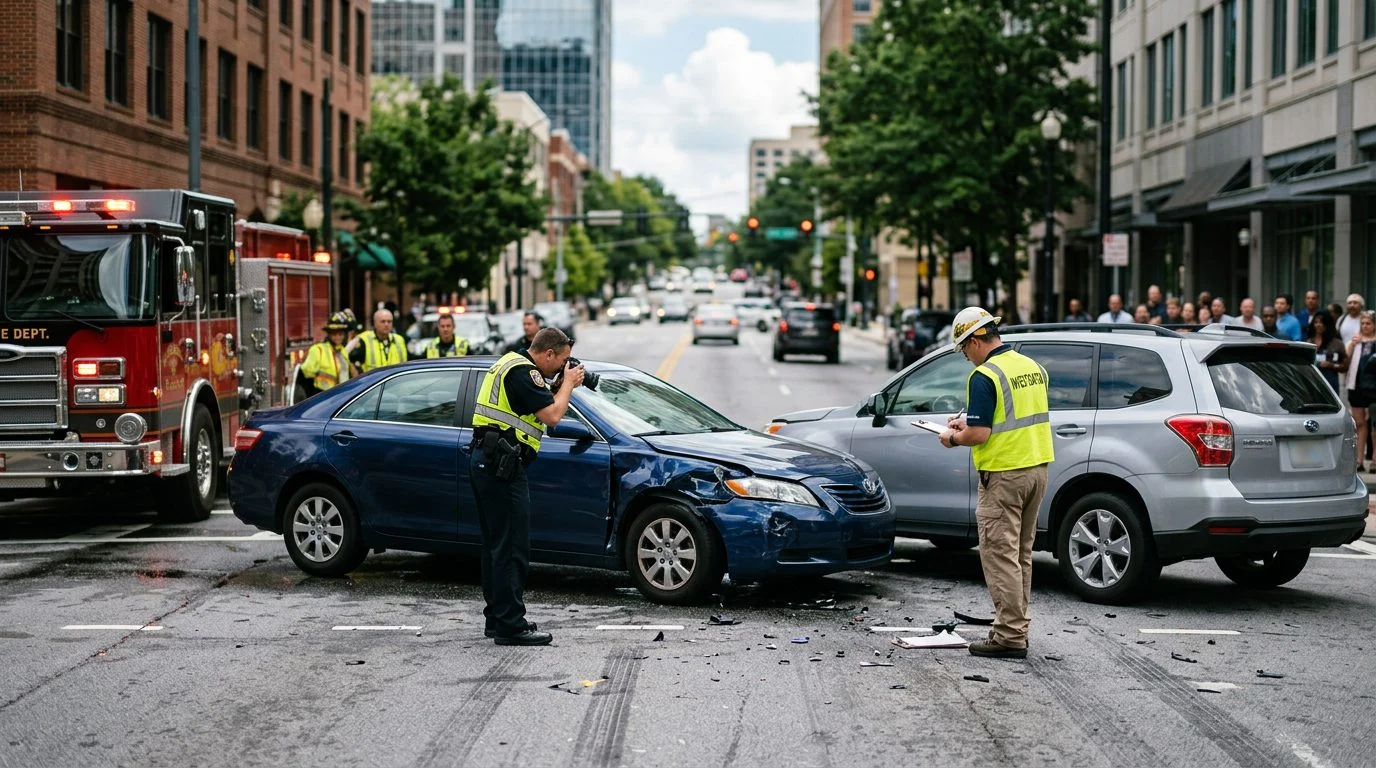
A near miss often leads to a crash. A driver who swerves to dodge another car may hit a pole, a guardrail, a ditch, or a second vehicle. The injuries and vehicle damage from that crash can be part of a claim.
The key question is whether another driver’s careless conduct caused the crash. Asking only whether a near miss happened misses the point.
Damage to your car counts as property damage. Under O.C.G.A. § 51-12-2, general damages are those the law presumes to flow from any tortious act and may be recovered without proof of any amount, while special damages are those that actually flow from a tortious act and must be proved in order to be recovered. Repair estimates, towing invoices, and rental receipts help prove those costs.
A claim for vehicle damage alone can differ from a claim for bodily injury. The proof needed and the steps to pursue each one may not be the same.
Emotional distress after a near miss and Georgia’s impact rule
Feeling afraid, anxious, or unsure about driving after a close call is a normal reaction. That feeling is real. You can and should talk about it with your doctor.
Georgia treats harm to feelings differently from physical harm. When the entire injury is to a person’s peace, happiness, or feelings, jurors decide the measure of damages. Punitive damages are not awarded in that kind of action (O.C.G.A. § 51-12-6).
In plain words, fear alone is hard to measure and hard to pursue. When a near miss also causes a physical injury, the fear that came with it becomes part of the overall story.
Keep a simple log of your sleep, your driving, and your worries. Share it with your provider.
Intentional near misses and deliberate ramming
Some close calls are not accidents. A driver may aim at a pedestrian, a cyclist, or another car to frighten or hurt them. Deliberate conduct is judged differently from ordinary carelessness.
Georgia allows punitive damages only when clear and convincing evidence shows willful misconduct, malice, fraud, wantonness, oppression, or that entire want of care which would raise the presumption of conscious indifference to consequences (O.C.G.A. § 51-12-5.1). Punitive damages are meant to punish, penalize, or deter a defendant. They are not compensation to the plaintiff.
If you believe the act was intentional, write down the driver’s behavior right away. Note the plate number, the time, the place, and any witnesses. Save dashcam or phone video. Ask police for a report number. The evidence decides which claims fit.
Not sure what your next step is?
Talk it through with our team — the first consultation is free, confidential, and carries no obligation.
How fault is divided and the 50 percent bar
Georgia divides fault when more than one person contributed. If you share some blame, the damages are reduced in proportion to your percentage of fault. If you are 50 percent or more responsible, you cannot recover any damages (O.C.G.A. § 51-12-33).
Here is a simple example. A pedestrian steps off a curb while looking at a phone, and a driver fails to slow down. If a jury or judge found the pedestrian 20 percent at fault, any award would drop by 20 percent. If the pedestrian were found 50 percent at fault, nothing would be recoverable. This is only an illustration.
Georgia also makes each at-fault person responsible only for their own share, not the whole amount (same statute). Real fault turns on traffic, signals, and each person’s choices.
Filing deadlines to keep in mind
Georgia generally gives two years after the right of action accrues to bring an action for injuries to the person, except that loss of consortium claims must be brought within four years (O.C.G.A. § 9-3-33). A near miss that led to an injury or crash is subject to these time limits.
Property damage claims can involve different timing questions. Don’t assume one date covers every part of your claim.
Claims against a government entity can follow different procedures and timing rules, so review them early.
Waiting can also make evidence harder to gather. Video gets overwritten, witnesses move, and memories blur. Acting early protects what you can still prove.
What to do after a near miss to protect your options
Start with your health. Get a medical check promptly, even if you feel fine. Tell the provider about the near miss and any new symptom, such as headache, neck pain, or dizziness.
Gather proof while it’s fresh. Photograph the scene, the vehicles, the road, and any visible injury. Save dashcam or phone video. Write down the time, the place, your direction of travel, and what each driver did.
Collect names and phone numbers of witnesses. If police came, ask for the report number.
Be careful with insurance companies. Think before giving a recorded statement, and keep copies of every letter, email, and bill. Don’t sign anything you don’t understand yet.

Talking with our team about your near miss
Many readers are still shaken. Some are worried about a sore neck that began days later. Others are weighing whether a near miss is worth raising with a lawyer.
Can you sue if you almost get hit by a car?
A claim generally needs an injury, a crash, or damage to property.
Can a pedestrian sue if a driver almost hits them?
A pedestrian may have a claim if the near miss led to injury or damage. Drivers must use due care to avoid colliding with pedestrians upon the roadway.
Can you sue for emotional distress after a near miss in Georgia?
Fear alone is hard to pursue. Georgia measures harm to feelings differently from physical harm.
How long do you have to file?
For injuries to the person, Georgia generally allows two years from the date the right of action accrues (O.C.G.A. § 9-3-33; Kenneth B. Cameron v. Jmp Pizza, Inc (2026)).
If that close call left you hurt, rattled, or unsure what it means for you, our team can talk it through in a free, confidential first consultation, with no obligation to continue.
This page is general information, not legal advice. Peter F. Jaraysi is the responsible lawyer for this page at Slam Dunk Attorney in Duluth, Georgia. Contact details appear in this page’s footer.
How Our Team Can Help
Compassionate, Plain-Language Guidance
We understand that a near miss can be frightening even when no one is physically hurt. We take the time to explain what happened and what it may mean for you.
Free First Consultation
Your first consultation is free, confidential, and comes with no obligation to continue.
Lawyers Who Listen
Jaraysi and Brian D.
Serving Metro Atlanta and Georgia
From our Duluth office, we represent people across metro Atlanta and throughout Georgia.
Important: Get Checked Even If You Feel Fine
Adrenaline can mask injuries after a near miss. See a doctor promptly, describe everything that happened, and keep records of your visits, symptoms, and any costs. Do not give a recorded statement to an insurance company before speaking with a lawyer.
Situations We Often Hear About
Pedestrian Near Misses
A driver swerved, ran a signal, or failed to yield and came close to hitting you while you were walking or crossing the street.
Injuries That Follow a Scare
Whiplash, emotional distress, and other injuries sometimes appear days after the event. Sharing your full story helps us understand your situation.