
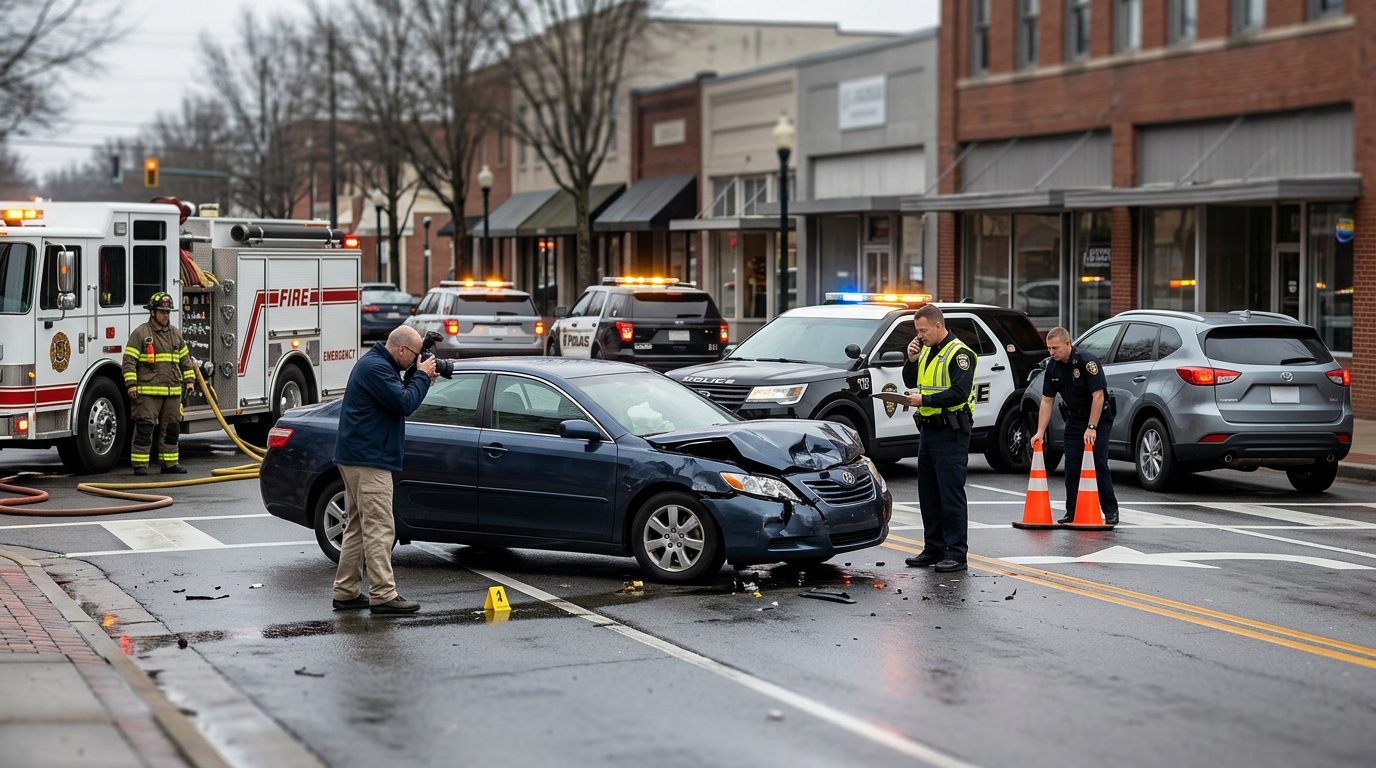
Lawrenceville Car Accidents
Insurance Questions After a Lawrenceville Car Accident? Talk With Us First.
Insurance companies, policy limits and claim forms can be confusing when you are recovering from an injury. Slam Dunk Attorney helps people in Lawrenceville and across Georgia understand their insurance options.
By Peter F. Jaraysi · Published October 21, 2026
Short Answer: Georgia’s Required Car Insurance
If you’re asking what insurance coverage is required for car accidents in Lawrenceville, the answer is the same as in the rest of Georgia. The Georgia Office of the Commissioner of Insurance and Safety Fire publishes information about auto insurance requirements in Georgia.
Liability coverage is the part that pays other people. If you cause a crash, your liability limits pay for the other driver’s injuries and damaged property, up to those limits. Liability coverage doesn’t pay for your own injuries or your own vehicle. Other coverages handle those needs, as explained below.
This matters because the at-fault driver’s limits often become the first number people look at after a crash. Knowing them early helps you plan your next steps.
If a crash in Lawrenceville left you or someone close to you hurt and unsure about coverage, our team can talk it through with you. Talk it through with our team — the first consultation is free, confidential, and carries no obligation.
Bodily Injury Liability Coverage Explained
Bodily injury liability pays people hurt by the insured driver. It can cover their medical bills, lost income and other losses from the injury, up to the policy limit. Georgia law separates special damages, which must be proved, from general damages, which the law presumes. O.C.G.A. § 51-12-2 draws that line.
Two limits apply. The per-person limit caps what any one injured person can collect from that policy. The per-accident limit caps the total for everyone hurt in the same crash.
Here’s a simple example. Say a policy has $25,000 per person and $50,000 per accident, and three people are hurt. One person has $30,000 in losses. The other two each have $10,000. The first person can receive at most $25,000 because of the per-person limit. The other two receive $10,000 each. The total from the policy is $45,000, which stays under the $50,000 per-accident limit.
A multi-vehicle pileup can strain these limits quickly. When several people are hurt, the per-accident limit may run out before every claim is paid.
Property Damage Liability Coverage
Property damage liability pays for damage the insured driver causes to someone else’s property. That can include another person’s car, a fence, a building or a utility pole. It works separately from bodily injury, and each has its own limit.
The $25,000 minimum may not cover a newer or higher-value vehicle. Repair or replacement costs can exceed that amount. That’s one reason many drivers choose higher property damage limits.
If another driver hits your car, their property damage liability may pay for the damage, subject to the limit and the claim. Your own collision coverage, if you have it, is another route for repairs.
Is 50/100/50 Good Insurance Coverage?
50/100/50 means $50,000 bodily injury per person, $100,000 bodily injury per accident, and $50,000 property damage per accident. It sits above the state minimum. It is a choice, not a legal requirement.
Higher limits leave more room under the at-fault driver’s policy. If a crash causes large medical bills, higher limits can help keep an injury claim from running out of coverage. That doesn’t mean every claim will be paid in full.
Higher limits also cost more in premiums. Whether they make sense for a particular driver turns on the facts: personal assets, vehicle value, driving history and budget. We don’t call any limit good or bad in general.
Optional Coverage Drivers Often Add
Uninsured motorist coverage protects you when the other driver can’t pay. Under O.C.G.A. § 33-7-11, a Georgia auto liability policy must include uninsured motorist coverage unless the insured rejects it as the statute allows.
Collision and comprehensive coverage are optional. Collision helps repair your own vehicle after a crash. Comprehensive covers other losses, such as theft or vandalism. Medical payments coverage is also optional. It pays medical bills separately from any injury claim against another driver.
What Happens If a Driver Has No Insurance
If the at-fault driver has no insurance, the injured person often has fewer sources to turn to. Their own uninsured motorist coverage may become the main path, if they carry it. Whether that coverage applies, and how much it pays, turns on the policies involved.
Insurance status isn’t always clear right after a crash. A driver may say they’re insured, but the policy may not be confirmed on the spot. At the scene, write down the other driver’s name, license plate, insurer and policy number if they share it. Photograph the vehicles, the road and any visible injuries.
Missing or unclear insurance details can slow a claim. Early notes make it easier to sort out coverage later.
Not sure what your next step is?
Talk it through with our team — the first consultation is free, confidential, and carries no obligation.
Why Coverage Matters After a Lawrenceville Crash
The at-fault driver’s liability limits often set the practical ceiling for an injury claim. That’s why the coverage question tends to come early. A crash on Lawrenceville roads or elsewhere in Gwinnett County raises the same questions.
Fault matters too. Georgia applies modified comparative fault under O.C.G.A. § 51-12-33 (Quynn v. Hulsey, 310 Ga. 473 (2020)). A plaintiff who is 50 percent or more responsible recovers nothing. Under O.C.G.A. § 51-12-33, a plaintiff who is to some degree responsible for the injury has damages reduced in proportion to their percentage of fault, and a plaintiff who is 50 percent or more responsible is not entitled to receive any damages. See the Quynn v. Hulsey ruling.
Timing matters as well. The Cameron v. JMP Pizza opinion quotes O.C.G.A. § 9-3-33 for the rule that Georgia generally requires a personal injury lawsuit within two years.
Crash risk is real. The Insurance Institute for Highway Safety reports 1,403 motor-vehicle crash deaths in Georgia in 2024, a rate of 12.5 per 100,000 people. Higher speeds also raise crash severity, according to IIHS speed research.
Talk With Our Team About Your Lawrenceville Crash
If you’re reading this after a crash, or helping a family member who was hurt, you may be dealing with the crash and this paperwork at the same time.
What insurance coverage is required for car accidents in Lawrenceville?
Does Georgia require uninsured motorist coverage?
Can I still recover damages if I was partly at fault?
Georgia’s modified comparative fault rule reduces a plaintiff’s damages in proportion to their percentage of fault, and a plaintiff who is 50 percent or more responsible is not entitled to receive any damages (O.C.G.A. § 51-12-33). Damages are reduced by your share of fault.
How long do I have to file a car accident injury lawsuit in Georgia?
Georgia generally requires a personal injury lawsuit to be filed within two years after the claim accrues.
If a crash in Lawrenceville left you or someone close to you hurt, and the insurance picture is still unclear, our team can talk it through with you. Our free first consultation is confidential and carries no obligation to continue. Reach out through our contact page to request yours.
This page is general information, not legal advice. Slam Dunk Attorney is based in Duluth, Georgia. The responsible lawyer for this page is Peter F. Jaraysi.
How We Can Help With Insurance Questions
Plain-Language Explanations
We explain the types of coverage that may apply to your crash, from liability to your own policy, in terms you can easily follow.
Review of Your Policies and Records
We look at the police report, your policy and other documents to help you understand what information matters for your claim.
Communication With Insurers
Our team can handle contact with insurance adjusters so you can focus on your health and recovery.
Practical Next Steps
We discuss what to do now, what to keep track of, and when it may help to speak with a lawyer about your options.
Before You Give a Recorded Statement
An insurance adjuster may ask you for a recorded statement soon after a crash. Consider speaking with a lawyer before you answer questions about your injuries or how the accident happened.
Insurance Terms Lawrenceville Drivers Often Hear
Liability Coverage
This is the coverage carried by the at-fault driver's policy. It is often the first insurance involved in a crash claim.
Uninsured and Underinsured Motorist Coverage
This part of your own policy may come into play when the other driver has little or no insurance, or not enough to cover your losses.
Medical Payments Coverage
Some policies include medical payments coverage, which can help with some medical bills regardless of who was at fault. Check your policy for details.
Your Own Policy
Your insurer may have reporting deadlines and duties under your policy. Reviewing your policy early can help you understand what it requires.