
Car Accidents | Georgia
Parking Lot Car Accidents in Georgia: Fault & Claims
Parking lot collisions follow the same fault rules as road accidents. We help you understand your claim and recover fair compensation.
By Peter F. Jaraysi · Published September 16, 2026
Parking Lot Car Accidents in Georgia: Fault, Reports, and Your Next Step
Fault in a parking lot car accident is determined by the same negligence rules that apply on public roads in Georgia—the driver who violated a duty of care is responsible, even though the collision happened on private property. Many drivers mistakenly believe parking lot accidents are automatically split 50/50 or don’t “count,” but that’s not how Georgia law works. Understanding fault, documentation, and your next steps can protect your claim and your recovery.
If you're sorting through a parking lot collision—whether it just happened or fault is being disputed—reach out to discuss what happened and what comes next; people in that situation can contact us. Talk it through with our team — the first consultation is free, confidential, and carries no obligation.
Why Parking Lot Accidents Feel Different (But Still Matter)
Parking lots are private property, which makes them feel like a separate legal world. In reality, Georgia negligence law and the duty of care apply equally. Every driver—whether in a parking lot or on I-285—has a legal obligation to drive safely, watch for other vehicles, and follow traffic rules.
Many drivers assume parking lot accidents are “no big deal” or automatically 50/50 fault. This misconception often leads people to skip documentation, accept blame too quickly, or miss important evidence. Fault still matters for your insurance claim, your injury recovery, and the other driver’s liability. Georgia law treats parking lot collisions the same way it treats road accidents when it comes to determining who is responsible.
How Fault Is Determined in Georgia Parking Lot Accidents
Georgia follows comparative negligence law, which means fault can be shared between drivers. Your recovery may be reduced by your own percentage of fault (O.C.G.A. § 51-12-33; Quynn v. Hulsey, 310 Ga. 473 (2020)). For example, if you’re found 20% at fault and the other driver 80% at fault, you can recover 80% of your damages.
Fault is based on who violated a duty of care or traffic rule. Common parking lot scenarios include:
- Backing without looking – failing to check mirrors and blind spots before reversing
- Failing to yield – not yielding the right of way at a parking lot aisle or intersection
- Speeding in a lot – driving too fast for conditions in a parking area
- Distracted driving – texting, eating, or looking away while moving through a lot
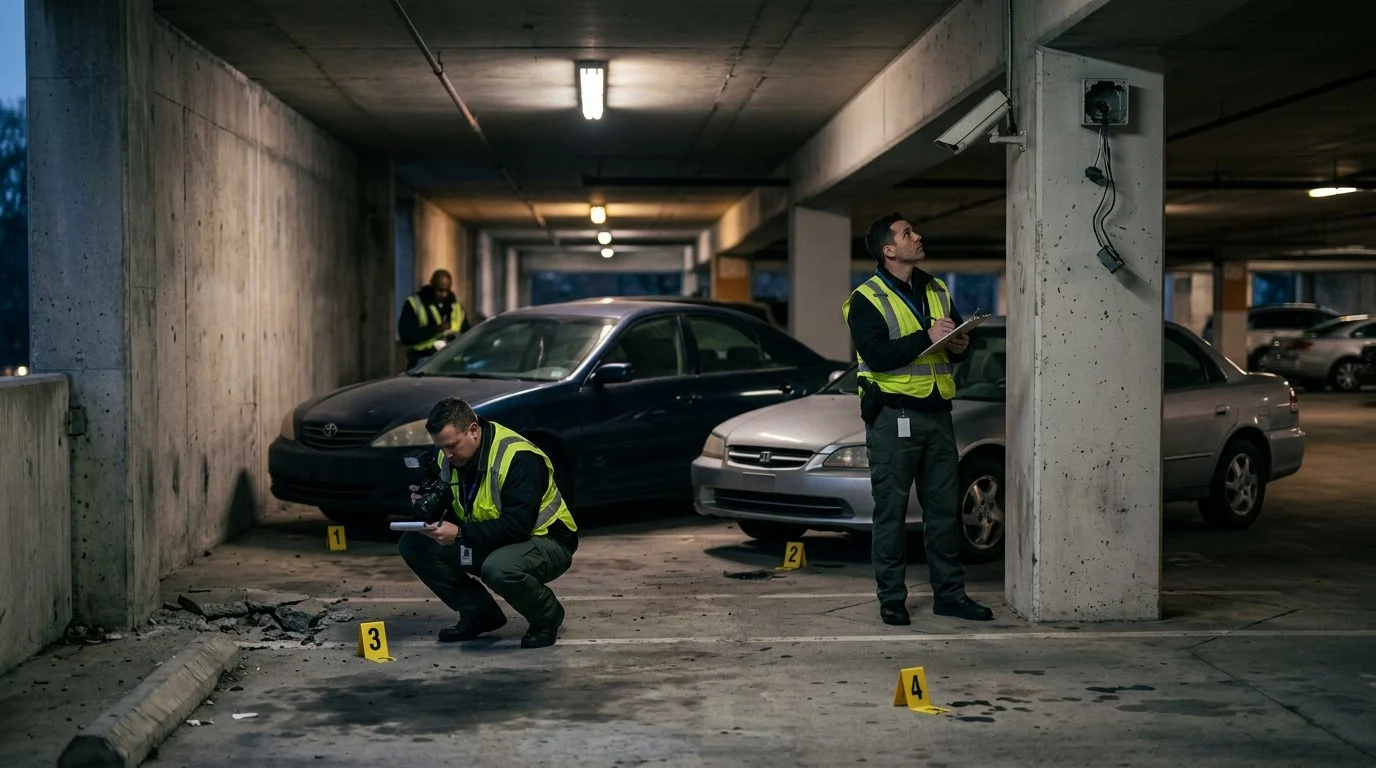
Insurance adjusters and courts apply the same negligence standard used on public roads. They examine evidence: witness statements, vehicle damage patterns, security camera footage, and the accident scene layout. Damage patterns often reveal which vehicle was moving and how fast. A witness who saw the collision can confirm what happened. Security footage from nearby businesses can be decisive.
Do You Need a Police Report for a Parking Lot Accident?
Georgia law does not require police to respond to all parking lot accidents. Many police departments will not dispatch for low-speed, property-damage-only collisions on private property. This doesn’t mean the accident isn’t serious—it’s simply a resource decision by law enforcement.
You can still file a report yourself or request one. Some Georgia police departments allow online reporting for minor collisions. If anyone is injured, call 911; police are much more likely to respond to injury collisions and will document the scene.
A police report is not required to file an insurance claim in Georgia. However, a report strengthens your position if fault is disputed. If the other driver’s insurer disagrees with your account, a police report provides an official record that supports your version.
What to Do Immediately After a Parking Lot Collision
Your actions in the first minutes matter. Here’s a clear checklist:
- Move vehicles to safety – If possible and safe, move both vehicles out of traffic flow to prevent additional collisions.
- Turn on hazard lights – Signal that vehicles are disabled or stopped.
- Check for injuries – Ask the other driver and any passengers if anyone is hurt.
- Call 911 if needed – If anyone reports pain, difficulty breathing, or visible injury, call immediately.
- Exchange information – Get the other driver’s name, phone number, address, driver’s license number, vehicle make/model/year, license plate, and insurance company and policy number.
- Take photos and video – Photograph both vehicles’ final positions, damage to each vehicle, the parking lot layout, road markings, signs, lighting, and weather conditions. Take video of the overall scene.
- Get witness contact information – If anyone saw the collision, ask for their name and phone number.
- Avoid admitting fault – Don’t say “I’m sorry” or “It was my fault.” Stick to facts: “Here’s what I saw happen.”
- Report to your insurance company – Call your insurer within 24 hours and describe what happened.
Documenting Your Parking Lot Accident for Insurance and Legal Purposes
Strong documentation is your best defense if fault is disputed. Photos should show:
- The final position of both vehicles relative to parking spaces, aisles, and lot boundaries
- Damage to each vehicle (close-ups and wide shots)
- The parking lot layout, including any directional arrows, stop signs, or yield markings
- Lighting conditions and weather
- Any relevant signage (speed limits, one-way indicators, handicap zones)
Write down the date, time, weather, and a brief description of what happened while it’s fresh in your mind. Note the other driver’s demeanor and any statements they made. If you were injured, keep all medical records, bills, and receipts—even minor symptoms can develop into significant injuries hours or days later.
Preserve any security camera footage from nearby businesses. Request it in writing and keep a copy. Many businesses record their parking lots, and that footage can be decisive evidence.
Not sure what your next step is?
Talk it through with our team — the first consultation is free, confidential, and carries no obligation.
Insurance Claims and Fault Disputes in Parking Lot Accidents
Your insurance company will investigate and assign fault based on the evidence and Georgia law. If the other driver’s insurer disputes fault, your insurer will advocate for you. If you believe you were wrongly assigned fault, you can dispute it with your insurer or the other party’s insurer.
If the other driver lacks adequate insurance, your uninsured or underinsured motorist coverage may apply. This coverage protects you when the at-fault driver has no insurance or insufficient limits to cover your damages.
If injuries or property damage exceed insurance limits, you may have a personal injury or property damage claim against the other driver directly.
When a Parking Lot Accident Causes Injury
Seek medical attention immediately, even if you feel okay. Some injuries—whiplash, concussion, internal injuries—appear hours or days after a collision. Keep all medical records, bills, and receipts.
Report the injury to your insurance company and the other driver’s insurer. Do not settle a claim quickly if you’re still treating or unsure of the full extent of your injury. Georgia law allows you to recover damages for medical expenses, lost wages, pain and suffering, and other losses caused by the other driver’s negligence.
Your Next Step: When to Reach Out for Guidance
Many parking lot accident claims are straightforward and resolve through insurance. Some situations—disputed fault, significant injury, uninsured drivers, or substantial damage—benefit from legal guidance.
If you’re navigating a parking lot collision where fault is unclear, injuries are involved, or the other driver disputes responsibility, talking through your situation with someone familiar with Georgia negligence law can clarify your rights and options. You don’t have to handle the insurance company or a dispute alone.
Frequently Asked Questions
Who is at fault in a parking lot accident in Georgia?
The driver who violated a duty of care is at fault—the same standard applies in parking lots as on public roads. Fault is determined by evidence: witness statements, vehicle damage, scene layout, and security footage.
Do I need a police report for a parking lot car accident?
No, a police report is not required to file an insurance claim in Georgia. However, it strengthens your position if fault is disputed.
What is comparative negligence and how does it apply to parking lot accidents?
Comparative negligence means fault can be shared (O.C.G.A. § 51-12-33; Quynn v. Hulsey, 310 Ga. 473 (2020)). If you’re 20% at fault and the other driver 80% at fault, you can recover 80% of your damages under Georgia law.
What should I photograph after a parking lot accident?
Photograph both vehicles’ final positions, damage to each vehicle, the parking lot layout, road markings, signs, lighting, and weather. Take wide and close-up shots.
Can I recover damages for injuries from a parking lot accident in Georgia?
Yes. Georgia law allows recovery for medical expenses, lost wages, pain and suffering, and other losses caused by another driver’s negligence.
What if I was partially at fault for a parking lot accident in Georgia?
You can still recover damages, reduced by your percentage of fault (O.C.G.A. § 51-12-33; Quynn v. Hulsey, 310 Ga. 473 (2020)). Georgia comparative negligence law allows partial recovery (O.C.G.A. § 51-12-33; Quynn v. Hulsey, 310 Ga. 473 (2020)).
If you’re sorting through a parking lot collision—whether it just happened or fault is being disputed—reach out to discuss what happened and what comes next. People in that situation can contact us, and we’re here to help clarify your rights and options.
Request a free consultation
or call to speak with our team about your parking lot accident.
Document Everything at the Scene
Take photos of vehicle damage, the accident location, road markings, and any visible security cameras. Get contact information from witnesses and the other driver. This evidence is critical to establishing fault.
How Fault Is Determined in Parking Lot Accidents
Duty of Care Applies Everywhere
Georgia law holds drivers to the same standard in parking lots as on public roads. The driver who violated a duty of care—by failing to yield, speeding, or driving recklessly—is at fault.
Evidence Tells the Story
Fault is established through witness statements, vehicle damage patterns, the scene layout, security footage, and police reports (if available). Multiple sources of evidence strengthen your claim.
Comparative Fault Rules Apply
Georgia allows recovery even if you are partially at fault, as long as you are less than 50% responsible; if you are 50% or more responsible, you recover nothing (O.C.G.A. § 51-12-33; Quynn v. Hulsey, 310 Ga. 473 (2020)). Your recovery is reduced by your percentage of fault (O.C.G.A. § 51-12-33; Quynn v. Hulsey, 310 Ga. 473 (2020)).
Insurance Handles Most Claims
Your insurer and the other driver's insurer typically investigate and negotiate. If settlement talks stall or the offer is unfair, legal action may be necessary.
What We Do for Parking Lot Accident Claims
Gather and Organize Evidence
We collect police reports, witness statements, photos, security footage, and insurance records to build a clear picture of how the accident happened.
Establish Liability
We analyze the facts and Georgia law to determine fault and hold the responsible party accountable for your injuries and damages.
Negotiate with Insurers
We communicate with insurance companies on your behalf to pursue fair compensation for medical bills, lost wages, vehicle repair, and pain and suffering.
Advise Your Options
We explain your rights, the strength of your claim, and whether settlement or litigation makes sense for your situation.
Common Questions About Parking Lot Accidents
Do I need a police report?
A police report is not required for a parking lot accident, but it strengthens your claim. If injuries or significant damage occurred, request one. If police do not respond, document the scene yourself and file a report with your insurance company.
What if there are no witnesses?
Witness statements are valuable but not essential. Vehicle damage, security footage, scene photos, and the other driver's statements can establish fault. An attorney can help you gather and interpret this evidence.
Is the property owner liable?
In rare cases, the parking lot owner may share liability if poor maintenance, inadequate lighting, or lack of security contributed to the accident. We evaluate whether premises liability applies to your situation.
What if the other driver leaves the scene?
Hit-and-run accidents are more complex but not impossible to resolve. Report it to police and your insurer immediately. We can help you pursue claims through your uninsured motorist coverage or other avenues.