
Duluth, Georgia | Serving metro Atlanta and Georgia
Losing a Loved One in a Rideshare Crash? You Don't Have to Face It Alone.
Slam Dunk Attorney focuses on wrongful death claims arising from Uber and Lyft accidents. We help Georgia families understand their options and pursue accountability while they grieve.
By Peter F. Jaraysi · Published October 30, 2026
A fatal Uber or Lyft crash can give surviving family a wrongful death claim under Georgia law. Families looking for a Georgia rideshare wrongful death lawyer usually need three answers first: who can file, how long they have, and which insurance may pay. This page covers each point in plain language. Slam Dunk Attorney is based in Duluth, Georgia, and represents clients in metro Atlanta and across the state.
What a Rideshare Wrongful Death Claim Is and Who It Is For
A rideshare wrongful death claim is a civil lawsuit. Surviving family brings it after someone dies in a crash involving an Uber or Lyft driver. The claim seeks money for the loss. It is not a criminal case.
The person who died may have been a passenger, the driver, a pedestrian, a cyclist or another motorist. A civil claim can move forward even when no one is charged with a crime. A police report can still be useful evidence.
This page is for spouses, children, parents and other relatives facing a loss now. Our first consultation is free and confidential, so families can ask questions before they decide anything.
If someone you love died in an Uber or Lyft crash in Georgia, our team can review the trip records, the deadline and your insurance options with you. Talk it through with our team — the first consultation is free, confidential, and carries no obligation.

Common Ways Fatal Uber and Lyft Crashes Happen
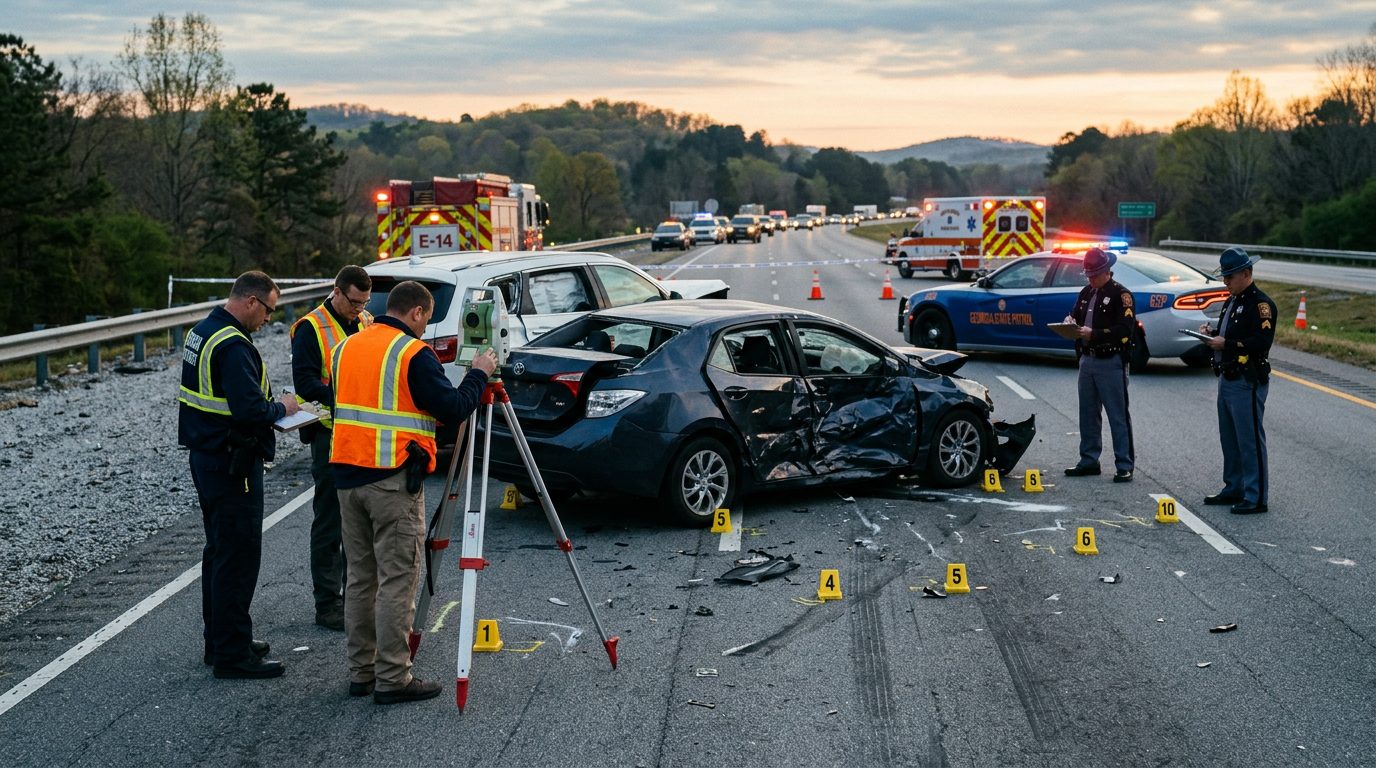
Fatal rideshare crashes often involve the same driving errors seen in other serious crashes. The app adds questions about driver status and who may pay.
- Impaired or drowsy driving. This includes driving after drinking or after many hours on the road.
- Distracted driving. Checking a ride request, a map or a phone takes attention off the road.
- Speeding or running red lights. Failing to yield at busy metro Atlanta intersections can cause deadly turning and side-impact crashes.
- Multi-vehicle crashes. A rideshare car may be one of several vehicles, with a truck, motorcycle or another driver also at fault.
Responsibility depends on the crash facts. Possible responsible parties include the driver, the vehicle owner, another driver or a property owner whose hazard played a role. Georgia assigns fault by percentage. A plaintiff found 50 percent or more responsible may not recover damages (O.C.G.A. § 51-12-33).
Many families focus only on the police report. The app’s trip record matters too. Under Georgia transportation network insurance law (O.C.G.A. § 33-1-24), within 15 days after a personal vehicle insurer requests it for claims coverage investigation, the rideshare company must provide the accident date and times and the precise times in the 12 hours preceding and following the accident that the driver logged on and off.
Who Can File in Georgia and the Filing Deadline
Under Georgia law, the surviving spouse may bring a wrongful death claim. If there is no surviving spouse, a child or children may bring it (O.C.G.A. § 51-4-2).
That question is reviewed at the consultation.
Georgia’s general time limit for actions for injuries to the person is two years after the right of action accrues (O.C.G.A. § 9-3-33). Ask the firm how that limit applies to your family’s claim. Do not wait on the question.
Under O.C.G.A. § 9-3-99, the running of the filing period for a tort claim brought by the victim of an alleged crime committed in Georgia, arising out of that crime, is tolled from the date of the alleged crime until its prosecution has become final or is otherwise terminated, provided that this time does not exceed six years, except as otherwise provided in O.C.G.A. § 9-3-33.1.
How Insurance Coverage Works When the Driver Was Using the App
Insurance in a rideshare crash depends mostly on the driver’s app status. Georgia sets different minimum coverage for each period.
- Logged on, no ride accepted. The statute sets a minimum of $100,000 per accident. It sets a maximum of $50,000 for one person’s injury or death.
- From accepting a ride request until the driver completes the transaction or the ride is complete, whichever is later. The rideshare company must carry at least $1 million per occurrence for death, personal injury and property damage (O.C.G.A. § 33-1-24).
A driver’s personal auto insurer may exclude coverage for losses while the driver is logged on to the app (O.C.G.A. § 33-1-24). The decedent’s own uninsured motorist coverage can apply when the at-fault driver is uninsured (O.C.G.A. § 33-7-11).
Coverage is confirmed case by case. It turns on the app records, the policies and the crash facts. Early review of the trip log helps the family plan.
What Damages May Be Recoverable
Georgia allows the surviving spouse or, if there is no surviving spouse, the child or children to recover the full value of the decedent’s life, as shown by the evidence (O.C.G.A. § 51-4-2). Other losses can also be part of the claim.
- Funeral and medical costs. The personal representative may recover funeral, medical and other necessary expenses when death results from a crime or from criminal or other negligence (O.C.G.A. § 51-4-5).
- Reasonable medical charges. Medical expenses are limited to the reasonable value of medically necessary care (O.C.G.A. § 51-12-1.1).
- Spouse’s share. The surviving spouse receives no less than one-third of the recovery (O.C.G.A. § 51-4-2).
- Protection from debts. A recovery under that subsection is not subject to the decedent’s debts (O.C.G.A. § 51-4-2).
If the decedent had Medicare, the Medicare Secondary Payer rules matter. Families should understand this before they review any settlement.
No dollar amount can be predicted before the facts, evidence and coverage are reviewed.
How the Process Works, Step by Step
A rideshare wrongful death claim usually moves through five steps. Suit is filed only if the claim does not resolve.
- Free consultation. The team reviews the crash, the family’s questions and the filing deadline.
- Evidence. The team works to preserve the police report, app and trip records, witness statements and medical records.
- Those records can be important evidence.
- Claim presentation. The firm identifies every possible responsible party and insurance source, then presents the claim to insurers. Some claims resolve through negotiation. Others go to court.
- Lawsuit, if needed. If the claim does not resolve, suit is filed in the proper Georgia court before the deadline.
Timelines vary with the insurers, the evidence and whether suit is filed. The consultation covers the steps expected in your case.
Not sure what your next step is?
Talk it through with our team — the first consultation is free, confidential, and carries no obligation.
Why Families Contact Slam Dunk Attorney
Slam Dunk Attorney is based in Duluth, Georgia. The firm represents clients in metro Atlanta and across Georgia. That includes Lawrenceville, Johns Creek, Alpharetta, Marietta, Norcross, Kennesaw, Dunwoody and Atlanta.
Peter F. Jaraysi and Brian D. Wright are among the firm’s lawyers. The firm’s assistants and office staff help families gather records and keep track of dates.
The firm also handles truck and motorcycle crashes, pedestrian accidents, nursing home abuse and catastrophic injury cases. Families whose facts overlap can review them in one consultation. The team explains each step in plain language, so the family knows what comes next.

Questions Families Ask Before Calling a Lawyer
What if the driver was logged off the app?
Coverage can differ with app status. The app records are reviewed early.
Can a parent file?
Georgia’s rules name the surviving spouse first, then children.
How long does a case take?
Timing varies with the insurers, the evidence and whether suit is filed.
What does the consultation cost?
The first consultation is free, confidential and carries no obligation to continue. Clients may still be responsible for court costs and case expenses. Fee terms are explained at the consultation.
If a family member died in an Uber or Lyft crash, a free review can answer your deadline and insurance questions. Contact Slam Dunk Attorney to talk through the trip records, the time limits and your options.
This page gives general information about Georgia law. It is not legal advice. Responsible lawyer: Peter F. Jaraysi, Slam Dunk Attorney, Duluth, Georgia. Contact:
How We Can Help Your Family
Clear, Plain-Language Answers
We explain Georgia wrongful death law in terms you can follow, so you know what to expect at each stage.
Investigation of the Rideshare Trip
We work to identify the driver, the app status, the trip records and the insurance coverage that may apply to the crash.
Accountability for Those Responsible
We look at every party whose conduct may have contributed to the crash, including other drivers, vehicle owners and companies.
Compassion Through a Difficult Time
Our team understands that a claim is never just a case file. We treat your family with patience and respect.
Speak With a Lawyer Before Giving Statements
Insurance representatives may contact your family quickly after a crash. Before giving a recorded statement or signing any paperwork, consider talking with a lawyer about what you are being asked to provide.
Rideshare Wrongful Death Claims We Handle
Passengers Who Lost Their Lives
When a passenger dies in an Uber or Lyft crash, the family may have questions about who was responsible and what claims may be available.
Pedestrians and Other Road Users
Rideshare crashes can also take the lives of pedestrians, cyclists and drivers of other vehicles. Their families deserve answers too.
Crashes Involving Trucks or Multiple Vehicles
Some fatal crashes involve commercial trucks or several vehicles. These cases can require added investigation to sort out each party's role.