
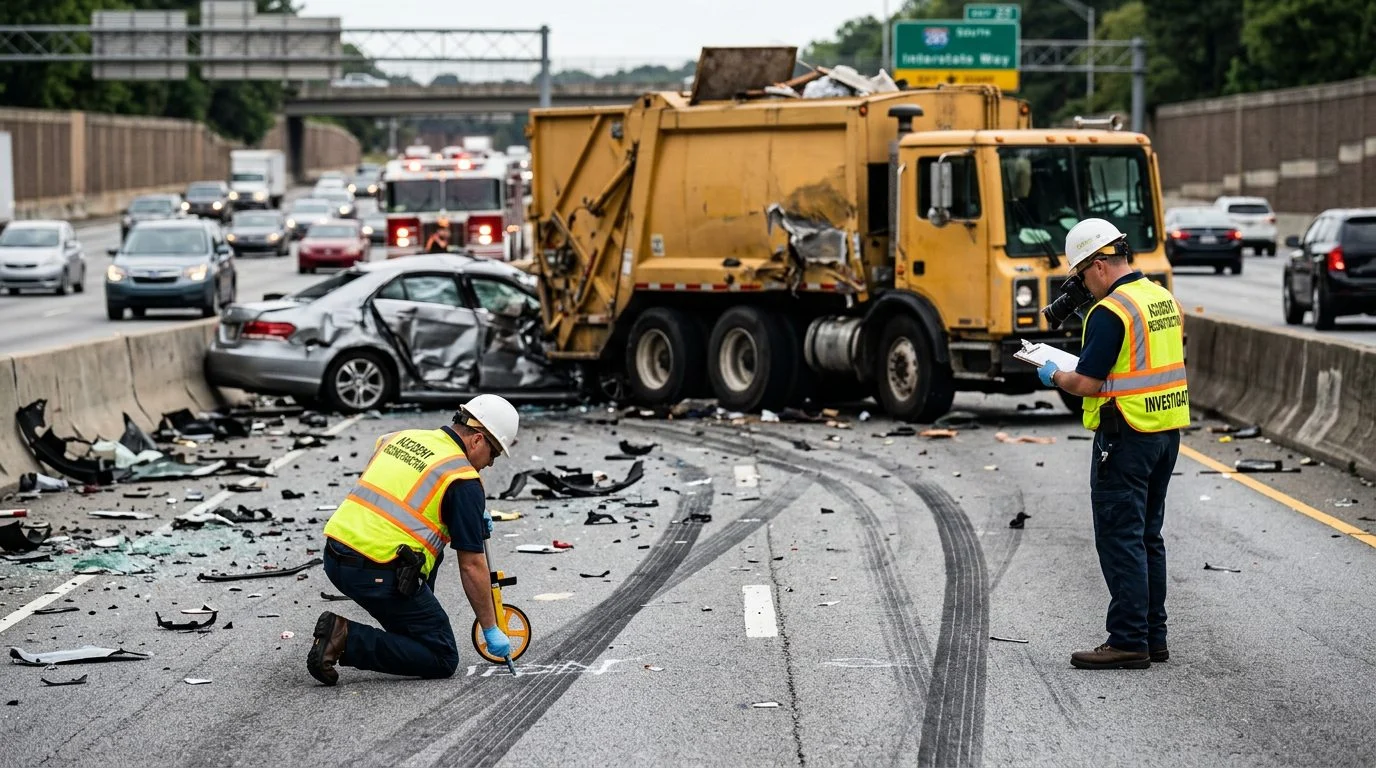
Duluth, Georgia | Truck Accidents Across Metro Atlanta
Hurt in a Garbage Truck Crash on I-285? Talk With Our Team Today
Garbage and refuse trucks are heavy, and crashes on I-285 can leave people with serious injuries. Our Duluth firm represents people hurt in truck accidents across metro Atlanta and Georgia.
By Peter F. Jaraysi · Published November 6, 2026
If you were hurt in an Atlanta garbage truck accident, the first steps matter most: get medical care, write down what happened, and be careful with calls from the trucking company’s insurer. Georgia’s general deadline for an injury lawsuit is two years, but a claim against a city can require written notice much sooner. Slam Dunk Attorney, based in Duluth, Georgia, represents people hurt in truck crashes across metro Atlanta. This guide answers the questions people ask most often after a crash like this.
What Makes a Truck Crash on I-285 Different
A truck crash on I-285 differs mainly because of size, weight, and blind spots. A loaded truck needs far more distance to stop than a passenger car. Its driver also has large blind spots along both sides and behind the trailer.
Garbage trucks and dump trucks are commercial trucks. They can be involved in the same kinds of crashes as tractor-trailers, and a heavy vehicle can cause serious harm to people in smaller cars. Our overview of truck accident claims in Georgia explains how these cases generally work.
Interstate traffic moves quickly around the top end of metro Atlanta. Less time to react means a lane change or sudden slowdown can turn into a serious collision. Because truck crashes often involve several vehicles, the police report and scene photos can matter a great deal later.
If a garbage truck or dump truck hurt you or someone you love on I-285, you don't have to sort out the insurer's calls alone. Reach out to our team for a free, confidential consultation. Talk it through with our team — the first consultation is free, confidential, and carries no obligation.

Common Injuries After a Truck Collision
Truck crashes can cause brain injuries, spinal cord injuries, broken bones, internal injuries, amputations, and severe burns. Many of these are catastrophic injuries, meaning they can change a person’s life for a long time.
Brain injuries and spinal cord injuries are often among the most serious. A spinal cord injury can lead to paralysis. Severe burns can require long treatment, and some people face amputation.
Some symptoms appear later. Headaches, dizziness, neck pain, or stiffness may not show up until hours or days after the crash. Get checked by a doctor even if you feel you’re “okay.” Tell your doctor about every symptom, even the small ones.
Catastrophic injuries often need long-term care, such as rehabilitation, follow-up visits, and help at home. The full extent of an injury can take time to understand. That’s why it’s wise not to rush decisions about your claim.
Crash Patterns Seen in Atlanta Truck Accidents
Most truck crashes fall into a few common patterns. The pattern can help explain how the collision happened.
A jackknife happens when the trailer swings out sideways, often during hard braking, and can sweep into other lanes. A rollover happens when the truck tips onto its side, often on a curve or ramp, and can crush or spill onto nearby cars. An underride crash happens when a car slides under the back or side of a trailer, which can cause severe harm to the people inside.
A blind spot crash happens when a truck changes lanes and hits a car the driver could not see in a mirror. A rear-end collision happens when a truck strikes a car from behind, often when traffic slows suddenly. A multi-vehicle collision involves several cars or trucks, which can make it harder to tell who struck whom first.
The crash pattern is a starting point, not a conclusion. Investigators look at the whole scene, the vehicle data, and the driver’s account before they decide how a crash happened.
Who May Be Responsible for the Crash
More than one person or company can share responsibility for a truck crash. The driver, the trucking or hauling company, the vehicle owner, and a maintenance or loading contractor can each be part of the picture. The facts decide who is involved.
Georgia law can hold a business responsible for harm its worker causes while doing the job. Under O.C.G.A. § 51-2-2, a person is liable for torts committed by a servant within the scope of the person’s business. An employer can also be liable for a contractor’s negligence in some situations, such as when it controls how the work is done, under O.C.G.A. § 51-2-5.
Georgia also uses a shared-fault rule. If you were partly at fault, your award is reduced by your percentage of fault. If you were 50 percent or more responsible, you cannot receive damages, under O.C.G.A. § 51-12-33. Readers in nearby areas can also review our pages for Lawrenceville and Johns Creek.
Evidence to Preserve in the First Days
The most useful evidence includes the crash report number, photos, witness contact details, medical records, and the names of the trucking company and insurer shown on the truck. Gather what you can while it’s still fresh.
Photos of the scene, the vehicles, the road, and your injuries capture details that fade quickly. Write down witness names and phone numbers before people leave.
Commercial trucks also create records. Drivers must review and certify their electronic logging device (ELD) records, and carriers cannot alter or erase the original hours-of-service information, under 49 C.F.R. § 395.30. Companies must keep records for at least the minimum periods in appendix A to this part, and after those periods records may be destroyed at the discretion of each company’s management, but this does not excuse compliance with any other governmental body’s lawful requirements for longer retention periods, under 49 C.F.R. § 379.3. That’s why early requests for records matter.
After some crashes, federal rules require drug and alcohol testing of the surviving driver. If an alcohol test isn’t given within two hours, the employer must record why. Alcohol testing stops after eight hours, and controlled substance testing stops after 32 hours, under 49 C.F.R. § 382.303. Keep a written log of symptoms, missed work, and out-of-pocket costs.
Dealing With the Trucking Company’s Insurer
The trucking company’s insurer works for the company, not for you. Its adjusters may call you soon after the crash.
You don’t have to give a recorded statement right away. You can wait until you understand your injuries before you sign releases or accept any payment. Speaking with a lawyer before you agree to anything is a common step.
Keep every medical appointment and follow your doctor’s instructions. Be careful about what you post online about the crash or your activities, because those posts can be seen by others involved in the claim. Write down the insurer’s name, claim number, and adjuster’s contact details.
Not sure what your next step is?
Talk it through with our team — the first consultation is free, confidential, and carries no obligation.
Georgia Deadlines to Know
Georgia’s general deadline for an injury lawsuit is two years from the date the right of action accrues, under O.C.G.A. § 9-3-33. The same statute sets four years for injury actions involving loss of consortium.
Claims against a city move faster. Under O.C.G.A. § 36-33-5, a written claim against a municipal corporation for injury must be presented within six months of the event. The claim must also state the specific amount of monetary damages sought. If a garbage truck belongs to a city, that six-month window can close long before the general two-year deadline.
State government entities have a separate rule.
Families of people killed in truck crashes have their own rules. Under O.C.G.A. § 51-4-2, a surviving spouse, or children if there is no spouse, may recover the full value of the decedent’s life, as shown by the evidence.
Talk With Our Team About Your I-285 Crash
If you were hurt in an Atlanta garbage truck accident on I-285, you can ask our team for a free, confidential consultation. You may be deciding whether to speak with the trucking company’s adjuster, sign a form, or wait. Our team can review what happened and explain the deadlines that may apply. The first consultation is free and confidential, with no obligation to continue.
Does an Atlanta garbage truck accident attorney handle claims against a city?
Our team represents people hurt in garbage truck crashes and can explain the six-month written-notice rule for city claims. Whether a city claim exists depends on the facts of the crash.
How long do I have to file a truck accident claim in Georgia?
Georgia’s general deadline for an injury-to-the-person lawsuit is two years after the right of action accrues, except as otherwise provided in this article, under O.C.G.A. § 9-3-33. Claims against a city can require written notice within six months.
Can I still recover if I was partly at fault?
Yes, your award is reduced by your share of fault under O.C.G.A. § 51-12-33. At 50 percent or more, you cannot receive damages.
Can a family sue after a loved one dies in a truck crash?
A surviving spouse, or children if there is no spouse, may recover for the homicide of a spouse or parent under O.C.G.A. § 51-4-2. The statute sets out who may bring the claim.
If a truck or garbage truck hurt you or a family member on I-285, reach out to Slam Dunk Attorney today to request your free, confidential consultation.
Attorney advertising. Responsible lawyer: Peter F. Jaraysi, Slam Dunk Attorney, Duluth, Georgia. Contact information is on our contact page.
How We Can Help
Confidential Conversations
What you share with our team is kept confidential, so you can talk openly about what happened.
Plain-Language Guidance
We explain the process in everyday terms so you know what to expect at each stage.
Free First Consultation
Our initial consultation is free, confidential, and comes with no obligation to continue.
Serving Metro Atlanta
We represent people hurt in crashes throughout metro Atlanta, including Lawrenceville, Johns Creek, Alpharetta, Marietta, Norcross, Kennesaw and Dunwoody.
Important: Be Careful After a Crash
Get medical care right away, even if your injuries seem minor. Before you give a recorded statement to an insurance company or a government agency, consider speaking with a lawyer first.
What to Gather After a Garbage Truck Crash
Photos and Video
Pictures of the scene, vehicle damage, lane positions and any visible injuries can help document what happened.
Police Report Information
Note the responding agency, the report number and the names of any officers or drivers involved.
Witness Contact Details
Names and phone numbers of people who saw the crash can be valuable if questions arise later.
Medical Records
Keep every visit note, test result and bill, including follow-up care recommended by your doctor.