
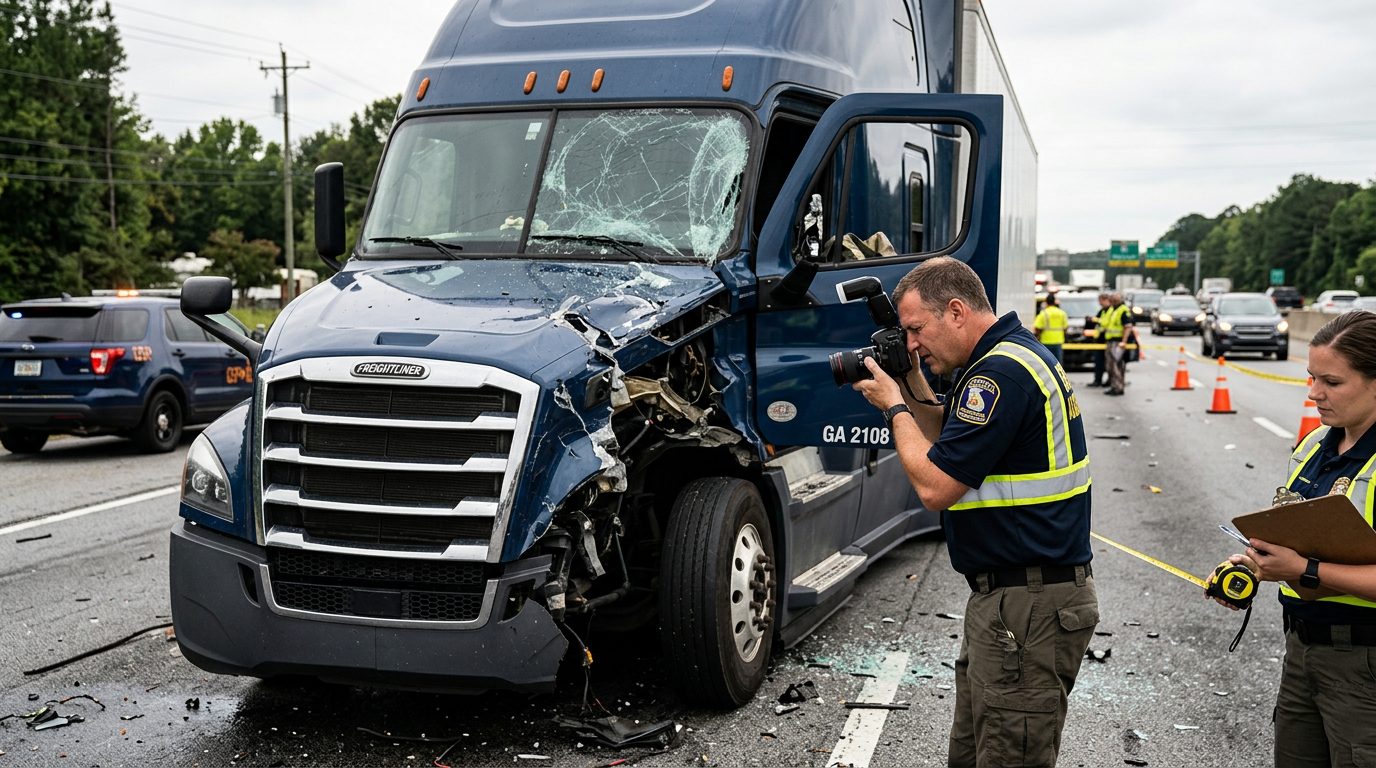
Semi Truck Accidents | Duluth, Georgia
Semi Truck Accident Compensation in Georgia: How Value Is Set
There is no single number for a semi truck claim. Here is a plain-language look at the factors that shape value, from your injuries and bills to fault and available insurance.
By Peter F. Jaraysi · Published October 19, 2026
If you ask how much money you can get if you get hit by a semi truck, the honest answer is that there is no single number. Value is built from your injuries, your medical bills and lost income, who was at fault, and how much insurance is available. This page explains each piece in plain Georgia terms.
Why There Is No Single Number for a Semi Truck Claim
There is no fixed figure for a semi truck claim. Each claim is valued on its own facts. Two crashes that look alike can end up with very different values once the records are in.
If you’re hurt, worried about bills, or looking into this for someone you love, you have a lot on your plate. It’s normal to want straight answers fast.
Online calculators and averages can give you a rough sense of scale. They can’t replace a look at the medical records and the crash details. A number on a website doesn’t know how your injury has changed your work or your sleep.
The rest of this page walks through the parts that move a claim up or down. For a wider view, see our Georgia truck accident overview. Slam Dunk Attorney is a personal injury law firm based in Duluth, Georgia, and our team serves metro Atlanta and Georgia.
If a semi truck crash has left you hurt or worried about someone you love, you may have a claim, and our team can review the facts with you. Talk it through with our team — the first consultation is free, confidential, and carries no obligation.

The Two Categories of Compensation in a Truck Crash Claim
A truck crash claim is built from two kinds of losses: economic damages and non-economic damages.
Economic damages come with a bill or a number attached. They include past and future medical bills, lost wages, lost earning ability, vehicle and property damage, and other out-of-pocket costs. Georgia law limits medical expenses to the reasonable value of medically necessary care, and the judge or jury decides that value (O.C.G.A. § 51-12-1.1). If you have any form of public or private health insurance, including benefits under a governmental workers’ compensation program, the evidence must include both the amount charged and the amount actually needed to satisfy that charge under your insurance contract or the workers’ compensation program, whether or not the insurance has been, is, or will be used.
Non-economic damages cover losses that don’t come with a receipt. Pain, emotional distress and changes to daily life fall in this group. Ongoing treatment notes and a clear record of what you can no longer do help support both categories.
If a loved one died, different rules apply. A surviving spouse, or children if there is no surviving spouse, may recover the full value of the life lost, as shown by the evidence (O.C.G.A. § 51-4-2). When death results from a crime or from criminal or other negligence, the personal representative can also recover funeral and medical expenses (O.C.G.A. § 51-4-5).
How Georgia Fault Rules Can Change What Is Recoverable
Georgia reduces your recovery by your share of fault. It bars recovery altogether if you are 50 percent or more responsible (O.C.G.A. § 51-12-33; Quynn v. Hulsey, 310 Ga. 473 (2020)).
Under O.C.G.A. § 51-12-33, the judge cuts the damages by your percentage of fault. Under O.C.G.A. § 51-12-33, if you are to some degree responsible for your own injury, the trier of fact determines your percentage of fault, and the judge reduces the damages otherwise awarded to you in proportion to that percentage. A higher share means a bigger cut. At 50 percent or more, the statute says you cannot receive damages.
Fault can be shared among several people. Each liable person then owes only their own share. The shares are not joint.
Trucking companies often examine fault closely. They may point to traffic evidence, witness accounts, or the driver’s records. Federal limits on driving time matter here. The federal hours-of-service regulation for property-carrying drivers says a driver may not drive without first taking 10 consecutive hours off duty, may not drive after a period of 14 consecutive hours after coming on duty following those 10 hours off, may drive a total of 11 hours within that 14-hour period, and, apart from certain short-haul exceptions, may not drive if more than 8 hours of driving time have passed without at least a consecutive 30-minute interruption in driving status. The driver’s logs can matter a great deal when these limits are in question.
Who Can Be Liable and Why Insurance Coverage Matters
More than one party can be responsible in a semi truck crash. The driver is one. The trucking company that employed or dispatched the driver can be another. In some cases, other businesses tied to the truck or its load may also be examined.
Federal law sets insurance requirements for trucking companies. A federal financial responsibility statute requires the Secretary of Transportation to prescribe regulations setting minimum levels of financial responsibility sufficient to satisfy liability amounts established by the Secretary covering public liability, property damage, and environmental restoration for the transportation of property by motor carrier or motor private carrier. The federal schedule of public liability limits for motor carriers sets $750,000 as the minimum level of financial responsibility for for-hire carriage of nonhazardous property in interstate or foreign commerce in vehicles with a gross vehicle weight rating of 10,001 or more pounds.
A minimum is not the same as what a specific policy pays. Policy limits set the ceiling on what that policy will pay. Where the facts support it, other sources of recovery may be looked into.
Records also have a short life. The federal record-of-duty-status regulation states that a motor carrier shall keep the records of duty status and supporting documents required under the federal hours-of-service rules for each of its drivers for not less than 6 months from the date of receipt. That window is short, so asking for those records early matters.
An insurer’s first offer is a starting point, not the final value of a claim. Our team can review an offer with you before you decide anything.
When Punitive Damages Come Into Play in Georgia
Punitive damages are extra damages meant to punish or deter. They are not meant to pay for your losses. Georgia law says they are awarded “not as compensation to a plaintiff but solely to punish, penalize, or deter a defendant” (O.C.G.A. § 51-12-5.1). They are not part of every truck claim.
Georgia generally caps punitive damages at $250,000 in most tort cases. In a tort case that does not arise from product liability, there is no cap when the defendant acted with specific intent to cause harm. There is also no cap when the defendant acted while under the influence of alcohol, drugs other than lawfully prescribed drugs administered in accordance with prescription, or any intentionally consumed glue, aerosol, or other toxic vapor, to the degree that judgment was substantially impaired, and the uncapped damages apply only against an active tort-feasor. The claim must also specifically ask for punitive damages in the complaint.
Impairment is one example people ask about. Whether any of these fits a particular crash takes a careful review of the records.
What Insurers and Courts Look at When Valuing a Semi Truck Injury
Insurers and courts look for proof that the injury is real, was treated, and was caused by the crash. Four kinds of records do most of that work.
Medical records come first. Consistent care after the crash, with imaging and treatment notes, tells a clear story. Gaps in treatment can be questioned. Keep every appointment and tell your provider about every symptom.
Bills and wage records come next. Itemized charges, pay stubs and notes from your employer show what the injury cost. If care was given under a letter of protection (a promise to be paid from any settlement), Georgia law makes that letter, the itemized charges and any sale of the accounts relevant and discoverable (O.C.G.A. § 51-12-1.1).
Crash evidence matters too. The Georgia Department of Public Safety explains who may obtain a crash report and how to request one investigated by the Georgia State Patrol (Georgia Department of Public Safety). Photos, dashcam video, witness names and electronic logs also help.
Finally, don’t sign a release until you know the full extent of your injuries. Some injuries show up days or weeks after a crash.
Not sure what your next step is?
Talk it through with our team — the first consultation is free, confidential, and carries no obligation.

Time Limits and Taking the Next Step
Georgia requires most injury lawsuits to be brought within two years after the right of action accrues, except that actions for injuries to the reputation must be brought within one year, and actions for loss of consortium must be brought within four years, after the right of action accrues (O.C.G.A. § 9-3-33). Don’t wait to find out whether you have a claim.
For a tort claim against the state under this article (claims against the State of Georgia), written notice of the claim must be given within 12 months of the date the loss was discovered or should have been discovered (O.C.G.A. § 50-21-26). This can matter if a government-owned vehicle was involved. Whether your crash happened in Duluth, Lawrenceville or elsewhere in metro Atlanta, these notice rules apply to a tort claim against the state under this article.
How much money can you get if you get hit by a semi truck?
There is no set amount. Value depends on your injuries, medical bills, lost income, fault and available insurance.
Does Georgia fault law reduce my recovery?
Yes. Your award drops by your percentage of fault, and you recover nothing at 50 percent or more (O.C.G.A. § 51-12-33; Quynn v. Hulsey, 310 Ga. 473 (2020)).
How long do I have to file?
Most Georgia injury claims must be brought within two years after the right of action accrues.
If a semi truck crash has left you hurt or worried about someone you love, you may have a claim, and our team can review the facts with you. Ask for a free, confidential first consultation, with no obligation to continue, through our contact our team page.
Disclaimer: This page is general information about Georgia law and is not legal advice. Slam Dunk Attorney is a personal injury law firm based in Duluth, Georgia. The responsible lawyer is Peter F. Jaraysi. Contact the firm through its contact page.
The Four Pieces That Shape a Semi Truck Claim
Your injuries
The type, severity and long-term effects of your injuries are central to how a claim is valued.
Medical bills and lost income
Treatment costs, future care and wages you have lost or may lose are documented and weighed together.
Who was at fault
Fault is one of the key questions in any truck crash claim, and the evidence from the scene and records is examined closely.
Available insurance
The insurance coverage that applies, including the trucking company's policies, affects how a claim can be resolved.
Keep Your Records From the Start
Save photos, the police report number, medical paperwork, pay stubs and any letters from insurers. Organized records help the people reviewing your claim understand what happened and what it has cost you.
What We Look at When Reviewing a Semi Truck Claim
Crash evidence
Scene photos, vehicle damage, witness accounts and the crash report help show how the collision happened.
Medical documentation
Records from emergency care through ongoing treatment show the injuries and the care they require.
Financial impact
Bills, wage records and documentation of how your daily life has changed help describe the full cost of the crash.
Coverage questions
We review the policies and insurance information that may apply to the trucking company and the parties involved.