
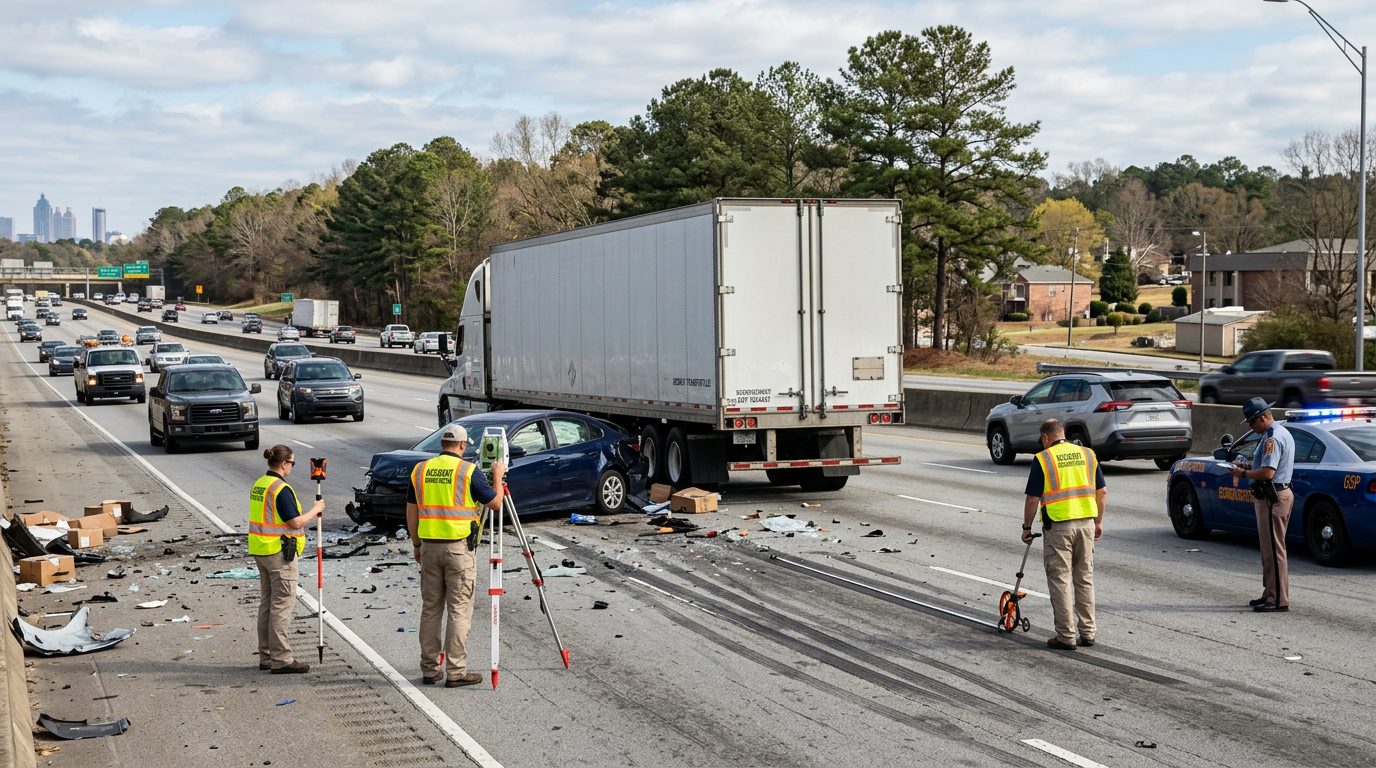
Truck Accidents | Duluth, Georgia
Truck Accident Claims in Georgia: Clear Next Steps After a Crash
A large truck collision can leave you facing medical bills, lost work, and an insurance company that wants to move fast. Here is how to take the right steps, one at a time.
By Peter F. Jaraysi · Published November 14, 2026
You were hurt in a crash with a big truck, and now you have medical bills, insurer calls, and a lot of questions. A truck accident claim in Georgia uses the same basic negligence rules as a car accident claim, but it usually involves more parties, more records, and more insurance.
This guide explains what stays the same and what changes. It also covers the early steps that matter most. For the broader picture, read our truck accident guide for Georgia. If you need truck accident claim assistance, knowing these differences is a useful first step.
Why a Truck Accident Claim Is Not Just a Bigger Car Accident Claim
A truck accident claim is still a negligence claim, but the investigation is usually much larger. Georgia law at O.C.G.A. § 51-1-2 states that, in general, ordinary diligence is “that degree of care which is exercised by ordinarily prudent persons under the same or similar circumstances,” and that “the absence of such diligence is termed ordinary negligence.”
The same basic question applies in both kinds of case. Did someone fail to use that care, and did that failure cause the harm?
The difference is in the details. A car crash often centers on two drivers and their insurers. A truck crash can involve the driver, the trucking company, the company that owns the truck, a freight broker that arranged the load, and a maintenance contractor. Each may have its own insurance and its own records.
Trucks are also heavy. That weight means a crash can cause severe harm, including spinal cord injury, traumatic brain injury, amputation, and severe burns. Serious injuries take time to understand, so the claim often takes longer to build.
So the differences are procedural and evidentiary as much as legal. The rules for proving fault stay the same. The work of finding and preserving proof changes a great deal.
If a truck crash has turned your life upside down, you don't have to sort out the next steps alone. A free, confidential first consultation with our team is a good place to start. Talk it through with our team — the first consultation is free, confidential, and carries no obligation.

Who Can Be Liable in a Georgia Truck Accident
In a truck crash, more than one company or person may share legal responsibility. The driver is only one possible defendant.
A person is liable for torts committed by a servant by his command, or in the prosecution and within the scope of his business, under O.C.G.A. § 51-2-2. That is why a trucking company may be responsible for a driver’s negligence on the job.
An employer can also be liable for a contractor’s negligence in certain cases. One example is when the employer keeps the right to direct or control the time and manner of the work, under O.C.G.A. § 51-2-5.
Georgia also looks at how a company chose and managed its drivers. The Georgia Supreme Court stated in Munroe v. Universal Health Services that an employer must use ordinary care not to hire or keep an employee it knew or should have known posed a risk of harm, where that harm was reasonably foreseeable from the employee’s tendencies.
Negligent entrustment is harder to prove. In Western Industries v. Poole, the Court of Appeals said that showing an owner should have known a driver was not competent is not enough.
Brokers can face claims too. In Montgomery v. Caribe Transport II (2026), the U.S. Supreme Court held that a state-law negligent-hiring claim against a broker falls within a federal safety exception and is not preempted.
Federal Trucking Rules, Insurance Limits, and Records That Change the Claim
Commercial trucks run under federal safety rules, and those rules can become evidence in a claim.
Hours of service is one example. Under 49 C.F.R. § 395.3, a driver may drive a total of 11 hours within a 14-hour period after 10 consecutive hours off duty. Under 49 C.F.R. § 395.1, a driver in short-haul operations, such as a 150 air-mile radius driver, is exempt from the requirements of §§ 395.8 and 395.11 if the conditions in that section are met. The 8-hour driving limit without a consecutive 30-minute interruption is in 49 C.F.R. § 395.3, which excepts drivers who qualify for the short-haul exceptions in 49 C.F.R. § 395.1(e)(1) or (2). Under 49 C.F.R. § 395.3(b), a driver of a property-carrying commercial motor vehicle may not drive for any period after having been on duty 60 hours in any period of 7 consecutive days if the employing motor carrier does not operate commercial motor vehicles every day of the week. Any period of 7 consecutive days may end with the beginning of an off-duty period of 34 or more consecutive hours.
Under 49 C.F.R. § 387.9, the prescribed minimum public liability for for-hire carriers of nonhazardous property in interstate or foreign commerce, in trucks rated at 10,001 pounds or more, is $750,000. That number is a required minimum. It is not an estimate of what any claim is worth.
Records are a major difference. Trucking companies keep driver logs, driver qualification files, inspection and maintenance records, and dispatch messages. Records may be kept electronically under 49 C.F.R. § 379.7, as long as the electronic version accurately reflects all of the information in the record and remains accessible in a form that can be accurately reproduced later for reference.
Georgia also limits when you can add a motor carrier’s insurer to a lawsuit. Under O.C.G.A. § 40-1-112(c), the insurer may be joined in the same action only in listed situations. Examples include when a related carrier is insolvent or bankrupt, or when personal service cannot be made after reasonable diligence on the driver or the motor carrier.
Why Evidence Timing Matters More in a Truck Accident
In a truck crash, key evidence often sits in the company’s hands. It can be lost if no one asks for it in time.
Georgia’s Supreme Court has said the duty to preserve evidence arises when litigation is reasonably foreseeable to the party that controls the evidence, not only after a lawsuit is filed. See Phillips v. Harmon.
A crash with serious injuries can make a lawsuit foreseeable quickly. That is why a preservation letter is a common early step. The letter asks the trucking company and its insurer to keep logs, dashcam video, maintenance files, and driver records.
You can also start building your own file now. Take photos of the scene, the vehicles, and your injuries. Write down the police report number, the company name on the truck, and the names of any witnesses. Save medical records and bills from the first days after the crash.
Keep a simple log of symptoms, treatment, missed work, and out-of-pocket costs. This habit helps in a car crash too. In a truck case, it matters more, because the company’s records may answer questions your photos cannot.
Reporting, Insurer Calls, and What to Say Early On
Georgia requires a driver to notify police after a crash that causes injury or death, or property damage of $500 or more. Under O.C.G.A. § 40-6-273, the notice goes to the local police department or, outside a city, to the county sheriff or the nearest state patrol office.
Get checked by a doctor even if you feel mostly fine at first. Tell the provider exactly how the crash happened. An early medical record helps show how the crash affected you.
Report the crash to your own insurer as your policy requires. Keep a copy of anything you send or sign.
Adjusters from the other driver’s insurer or the trucking company may ask for a recorded statement. Many people choose to talk with a lawyer before giving one. Early statements can be incomplete when injuries are still being diagnosed.
Stick to facts you know. Describe what happened in plain words. Don’t guess about speed, fault, or injuries that have not been diagnosed.
Georgia Deadlines and Shared Fault
For most Georgia personal injury claims, the filing deadline is two years after the right of action accrues. That rule comes from O.C.G.A. § 9-3-33. Wrongful death claims follow their own timing rules, so don’t assume the same clock applies.
Georgia also uses a shared fault rule. Under O.C.G.A. § 51-12-33(a), if you are partly responsible, the judge reduces your damages in proportion to your percentage of fault. Under subsection (g), you recover nothing if you are 50 percent or more responsible.
Truck cases often involve more parties to divide fault among. Under subsection (c), the jury must consider the fault of everyone who contributed, whether or not they were named in the suit. Under subsection (b), each liable person pays its own apportioned share, not a joint share.
A defendant can also name a nonparty as partly at fault. Under subsection (d), that notice must be given at least 120 days before trial.
Insurers may argue that you share some blame. Trucking companies often build detailed defenses. That is why early documentation of how the crash happened matters in both car and truck cases.
Not sure what your next step is?
Talk it through with our team — the first consultation is free, confidential, and carries no obligation.
Damages in Car and Truck Claims: What Drives the Value
The value of a claim depends on the facts of that claim, not on the size of the vehicle alone.
Claims usually look at medical bills, lost income, and how the injury changes daily life. Serious injuries add long-term treatment, rehabilitation, equipment, and future care needs. Catastrophic injuries such as paralysis or traumatic brain injury can call for years of care.
Medicare may be involved too. The Centers for Medicare & Medicaid Services explains that Medicare may make conditional payments when another insurer is responsible. Those payments must be reimbursed after a settlement, judgment, award, or other payment.
Keep receipts, bills, and pay stubs. Keep a written record of how the injury affects your work, sleep, and family life. These records help show the full picture over time.
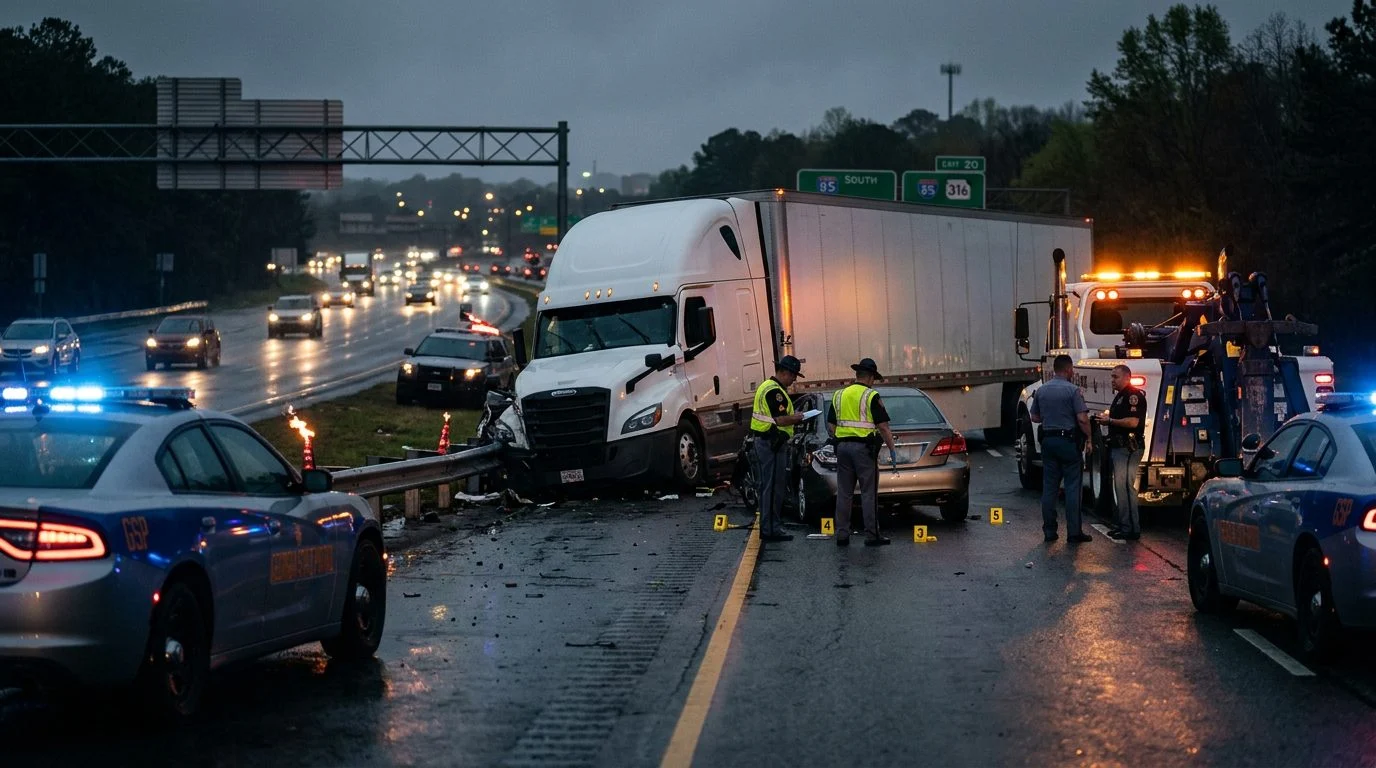
Talk With Our Team About Your Crash
A first conversation can help you sort out the steps in front of you after a truck crash.
You may be recovering from a crash you did not choose. You may be juggling medical visits and insurer calls, or helping a family member decide what comes next.
How long do I have to file a truck accident claim in Georgia?
Georgia generally requires actions for injuries to the person to be brought within two years after the right of action accrues, though injuries to reputation must be brought within one year and loss-of-consortium claims within four years, under O.C.G.A. § 9-3-33. Wrongful death claims follow their own timing rules.
Can I still recover if I was partly at fault?
Yes, if you are less than 50 percent responsible. Your recovery is reduced by your share of fault, under O.C.G.A. § 51-12-33. If you are 50 percent or more responsible, you recover nothing.
Do I have to call the police after a truck accident?
Georgia requires a driver involved in a crash resulting in injury, death, or property damage to an apparent extent of $500 or more to give immediate notice to police within a city, or outside a city to the county sheriff or nearest state patrol office, under O.C.G.A. § 40-6-273.
If a truck crash has affected you or someone you love, you can talk it through with us first. Slam Dunk Attorney offers a free, confidential first consultation, with no obligation to continue. You can reach our team here.
Responsible attorney: Peter F. Jaraysi, Slam Dunk Attorney, Duluth, Georgia. The firm represents people across metro Atlanta and Georgia, including Lawrenceville, Johns Creek, Alpharetta, Marietta, Norcross, Kennesaw, and Dunwoody. This page provides general information, not legal advice, and reading it does not create an attorney-client relationship. Every case is different.
How Our Firm Supports Truck Accident Clients
Plain-Language Guidance
We explain your situation in clear terms, so you understand what is happening and what your choices are.
Organized Case Information
Our team helps gather and organize the crash report, medical records, and other documents that matter to your claim.
Advocacy for Your Interests
We work to protect your interests when dealing with insurers and other parties involved in the crash.
Attention to Your Recovery
We understand that injuries come first. We keep you informed while you focus on your health and family.
Before You Speak With an Insurer
Adjusters for the trucking company or its insurer may contact you soon after a crash. Speaking with them without advice can affect your claim. Consider talking with a lawyer before giving a recorded statement or signing any release.
Steps to Take After a Truck Accident
Get Medical Care
See a doctor even if your injuries feel minor. Some injuries, including head and spinal injuries, can take time to show symptoms.
Document the Scene
If you are able, take photos of the vehicles, the road, visible injuries, and any skid marks or debris. Write down names and contact information for witnesses.
Keep Your Records
Save medical bills, pay stubs, receipts for expenses, and any letters from insurers. Keep a simple journal of how the injury affects your daily life.
Reach Out for Support
Contact our team to talk through what happened. A free, confidential consultation can help you understand your next steps.