
Truck Accidents | Duluth, GA
Hurt in a Semi Truck Crash? Find Out If You Can Sue
Semi truck collisions involve more parties, more paperwork and more pressure from insurers than typical car wrecks. Our Duluth team can explain your options in plain language and review what happened.
By Peter F. Jaraysi · Published October 23, 2026
Can you sue if a semi truck hits you? Often, yes. If another driver or company was careless and that carelessness caused the crash, you may have a claim for your losses. Whether you can sue depends on the facts, including who was at fault, what injuries you suffered, and whether the filing deadline is still open.
This guide answers that question in plain terms. It explains who can be responsible, what Georgia law requires you to show, how fault is divided, how long you have to file, and which evidence matters early. It is written for people hurt in a crash and for family members acting for someone hurt or killed.
Can you sue if a semi truck hits you? Often, yes, when someone else was negligent.
Often, yes, when another party’s negligence (failure to use reasonable care) caused the crash. Most of these cases start with an insurance claim. A lawsuit usually follows only if that claim cannot be resolved.
Insurers can accept fault, deny it, or dispute how serious your injuries are. Knowing that early helps you plan for a possible lawsuit, even if you hope the claim settles first. A lawsuit is a formal court case, and it follows its own timeline and rules.
If a semi truck crash left you or someone you love hurt, our team can talk through whether a claim may be available, and you don't have to face the next steps alone. Talk it through with our team — the first consultation is free, confidential, and carries no obligation.

Who can be held responsible when a semi truck hits you?
Responsibility can reach the truck driver, the trucking company, and sometimes other businesses tied to the truck.
The driver is the most obvious party. Negligent driving includes speeding, distracted driving, and following too closely. A driver who ignores traffic rules or is too tired to drive safely may also share the blame.
The trucking company, called the motor carrier, is often a separate target. Georgia law makes a person liable for torts committed by a servant in the prosecution and within the scope of his business, whether committed by negligence or voluntarily (O.C.G.A. § 51-2-2). In plain terms, a company can answer for a driver’s negligence while that driver was doing the company’s work.
Companies can also face claims over their own choices. These claims can involve how a carrier hired, trained, supervised, or kept a driver, and how it maintained its equipment.
Other parties may share responsibility too. These can include a vehicle owner, a maintenance contractor, a company that loaded the cargo, or a maker of a defective part. In Montgomery v. Caribe Transport II, LLC (2026), the U.S. Supreme Court held that a state-law claim that a broker negligently hired an unsafe motor carrier is not preempted by the FAAAA, a federal trucking statute. A truck crash can involve several companies and insurance policies, so the list of possible defendants is often longer than it first looks.
What must you prove under Georgia negligence law?
You generally must show that the other party owed you a duty, broke that duty, and that the break caused your harm.
Georgia describes ordinary negligence as the absence of ordinary diligence. That means failing to use the care that ordinarily prudent people use in similar circumstances (O.C.G.A. § 51-1-2).
Duty. A driver and a trucking company owe other road users reasonable care.
Breach. The driver or company failed that standard, such as by breaking traffic laws or safety rules.
Causation. The breach directly led to the collision and to your injuries.
Damages. You suffered measurable harm, such as medical bills, lost income, and pain and suffering. Damages compensate for an injury that can be estimated in money. If an injury is small or mitigating circumstances are strong, only nominal damages are given (O.C.G.A. § 51-12-4).
Insurers and defense lawyers often challenge the facts behind each point. That is why careful documentation matters from the start.
How can federal trucking rules become evidence?
Federal trucking rules set duties for drivers and carriers, and the records kept under them can help show what happened.
A motor carrier must require its drivers to observe the duties and prohibitions that federal motor carrier rules in part 325 of subchapter A or in this subchapter place on drivers (49 C.F.R. § 390.11). Drivers must also record their duty status for each 24-hour period. Carriers that operate commercial motor vehicles must install an electronic logging device (ELD) and require their drivers to use it to record that status, although a carrier may instead require manual records for certain drivers in accordance with the section (49 C.F.R. § 395.8).
Each motor carrier must keep a driver qualification file for every driver it employs. That file must be kept while the driver works for the carrier and for three years after, except that certain records may be removed three years after the date of execution (49 C.F.R. § 391.51).
Records such as a driver’s employment application and motor vehicle record can sometimes help show what a driver’s qualifications were at the time of a crash. A rule violation can support a claim, but it still has to connect to how the crash happened.
How long do you have to file a truck crash claim in Georgia?
Georgia generally requires a personal injury lawsuit to be brought within two years after the right of action accrues (O.C.G.A. § 9-3-33).
That deadline is strict. Waiting past it puts a claim at serious risk, even when fault seems clear. Evidence also fades over time, so early action helps even when the deadline feels far away.
Claims against government entities move on a shorter clock. If a state government entity may be responsible, written notice of the claim generally must be given within 12 months of when the loss was discovered or should have been discovered (O.C.G.A. § 50-21-26). An action against the state cannot begin until that notice has been timely presented and either the Department of Administrative Services has denied the claim or more than 90 days have elapsed after the presentation of the notice of claim without action by the Department (O.C.G.A. § 50-21-26).
How does Georgia split fault between the parties?
Georgia reduces your damages by your share of fault, and you cannot recover damages if you are 50 percent or more responsible (O.C.G.A. § 51-12-33; Quynn v. Hulsey (2020)).
This is called modified comparative negligence (a shared-fault rule). Under O.C.G.A. § 51-12-33, the judge reduces the damages in proportion to the injured person’s percentage of fault. A person who is 50 percent or more responsible for the injury or damages claimed may not receive any damages.
The same statute covers how several defendants pay. Each liable person pays only its apportioned share, and those shares are not joint liability among them.
Insurers and defendants often argue that the injured person shared the blame. Details such as speed, lane position, and braking can get close review.
Not sure what your next step is?
Talk it through with our team — the first consultation is free, confidential, and carries no obligation.
What evidence is lost fastest after a truck crash?
The scene, the witnesses, and the police report are often the first evidence to disappear, so they deserve attention early.
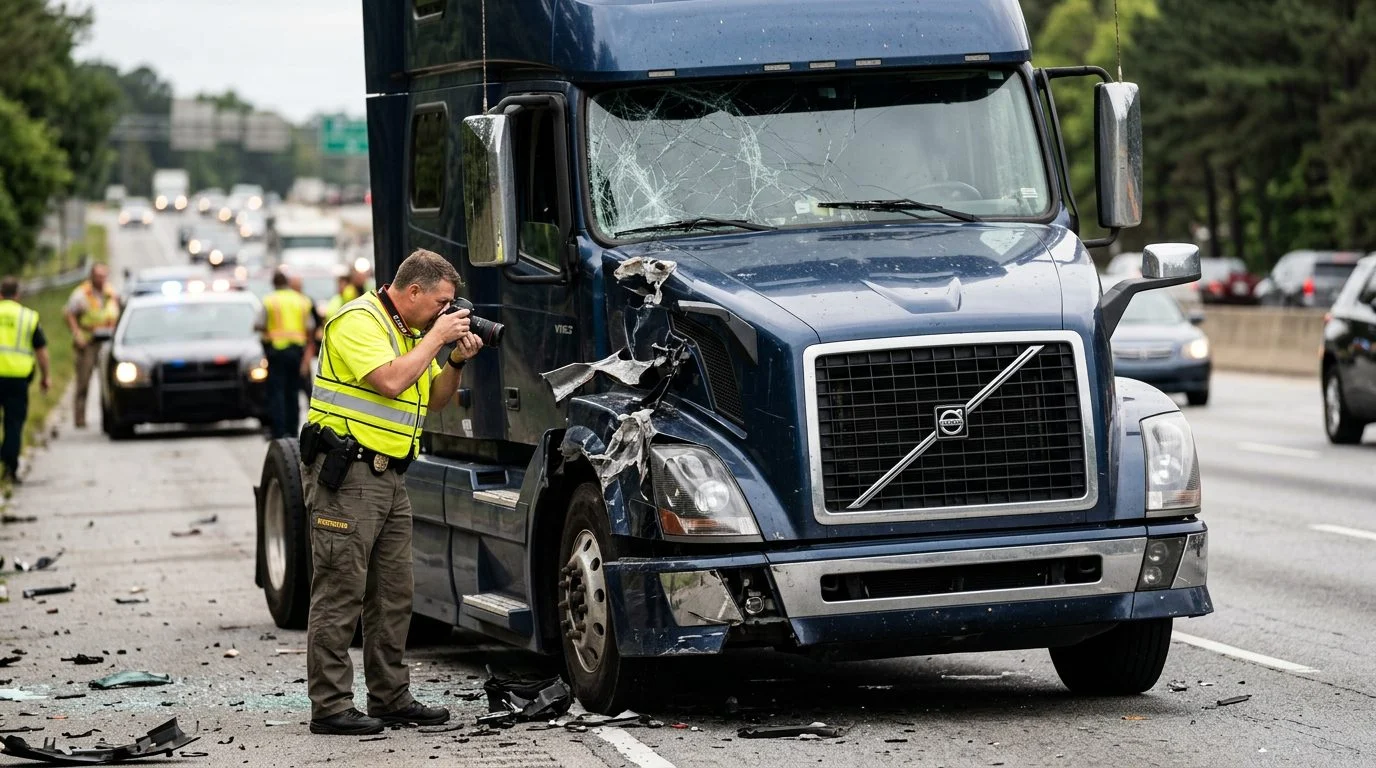
- Photos of the scene, vehicle damage, road conditions, and visible injuries, taken as soon as it is safe.
- The police report and witnesses. Georgia’s GDOT crash reporting page describes how Georgia police crash reports are obtained and used. Write down witness names and contact details while memories are fresh.
- Truck details. The company name, DOT number, and insurance information are often shown on the cab or trailer. Photograph them.
- Medical and work records. Keep medical records, a written timeline of symptoms and treatment, and records of missed work.
Trucking companies and insurers often start collecting their own records soon after a crash. Your notes and photos help keep your side of the story documented.
Can a family sue after a fatal semi truck crash?
In Georgia, a surviving spouse may bring a wrongful death claim. If there is no spouse, the children may do so, as a Georgia Court of Appeals opinion quoting O.C.G.A. § 51-4-2 explains.
The recovery is the full value of the life of the decedent. When death results from a crime or from criminal or other negligence, the personal representative can also recover funeral, medical, and other necessary expenses resulting from the injury and death (O.C.G.A. § 51-4-5).
Catastrophic injuries raise their own documentation needs. Spinal cord injury, paralysis, traumatic brain injury, amputation, and severe burns often need long-term medical care. Medical records, care plans, and work history show how these injuries affect work and daily life.

Talk with a Duluth truck accident lawyer about your situation
Talking with a lawyer early can help you understand the deadlines, the parties, and the evidence in your own situation.
You may be hurting, dealing with a damaged vehicle, and getting calls from a trucking insurer while you decide what comes next. That is a hard place to be. You don’t need every answer before you reach out.
Can you sue a trucking company after a semi truck crash?
Often, yes. A trucking company can answer for its driver’s negligence when the driver was doing the company’s work.
How long do you have to file in Georgia?
Georgia generally allows two years from the injury for a personal injury lawsuit. Claims against government entities can have a shorter notice deadline.
What if I was partly at fault?
Georgia reduces damages by your share of fault. You cannot recover if you are 50 percent or more responsible (O.C.G.A. § 51-12-33; Quynn v. Hulsey (2020)).
If a semi truck crash left you or someone you love hurt, you can contact Slam Dunk Attorney in Duluth, Georgia, for a free, confidential first consultation with no obligation to continue. Reach us through our contact page. For more on truck claims in Georgia, read our truck accident claims guide.
Responsible lawyer: Peter F. Jaraysi, Slam Dunk Attorney, Duluth, Georgia. Contact details are on our contact page.
What Makes a Semi Truck Case Different
More Than One Potential Party
A crash may involve the driver, the trucking company, the cargo loader, a maintenance contractor or a parts manufacturer. Each one's role can matter.
Detailed Trucking Records
Driver logs, dispatch messages, inspection reports and maintenance files can show what happened before the crash. These records may not be kept forever.
Federal Safety Rules
Commercial drivers and carriers are subject to federal safety regulations, including hours-of-service and vehicle inspection rules. Whether they were followed is part of the review.
Early Investigation
Scene evidence, vehicle data and witness accounts can be harder to gather as time passes. Early action helps preserve what matters.
Be Careful With Insurance Calls
A trucking company's insurer may contact you soon after a crash. Before giving a recorded statement or signing anything, talk with a lawyer about how your words could be used.
Who Might Be Responsible After a Semi Truck Crash
The Truck Driver
A driver who was fatigued, distracted, speeding or impaired may have caused the collision.
The Trucking Company
A company can sometimes answer for a driver's negligence when the driver was doing the company's work, depending on the facts.
Maintenance and Equipment Parties
Brake failures, tire defects and other equipment problems may point to a repair shop, a contractor or a manufacturer.
Cargo and Loading Parties
Improperly secured or overloaded cargo can shift and contribute to a crash. Those who loaded it may share responsibility.