
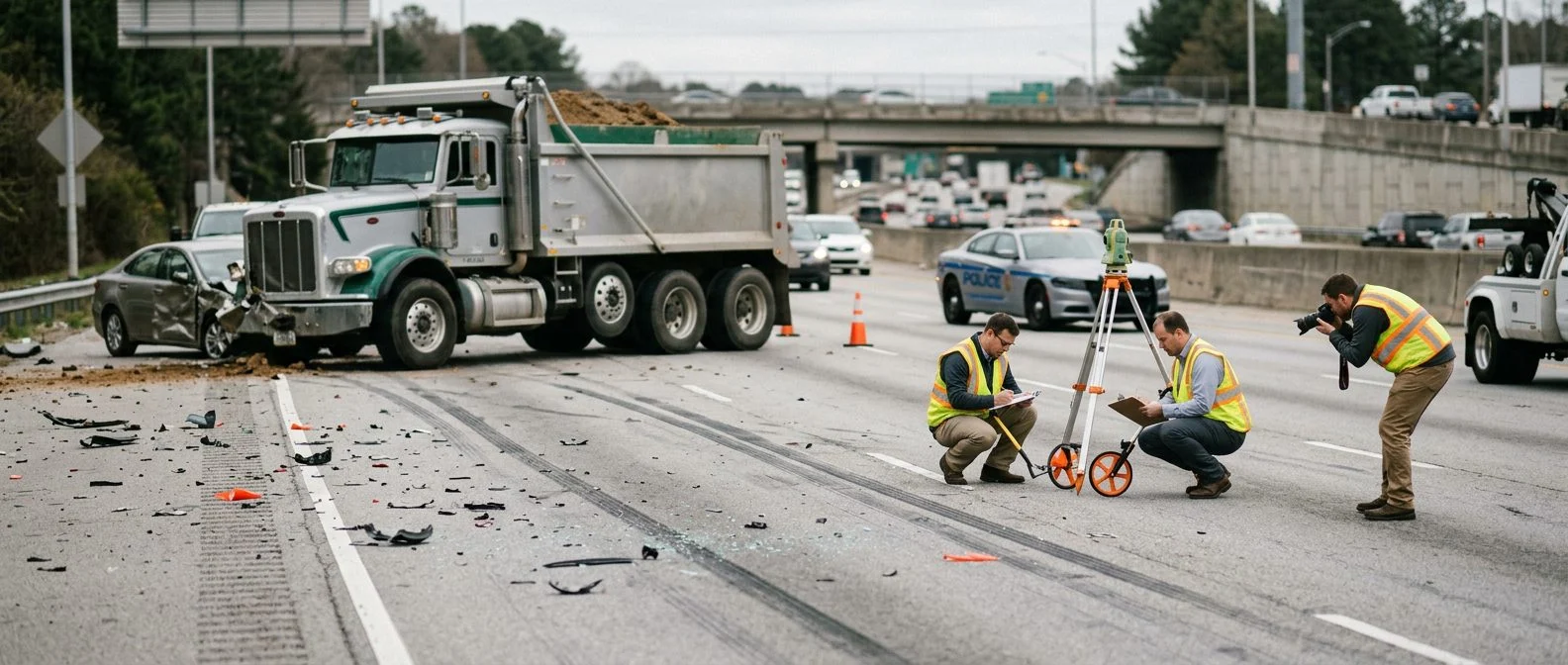
Dump Truck Accidents | Atlanta and Georgia
Hurt in a Dump Truck Crash? Find Out Who May Be Responsible.
Dump truck crashes can involve several parties, from the driver to the company that operates the truck. Our Duluth-based lawyers help injured people and families understand their options across metro Atlanta. Your first consultation is free, confidential, and comes with no obligation to continue.
By Peter F. Jaraysi · Published October 23, 2026
A dump truck crash can involve more than one party who may be responsible. That can include the driver, the company that runs the truck, and businesses on the job site. Georgia generally gives injured people two years to file most injury claims (O.C.G.A. § 9-3-33; Kenneth B. Cameron v. Jmp Pizza, Inc (2026)). This guide offers general information about these kinds of cases.
Why a Dump Truck Crash Is Different From a Typical Car Accident
A dump truck crash often causes more severe harm than a car crash because the truck is so much heavier. A loaded dump truck weighs far more than a passenger vehicle. In a collision, most of the force lands on the smaller vehicle and the people inside it. Rollovers and hard impacts can be especially dangerous.
Dump trucks also work in different places than most vehicles. They run on construction sites, in active work zones, and on local roads with frequent stops. They unload, back up, and turn in tight spaces. Each of those movements adds risk for people driving, walking, or working nearby.
Most dump trucks also belong to a company. A crash may involve a business and its insurer, not just one driver. Our truck accident pillar page covers the wider picture of commercial truck claims in Georgia. Georgia’s Governor’s Office of Highway Safety publishes a large-truck fact sheet that breaks down who is affected in large-truck crashes, including occupants of other vehicles.
A crash with a loaded dump truck can leave you hurt and unsure who pays for what. You don't have to work through that alone, and we're glad to talk about your situation. Talk it through with our team — the first consultation is free, confidential, and carries no obligation.

Who May Be Responsible After a Dump Truck Accident in Atlanta
The driver, the trucking company, and other businesses at the scene may each carry some responsibility. Which parties are responsible turns on the facts of the crash.
Examples include speeding, distraction, improper loading, and failing to yield. Georgia law also makes an employer liable for wrongs its worker commits within the scope of the business, under O.C.G.A. § 51-2-2. That can reach the company that employs the driver.
The company may also face claims of its own. These can involve how it hired, trained, supervised, and maintained its drivers and trucks. Those claims focus on the company’s choices, not only on the driver’s actions.
Job sites add another layer. Georgia law can make an employer liable for a contractor’s negligence in certain cases. One example is when the employer keeps the right to direct the time and manner of the work, as described in O.C.G.A. § 51-2-5. A loading company or equipment provider may also be involved, based on how the work was set up.
Several insurance policies can apply to one crash. Identifying every potentially responsible party early helps make sure no one is overlooked.
Evidence That Often Matters Early in a Dump Truck Case
The evidence that matters most is often the evidence that disappears first. Some of it sits with the trucking company, and some of it fades with time.
- The police report. It can list the crash location, any citations, and witness names.
- Photos and video. Capture the scene, the truck, the load, the damage, and any signs or traffic controls.
- Witness details. Names and contact information for drivers, workers, and bystanders matter.
- Medical records. These show the injuries and the treatment timeline from the crash forward.
- Trucking company records. Federal rules require carriers to keep certain records for set periods. For most carriers, a driver’s written inspection report must be kept for three months from the date the report was prepared, though this rule does not apply to a private motor carrier of passengers (nonbusiness), a driveaway-towaway operation, or a carrier operating only one commercial motor vehicle. Periodic inspection reports must be kept for fourteen months. Drivers must also record their duty status for each 24-hour period.
- Your own log. Keep a simple record of lost wages, out-of-pocket costs, and daily symptoms.
Because some carrier records have short retention periods, early requests to preserve them can matter a great deal.
How Georgia Law Affects Time Limits and Fault in a Dump Truck Claim
Most Georgia injury claims must be filed within two years. Shared fault can also reduce what an injured person recovers.
The two-year rule comes from O.C.G.A. § 9-3-33. It says actions for injuries to the person must be brought within two years after the right of action accrues.
Fault works differently. Under O.C.G.A. § 51-12-33, the jury sets the injured person’s share of fault, and the judge reduces the award by that share. An injured person who is 50 percent or more at fault cannot receive damages. Under O.C.G.A. § 51-12-33, any damages awarded to them are reduced in proportion to their percentage of fault, and they are not entitled to receive any damages if they are 50 percent or more responsible for the injury or damages claimed.
The same statute divides damages among liable parties by each party’s fault. That liability is not joint, so each party answers for its own share. The fault of everyone who contributed counts, even a party who was never named in the lawsuit. In a job-site crash, that can matter a lot.
Talking With Our Lawyers About Your Atlanta Dump Truck Crash
If a dump truck crash has left you hurt, you don’t have to sort out fault alone. You may be managing pain, medical visits, missed paychecks, and calls from a truck company’s insurance adjuster. Those calls can feel urgent, and it helps to know where you stand.
Slam Dunk Attorney is based in Duluth, Georgia. We represent people hurt in dump truck, commercial truck, and other crashes across metro Atlanta, including Lawrenceville, Johns Creek, and Alpharetta, and across Georgia. Our lawyers, including Peter F. Jaraysi and Brian D. Wright, review each crash’s facts individually.
The first consultation is free, confidential, and carries no obligation to continue. If you want to understand who may be responsible in your crash, reach out through our contact form.
Common Questions
How long do I have to file a dump truck injury claim in Georgia?
Georgia generally requires injury claims to be brought within two years after the right of action accrues. Wrongful death claims follow different timing rules.
Can the trucking company be sued if its driver caused my crash?
Georgia law can make an employer liable for wrongs its worker commits within the scope of the business. The company may also face its own claims.
What evidence should I start gathering?
Start with the police report, photos, witness names, and medical records. Keep a simple log of lost wages and daily symptoms.
This page is general information, not legal advice. The responsible lawyer is Peter F. Jaraysi of Slam Dunk Attorney, Duluth, Georgia. Contact us through our contact form.
How Our Team Can Help After a Dump Truck Crash
Reviewing the Crash Facts
We look at the crash report, photos, and other evidence to understand how the collision happened and what may have caused it.
Identifying Possible Responsible Parties
Our lawyers examine the roles of the driver, the trucking or hauling company, vehicle owners, and others who may share responsibility.
Focusing on Your Recovery
We help you think through medical care, lost income, and the long-term effects of your injuries, so you can focus on healing.
Clear, Plain-Language Updates
We explain your options in everyday terms and keep you informed as your case moves forward.
Be Careful With Early Calls
Trucking companies and insurance adjusters often contact injured people quickly, sometimes within hours of a crash. Before giving a detailed statement or signing anything, consider speaking with a lawyer who can explain what you are being asked to do.
Steps That Can Help Protect Your Health and Your Claim
Get Medical Care Right Away
Some injuries, including head, back, and internal injuries, may not show symptoms until later. A prompt medical evaluation protects your health and creates an accurate record.
Report the Crash
Call the police so the crash is documented. Ask for the officer's name and the report number.
Document the Scene
If you are able, take photos of the vehicles, the truck's markings, the road conditions, and your injuries. Write down what you remember while it is fresh.
Keep Your Records
Save medical bills, treatment notes, prescriptions, and records of missed work. Keep copies of everything you send or receive.