
Slip and Fall | Georgia
Slipped and Fell in Georgia? Here's How to Tell If You Can Still Sue
A hazard that was visible, a wet floor or a cracked walkway can still raise real questions. Here is a plain-language look at the issues that matter most.
By Peter F. Jaraysi · Published November 11, 2026
If you slipped on a wet floor or tripped on broken pavement in Brunswick, Georgia, you may be wondering whether the hazard being visible means you have no claim.
Whether one can move forward is a question of how the fall happened and what the property owner did about the danger. This guide explains the Georgia rules that matter most. Georgia law applies the same way statewide, so a fall in Brunswick follows the same questions as a fall anywhere else in the state.
What “Open and Obvious” Means in a Georgia Slip and Fall
Examples include a clearly wet floor, a spill or a visible step. Picture a puddle near a store entrance on a rainy afternoon, or a cracked curb in a parking lot in daylight.
The phrase describes the hazard, not the injury. Many people blame themselves right away, especially when they were the only one who saw what happened.
Being hurt on something you could see is not the same as being at fault for the fall. Family members helping someone in this position often carry the same worry. The rest of this guide looks at what the law asks next.
If you were hurt in a fall and aren't sure whether a visible hazard still leaves you a claim, our team is glad to talk it through with you. Talk it through with our team — the first consultation is free, confidential, and carries no obligation.

The Property Owner’s Duty to Invitees Under Georgia Law
Under Georgia law, a property owner must use ordinary care to keep its premises and approaches safe for people it invites in. The premises statute, O.C.G.A. § 51-3-1, makes an owner or occupier (the person who controls the property) liable when its failure to use that care causes injury. The statute covers people whom the owner, by express or implied invitation, induces or leads to come on the property “for any lawful purpose.”
People who come by express or implied invitation are called invitees. Customers in a store, diners in a restaurant and shoppers in a parking area are common examples.
The key phrase is ordinary care. The statute asks whether the owner failed to use ordinary care and whether that failure caused the injury. What the owner knew about the hazard, and what it did about it, sits at the center of that question.
Can a Visible Hazard Still Support a Claim?
A visible hazard can still be part of a valid claim, but the outcome turns on the specific facts. The main questions are whether the danger was truly obvious and whether the visitor had a reasonable chance to see it and avoid it. Those questions are where most disputes are fought.
Several situations often get argued. Poor lighting may have hidden a wet floor that looked dry. A display, a crowd or a sudden change in the floor may have pulled attention away. A visitor may have had only one route in or out, such as a narrow aisle with no other way around.
A spill may have appeared only minutes before the fall, with no time for staff to clean it or post a warning. A step down may also look ordinary to a visitor who had no reason to expect it, especially in a place people assume is level.
Each of these points is a fact, not a rule. The property owner may argue the hazard was obvious. The injured person may answer with the lighting, the timing or the route. Those details are why written notes and photos made soon after the fall carry weight later.
How Comparative Fault Affects a Georgia Claim
Georgia reduces an injured person’s recovery by their share of fault. It bars recovery entirely at 50 percent or more. Under O.C.G.A. § 51-12-33, the trier of fact (the jury or judge deciding the case) sets the plaintiff’s percentage of fault. The judge then reduces the award in proportion to that percentage.
Under subsection (g), a plaintiff who is “50 percent or more responsible for the injury or damages claimed” is not entitled to receive any damages (O.C.G.A. § 51-12-33; Quynn v. Hulsey (2020)). The fault of everyone who contributed to the injury counts, under subsection (c), even people who were never named in the case.
This rule matters most when the hazard was visible. The owner may say the visitor should have seen the danger. The visitor may say the owner should have fixed it or warned about it. That is why a fault dispute is so common in these cases.
A separate rule comes from O.C.G.A. § 51-11-7. It says that if the plaintiff by ordinary care could have avoided the consequences of the defendant’s negligence, the plaintiff is not entitled to recover. In other cases, the defendant is not relieved even though the plaintiff may have contributed to the injury. Many people mix these ideas up, so it helps to keep them apart.
Evidence That Matters After a Fall
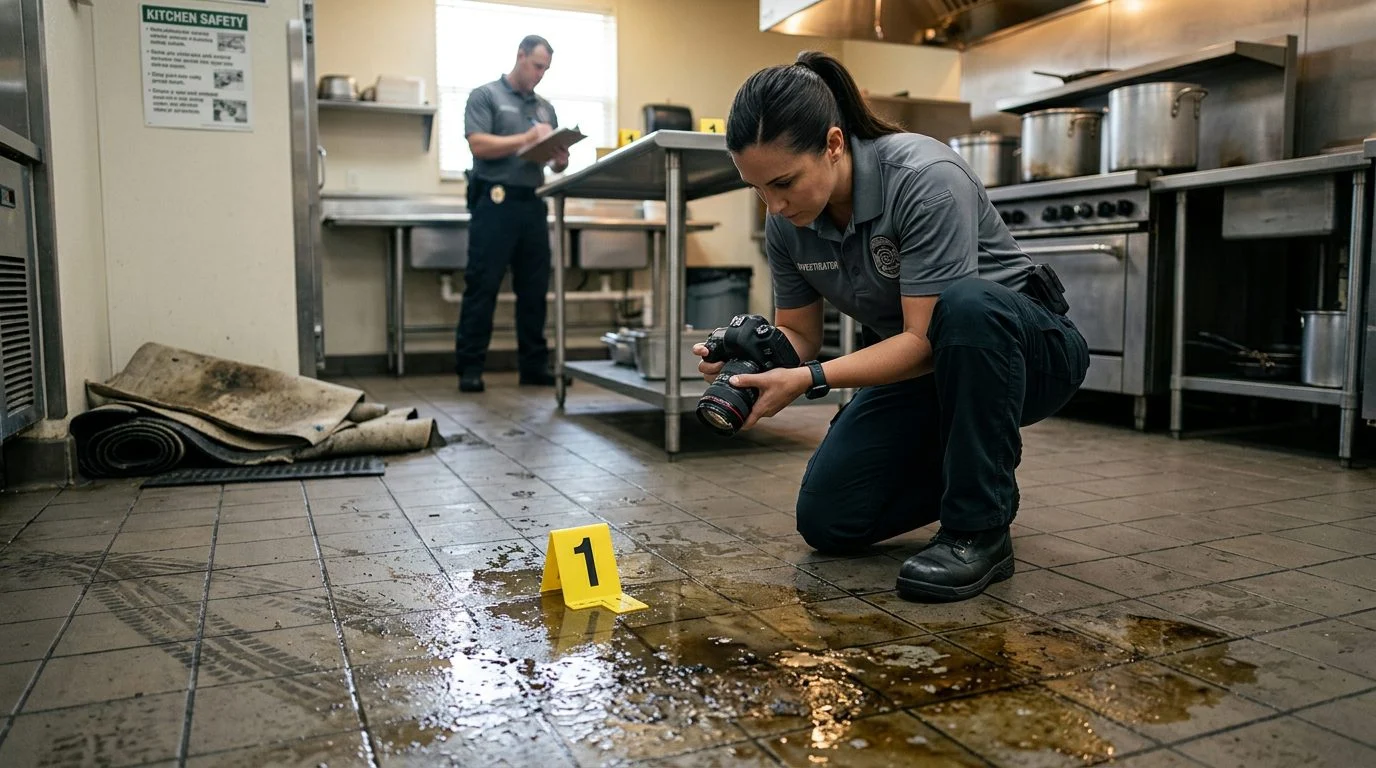
The most useful evidence shows the hazard, the conditions and how the fall happened. Collect it as soon as you safely can. Take photos and video of the spot from several angles, including the lighting, the nearby floor and any signs or missing signs.
Photograph the shoes or clothing you wore. Footwear often becomes part of the fault question. Write down what you remember while it is fresh, including the time, who was nearby and any employee you spoke with.
Ask for an incident report, and keep a copy of anything you sign. Note the names of witnesses, even if they only saw you on the floor afterward.
Get medical attention promptly and follow the care your provider recommends. Those records link the injury to the fall. Keep a simple log of symptoms, missed work, appointments and out-of-pocket costs.
Evidence can disappear, so act early. In Phillips v. Harmon, the Georgia Supreme Court explained that the duty to preserve evidence arises when litigation is reasonably foreseeable to the party that controls the evidence, not only once a suit is pending. Store surveillance footage can be overwritten, so it helps to ask the property owner in writing to keep any video from the day of the fall.
The Time Limit for Filing a Georgia Slip and Fall Claim
Georgia’s general deadline for injury claims is two years. Under O.C.G.A. § 9-3-33, actions for injuries to the person must generally be brought within two years after the right of action accrues, except that actions for injuries to the person involving loss of consortium must be brought within four years after the right of action accrues. Accrual is the legal term for when a claim comes into existence.
Waiting costs time. Witnesses move, video is overwritten and memories fade. Those losses can make a claim harder to prove, even when the fall itself was real.
Some claims follow different timing rules. Don’t assume the general two-year period fits your situation without a review of the facts.
Not sure what your next step is?
Talk it through with our team — the first consultation is free, confidential, and carries no obligation.
Talking With an Insurance Adjuster After a Fall
Keep early calls with an insurance adjuster short, polite and factual. An adjuster works for the insurance company, and their job is to evaluate the claim for that company.
Adjusters may ask for a recorded statement or a signed medical records release early on. You do not have to agree on the spot. Ask what the request is for and what it would let them see.
Avoid guessing about how the fall happened, who was at fault or how badly you are hurt. Stick to what you saw and felt. If you don’t know something, say so. “I’m still getting care” is more accurate than estimating how long recovery will take.
Keep copies of all letters, emails and forms. Write down the claim number, the adjuster’s name, and the date and topic of every call.
Georgia law also limits how medical costs are counted. Special damages for medical expenses are limited to the reasonable value of medically necessary care, under O.C.G.A. § 51-12-1.1. Keep every bill and explanation of benefits.

Talk Through Your Fall With Our Team
If you were hurt in a fall you did not choose, you don’t have to work out the open and obvious question alone. Whether a visible hazard still leaves you a claim is worth discussing with a lawyer who can review the facts, the photos and your medical records together. For more on these claims, read our slip and fall claims guide.
Slam Dunk Attorney is based in Duluth, Georgia, and represents people hurt in falls and other accidents across the state. Our first consultation is free, confidential and comes with no obligation to continue. If you were hurt in a fall and aren’t sure whether a visible hazard still leaves you a claim, our team is glad to talk it through with you. You can contact our team here.
Responsible lawyer for this page: Peter F. Jaraysi, Slam Dunk Attorney, Duluth, Georgia. This page is general information, not legal advice, and reading it does not create a lawyer-client relationship.
Save Evidence Early
Photos of the exact spot, the floor or pavement, the lighting, and your footwear can be hard to recreate later. Write down names of anyone who saw the fall, and keep every medical record and incident report.
Steps to Take After a Slip and Fall
Get Medical Care
Even if you feel mostly fine, an evaluation creates a record of your injuries and how they developed over time.
Document the Scene
Take pictures and video of the hazard, the surrounding area, and any warning signs or their absence.
Report the Fall
Ask the property owner or manager to create an incident report, and keep a copy for your own files.
Talk With a Lawyer
A free, confidential consultation can help you understand how Georgia law may apply to your situation.
How We Approach Your Slip and Fall Case
Plain-Language Answers
We explain Georgia premises liability questions in terms you can follow, without legal jargon.
Prompt Attention
We respond quickly so you can understand your options while the details are still fresh.
Focus on Your Recovery
We handle the paperwork and insurance communications so you can concentrate on getting better.
Respect for Your Situation
Every fall is different. We listen closely to what happened before offering any view on next steps.