

Motorcycle Accidents
Comparative Fault in Motorcycle Accidents: Georgia Law
Understanding how Georgia's comparative fault rule affects your right to recover damages after a motorcycle crash.
By Peter F. Jaraysi · Published September 25, 2026
Comparative Fault in Motorcycle Accidents: Georgia Law
In Georgia, you can recover damages for a motorcycle accident even if you bear some responsibility for the crash—as long as you’re less than 50% at fault. Georgia’s modified comparative fault rule reduces your recovery by your percentage of fault, but if you’re found 50% or more responsible, you cannot recover anything. Understanding how this rule works is essential if an insurance company has assigned you a percentage of fault or denied your claim.
If you're trying to understand whether a comparative fault claim against you is fair, or if an insurer has denied your motorcycle accident claim based on fault, reach out—people in your situation contact us regularly to review their options. Talk it through with our team — the first consultation is free, confidential, and carries no obligation.

What Is Comparative Fault in Georgia?
Georgia uses a “modified comparative fault” system that allows injured people to recover damages even when they share some blame for an accident. Under Georgia law, you can recover only if you are less than 50% responsible for the injury; a plaintiff who is 50% or more responsible recovers nothing. Your recovery is then reduced by your percentage of fault.
Here’s a concrete example: if you are found 30% at fault for a motorcycle accident and your total damages are $100,000, you would recover $70,000. The insurance company or court subtracts your 30% share from the full amount. But if you’re found 50% or more at fault, you receive nothing—you’re barred from recovery entirely, while a plaintiff 49% or less at fault still recovers, reduced by their share. This “50% bar” is the critical threshold in Georgia motorcycle accident claims.
The rule applies equally to all drivers, including motorcycle riders. Georgia law does not presume fault based on the type of vehicle you were riding. You’re held to the same standard of care as a car or truck driver, and comparative fault analysis treats your conduct the same way.
How Comparative Fault Applies to Motorcycle Accidents
Comparative fault is determined by examining each party’s conduct and whether they violated a duty of care—the legal obligation to act reasonably and avoid harming others. In motorcycle accident cases, courts and insurers look at several factors:
- Speed: Were you traveling at a safe speed for road conditions?
- Lane position: Were you in a proper lane, or in a blind spot where the other driver couldn’t see you?
- Visibility: Was your motorcycle visible? Were lights on? Were you wearing reflective gear?
- Road conditions: Did either party fail to adjust for rain, gravel, potholes, or other hazards?
- Traffic laws: Did you obey traffic signals, stop signs, and right-of-way rules?
- Other driver’s actions: Did the other driver fail to check mirrors, signal turns, or maintain control?
Helmet use does not establish fault—wearing a helmet is the right choice for safety, but it doesn’t prove or disprove that you caused the accident. However, insurers may consider helmet use when evaluating damages, particularly in injury cases.
Both parties’ actions are weighed proportionally. Comparative fault is not about who was “more wrong”—it’s about assigning each party a percentage of responsibility based on the evidence. Insurance companies and courts use police reports, witness statements, accident reconstruction analysis, and physical evidence to assign these percentages.
Common Scenarios and Comparative Fault in Motorcycle Accidents
Real-world motorcycle accident cases show how comparative fault disputes arise:
Motorcycle hit by car changing lanes: The other driver may be primarily at fault for failing to check their blind spot. But if you were speeding or riding in that blind spot, comparative fault may be split. You might be found 20% at fault and the other driver 80% at fault.
Rear-end collision: The following vehicle is typically assigned primary fault for failing to maintain a safe following distance. However, if your motorcycle braked suddenly without warning—for example, swerving around debris without brake lights activated—comparative fault may apply to you as well.
Intersection accident: Fault depends on traffic signals, right-of-way rules, and both riders’ actions. If you ran a red light but the other driver was speeding through the intersection, fault may be shared.
Road hazard or debris: If you swerved to avoid a pothole and struck another vehicle, comparative fault may apply to you if the swerve was abrupt or unsafe. The other driver might also share fault if they didn’t maintain control.
Multiple vehicles involved: Each party’s percentage of fault is determined independently. In a three-vehicle crash, one driver might be 50% at fault, another 35%, and a third 15%.
Why Comparative Fault Matters in Your Claim
Comparative fault is often the most contested issue in motorcycle accident cases. Insurance companies use it to reduce settlement offers, and sometimes to deny claims entirely. Understanding your percentage of fault helps you evaluate whether a settlement is fair and whether you should pursue the claim further.
If the other party claims you were more than 50% at fault, your entire claim is at risk. You need to know whether that claim is supported by evidence or whether it’s an inflated assertion by the other side’s insurer. Evidence—photos of the accident scene, the police report, witness statements, and expert accident reconstruction—determines the outcome. Without solid evidence on your side, you may accept an unfair settlement or lose your right to recover.
In the motorcycle accident cases our attorneys handle, comparative fault disputes frequently arise because insurers mischaracterize rider behavior or ignore the other driver’s violations. A rider in a blind spot may be blamed for the accident, even though the other driver had a duty to check that blind spot. A rider who braked suddenly to avoid a hazard may be assigned partial fault, even though the sudden stop was a reasonable response to danger. Challenging these claims requires evidence and a clear understanding of Georgia law.
How Comparative Fault Is Determined
Comparative fault is not decided by a single source. Multiple pieces of evidence and processes feed into the final determination:
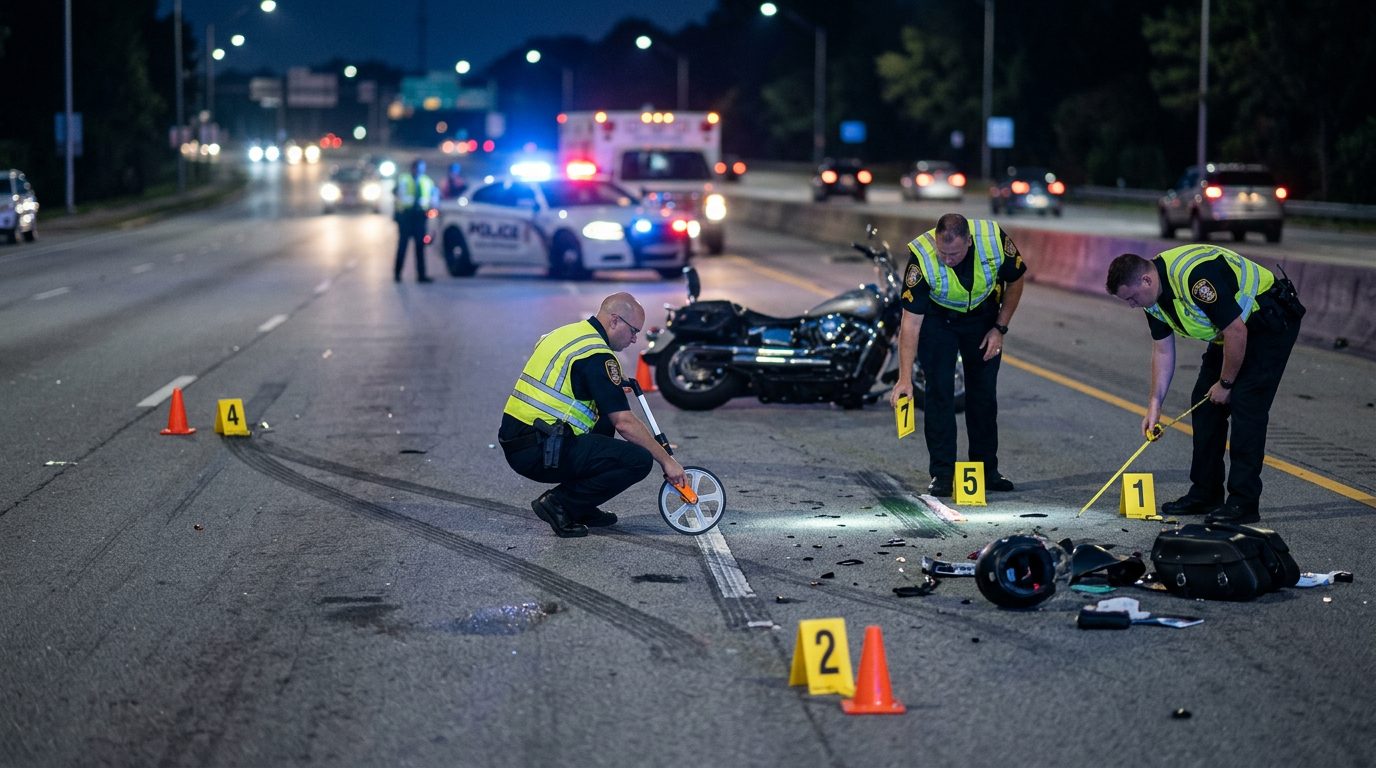
Police report: The responding officer documents their initial assessment of fault based on the scene, vehicle damage, and witness statements. The police report is influential but not binding. A judge or jury can disagree with the officer’s assessment if other evidence contradicts it.
Witness statements: Independent accounts from people who saw the accident carry significant weight. Witnesses have no stake in the outcome and can describe what they observed clearly.
Physical evidence: Vehicle damage patterns, skid marks, traffic signal timing, road conditions, and debris location all tell a story. A motorcycle with rear-end damage suggests it was hit from behind; side damage suggests a side-impact or lane-change collision.
Accident reconstruction: Expert analysis uses physics, vehicle dynamics, and scene evidence to determine speed, trajectory, and timing. Reconstruction experts can testify about whether a driver had time to react or whether a collision was avoidable.
Insurance investigation: Both insurers investigate and may assign different percentages of fault. Their conclusions are not binding, but they influence settlement negotiations.
Negotiation or trial: If the parties disagree on comparative fault, a judge or jury makes the final determination. At trial, both sides present evidence, and the jury assigns a percentage to each party.
Not sure what your next step is?
Talk it through with our team — the first consultation is free, confidential, and carries no obligation.
Protecting Your Rights When Comparative Fault Is Raised
If you’re in a motorcycle accident, take steps immediately to protect your interests:
Do not admit fault at the scene or to the other driver’s insurance company. Even casual statements like “I didn’t see you coming” or “I was going pretty fast” can be used against you later. Stick to factual descriptions: “I was traveling north on Main Street when the other vehicle changed lanes into me.”
Gather your own evidence: Take photos of vehicle damage, road conditions, traffic signals, and the accident scene. Get contact information from witnesses. Keep medical records and receipts for all accident-related expenses.
Report the accident to your insurance company promptly and accurately. Provide facts, not opinions. Let your insurer know you’re gathering evidence and will share it.
Keep records of all communications with insurers and the other party. Write down dates, times, and what was said. Save emails and text messages.
Be cautious about settlement offers that assign you a high percentage of fault without supporting evidence. If an insurer claims you were 60% at fault but offers no police report, witness statements, or expert analysis, that claim may be inflated.
Consider having an attorney review the other party’s comparative fault claims before accepting a settlement. An attorney can identify weaknesses in their evidence and negotiate a fairer outcome.
When to Seek Legal Guidance
You should consider consulting with an attorney if:
- The other party or their insurer claims you were more than 50% at fault.
- You disagree with the percentage of fault assigned in a settlement offer.
- Your claim has been denied based on comparative fault.
- Multiple vehicles or parties are involved and fault is unclear.
- You have suffered significant injuries and the comparative fault determination affects your recovery substantially.
A motorcycle accident can leave you confused about your legal standing, especially if an insurer has assigned you fault. The comparative fault rule in Georgia is fair—it lets you recover even if you share some blame—but only if you understand how it works and challenge unfair fault assignments.
FAQ
Can I recover damages in Georgia if I was partially at fault for my motorcycle accident?
Yes, you can recover as long as you are less than 50% at fault; your recovery is reduced by your percentage of fault, and if you are 50% or more at fault you recover nothing.
What happens if I’m found 51% or more at fault?
You cannot recover any damages; Georgia’s 50% bar rule bars recovery entirely if you are more than 50% responsible.
Does the police report determine comparative fault?
No, the police report is informative but not binding; a judge or jury can assign comparative fault differently based on evidence.
How do insurance companies assign percentages of fault?
Insurers investigate using police reports, witness statements, physical evidence, and sometimes accident reconstruction to assign percentages.
Does wearing a helmet affect comparative fault?
No, helmet use does not establish or disprove fault, though it may be considered in damages analysis.
Can I challenge the other party’s comparative fault claim?
Yes, if their claim lacks supporting evidence or contradicts witness statements or physical evidence, you can challenge it through negotiation or trial.
If you’re working through a motorcycle accident claim and an insurer has raised comparative fault against you—or if you’re unsure whether the fault percentage they’ve assigned is fair—our team can help you understand your options. People facing these questions reach out to us regularly, often before they’ve decided whether to pursue a claim. Contact us for a free case review.
Georgia's 50% Bar Rule
Under Georgia law, you can recover damages only if you are less than 50% at fault for the accident. If you are found 50% or more responsible, you cannot recover any damages—even if the other party bears some fault. Your recovery is reduced by your percentage of fault.
How Comparative Fault Works in Georgia Motorcycle Cases
Your Fault Percentage Is Determined
A judge or jury evaluates the actions of all parties involved and assigns a percentage of fault to each. This determination is based on evidence, witness testimony, and the circumstances of the accident.
Your Recovery Is Reduced
If you are found less than 50% at fault, you can recover damages. However, the amount you receive is reduced by your percentage of responsibility, and if you are 50% or more at fault, you cannot recover anything. For example, if you are 30% at fault and damages total $100,000, you recover $70,000.
The 50% Bar Applies
If you are determined to be more than 50% at fault, Georgia law bars you from recovering any damages. This is an all-or-nothing threshold that can significantly impact your case.
Evidence Matters
Comparative fault determinations depend heavily on evidence: police reports, accident reconstruction, witness statements, traffic violations, and the actions of all parties leading up to the crash.
Why Comparative Fault Matters in Your Motorcycle Accident
Protects Your Right to Recover
Even if you bear some responsibility, Georgia law allows you to pursue compensation as long as you are not the primary cause of the accident. Understanding this rule helps you know whether you have a viable claim.
Requires Strong Evidence
Fault determinations rely on documentation and facts. Building a thorough record—including police reports, photos, witness accounts, and accident details—is essential to support your position.
Affects Settlement and Trial Strategy
How fault is likely to be assigned influences settlement negotiations and trial preparation. Early analysis of comparative fault helps guide realistic expectations and case decisions.
Applies to All Motorcycle Accident Types
Whether your crash involved another vehicle, a hazard, or multiple parties, Georgia's comparative fault rule applies. The specific facts of your accident determine how fault is allocated.
Uncertain About Fault in Your Motorcycle Accident?
Related practice areas
- Motorcycle Accident Injuries: Types, Severity & Recovery