
Why Understanding Your Fall Injury Lawsuit Rights Matters in Georgia
A fall injury lawsuit is your legal path to compensation when you’ve been hurt on someone else’s property due to unsafe conditions. In Georgia, property owners have a responsibility to keep their premises reasonably safe, and when they fail, they can be held accountable.
Here’s what you need to know about filing a fall injury lawsuit in Georgia:
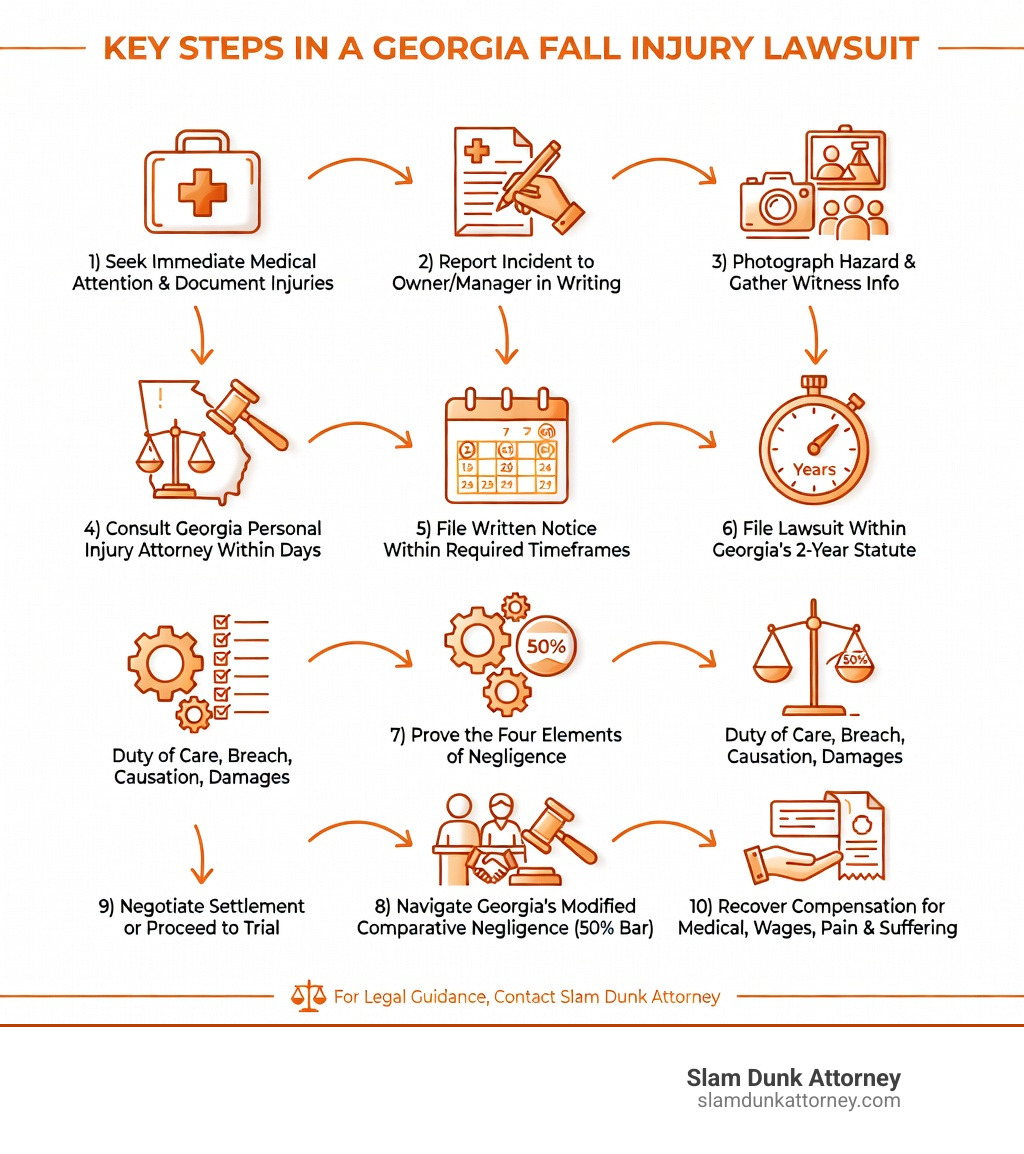
- You must prove negligence – The property owner knew or should have known about the dangerous condition
- Georgia’s two-year deadline – You generally have two years from the date of injury to file
- Your fault matters – Georgia uses a 50% bar rule, meaning if you’re more than 50% at fault, you can’t recover damages
- Multiple parties may be liable – Property owners, tenants, businesses, or contractors could all share responsibility
- Compensation covers – Medical bills, lost wages, pain and suffering, and future care needs
Falls are a leading cause of injury hospitalizations in Georgia. These aren’t just statistics. They’re real people facing medical bills, lost income, and life-changing injuries.
The reality is simple: Property owners in Georgia must maintain safe conditions. When they don’t, and you get hurt, the law gives you options.
But understanding those options means navigating Georgia’s specific premises liability laws, proving negligence under state standards, and dealing with insurance companies that will try to minimize what they owe you. That’s where experienced legal guidance becomes essential.
I’m Peter Jaraysi, Esq., and I’ve built Slam Dunk Attorney around one mission: fighting for everyday people who’ve been hurt through no fault of their own, including those pursuing a fall injury lawsuit in Georgia. My team and I understand the medical, financial, and emotional toll these accidents take, and we’re here to level the playing field against insurance companies that try to lowball you.
Proudly Serving Duluth and All of Georgia Contact us to start your recovery! Explore Our Practice Areas
Navigating the Legal Path of a Georgia Fall Injury Lawsuit
When you take a tumble in a Duluth, Georgia grocery store or trip on a jagged sidewalk in Decatur, the world feels like it’s spinning. Once the dust settles, you’re left with a choice: do you absorb the costs of someone else’s mistake, or do you stand up for your rights? Filing a fall injury lawsuit isn’t about being “sue-happy”—it’s about basic fairness.
In Georgia, the legal foundation for these cases is “premises liability.” This area of law dictates that owners and occupiers of land have a legal duty of care to keep their premises safe for those they invite onto the property. If they fail in this duty, and that failure leads directly to your injury, we can hold them liable for negligence.

However, not every visitor to a property is treated the same under Georgia law. Your legal standing—and the level of care the owner owes you—depends on why you were there. We generally categorize visitors into three groups:
| Visitor Type | Definition | Owner’s Duty of Care |
|---|---|---|
| Invitee | Someone present for the owner’s benefit (e.g., a customer in a store or a patient in a clinic). | Highest duty: The owner must exercise ordinary care to keep the premises and approaches safe. |
| Licensee | Someone present for their own convenience or interest, with permission (e.g., a social guest). | Lower duty: The owner is liable only for willful or wanton injury. |
| Trespasser | Someone present without permission or legal right. | Lowest duty: Generally, the owner only owes a duty not to intentionally harm the trespasser. |
Understanding where you fit in this table is the first step our team at Slam Dunk Attorney takes when evaluating your case. Most fall injury lawsuit claims involve “invitees”—people doing business or visiting public spaces where they have every right to expect a safe environment.
Identifying Liability and Common Causes of Falls
Liability is a fancy legal word for “responsibility.” To win a fall injury lawsuit, we have to point the finger at the right party. Sometimes it’s the property owner, but it could also be a property management company, a cleaning contractor, or a business tenant.
Common culprits behind these accidents in Georgia include:
- Wet or Slippery Surfaces: Spilled soda in an Atlanta mall, rainwater tracked into a lobby in Johns Creek, or freshly waxed floors without a “Wet Floor” sign.
- Uneven Flooring: Torn carpeting in a Norcross office building or loose floorboards in a rental home.
- Poor Lighting: Dimly lit stairwells or parking lots in Kennesaw that hide potholes or debris.
- Cluttered Walkways: Boxes left in aisles or extension cords stretched across a path.
- Outdoor Hazards: Unmarked changes in elevation or jagged cracks in a sidewalk.
If you were injured at a major retail chain or a local business, you might be wondering, can I sue a company for a fall in one of their stores? The answer is yes, provided we can prove they were negligent. Companies have a duty to perform regular inspections. If they let a hazard sit for hours without fixing it, they are likely on the hook for your medical bills.
Proving Fault in Your Fall Injury Lawsuit
Proving fault is the “slam dunk” moment of any case, but it requires meticulous evidence. In Georgia, we must prove that the property owner had “superior knowledge” of the hazard. This means they knew about the danger, and you didn’t—and couldn’t have reasonably known about it.
We look for two types of knowledge:
- Actual Knowledge: A store employee saw the spill or a customer reported the broken railing before you fell.
- Constructive Knowledge: The hazard existed for such a long time that the owner should have discovered it if they were exercising “ordinary care.”
For example, if a grape sits on a grocery store floor for three hours and gets stepped on by ten people before you slip on it, the store has constructive knowledge. They should have cleaned it up during a routine sweep. How is liability determined in a slip and fall accident? It comes down to evidence: surveillance footage, sweep logs, witness statements, and photos of the scene.
Proving that a landowner breached their duty of care is the core of our work. We dig deep into maintenance records to show a pattern of neglect. You can learn more about the complexities of determining liability on our FAQ page.
Understanding Recoverable Damages and Compensation
A fall injury lawsuit isn’t just about hospital bills. It’s about restoring your life to where it was before the accident. In Georgia, you can pursue compensatory damages, which are designed to “make you whole.”
These damages fall into two buckets:
Economic Damages (The Paper Trail):
- Medical Expenses: Everything from the ambulance ride and ER visit to physical therapy and future surgeries.
- Lost Wages: Money you lost because you couldn’t work while recovering.
- Loss of Earning Capacity: If your injury is permanent and you can no longer work the same job or hours.
Non-Economic Damages (The Human Cost):
- Pain and Suffering: The physical pain and emotional distress caused by the injury.
- Loss of Enjoyment of Life: If you can no longer hike at Stone Mountain or play with your grandkids because of a back injury.
- Loss of Consortium: The impact the injury has on your relationship with your spouse.
Every case is different, but we fight for the maximum possible recovery. For more details on what you might be entitled to, check out our guide on what damages can I recover for a slip and fall accident in Georgia?
Georgia’s Strict Deadlines for Filing a Claim
Time is not on your side after a fall. Georgia law is very specific about when you must take action.
- The General Rule: Under Georgia’s statute of limitations, you generally have two years from the date of the accident to file a lawsuit for personal injury.
- The Government Exception: If you fell on property owned by a city (like Duluth, Georgia or Atlanta), a county, or the state, the rules change drastically. You must often file a formal “ante litem” notice within six months (for municipalities) or one year (for counties/state). Failing to send this notice can kill your case before it even starts.
Because these deadlines are so strict, we recommend contacting a lawyer as soon as you are medically stable. You can find more information about Georgia statutes of limitations to ensure you don’t miss your window for justice.
How Comparative Negligence Impacts Your Fall Injury Lawsuit
“Why didn’t you see the puddle?” This is the first question an insurance adjuster will ask. They are trying to shift the blame onto you using a legal concept called comparative negligence.
Georgia follows a modified comparative negligence rule with a 50% bar. Here is how it works in plain English:
- If you are 0% at fault, you get 100% of the compensation.
- If you are 20% at fault (maybe you were looking at your phone), your compensation is reduced by 20%.
- The “Cliff”: If you are found to be 50% or more at fault, you get nothing. Zero. Zip.
The defense will argue that the hazard was “open and obvious”—meaning any reasonable person should have seen it and avoided it. Our job is to prove that the hazard was a “trap” or that you were understandably distracted (perhaps by the store’s own displays). This is a high-stakes chess match, and you want an experienced team making the moves.
The Importance of Local Legal Guidance in Duluth, Georgia
You might think any lawyer with a billboard can handle a fall injury lawsuit, but local knowledge matters. A firm based in Duluth, Georgia, knows the local courts, the local judges, and the tactics used by local insurance defense firms.
At Slam Dunk Attorney, we don’t just “process” cases. We hustle. We go to the scene in Alpharetta or Lawrenceville to measure the height of a trip hazard. We interview witnesses in Chamblee. We preserve evidence before the store “accidentally” record-over the surveillance footage.
The essential role of a slip injury attorney is to be your shield and your sword. We handle the stressful negotiations so you can focus on getting your mobility back. Whether you are in Dunwoody or Marietta, having a team that understands the nuances of Georgia law can be the difference between a lowball settlement and a recovery that actually covers your needs.
Conclusion
A fall can happen in a split second, but the consequences can last a lifetime. If you’ve been injured because a property owner was too lazy or too cheap to keep their premises safe, you shouldn’t have to pay the price.
At Slam Dunk Attorney, we bring a championship-level team approach to every fall injury lawsuit. We pride ourselves on honesty, transparency, and the sheer hustle required to win against big insurance companies. We serve clients across the Peach State—from Duluth, Georgia and Atlanta to Johns Creek and Kennesaw—ensuring that our neighbors get the justice they deserve.
Don’t let an insurance company tell you what your injury is worth. Let us show them. If you’re ready to take the next step, we offer free consultations to help you understand your rights without any financial pressure. Learn more about our Duluth, Georgia legal services and how we can help you get back on your feet.
The information provided on this blog is for general informational purposes only and is not intended to be, nor should it be construed as, legal advice. Every personal injury case is unique, and the laws and circumstances that apply can vary based on the specific facts of your situation. Reading this content does not create an attorney-client relationship. To receive legal advice specific to your case, you should consult directly with a qualified personal injury attorney licensed to practice in the state of Georgia.
Call or text 404-951-3513 or complete a Free Case Evaluation form