
Why Legal Advice After a Car Accident Matters
Legal advice car accident situations are overwhelming. You’re facing injuries, vehicle damage, and insurance adjusters, all while trying to steer your recovery. After a wreck in Georgia, knowing your rights is critical.
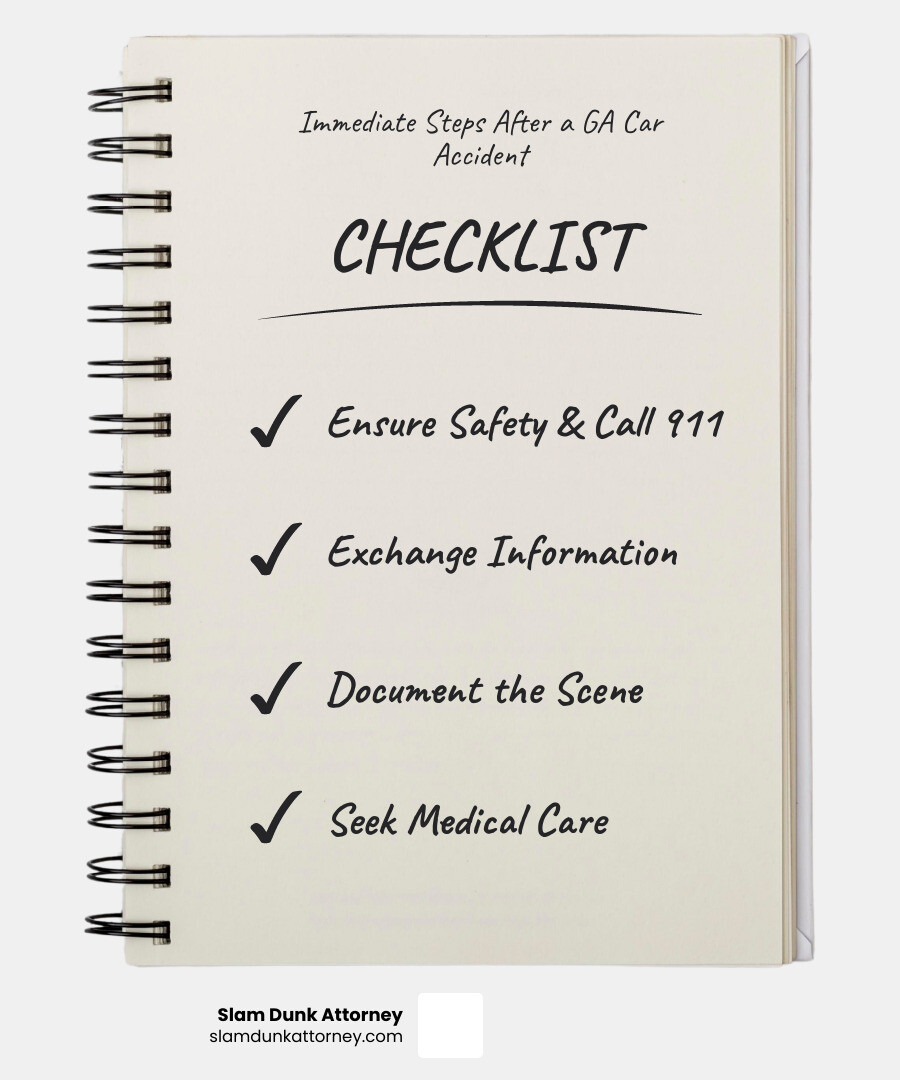
Key steps to take immediately:
- Call 911 if there are injuries or significant damage.
- Exchange information with all drivers involved.
- Document the scene with photos before moving vehicles.
- Seek medical attention, as some injuries appear later.
- Report the accident to your insurer, but stick to the facts.
- Consult a Georgia personal injury lawyer before accepting any settlement.
Georgia is an at-fault state, meaning the driver who caused the crash is responsible for damages. Insurance companies know most people don’t understand their rights under Georgia law and may use this to their advantage by offering a low settlement.
The good news is that you don’t have to face this alone, and you don’t have to pay upfront for legal help. We fight for accident victims across Georgia, ensuring they are treated like people, not case numbers. We’re here to provide clear legal advice after a car accident and protect your right to fair compensation.
Proudly Serving Duluth and All of Georgia Contact us to start your recovery! Explore Our Practice Areas

Your Guide to Getting Legal Advice for a Car Accident in Georgia
Immediate Steps and Gathering Crucial Evidence
The moments after a car accident are chaotic, but the steps you take can protect your future claim.
- Prioritize Safety: Check on everyone involved. If possible and safe, move vehicles to the side of the road. Call 911 immediately for any injuries.
- Call the Police: A police report is an official record of the incident and crucial evidence. Officers will document the scene and may determine initial fault.
- Exchange Information: Calmly get the other driver’s name, contact details, driver’s license number, and insurance information. This is a key first step if you’re wondering What to do if I’m rear-ended?.
- Document Everything: Use your phone to take photos and videos of vehicle damage, the accident scene (road conditions, signs, debris), and any visible injuries. Also, get pictures of license plates and insurance cards. If there are witnesses, ask for their contact information. Understanding How to Read a Police Accident Report can help you make sense of the official record later.
- Seek Medical Attention: See a doctor as soon as possible, even if you feel fine. Adrenaline can mask serious injuries like whiplash or internal issues. Delaying care can harm your health and your claim.
- Notify Your Insurer: Report the accident to your insurance company, but be careful. Stick to the facts and avoid admitting fault. It’s best to consult a lawyer before giving a recorded statement.
Understanding Fault and Insurance in an At-Fault State
Georgia is an “at-fault” state. This means the driver responsible for the crash is liable for the damages. This is different from “no-fault” states where your own insurance covers initial expenses. For more on this, see our FAQ: Is Georgia a no-fault state?.
How Fault is Determined in Georgia
Insurance adjusters determine fault by reviewing:
- Police Reports: The officer’s assessment of the scene.
- Traffic Law Violations: Evidence of speeding, distracted driving, or other infractions.
- Witness Statements: Accounts from independent observers.
- Physical Evidence: Skid marks, vehicle damage, and accident reconstruction.
Our team understands How do adjusters determine who is at fault in a car accident? and can build a strong case on your behalf.
Georgia’s Modified Comparative Negligence Rule
A key Georgia law is the “modified comparative negligence” rule. If you are found partially at fault, your compensation is reduced by your percentage of fault. Crucially, if you are found 50% or more at fault, you cannot recover any compensation. For example, if you have $100,000 in damages but are 30% at fault, you can only receive $70,000. An experienced attorney can fight to minimize your assigned fault. Learn more here: Compensation for a car accident that was partially my fault.
Dealing with Insurance Companies
Insurance companies aim to minimize payouts. They may delay claims, dispute liability, or make lowball offers. They often request recorded statements to use your words against you. It’s always best to consult with a lawyer before giving a statement to any insurance company. We handle all communications with adjusters to protect your rights.
When to Seek Professional Legal Advice for a Car Accident
While not every minor fender-bender requires a lawyer, getting professional legal advice car accident representation is essential in many cases.
You should hire a Georgia car accident lawyer if:
- There are Serious Injuries: Significant injuries (head trauma, broken bones, whiplash) require extensive medical care and can lead to long-term costs and lost wages.
- Fault is Disputed: If the other insurer is blaming you, a lawyer can gather evidence to prove liability.
- You Receive a Lowball Offer: An attorney can assess the true value of your claim and negotiate for a fair amount that covers all your damages.
- The Case is Complex: Accidents involving trucks, rideshare vehicles (Uber/Lyft), or multiple parties require specialized legal knowledge.
- The Insurance Company is Acting in Bad Faith: If your claim is being unfairly delayed or denied, a lawyer can intervene. This is often the only solution when My car was hit and their insurance won’t pay..
- You Have Significant Property Damage: A lawyer can help with diminished value claims (the loss in your car’s market value after repairs) and loss of use.
So, Is It Worth Getting a Lawyer for a Car Accident? If injuries or significant damages are involved, the answer is almost always yes.
Finding Free and Low-Cost Legal Resources in Georgia
Financial concerns shouldn’t prevent you from getting expert legal advice car accident help.
- Free Consultations: Reputable personal injury firms, including Slam Dunk Attorney, offer free, no-obligation consultations to assess your case and explain your rights.
- Contingency Fee Agreements: Most personal injury lawyers work on a contingency fee basis. This means you pay no attorney fees unless we win your case. Our fee is a percentage of the compensation we secure for you.
- Legal Aid Organizations: Georgia has legal aid groups that offer free or low-cost services to eligible individuals.
- Bar Association Referrals: The State Bar of Georgia and local bar associations can connect you with qualified personal injury attorneys.
- Law School Clinics: Georgia law schools may have clinics where students, supervised by professors, provide free legal services.
The Georgia Car Accident Claim Process and Timeline
Understanding the claims process can help manage expectations.
1. Medical Treatment and Documentation
Your health is the priority. Follow your doctor’s advice and keep detailed records of all treatments and expenses. This documentation is the foundation of your claim.
2. Investigation and Evidence Gathering
While you recover, our team will gather police reports, witness statements, medical records, and other evidence to build a strong case.
3. Demand Letter and Negotiations
Once you reach Maximum Medical Improvement (MMI), we send a demand letter to the at-fault insurer outlining your damages. Most cases are settled during the negotiation phase that follows.
4. Filing a Lawsuit (If Necessary)
If the insurer won’t offer a fair settlement, we may file a lawsuit. This formal process can involve findy, mediation, and, if necessary, a trial. The answer to How long does a personal injury lawsuit take? varies, but we aim to resolve cases as efficiently as possible.
5. Compensation You Can Expect
In Georgia, you can seek compensation for:
- Economic Damages: Medical bills (past and future), lost wages, and property damage.
- Non-Economic Damages: Pain and suffering, emotional distress, and loss of enjoyment of life.
The value of a case depends entirely on its unique facts, the severity of your injuries, and the total impact on your life. For more details, see our FAQ: What is the average settlement for a Georgia car accident?.
Statute of Limitations in Georgia
This is critical: In Georgia, you generally have two years from the date of the accident to file a personal injury lawsuit and four years for property damage. If you miss this deadline, you lose your right to seek compensation.
Common Accidents and Injuries
We handle all types of cases, from Rear End Collision cases to complex T-Bone Accident in Duluth: Who is at Fault? scenarios. Common causes include distracted driving, speeding, and drunk driving, leading to injuries like whiplash, broken bones, and traumatic brain injuries (TBIs).
Taking the Next Step: Protecting Your Rights After a Wreck
Final Thoughts on Getting the Right Legal Advice for Your Car Accident
The aftermath of a Georgia car accident is challenging, but you don’t have to steer it alone. Making informed decisions from the start is the best way to protect your rights and your recovery.
Our team at Slam Dunk Attorney is dedicated to providing championship-level legal representation for accident victims in Duluth, Atlanta, Norcross, Lawrenceville, and across Georgia. We believe in direct, honest communication and will handle the legal heavy lifting so you can focus on healing.
We work on a contingency fee basis, which means there’s no upfront cost, and we only get paid if we win your case. A free consultation can provide invaluable clarity and peace of mind. If you need expert legal advice car accident assistance, don’t wait.

Ready to discuss your case? Contact a Duluth car accident lawyer at Slam Dunk Attorney for a free consultation. Let’s get you back on the road to recovery.
The information provided on this blog is for general informational purposes only and is not intended to be, nor should it be construed as, legal advice. Every personal injury case is unique, and the laws and circumstances that apply can vary based on the specific facts of your situation. Reading this content does not create an attorney-client relationship. To receive legal advice specific to your case, you should consult directly with a qualified personal injury attorney licensed to practice in the state of Georgia.
Call or text 404-951-3513 or complete a Free Case Evaluation form