
Why Understanding Your Legal Rights After a Property Injury Matters
When you are hurt because of a dangerous condition on someone else’s property, it is not just an accident. Under Georgia law, you may have important rights you do not even realize you have. Understanding those rights, and how to use them, can make the difference between being stuck with medical bills and lost income, or receiving fair compensation.
A hazardous condition attorney focuses on Georgia premises liability cases. We help people who are injured on another person’s property because of unsafe conditions. Our role is to investigate what happened, show how the property owner was negligent under Georgia law, and pursue compensation for medical bills, lost wages, and pain and suffering.
What a Hazardous Condition Attorney Does:
- Investigates the dangerous condition and gathers evidence (photos, witness statements, maintenance records)
- Proves the property owner knew or should have known about the hazard
- Negotiates with insurance companies to maximize compensation
- Files lawsuits when fair settlements are not offered
- Handles all legal deadlines, including Georgia’s 2-year statute of limitations for most injury cases
If you were injured by an unsafe condition on another’s property in Georgia, you may have a premises liability claim.
Georgia property owners have a legal duty to keep their premises reasonably safe. When they fail and someone gets hurt, they can be held responsible. Proving this failure requires understanding Georgia law, gathering evidence, and dealing with insurance companies that often try to pay as little as possible.
That is where legal help makes the difference.
I am Peter Jaraysi, Esq., founder of Slam Dunk Attorney in Duluth. Our team helps injured Georgians hold negligent property owners accountable, and we know how to build strong premises liability claims under Georgia law.
Proudly Serving Duluth and All of Georgia Contact us to start your recovery! Explore Our Practice Areas
Understanding Premises Liability and Hazardous Conditions in Georgia
When you step onto someone else’s property, whether it’s a grocery store, a friend’s house, or a local business in Duluth, you have a reasonable expectation of safety. Property owners in Georgia have a legal responsibility to ensure their premises are safe for visitors. When they fall short of this duty, and a dangerous condition leads to an injury, the legal concept of premises liability comes into play. Our team at Slam Dunk Attorney is here to help you understand what this means for you.
What Legally Constitutes a Hazard? A Hazardous Condition Attorney Explains
A hazardous condition is any property feature posing an unreasonable risk of harm to lawful visitors. It’s a danger a responsible property owner should have addressed. As hazardous condition attorneys, we handle cases where an owner knew, or should have known, about a hazard but failed to act.
For a property owner to be liable, they must have had “actual” or “constructive” notice. Actual notice means they knew about the hazard. Constructive notice means the hazard existed long enough that a reasonable owner should have found and fixed it. Common examples we see in Georgia premises liability cases include wet floors, poor lighting, or broken stairs.
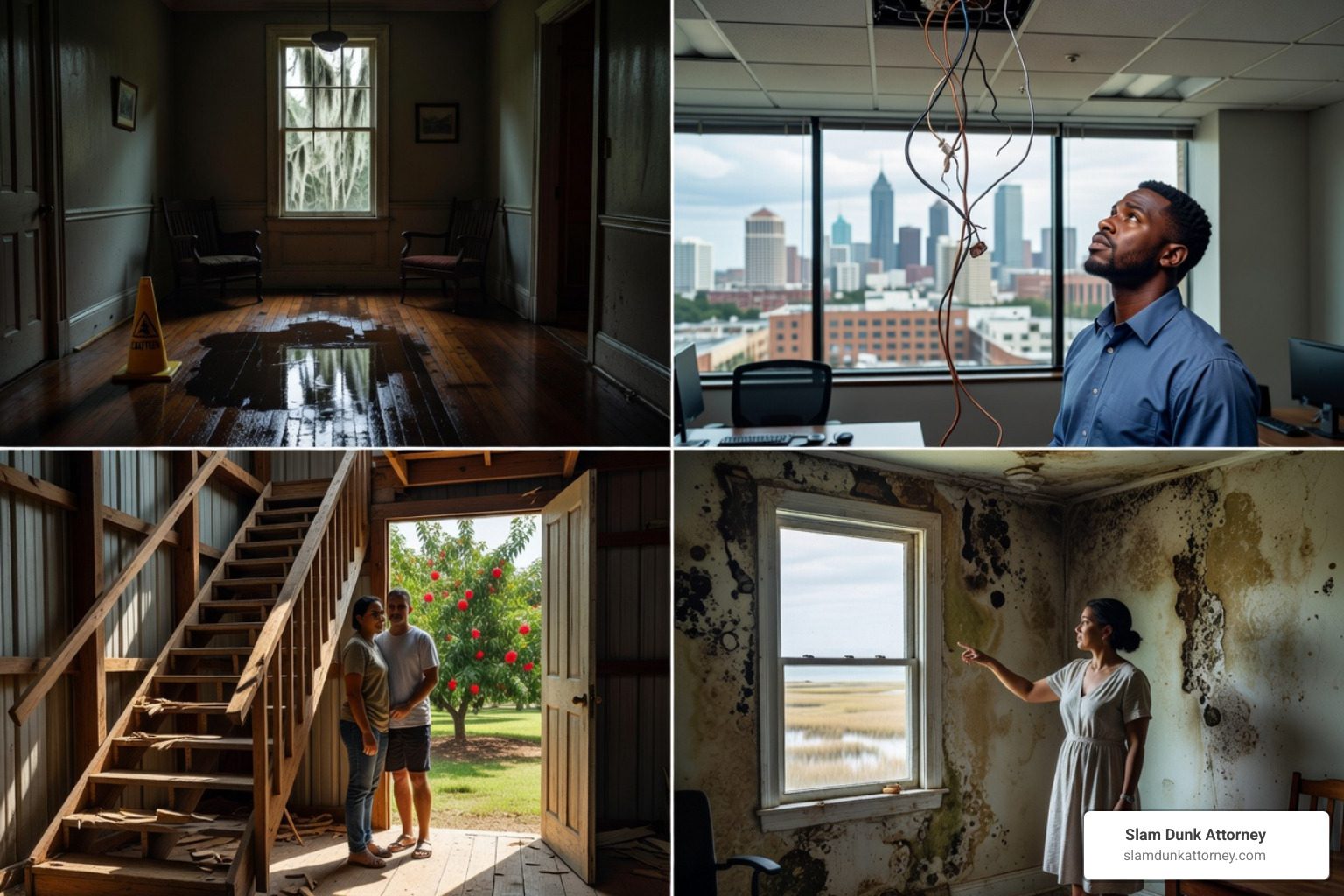
Here is a list of common hazardous conditions that can be found in Georgia businesses and residences:
- Spills of liquids, food, or other substances on floors
- Loose rugs, mats, or carpeting
- Uneven or damaged flooring, tiles, or concrete
- Potholes and cracks in parking lots or sidewalks
- Broken or missing steps and stair railings
- Inadequate or faulty lighting in common areas
- Clutter or debris left in walkways
- Falling merchandise from improperly stacked shelves
- Defective escalators or elevators
- Lack of proper signage for known hazards (e.g., “wet floor”)
- Poorly maintained landscaping, such as overgrown bushes obscuring pathways
- Insufficient security measures leading to criminal activity on the premises
- Exposed wiring or other electrical hazards
- Toxic chemical exposure
The Property Owner’s Duty of Care in Georgia
In Georgia, property owners have a legal “duty of care” to keep their premises safe for visitors. The level of care depends on the visitor’s status, but for lawful visitors, owners must exercise “ordinary care.”
Georgia Code § 51-3-1 states that “where the owner or occupier of land, by express or implied invitation, induces or leads others to come upon his premises for any lawful purpose, he is liable in damages to such persons for injuries occasioned by his failure to exercise ordinary care in keeping the premises and approaches safe.” This means if you are an invited guest or customer, the owner owes you a duty to keep the area reasonably safe.
“Ordinary care” involves taking reasonable steps to prevent foreseeable harm, such as:
- Duty to inspect: Regularly checking the property for potential hazards.
- Duty to warn: Placing clear warnings about any dangers that cannot be immediately fixed.
- Duty to repair: Promptly fixing any hazardous conditions they know about or should know about.
While the duty to trespassers is lower, most cases involve invitees (customers) or licensees (social guests). For these lawful visitors, Georgia property owners must proactively maintain a safe environment. These principles apply across Georgia, from a store in Atlanta to a home in Duluth. For more details, you can read more here: Premises Liability Lawyer Duluth GA | Slip and Fall Attorney.
Proving Your Case: Evidence and Legal Problems
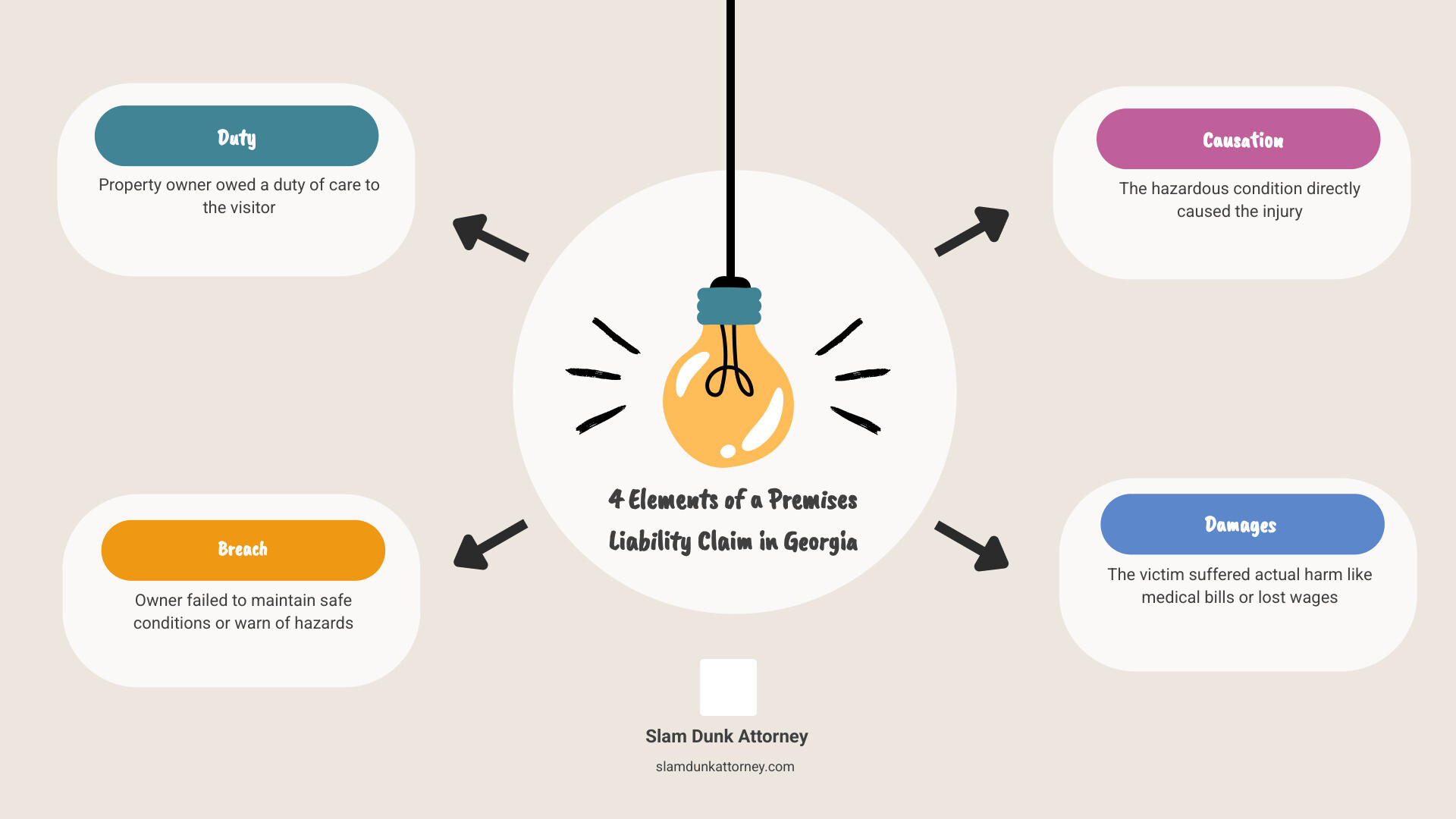
Proving a property owner is legally responsible for your injuries requires an experienced hazardous condition attorney. To win a premises liability case in Georgia, we must prove four key elements:
- Duty: The property owner owed you a duty of care.
- Breach: The owner breached that duty.
- Causation: The hazardous condition directly caused your injuries.
- Damages: You suffered actual harm or losses.
A key challenge is proving the owner’s knowledge of the hazard, known as “notice.”
- Actual Notice: The property owner or their employees explicitly knew about the dangerous condition.
- Constructive Notice: The hazard existed long enough that a reasonable owner, through regular inspection, should have known about it. For example, a spill that remained for hours or a sidewalk that was broken for weeks.
Strong evidence is critical. Our team collects:
- Photos and Videos: Visual evidence of the hazard and surrounding area.
- Witness Statements: Accounts from eyewitnesses about the accident and the condition.
- Incident Reports: The official report filed with the property owner or manager.
- Medical Records: Documentation linking your injuries to the accident.
- Building Code Violations: Proof that the hazard violated safety regulations.
Proving liability is complex, and insurers often try to shift blame or minimize payouts. An attorney who knows how to build a strong case under Georgia law is essential. You can learn more here: Are Slip and Fall Cases Hard to Win? and How Is Liability Determined in a Slip and Fall Accident?.
99a1d1935b04895a6a085153856e29e85db33207
What Happens If I’m Partially at Fault?
A common concern is being partially at fault. Georgia’s “modified comparative negligence” rule (Georgia Code § 51-12-33) addresses this. You can still recover compensation if you were partially at fault, but there’s a limit.
Here’s how it works:
- If you are found to be less than 50% at fault for the accident, your compensation will be reduced by your percentage of fault.
- However, if you are found to be 50% or more at fault, you are barred from recovering any compensation at all. This is the “50% bar rule.”
Insurance companies often use this rule to blame the victim, arguing you weren’t paying attention to push your fault to 50% or more and avoid paying. Our role as your hazardous condition attorney is to counter these tactics. We build a strong case to demonstrate the owner’s negligence, minimize any claims of your fault, and ensure you receive the maximum compensation allowed under Georgia law.
How a Hazardous Condition Attorney Can Help You Recover
Being injured on someone else’s property can be a frightening and disorienting experience. Beyond the physical pain, you might face mounting medical bills, lost income, and the stress of dealing with insurance companies. That’s where we come in. A dedicated hazardous condition attorney from Slam Dunk Attorney can guide you through every step of the legal process, protecting your rights and fighting for your full recovery.
Steps to Take Immediately After an Injury on Someone’s Property
The moments following an injury are crucial for your health and any potential legal claim. We advise our clients in Georgia to take these steps:
- Seek Medical Attention: Your health is the priority. See a doctor even for minor injuries, as some issues aren’t immediately apparent. Medical records are also crucial evidence.
- Report the Incident: Inform the property owner or manager immediately. Ask them to file an incident report and get a copy.
- Document the Scene: If possible, take photos and videos of the hazard, the surrounding area, and your injuries. Note any missing warning signs.
- Get Witness Information: Ask any witnesses for their names and contact information. Their testimony is valuable.
- Preserve Evidence: Keep the shoes and clothing you were wearing. Do not clean or repair them, as they are important evidence.
- Avoid Admitting Fault: Do not apologize or say anything that implies you were at fault. Stick to the facts when speaking to anyone.
- Contact a Hazardous Condition Attorney: Once you’ve handled your immediate needs, contact an attorney. The sooner we can investigate, the stronger your case will be.
These steps create a strong foundation for your claim.

Maximizing Your Compensation with a Hazardous Condition Attorney
As your hazardous condition attorney, our goal is to recover maximum compensation for your losses. This requires calculating your damages and negotiating with insurance companies.
In Georgia, compensation falls into two main categories:
1. Economic Damages: These are quantifiable financial losses.
- Medical Bills: All costs for past, present, and future medical care.
- Lost Wages & Earning Capacity: Compensation for income lost and for any reduction in your future ability to earn.
- Other Out-of-Pocket Expenses: Costs for things like travel to appointments or necessary home modifications.
2. Non-Economic Damages: These are subjective losses that impact your quality of life.
- Pain and Suffering: Compensation for the physical pain and mental anguish caused by your injuries.
- Loss of Enjoyment of Life: Compensation if your injuries stop you from enjoying hobbies and daily activities.
Understanding the Georgia Statute of Limitations is critical. You generally have two years from the injury date to file a premises liability lawsuit. Missing this deadline means you lose your right to seek compensation. Contacting a hazardous condition attorney promptly is vital. For more information, see What is the Statute of Limitations for Slip and Fall Cases in Georgia?.
Insurance companies often offer quick, lowball settlements. Our team at Slam Dunk Attorney is experienced in these negotiations. We:
- Investigate: We gather all evidence to build a strong case.
- Calculate Damages: We account for all your current and future losses. What Damages Can I Recover for a Slip and Fall Accident in Georgia?
- Negotiate: We handle all communications with insurers and fight for a fair settlement.
- Go to Court: If a fair settlement isn’t reached, we are prepared to file a lawsuit and represent you at trial.
Our team’s commitment to hustle, honesty, and transparency means we take the legal burden off your shoulders so you can focus on recovery. If you’ve been injured on someone else’s property in Georgia, a skilled legal advocate can make all the difference. For personalized guidance on how a hazardous condition attorney can help you get the justice you deserve, contact our team for a free consultation.
Contact a Duluth slip and fall lawyer
The information provided on this blog is for general informational purposes only and is not intended to be, nor should it be construed as, legal advice. Every personal injury case is unique, and the laws and circumstances that apply can vary based on the specific facts of your situation. Reading this content does not create an attorney-client relationship. To receive legal advice specific to your case, you should consult directly with a qualified personal injury attorney licensed to practice in the state of Georgia.
Call or text 404-951-3513 or complete a Free Case Evaluation form