
Wrongful Death · Marietta, Georgia
When a Truck Crash Takes a Loved One, You Don't Have to Face It Alone
Slam Dunk Attorney represents Marietta families in wrongful death claims arising from fatal truck crashes across metro Atlanta and Georgia. Your first consultation is free, confidential and comes with no obligation to continue.
By Peter F. Jaraysi · Published October 20, 2026
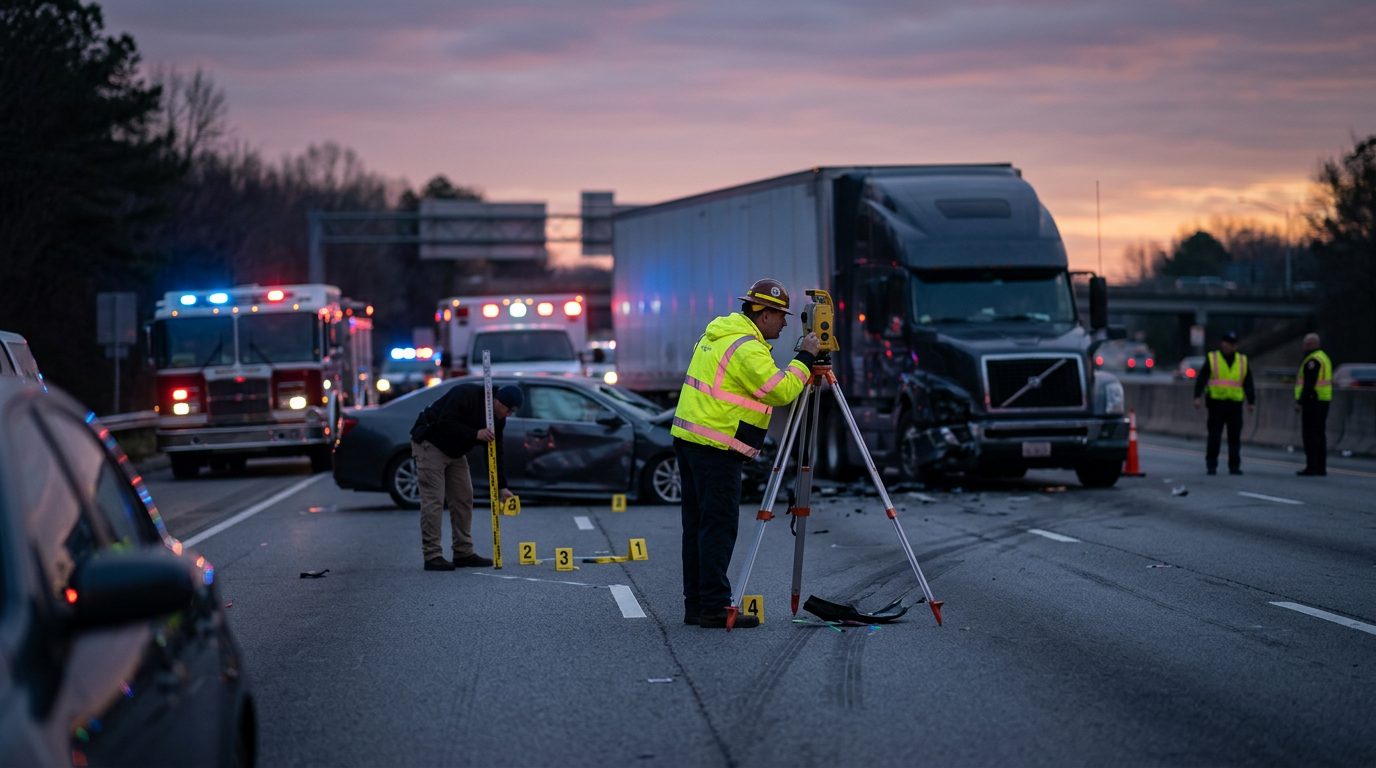
When a truck crash causes a death, more than one party can be responsible. The driver, the company that employs the driver, the vehicle owner, and sometimes a freight broker or maintenance contractor may all play a role. Which of them matter depends on how the truck was owned, leased, loaded, and maintained.
Losing a parent, spouse, or child is hard enough without a stack of legal questions. This guide explains who may be responsible, the federal trucking rules that often matter, and the Georgia wrongful death rules. It is written for families in Marietta and Cobb County, and it is general information. If you’re looking for a wrongful death law firm Marietta families can call, Slam Dunk Attorney is based in Duluth, Georgia. The firm handles wrongful death and truck crash claims across metro Atlanta and Georgia.
Who Can Be Held Responsible in a Fatal Truck Crash?
Several parties can be responsible in a fatal truck crash, not just the person behind the wheel. The driver can be responsible if his or her actions caused the crash. The employing motor carrier, the vehicle owner, the freight broker, and a maintenance contractor can also be part of the picture in some cases.
Who is involved usually comes down to records. Ownership papers, lease agreements, load paperwork, and repair logs show how the truck was run and who controlled it. Families often want to know what happened first, and that is a fair place to start. The legal question of responsibility is worked out from those records over time, not from a single news report.
Naming every possible party early helps protect claims against each one. That is why the first steps matter so much.
If a truck crash took someone you love and you're unsure who may be responsible, our team is ready to listen and explain your options. Talk it through with our team — the first consultation is free, confidential, and carries no obligation.

The Driver and the Employing Carrier
The driver and the employing motor carrier are usually the first parties families ask about. Driver negligence, meaning a failure to use reasonable care, can take many forms. Common examples include fatigue, distraction, speeding, impairment, and ignoring traffic rules. These are general categories, not conclusions about any particular crash.
Georgia holds an employer answerable for certain work conduct of its employees. The statute says a person is liable for torts committed by a servant in the prosecution and within the scope of the person’s business, O.C.G.A. § 51-2-2.
Federal rules also place duties on carriers. Under 49 C.F.R. § 390.11, a motor carrier must require observance of the driver duties and prohibitions prescribed in part 325 of subchapter A or in this subchapter.
In Quynn v. Hulsey, decided in 2020, the Georgia Supreme Court addressed this issue.
The Vehicle Owner, Freight Broker, and Maintenance Contractor
The company that owns the truck, the broker that arranged the load, and the shop that maintained the truck can each be a party. Each one has a different role, and each role leaves different records.
The vehicle owner may be a separate company from the carrier, especially when a truck is leased. Ownership and lease papers show who held the truck and who controlled its use. Those papers matter because they show which company had a duty to keep the truck safe.
A freight broker arranges the shipment and selects the carrier. Some claims look at whether that choice was made with reasonable care.
A maintenance contractor who inspected or repaired brakes, tires, or other parts may be a party if a mechanical failure played a role. Early identification of every party helps families protect claims against each one.
Federal Trucking Rules That Shape the Claim
Federal trucking rules set hard limits on driving time and on the records carriers must keep. Those records can become key evidence after a crash.
Under 49 C.F.R. § 395.3, a driver may not drive without first taking 10 consecutive hours off duty. A driver may not drive after a 14-consecutive-hour period that starts after coming on duty. Within that period, a driver may drive a total of 11 hours. Driving is also not allowed after more than 8 hours of driving time without at least a 30-minute break, with limited short-haul exceptions.
Carriers must also keep a file on each driver. Under 49 C.F.R. § 391.51, a carrier keeps the driver qualification file for as long as the driver works for that carrier and three years after, though some records in it, such as annual driving record checks and medical examiner’s certificates, may be removed three years after the date they were made.
Record retention has limits too. Under 49 C.F.R. § 379.3, companies keep records for minimum periods. After those periods, the records may be destroyed. That is why early requests for logs, dispatch records, and maintenance files matter.
Federal law also makes a carrier or broker providing transportation subject to federal jurisdiction under chapter 135 liable for damages a person sustains from its violations of that part of federal transportation law, under 49 U.S.C. § 14704. Electronic logging device data, dispatch records, and inspection reports help show what happened.
Georgia Wrongful Death Rules: Who May Bring the Claim
In Georgia, a surviving spouse may bring the claim. If there is no surviving spouse, a child or children may bring it. The law allows recovery for the homicide of a spouse or parent, O.C.G.A. § 51-4-2, and the claim is measured by the full value of the decedent’s life, as shown by the evidence.
If no one is entitled to bring the claim, the administrator or executor of the estate can act. Under O.C.G.A. § 51-4-5, that personal representative can bring the action for the benefit of the next of kin.
Knowing who holds the claim helps a family decide who should act and how quickly. The answer depends on who survived, so ask early.
The Two-Year Filing Deadline and Why Early Action Matters
Georgia’s general deadline for injury claims is two years after the right of action accrues. The rule appears in O.C.G.A. § 9-3-33, which covers actions for injuries to the person.
Because the clock runs from when the right of action accrues, and because these claims are complex, asking about timing early is the safer path. Waiting can leave less time to gather proof.
Some steps help preserve evidence. Families can ask for the police crash report and write down the names of witnesses. They should also note every company connected to the truck. Requests for logs, dash camera footage, and maintenance files should go out early, because retention periods are finite.
Early action also gives your legal team time to review the records before memories fade. It helps the people reviewing your case understand the whole timeline.
Not sure what your next step is?
Talk it through with our team — the first consultation is free, confidential, and carries no obligation.
What Damages Can Be Pursued in a Georgia Wrongful Death Case
Georgia law allows recovery of the full value of the decedent’s life, as shown by the evidence. Under O.C.G.A. § 51-4-2, a surviving spouse or, if there is no surviving spouse, a child or children, either minor or sui juris, may recover for the homicide of the spouse or parent the full value of the life of the decedent, as shown by the evidence. The same statute says a surviving spouse’s share is never less than one-third of the recovery.
The personal representative can also recover funeral, medical, and other necessary expenses resulting from the injury and death when the death results from a crime or from criminal or other negligence, under O.C.G.A. § 51-4-5. These are often the first losses families document.
Fault sharing also matters. Georgia uses a modified comparative fault rule (O.C.G.A. § 51-12-33; Quynn v. Hulsey, 310 Ga. 473 (2020)). Under O.C.G.A. § 51-12-33 (Quynn v. Hulsey, 310 Ga. 473 (2020)), as quoted in Quynn v. Hulsey, a person who is 50 percent or more responsible recovers nothing. Under O.C.G.A. § 51-12-33, the judge reduces the damages otherwise awarded to the plaintiff in proportion to the plaintiff’s percentage of fault, and the plaintiff is not entitled to receive any damages if the plaintiff is 50 percent or more responsible for the injury or damages claimed.
Medical bills raise another question. The amount that applies in each case turns on the evidence.

Talk With Our Team About a Fatal Truck Crash in Marietta
If a truck crash took a loved one in Marietta or elsewhere in Cobb County, you may not know which companies to name or which deadlines apply. Those questions can feel heavy while you’re still grieving.
Peter F. Jaraysi is the responsible lawyer for this page. The firm’s lawyers, including Peter F. Jaraysi and Brian D. Wright, handle wrongful death matters across metro Atlanta and Georgia. The firm is based in Duluth, Georgia.
For more on fatal truck cases in the Atlanta area, read our Atlanta wrongful death guide.
Common Questions
Who can file a wrongful death claim in Georgia?
A surviving spouse can, and if there is no spouse, the children can. If no one qualifies, the estate’s administrator or executor may act for the next of kin.
Can a trucking company be sued?
It can be, when Georgia law makes it answerable for its driver’s work conduct or for its own negligence.
If a truck crash has left your family facing these questions, our team is ready to talk them through with you. Our first consultation is free, confidential, and carries no obligation to continue. You can reach us through our contact page.
How our team supports your family
Careful investigation
Truck crash cases often involve driver logs, maintenance records and company policies. We work to identify the evidence that matters and to preserve it early.
Clear, plain-language updates
Our lawyers explain each step of the process in terms you can understand, so you always know where your family's case stands.
Compassion during a difficult time
We understand that a wrongful death claim is about a person you loved. We approach every family with patience and respect.
Attention to the whole family
Our team keeps the family's questions and concerns at the center of the case, from the first call through every stage that follows.
Evidence can disappear quickly
Trucking companies and their insurers often begin gathering their own evidence soon after a crash. Avoid giving recorded statements or signing documents from an insurance company before you have spoken with a lawyer about your family's situation.
Questions families often ask
Who can bring a wrongful death claim?
Georgia law sets out who may bring these claims, generally a surviving spouse, the children, or the personal representative of the estate. Our team can explain how this applies to your family.
Can a trucking company be held responsible?
In some cases, the trucking company may be answerable for its driver's conduct on the job or for its own negligence, such as poor hiring, training or maintenance. Each situation depends on its facts.
What should we do first?
Keep any photos, police reports, medical records and correspondence you have. Write down what you remember while it is fresh, and reach out to our team to talk through next steps.
Will we have to pay for the consultation?
No. Your first consultation is free, confidential and without obligation. You can ask questions and decide what makes sense for your family afterward.