
Slip and Fall | Duluth, Georgia
Hurt at a Restaurant? Understand the Lawsuit Process Before You Decide What's Next
Slip and fall injuries at restaurants raise specific questions about notice, evidence and insurance. Our team focuses on premises liability claims across metro Atlanta and Georgia, and we explain each step in plain language. Your first consultation is free, confidential and comes with no obligation to continue.
By Peter F. Jaraysi · Published October 26, 2026
A fall inside a restaurant can leave you hurt, worried about bills, and unsure what happens next. This guide explains the Georgia slip and fall lawsuit process in plain terms. It covers the steps from the first conversation through a demand letter, settlement talks, and a lawsuit if one is needed. Every case depends on its own facts, so treat this as a map, not a promise of how your case will go. Our firm is based in Duluth, Georgia, and represents people hurt in these accidents across metro Atlanta and the state.
What does a restaurant slip and fall lawyer’s process look like, from the free consultation through investigation, demand letter, and settlement or lawsuit?
The process usually moves in order. It starts with a free consultation, then an investigation of the fall, then a demand letter to the restaurant’s insurer. Settlement talks follow, and a lawsuit comes only if the claim cannot be resolved. Each stage depends on how the fall happened, what injuries you have, and how the insurer responds.
The first stage is a conversation. Your lawyer listens to what happened and reviews any records you already have. If the investigation supports a claim, it looks at the hazard, the restaurant’s records, and your medical care. Once the picture is clear, your lawyer may send a demand letter asking the insurer to pay. Many claims end in settlement talks. A few need a lawsuit, which means filing a complaint in court. Georgia sets a deadline for filing, so timing matters from the start.
If someone you love fell at a restaurant and you're still deciding what comes next, we'd be glad to talk through the facts and timeline with you. Talk it through with our team — the first consultation is free, confidential, and carries no obligation.

Who Is Responsible When Someone Slips in a Restaurant?
A restaurant can be responsible when it fails to use ordinary care to keep its floors and walkways safe. Ordinary care means reasonable care under the circumstances.
Under O.C.G.A. § 51-3-1, an owner or occupier of land who, by express or implied invitation, induces others to come upon the premises for any lawful purpose is liable in damages for injuries caused by a failure to exercise ordinary care in keeping the premises and approaches safe. You came in for a lawful purpose, such as a meal, and the restaurant invited you. Under O.C.G.A. § 51-3-1, an owner or occupier that invites people onto its premises must use ordinary care to keep the premises and approaches safe. A Georgia appeals court opinion, Holston v. Aboebarensi, Inc., explains that an owner is not an insurer of invitees.
Common restaurant hazards include spilled drinks, wet or greasy floors near the kitchen or bar, missing or curled mats, cracked tile, and uneven steps where the dining room meets the kitchen. State guidance for workplaces lists spill cleanup, removing obstructions, and keeping walkways clear as key prevention steps. That is the kind of care a customer expects in a restaurant.
The central question is often what the restaurant knew. Did it create the hazard, know about it, or have enough time to find and fix it? Georgia also looks at your own share of fault. Under O.C.G.A. § 51-12-33, a judge reduces your damages in proportion to your percentage of fault. If you are 50 percent or more responsible, you cannot receive damages. An insurer may argue you were distracted or wearing unsafe shoes, so be ready for that argument.
What Should Happen Right After a Restaurant Fall, Before Calling a Lawyer?
Get medical care first. Then report the fall and start recording what happened while the details are fresh. Some injuries don’t show symptoms until hours or days later, so an early visit matters.
Keep every record. That includes visit notes, bills, referrals, and prescriptions. Ask a manager for an incident report, and write down the name of the person who took it. If you can, take photos or video of the spot, the floor surface, the lighting, and the shoes you wore. Write down the date, the time, and what you saw and felt.
Collect names and phone numbers of anyone who saw the fall. Keep the shoes and clothing you wore, and don’t wash or throw them away. Start a simple daily log of pain, missed work, and tasks you can’t do. This log helps show how the injury affects your life. If the restaurant’s insurer calls, you are free to say you want to speak with a lawyer first.
How Does the Free Consultation Start the Process?
The free consultation is a first conversation about your fall. The firm’s first consultation is free, confidential, and carries no obligation to continue. You can decide what to do next after you hear how the firm would approach your case.
Plan to describe the date, the location, and how the fall happened. Explain your injuries and any treatment so far. Bring whatever you already have, including medical records, bills, the incident report, photos, witness names, and a timeline. Write your questions down before you go, so you don’t forget them.
Ask how the firm handles fees and case expenses. Ask what the arrangement means for you, and ask for the answers in writing before you agree to anything. A good first meeting gives you facts, not pressure. You should leave knowing your next steps and your choices.
What Does the Investigation Involve After a Restaurant Slip and Fall?
Investigation is the work of gathering proof. It shows what the restaurant knew and how your injury happened. Early action matters because records can disappear.
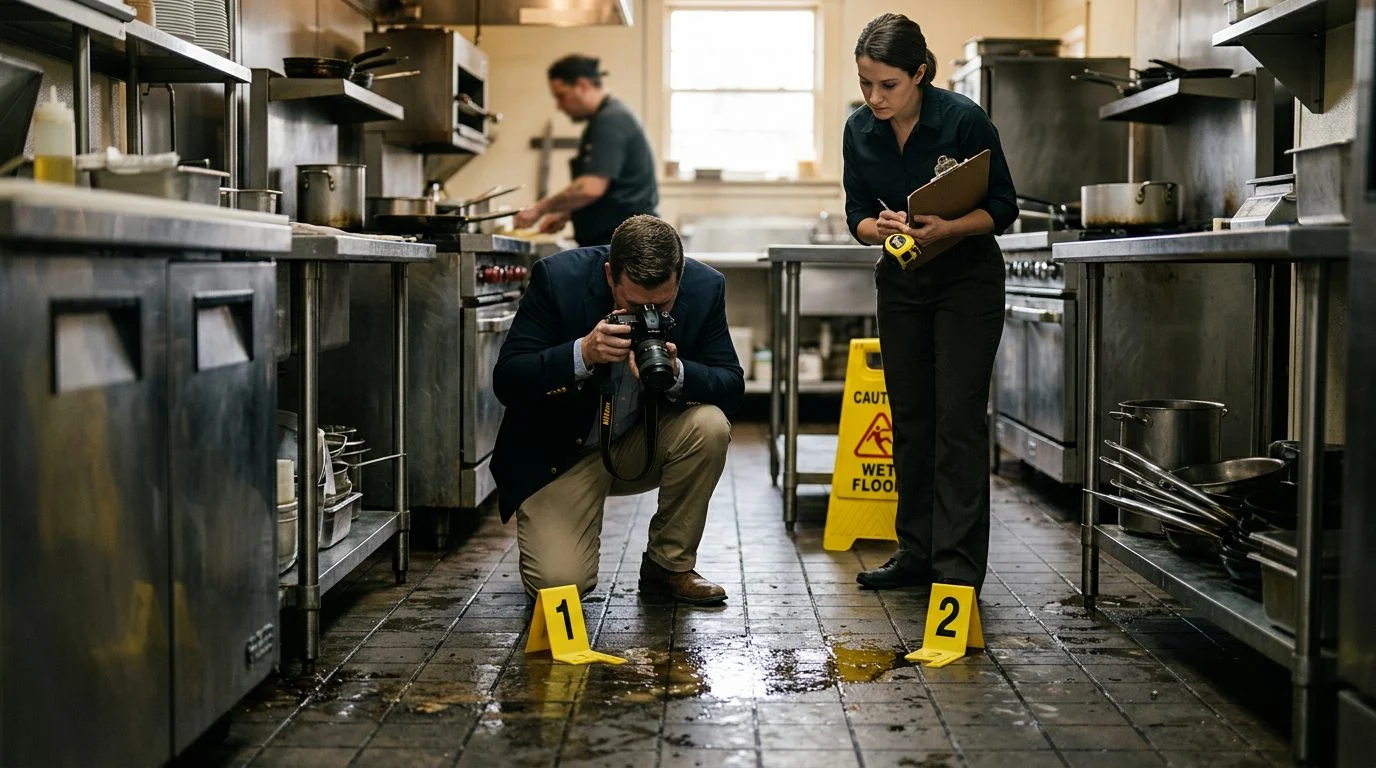
A preservation letter asks the restaurant to keep evidence. That can include security video, incident reports, cleaning logs, maintenance records, and staff schedules. Security video is often recorded over on a schedule, so early requests are important. Your lawyer may also visit the location, photograph the hazard, and measure it where useful. Comparing the conditions to the date of your fall can be important.
Medical records link your injury to the fall. Treatment history shows what care was needed and when. Under O.C.G.A. § 51-12-1.1, special damages for medical care are limited to the reasonable value of medically necessary care.
Local rules can also matter. Fulton County’s code enforcement program covers maintenance standards for commercial property. The firm usually notifies the insurer in writing that it represents you. After that, contact with the insurer generally goes through your lawyer.
What Is a Demand Letter in a Slip and Fall Claim, and What Does It Include?
A demand letter is a written request asking the restaurant or its insurer to pay your claim. It is usually sent after the investigation and your medical picture are reasonably complete. Sending it too early can leave out important facts.
A demand letter typically includes a factual summary of the fall, the basis for the restaurant’s responsibility, and a description of your injuries and treatment. It also includes your bills, wage information, and the amount being requested. Georgia law separates two kinds of damages. Under O.C.G.A. § 51-12-2, general damages are those the law presumes flow from a wrong, and they can be recovered without proof of an exact amount. Special damages actually flow from the wrong, and they must be proved.
After the letter arrives, the insurer responds. It may ask for more records, make an offer, or dispute fault or the amount of your injuries. How long an insurer takes to respond varies, and no one can predict that timing at the start. Your lawyer reviews each response with you before you decide how to proceed.
Not sure what your next step is?
Talk it through with our team — the first consultation is free, confidential, and carries no obligation.
How Do Settlement Talks Differ From a Lawsuit in Georgia?
Settlement talks are negotiations to resolve the claim without a court case. A lawsuit is a formal case filed in court when talks don’t resolve the claim. Many claims move between these two paths.
Settlement talks involve back-and-forth offers between your lawyer and the insurer. Sometimes the parties use mediation, where a neutral third person helps them talk through the numbers. Talks can continue while a case is pending.
Timing matters even while talks go on. Under O.C.G.A. § 9-3-33, actions for injuries to the person must be brought within two years after the right of action accrues. Claims for loss of consortium, which can involve a spouse’s losses, have a four-year period under the same statute.
Filing a lawsuit starts with a complaint in court. Under O.C.G.A. § 9-11-4(a), upon the filing of the complaint, the clerk issues a summons and delivers it for service. Then discovery begins. Discovery includes written questions, document requests, and depositions. Some claims settle at any stage, some end at trial, and the path depends on the facts and the parties’ positions.
What Costs and Case Expenses Can Come Up During a Slip and Fall Claim?
Costs can include court filing fees, charges for medical records, deposition costs, and other case expenses. These can come up during investigation, negotiation, and litigation. Each item adds up, so ask about them early.
Even with a free first consultation, you may still be responsible for court costs and case expenses under the arrangement you sign. Ask when these costs are due and how they are paid. Ask whether they come out of any settlement or judgment, and what happens if the case ends early.
Write your cost questions down before your first meeting. A short list helps you compare what you hear with what you read. Keep copies of every cost statement you receive, so you can track each charge over time.
Key Takeaways
- The process usually moves from consultation to investigation, a demand letter, settlement talks, and a lawsuit only if needed.
- Georgia generally gives two years from the date of injury to file a personal injury lawsuit (O.C.G.A. § 9-3-33; Kenneth B. Cameron v. Jmp Pizza, Inc (2026)).
- Early action on medical care, records, photos, and witness names protects your claim.
- Your own share of fault can reduce damages, and 50 percent or more bars recovery (O.C.G.A. § 51-12-33; Quynn v. Hulsey (2020)).
Frequently asked questions
How long do I have to file a slip and fall lawsuit in Georgia?
For injuries to the person, Georgia generally requires a lawsuit within two years after the right of action accrues. Claims for loss of consortium have four years.
Can I still recover if I was partly at fault?
Yes, your damages are reduced by your percentage of fault (O.C.G.A. § 51-12-33; Quynn v. Hulsey (2020)). You cannot recover damages if you are 50 percent or more responsible.
Do all slip and fall claims go to court?
No. Many claims resolve through settlement talks, and a lawsuit is used when talks don’t resolve the claim.
If someone you love fell at a restaurant and you’re still deciding what comes next, we’d be glad to talk through the facts and timeline with you. You can reach us through our contact page to ask for a free case review.
This page is general information, not legal advice. The responsible lawyer for this page is Peter F. Jaraysi of Slam Dunk Attorney in Duluth, Georgia. Contact information is on our contact page.
How We Approach Restaurant Slip and Fall Claims
Preserving the Evidence
Photos, incident reports, surveillance footage and witness names can disappear quickly. We help you identify and request what matters early.
Explaining the Legal Process
From the initial investigation through negotiation or litigation, we describe each stage so you know what to expect.
Clear Communication
You will hear from our team about your claim, and we will answer your questions in everyday language.
Focus on Your Recovery
We handle the paperwork and insurance contact so you can concentrate on your medical care and family.
Important: Report the Fall and Get Medical Care
Tell the restaurant manager about the fall and ask that an incident report be completed. Seek medical attention even if your injuries seem minor, and keep every bill and treatment record. Avoid giving recorded statements to the restaurant's insurer before speaking with a lawyer.
Common Steps in a Restaurant Slip and Fall Claim
1. Free Consultation
We review what happened, where it happened and what injuries you have. The consultation is confidential and there is no obligation to continue.
2. Investigation
We work to determine how the hazard arose, such as a wet floor, uneven surface or missing warning sign, and who was responsible for keeping the area safe.
3. Claim and Negotiation
We present your claim to the responsible party and their insurer, and we discuss the options with you before any decisions are made.
4. Litigation When Needed
If a fair resolution cannot be reached through negotiation, we discuss filing a lawsuit and what that process involves, including court costs and case expenses.