
Premises Liability
Slip and Fall Claims in Metro Atlanta: Know Your Rights Under Georgia Law
If you've been injured on someone else's property due to negligence, you may have a claim. Learn what Georgia law requires property owners to do—and what you need to prove.
By Peter F. Jaraysi · Published September 27, 2026
Slip and Fall Claims in Metro Atlanta: What Georgia Law Says About Your Rights
If you’ve slipped and fallen on someone else’s property in Atlanta, Lawrenceville, Alpharetta, or anywhere across the metro Atlanta region, you may have a legal claim—but only if the property owner’s negligence caused your injury. Georgia law holds property owners to a duty of care, and when they breach that duty, you may be entitled to recover damages. Understanding what the law requires, what you must prove, and what evidence matters is the first step toward protecting your rights.
If you've slipped and fallen on someone else's property in the metro Atlanta area and you're wondering whether the owner bears responsibility, reach out—people in your situation contact us regularly to understand their rights. Talk it through with our team — the first consultation is free, confidential, and carries no obligation.

What Makes a Slip and Fall a Legal Claim in Georgia
A slip and fall becomes a legal claim only when a property owner’s failure to maintain safe premises or warn of hazards directly causes your injury. Simply falling is not enough; you must show that the owner was negligent.
Under Georgia premises liability law, property owners have a legal duty to keep their premises in a reasonably safe condition and to warn visitors of known hazards. This duty exists because the law recognizes that property owners control the space and can take steps to prevent injuries. The strength of that duty depends on your status as a visitor: whether you were an invitee (a customer or guest invited onto the property), a licensee (someone with permission but not for business purposes), or a trespasser (someone without permission).
To win a slip and fall claim in Georgia, you must prove four things: the owner owed you a duty of care, the owner breached that duty by failing to maintain the property or warn you, you were injured as a direct result of that breach, and you suffered damages (medical bills, lost wages, pain and suffering). The property owner’s knowledge—or lack of it—is central to your case. A hazard existing on the property is not enough. You must show the owner knew about it or should have known about it and had a reasonable opportunity to fix it or warn you.
Georgia’s Comparative Negligence Rule and Slip and Fall
Georgia’s modified comparative negligence rule directly affects whether you can recover damages at all, regardless of how serious your injury is.
Under Georgia law, if you are found to be 50% or more at fault for your own injury, you cannot recover any damages. This is called the “50% bar.” For example, if you were wearing inappropriate footwear or not paying attention to your surroundings, a court might find you partly responsible. If your negligence equals or exceeds the property owner’s negligence, your claim fails entirely.
In metro Atlanta slip and fall cases, this rule plays out regularly. A jury might find that you were 40% at fault (perhaps you were hurrying and not watching your step) and the property owner was 60% at fault (they failed to clean up a spill or post a warning). In that scenario, you can recover 60% of your damages. But if the jury finds you 50% or more at fault, you recover nothing. This is why evidence of the property owner’s conduct—how long the hazard existed, whether they knew about it, whether they had time to fix it—is so important. The stronger the evidence of the owner’s negligence, the less likely a court will find you equally or more at fault.
Property Owner Duties Under Georgia Law
Georgia property owners have specific legal duties that vary depending on the type of visitor and the circumstances.
Invitees (customers, patients, business visitors) receive the highest level of protection. Owners must maintain the premises in a safe condition, inspect regularly for hazards, and warn of any known dangers. If a retail store’s floor is wet from a spill, the owner must clean it promptly or post a warning sign. If a parking lot has a pothole, the owner must repair it or warn customers to avoid it.
Licensees (social guests, people with permission but not for business) receive a moderate level of protection. Owners must warn licensees of known hazards but do not have as broad a duty to inspect as they do for invitees.
Trespassers receive minimal protection. Owners generally owe trespassers only a duty not to willfully or wantonly injure them.
In the metro Atlanta region—where retail, hospitality, and commercial properties are dense and busy—most slip and fall claims involve invitees. The duty of care is measured by what a reasonably prudent property owner would do under the same circumstances. In Georgia courts, this means the owner must act with ordinary care to keep the premises safe. For commercial properties, this standard is often higher because owners know their spaces will be heavily trafficked and they have the resources to maintain them.
Common Slip and Fall Hazards in Metro Atlanta
Wet floors in retail stores, restaurants, and office buildings are among the most common hazards. A spill in a grocery store aisle, water tracked in from rain at an entrance, or a leaking pipe can all create dangerous conditions. Property owners must respond quickly—cleaning the spill or posting a warning sign—to avoid liability.
Weather-related hazards are significant in the Atlanta area. Rain, ice, and occasional snow create slippery walkways and parking lots. Property owners must clear snow and ice promptly, salt or sand walkways, and warn customers of hazardous conditions. The seasonal nature of these hazards means owners have a duty to prepare and respond as weather changes.
Poorly maintained sidewalks and parking areas are common in older commercial districts and strip malls across the metro. Cracked concrete, uneven surfaces, and potholes create trip and slip hazards. Inadequate lighting in stairwells, hallways, and parking areas increases the risk of falls, especially in the evening and early morning.
Torn carpeting, broken tiles, and structural defects—such as a loose handrail or missing step—are hazards owners can often identify and fix easily. Debris and clutter left unattended in aisles, hallways, or common areas are preventable hazards. In the catastrophic-injury cases our attorneys handle, we often see that the hazard existed for hours or even days before the owner took action.
Evidence That Matters in Metro Atlanta Slip and Fall Claims
Proving a slip and fall claim requires evidence that shows what happened, why it happened, and how it injured you.
How long the hazard existed is critical. If a spill was on the floor for hours, a jury is more likely to find the owner should have known about it and cleaned it up. If the hazard existed for only minutes, the owner may not have had a reasonable opportunity to discover and fix it. Maintenance records and inspection logs help show whether the owner had systems in place to find and address hazards.
Witness statements from other customers or employees are powerful. If someone else saw the hazard or saw you fall, their account can corroborate your version of events. Collect names and contact information from anyone who witnessed the incident.
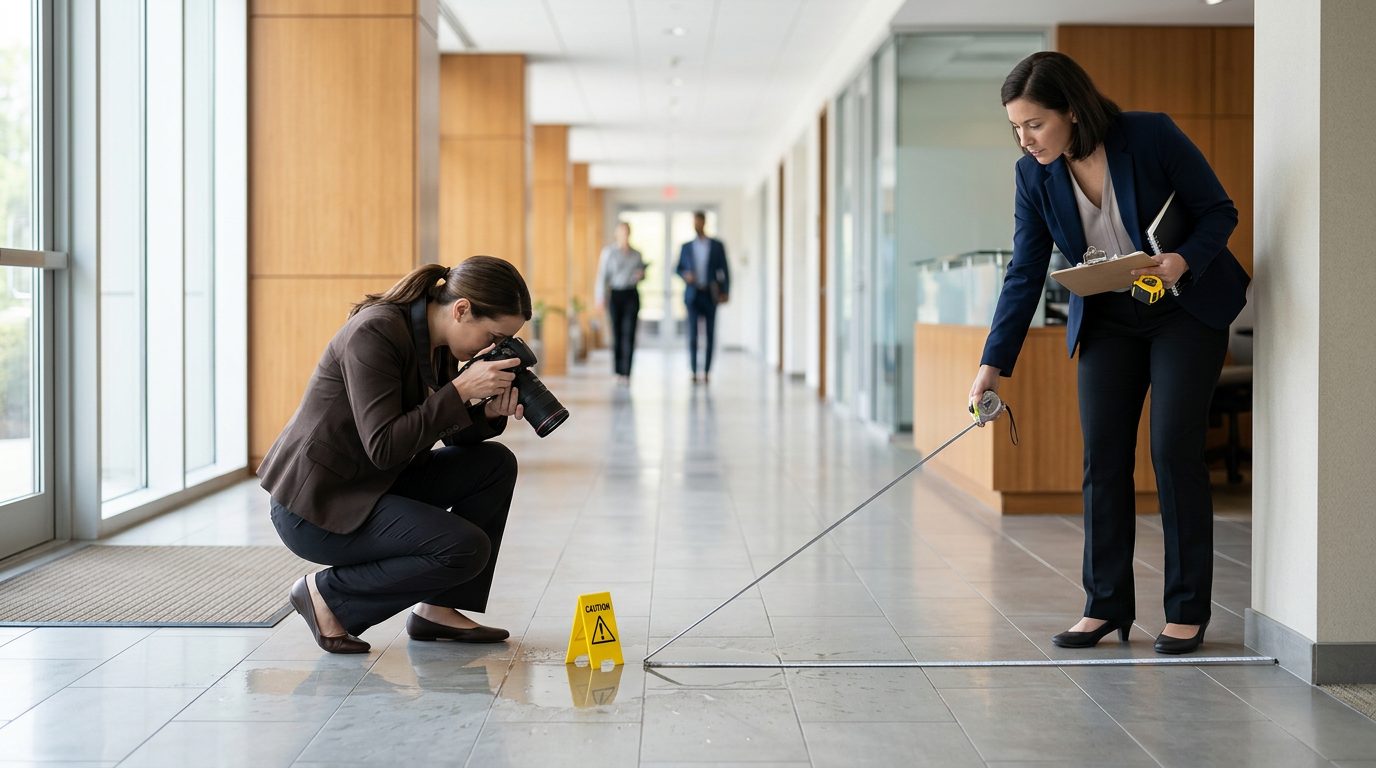
Photos and video of the scene are invaluable. Take pictures of the exact spot where you fell, the hazard itself, lighting conditions, and the overall property condition. If the property owner cleaned up the hazard immediately after your fall, photos taken at the scene may be the only evidence of what caused your injury.
Medical records documenting your injuries are essential. Seek medical attention promptly after a fall. Your medical records establish a direct link between the fall and your injuries and provide a foundation for calculating damages.
Prior complaints or incident reports at the location strengthen your claim. If other people have fallen at the same spot or reported the same hazard, it shows the owner knew or should have known about the problem.
Not sure what your next step is?
Talk it through with our team — the first consultation is free, confidential, and carries no obligation.
Local Considerations for Atlanta-Area Slip and Fall Cases
Georgia courts in the metro Atlanta region apply premises liability law consistently, but local factors influence how cases are evaluated.
Weather patterns specific to the area matter. Atlanta courts recognize that winter weather hazards are seasonal but require owners to respond promptly. A property owner who fails to salt a parking lot after an ice storm may face liability because owners in Georgia are expected to address ice and snow conditions.
Commercial versus residential property differences are significant. Commercial property owners—retail stores, restaurants, office buildings—are held to a higher standard because they control high-traffic spaces and have resources to maintain them. Residential property owners have lower duties to social guests and even lower duties to trespassers, though they must still warn of known hazards.
Busy retail and hospitality environments are treated with the understanding that owners must maintain higher vigilance. A grocery store or shopping mall in Atlanta, Marietta, or Dunwoody is expected to have more frequent inspections and faster response times to hazards than a small neighborhood shop.
Municipal code requirements for property maintenance vary slightly across metro Atlanta cities. Atlanta, Lawrenceville, Johns Creek, Alpharetta, and other municipalities have codes requiring owners to maintain safe premises, clear snow and ice, and keep walkways free of debris. These codes can support your claim by establishing what the law requires.
What You’ll Need to Prove Your Claim
To succeed in a slip and fall claim in Georgia, you must establish each element clearly.
The property owner owed you a duty of care. This is usually straightforward: if you were a customer or invited guest, the owner owed you a duty to maintain safe premises and warn of hazards.
The owner breached that duty. You must show the owner failed to maintain the premises, failed to inspect for hazards, or failed to warn you. Evidence of how long the hazard existed and whether the owner knew about it is central here.
You were injured as a direct result of that breach. Your injury must have been caused by the hazard, not by some other factor. Medical records and your account of how you fell establish this connection.
Your damages are real and documented. Medical bills, lost wages, and documented pain and suffering are all recoverable. Keep receipts and records of all expenses related to your injury.
Documentation and timely action matter. Georgia’s statute of limitations for premises liability claims is a critical deadline. You must file your claim within the applicable timeframe or lose your right to recover entirely. Preserving evidence—photos, witness contact information, medical records, and your own written account of what happened—protects your claim and makes it stronger.

Next Steps If You’ve Been Injured in a Slip and Fall
If you’ve fallen on someone else’s property in the metro Atlanta area, take these steps immediately.
Seek medical attention right away. Even if your injury seems minor, a prompt medical evaluation creates a documented record linking your fall to your injuries. Some injuries worsen over time, and early documentation protects your claim.
Report the incident to the property owner or manager. Tell them what happened and ask them to document it. Request a copy of any incident report they file.
Document the scene with photos and written notes. Photograph the exact spot where you fell, the hazard, lighting, and the overall condition of the property. Write down what you remember: the date, time, weather, what you were wearing, and exactly how you fell. Take these notes while your memory is fresh.
Collect witness contact information. If anyone saw you fall or saw the hazard, get their names, phone numbers, and email addresses.
Preserve evidence. Keep the clothing and shoes you wore when you fell. Keep all medical records, bills, and receipts related to your injury. Do not discard anything that might be relevant to your claim.
Avoid giving recorded statements without legal guidance. The property owner’s insurance company may contact you. Do not give a recorded statement or sign anything without understanding what you’re agreeing to.
Understand your timeline. Georgia law sets a deadline for filing premises liability claims. The sooner you gather evidence and understand your rights, the better protected your claim will be.
If you’ve slipped and fallen on someone else’s property in the metro Atlanta area—whether at a retail store, restaurant, office building, apartment complex, or other commercial or residential space—and you’re uncertain whether the property owner bears responsibility for your injury, we’re here to help. People in your situation reach out regularly to discuss what happened and to understand whether they have a viable claim. Contact us for a free case review, and let’s talk about your specific circumstances and what the law may allow you to recover.
What We Focus On
Property Owner Liability
Georgia law requires property owners to maintain reasonably safe premises and warn visitors of known hazards. We help you understand whether the owner's negligence caused your fall.
Evidence That Matters
Photos, maintenance records, witness statements, and incident reports are critical. We know what evidence strengthens your claim and how to gather it properly.
Timely Action
The sooner you document your injury and the scene, the stronger your position. We guide you on the steps to take immediately after a fall.
Clear Communication
We explain Georgia's premises liability law in plain language, answer your questions, and keep you informed throughout the process.
Important: Case Costs Are Separate From Attorney Fees
We work on a no-fees-unless-there-is-a-recovery basis, but you may still owe certain case costs—such as filing fees, expert witness fees, and investigation expenses. We'll discuss all costs with you upfront so there are no surprises.
Steps to Strengthen Your Slip and Fall Claim
Document Everything
Take photos of the hazard, the scene, and your injuries. Write down what happened, the date, time, and weather. Get contact information from anyone who saw the fall.
Report the Incident
Notify the property owner or manager in writing. Request a copy of any incident report. Keep records of all communication.
Seek Medical Attention
Get evaluated by a doctor and follow their treatment plan. Medical records create a clear link between the fall and your injuries.
Preserve Evidence
Don't discard clothing or shoes worn during the fall. Keep receipts for medical bills and other expenses related to your injury.