
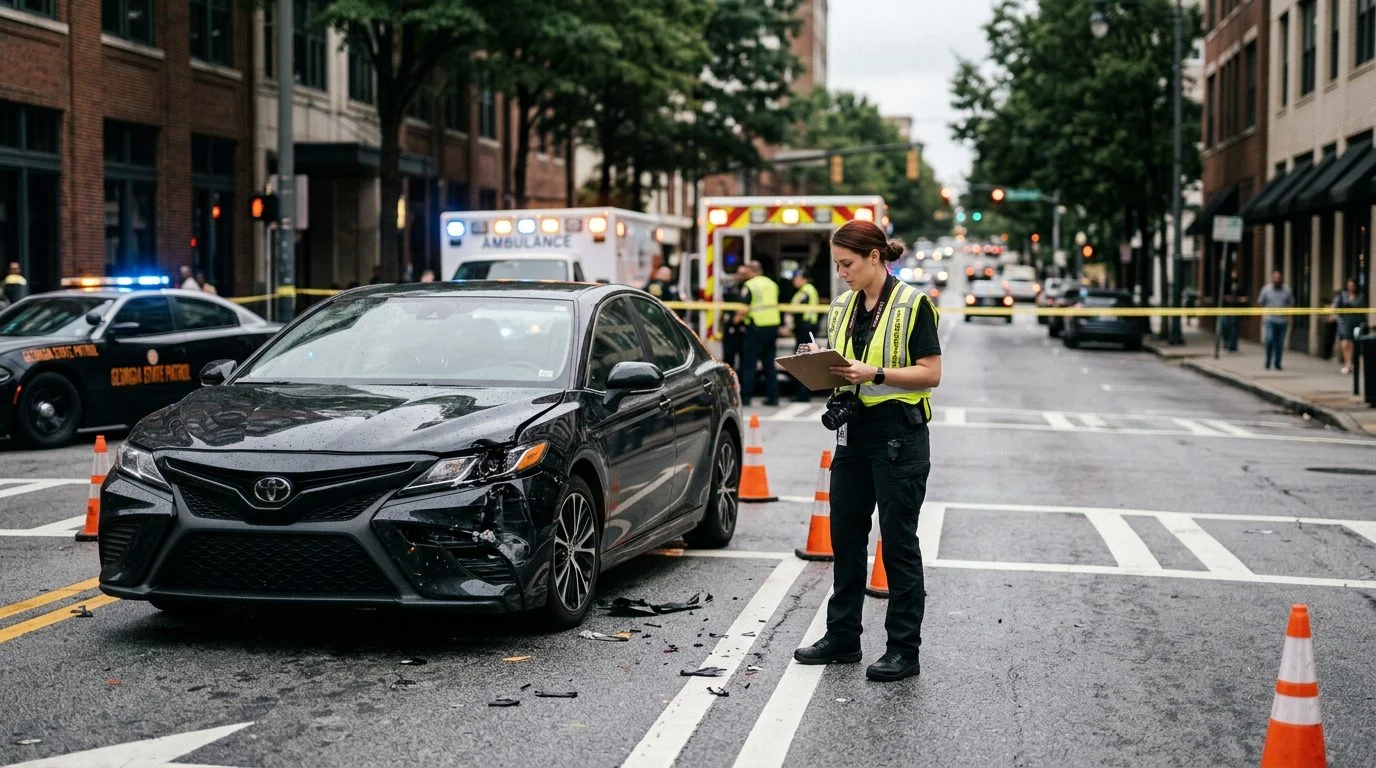
Pedestrian Accidents | Duluth, Georgia
Hit by a Car as a Pedestrian in Georgia? Talk With Our Lawyers
Our lawyers at Slam Dunk Attorney help injured pedestrians across metro Atlanta understand their options. Your first consultation is free, confidential, and comes with no obligation to continue.
By Peter F. Jaraysi · Published November 2, 2026
A pedestrian hit by a car in Georgia can generally seek compensation from the driver whose carelessness caused the crash.
If a parent, spouse, or other older relative was struck while walking, you may be the one asking these questions. This guide covers the questions families ask most about pedestrian hit by car rights in Georgia, in plain language.
This is general information about Georgia law. It is not advice about any one crash.
Why Pedestrian Crashes Involving Older Adults Raise Special Concerns
An older adult hit by a car often faces a longer and more complicated recovery than a younger person in the same crash. Recovery can take time, and existing conditions such as heart disease or osteoporosis can make treatment harder.
The Governors Highway Safety Association states that people outside vehicles are especially vulnerable in collisions. It also notes that pedestrian crashes can cause serious injuries, including head injuries. Governors Highway Safety Association publishes that guidance.
Families also juggle hospital visits, insurance calls, and caregiving at the same time. A clear list of questions can make those weeks easier to manage.
If you are caring for a parent who was hurt while walking and are weighing your options, you do not have to face the next steps alone. Talk it through with our team — the first consultation is free, confidential, and carries no obligation.

What Legal Rights Does a Pedestrian Hit by a Car Have in Georgia?
Pedestrian hit by car rights in Georgia start with a simple duty. Every driver must exercise due care to avoid colliding with any pedestrian upon any roadway (O.C.G.A. § 40-6-93).
O.C.G.A. § 40-6-93 requires every driver to exercise due care to avoid colliding with any pedestrian upon any roadway. The statute also calls for extra precautions when a driver sees a child or an obviously confused or incapacitated person. That rule can matter for an older walker who is disoriented or unsteady.
Location still matters, though, because it shapes how fault is judged.
Georgia law describes general damages and special damages under O.C.G.A. § 51-12-2: general damages are those the law presumes to flow from any tortious act and may be recovered without proof of any amount, while special damages actually flow from a tortious act and must be proved in order to be recovered. General damages are those the law presumes to flow from a wrongful act. Special damages actually flow from the act and must be proved, so bills, pay records, and receipts matter.
How Do Insurance Companies Decide Who Is at Fault?
An insurance company decides fault by weighing the evidence. Its early conclusion is not the final word.
Adjusters usually review the police report, witness statements, vehicle damage, and any video. Each piece can point in a different direction. Georgia’s negligence standard asks whether a person used the care an ordinarily prudent person would use in similar circumstances. Failing to do so is ordinary negligence under O.C.G.A. § 51-1-2.
Your family does not have to accept an early fault decision. Keep copies of every letter. Write down each call, including the adjuster’s name and what was said. Be careful with recorded statements, because the full extent of injuries may not be known yet.
How Does Georgia’s Comparative Negligence Rule Affect a Claim?
Georgia reduces a claim by the injured person’s share of fault. It bars recovery when that share reaches 50 percent or more. Georgia calls this modified comparative negligence, set out in O.C.G.A. § 51-12-33.
Here is a simple example. Under O.C.G.A. § 51-12-33, where the plaintiff is to some degree responsible for the injury or damages claimed, the judge shall reduce the amount of damages otherwise awarded to the plaintiff in proportion to his or her percentage of fault. At 50 percent, the statute bars recovery. Each liable party pays only its own share, and there is no joint liability between them. Fault of others who contributed to the injury can also be considered.
Questions about where an older adult was crossing come up often. Under O.C.G.A. § 40-6-91, a driver must stop and remain stopped for a pedestrian in a crosswalk on the half of the road the car is using, or when the pedestrian is approaching and within one lane of that half. Under O.C.G.A. § 40-6-92, a pedestrian crossing elsewhere must yield to vehicles on the roadway unless he has already, and under safe conditions, entered the roadway. Between signalized intersections, pedestrians may not cross except in a marked crosswalk. How these rules apply depends on the facts of each crash.
What Injuries Are Most Common When an Older Adult Is Hit by a Car?
Head injuries, broken bones, and internal injuries are among the harms a pedestrian crash can cause. The exact injuries depend on the crash, the speed involved, and the person’s health beforehand.
Head injuries deserve close attention. A traumatic brain injury can be hard to spot at first. Changes in memory, balance, or mood after a crash deserve a medical check, even when they seem mild. Write down what you notice and when.
Existing conditions such as osteoporosis or heart disease can make treatment harder. They also shape how injuries are described in medical records. Insurers often read those records closely, so accurate histories matter.
Keep every discharge summary and follow-up note. These records show what happened and when. They help connect the crash to the care that followed.
How Much Compensation Can a Family Pursue After a Pedestrian Crash?
The amount a family can pursue depends on the losses, the injuries, the evidence, and the insurance available. No one can predict the figure in advance.
Economic losses include medical care, rehabilitation, lost income, and home changes such as ramps or bathroom equipment. Non-economic losses include pain and suffering, which is harder to measure.
In any civil action to recover damages for injury or death to a person, Georgia limits special damages for medical and healthcare expenses to the reasonable value of medically necessary care, and the factfinder decides that value. See O.C.G.A. § 51-12-1.1. The amount billed is not always the amount the law measures.
If an older adult has died, Georgia law lets certain family members bring a wrongful death claim. A surviving spouse may recover the full value of the decedent’s life, as shown by the evidence. If there is no spouse, the children may recover it. See O.C.G.A. § 51-4-2. When a death results from criminal or other negligence, the personal representative may recover funeral and medical expenses under O.C.G.A. § 51-4-5. This is a separate legal path with its own rules.
Not sure what your next step is?
Talk it through with our team — the first consultation is free, confidential, and carries no obligation.
What If the Driver Left the Scene or Has No Insurance?
Report the crash to police right away.
If the driver has little or no insurance, your family’s own coverage may matter. That protection pays the insured for bodily injury or death caused by an uninsured driver, within policy limits. O.C.G.A. § 33-7-11 reads: “(a)(1) No automobile liability policy or motor vehicle liability policy shall be issued or delivered in this state to the owner of such vehicle or shall be issued or delivered by any insurer licensed in this state upon any motor vehicle then principally garaged or principally used in this state unless it contains an endorsement or provisions undertaking to pay the insured damages for bodily injury, loss of consortium or death of an insured, or for injury to or destruction of property of an insured under the named insured’s policy sustained from the owner or operator of an uninsured motor vehicle, within limits exclusive of interests and costs which at the option of the insured shall be.” Check the older adult’s auto policy and any household policy for that coverage.
If the driver fled, note the plate number, the make and model, and any description you have. Those details can help police and insurers.
What Documentation Helps Families Keep Track of a Claim?
Start a file on the first day and keep it current. The most useful items are the police report number, witness names and phone numbers, photos of the scene and injuries, and every medical record and bill.
Also keep a running log. Record missed appointments, days missed from work or caregiving, and rides or home help you paid for. Special damages must be proved, so these records carry weight.
Save clothing, mobility aids, and devices involved in the crash. Keep them as they are if you can, since they can show how the crash happened.
Finally, write a timeline while memories are fresh. Note the date, time, place, what the older adult said, and who was present. A written timeline is easier to rely on later than memory alone.
How Long Does a Family Have to File a Claim in Georgia?
Georgia generally gives two years to bring an action for injuries to the person, under O.C.G.A. § 9-3-33. The clock runs from when the right of action accrues. That date can turn on details of the crash.
Loss-of-consortium claims, which involve the injured person’s spouse, have four years under the same statute.
An insurance claim is not a lawsuit. Talks with an adjuster run on a separate track from the court deadline. Keep the dates on a calendar so nothing is missed.
Ask about deadlines early. The sooner a family knows the dates, the more room it has to decide its next steps.

Talk With Our Team About a Pedestrian Crash Involving an Older Family Member
Getting clear answers early can ease the load on a family already caring for someone hurt through no choice of their own.
Can a pedestrian hit by a car get compensation in Georgia?
Yes, a pedestrian hit by a negligent driver can generally seek compensation for losses the law recognizes. Fault and proof shape how any claim is weighed.
Does a crash outside a crosswalk decide the claim?
Not by itself. Georgia’s comparative fault rule weighs each person’s share of fault (O.C.G.A. § 51-12-33; Quynn v. Hulsey (2020)).
What if the driver left the scene?
Report the crash to police and write down any details about the vehicle.
Do we have to accept the insurance company’s fault decision?
No. An early insurance fault decision is not final, and your family can gather evidence before responding.
If you have questions about pedestrian hit by car rights, you do not have to work through them alone. Slam Dunk Attorney, based in Duluth, Georgia, offers a free, confidential first consultation with no obligation to continue. Our team can talk through your family’s questions about the crash. Contact Slam Dunk Attorney.
Responsible lawyer: Peter F. Jaraysi, Slam Dunk Attorney, Duluth, Georgia. Contact details are on the firm’s contact page. This page is general information about Georgia law and is not legal advice for any specific situation.
How We Approach Your Case
Focus on your recovery
A pedestrian injury can change daily life quickly. We start by listening to your story and your medical needs.
Careful review of the facts
Our team looks at the crash details, the driver's conduct, and the records that help show what happened.
Plain-language communication
We explain your situation in clear terms so you can make informed decisions at every stage.
Local to metro Atlanta
Based in Duluth, Georgia, we represent injured people in Atlanta, Lawrenceville, Johns Creek, Alpharetta, Marietta, Norcross, Kennesaw, Dunwoody, and communities across the state.
Be Careful Before Speaking With an Insurer
An insurance adjuster may contact you soon after a crash. Before you give a recorded statement or sign any paperwork, consider talking with a lawyer about what you are being asked to say.
Steps That Can Help After a Pedestrian Crash
Get medical care
Seek treatment right away, even if your injuries seem minor. Follow the care plan your doctors recommend.
Document the scene
If you are able, note the location, the vehicle, the driver's details, and any witnesses. Photos can help.
Keep your records
Save medical bills, receipts, and notes about missed work and how your injuries affect daily life.
Contact our lawyers
Call or request a free consultation so our team can review what happened and discuss your options.