
Pedestrian Accident | Truck Driver Cases
Why Pedestrian Accidents Involving Trucks Demand Serious Legal Help
Truck blind spots, size, and stopping distance create unique dangers. If you or a loved one was hit, we're here to listen.
By Peter F. Jaraysi · Published September 25, 2026
Pedestrian Truck Accidents in Georgia: Why They’re Different & What You Need to Know
When a pedestrian is struck by a commercial truck, the injury severity and legal complexity differ fundamentally from car-pedestrian collisions. A truck weighs 10,000 to 80,000 pounds or more. A passenger car weighs 3,000 to 4,000 pounds. That mass difference creates exponentially higher injury and fatality risk. Understanding pedestrian truck accidents helps you recognize what your case involves and why early professional guidance matters.
If you or a family member was struck by a commercial truck, you're navigating a uniquely complex situation—and many people in that position reach out to us to understand what comes next. Talk it through with our team — the first consultation is free, confidential, and carries no obligation.
The Physics of Pedestrian Truck Accidents
Pedestrians struck by trucks face substantially higher fatality rates than those struck by cars. The reason is simple: mass, speed retention, and unique injury mechanisms. A truck doesn’t slow down as quickly as a car. It retains far more energy through collision. The pedestrian absorbs forces a lighter vehicle cannot generate.
Large trucks have massive blind spots called “no-zones” on all four sides. A truck driver cannot see a pedestrian directly in front, behind, or alongside the vehicle. These blind spots are significantly larger than those on passenger cars. A pedestrian may believe they’re visible when they’re actually in a zone where the driver has zero sight line.
Pedestrian truck accidents produce unique injury patterns. Underride injuries occur when a pedestrian is pulled beneath the truck’s body. Override injuries happen when the truck’s body rides over the pedestrian. Neither occurs in car-pedestrian accidents. These mechanisms create catastrophic trauma: spinal cord damage, traumatic brain injury, amputation, and internal organ damage are common outcomes.
Why Pedestrian Truck Accident Investigations Are Complex
A pedestrian truck accident investigation is far more involved than a typical car accident. Commercial trucks operate under federal and state regulations that create additional evidence and liability pathways.
The Federal Motor Carrier Safety Administration (FMCSA) sets strict rules governing commercial truck operations. These include hours-of-service limits (how long a driver can work before mandatory rest), vehicle maintenance standards, driver qualification requirements, and cargo securement rules. When a truck violates these regulations, the violation establishes negligence in a Georgia civil claim—even if the violation didn’t directly cause the accident.
Commercial trucks are equipped with electronic logging devices (ELDs) and onboard data recorders. These capture critical information: driver hours worked, speed, braking patterns, acceleration, and engine performance. This data becomes powerful evidence in a pedestrian truck accident case. It can show whether the driver was fatigued, speeding, or failed to brake appropriately. Unlike a passenger car, which leaves no such record, a truck’s data often tells a precise story of what happened seconds before impact.
Maintenance and inspection records are equally important. Trucking companies must maintain vehicles and document inspections. If brakes were defective, tires worn, or safety equipment missing, those records prove it. A pedestrian truck accident investigation typically involves multiple parties: the driver, the trucking company, the maintenance provider, the cargo shipper, and sometimes the vehicle manufacturer. Each party may share liability.
Liability in Georgia Pedestrian Truck Accident Cases
Under Georgia law, a truck driver has a heightened duty of care. The vehicle’s size and inherent danger to others on the road demand greater caution than a passenger car driver would exercise.
Georgia follows a comparative fault rule, which means a pedestrian can recover damages even if partially at fault—as long as the pedestrian is less than 50% responsible. This is important because trucking companies and insurers often argue the pedestrian was negligent. They claim the pedestrian stepped into traffic without looking, ignored traffic signals, or wore dark clothing at night. An experienced attorney can counter these arguments with evidence and expert analysis.
Beyond the driver’s own negligence, the trucking company itself may be liable. Negligent hiring, retention, or supervision creates company liability. If the company hired a driver with a history of safety violations, failed to train the driver properly, or ignored complaints about reckless driving, the company can be held responsible. This is critical: you may have claims against both the driver and the company, multiplying potential sources of recovery.
Violations of federal FMCSA regulations also create liability. If the driver worked beyond legal hours-of-service limits, the truck was not properly maintained, or cargo was improperly secured, these violations establish negligence. Georgia courts recognize federal trucking standards as the baseline for safe operation.
Evidence Unique to Pedestrian Truck Accidents
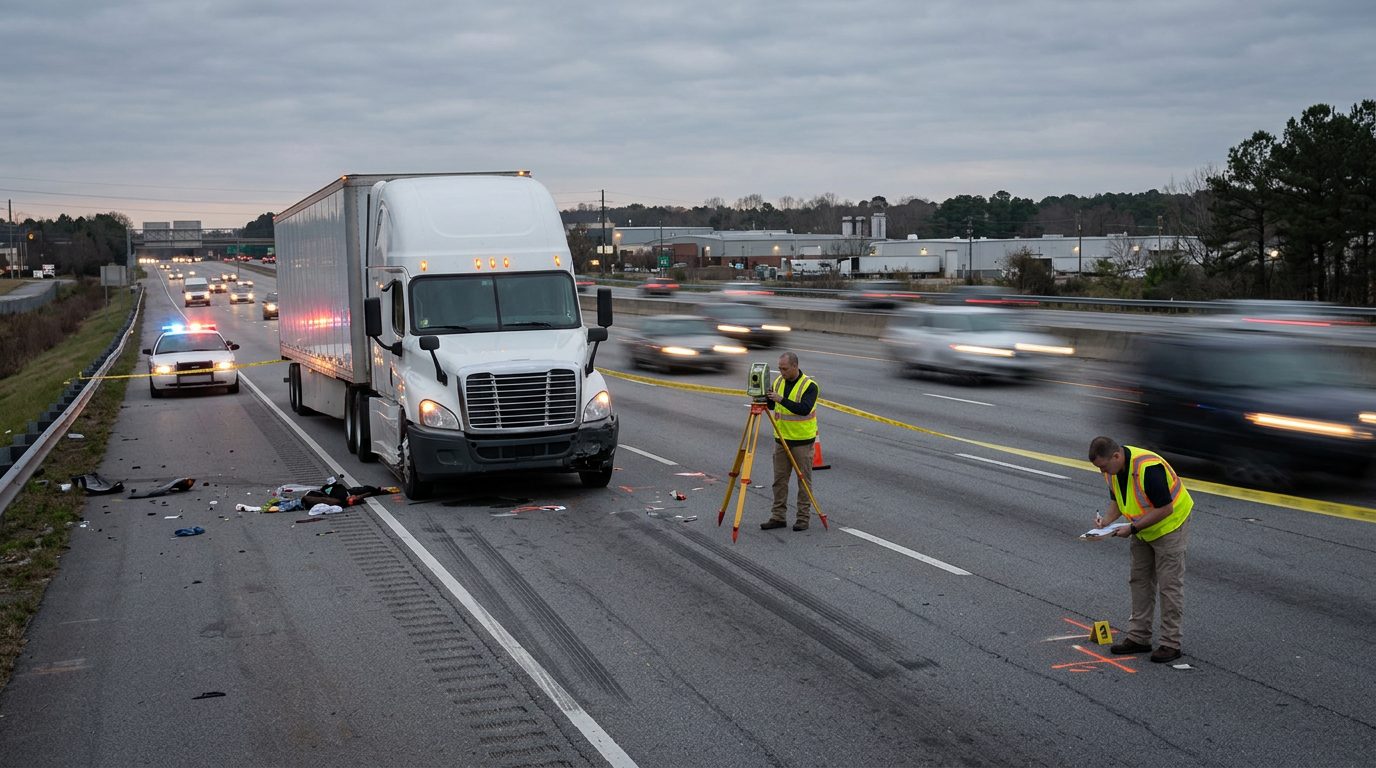
The investigation into a pedestrian truck accident relies on evidence that doesn’t exist in car accidents. Dashcam footage from the truck itself often captures the collision. Surveillance cameras from nearby businesses, traffic lights, or parking lots may show the accident from multiple angles. Witness statements from other drivers, pedestrians, or business owners provide perspective.
ELD data is central to the case. An attorney can subpoena this data to establish the driver’s speed, braking, and hours worked before collision. If the data shows the driver was fatigued or speeding, it strengthens the pedestrian’s claim. Accident reconstruction experts analyze sight lines, stopping distances, vehicle dynamics, and collision mechanics. They can testify about whether the driver had time and ability to avoid the pedestrian.
Truck maintenance and inspection records reveal prior safety violations or defects. If brakes were worn or a safety system was disabled, those records prove negligence. Prompt evidence preservation is critical: trucking companies and insurers know that ELD data, maintenance records, and surveillance footage can be lost or destroyed. An attorney must act quickly to secure this evidence before it disappears.
Medical and Damages in Pedestrian Truck Accidents
Pedestrian truck injuries are often catastrophic. Spinal cord damage can result in partial or complete paralysis. Traumatic brain injury may cause permanent cognitive, physical, or behavioral changes. Amputations require lifelong prosthetics and rehabilitation. Internal organ damage may require multiple surgeries and ongoing medical care.
Recovery from a pedestrian truck accident injury is typically longer and more complex than recovery from a car accident. Many victims require months or years of rehabilitation, physical therapy, and psychological counseling. Some injuries are permanent. Lifetime care, assistive devices, home modifications, and personal attendant services may be necessary.
Damages in these cases are often substantial. They include medical expenses, lost wages, lost earning capacity, pain and suffering, and reduced quality of life. Wrongful death claims arise more frequently in pedestrian truck accidents than in car accidents because injury severity is higher. Trucking insurers know the potential damages are large, and they often make early settlement offers that fall far short of the true value of a catastrophic injury or death.
Not sure what your next step is?
Talk it through with our team — the first consultation is free, confidential, and carries no obligation.
Why Professional Guidance Matters Early
Trucking companies and their insurers employ teams of lawyers and investigators. Their job is to minimize what they pay. An injured pedestrian or grieving family member needs experienced representation to level the playing field.
Evidence can disappear quickly. ELD data may be overwritten. Maintenance records can be lost. Surveillance footage is often deleted after 30 days. An attorney must act immediately to preserve evidence through formal legal channels.
Comparative fault arguments are routine in pedestrian truck accident cases. The insurer will argue the pedestrian was negligent to reduce or eliminate their liability. An attorney can counter these arguments with evidence, expert testimony, and knowledge of Georgia law.
Federal and state trucking regulations create additional liability avenues that a general personal injury attorney may miss. An attorney experienced in pedestrian truck accidents knows which regulations apply, how to obtain evidence proving violations, and how to present that evidence to a jury.
Settlement offers from trucking insurers are often inadequate. Without an attorney to evaluate the offer against the true value of the injury, a pedestrian may accept far less than they deserve. An experienced attorney can negotiate aggressively and, if necessary, take the case to trial.
Frequently Asked Questions
What is a truck’s blind spot, and why does it matter in pedestrian accidents?
A truck’s blind spots (no-zones) are areas where the driver cannot see. They exist in front, behind, and on both sides—and they’re much larger than on passenger cars. A pedestrian in a no-zone is invisible to the driver, even if the driver is looking.
Can a pedestrian recover damages if they were partially at fault in a Georgia truck accident?
Yes. Under Georgia’s comparative fault law, a pedestrian can recover damages if they are less than 50% responsible for the accident, though any recovery is reduced by the pedestrian’s percentage of fault.
What is an electronic logging device (ELD), and how is it used as evidence?
An ELD records a truck driver’s hours of service, speed, braking, and other operational data. This data becomes critical evidence showing whether the driver was fatigued, speeding, or failed to brake appropriately.
Can a trucking company be held liable for a driver’s negligence?
Yes. A trucking company can be liable for negligent hiring, retention, or supervision of the driver. The company can also be liable if it violated federal safety regulations or failed to maintain the vehicle properly.
Why do I need an attorney for a pedestrian truck accident claim?
Trucking companies and their insurers have legal teams and investigators. Evidence can be lost quickly. Federal and state regulations create complex liability issues. An experienced attorney protects your rights, preserves evidence, and negotiates for fair compensation.
If you or a family member was struck by a commercial truck in Georgia, you’re facing a situation that requires in-depth knowledge and immediate action. The complexity of federal regulations, the volume of evidence, and the severity of injuries in pedestrian truck accidents demand professional guidance from the start. Contact our truck accident attorneys to discuss what happened and what your options are. Many people in your situation have reached out to our team to understand their next steps.
What Makes Truck-Pedestrian Accidents Different
Blind Spots (No-Zones)
Commercial trucks have large blind spots in front, behind, and on both sides—areas where a driver cannot see a pedestrian, even when looking. A person standing in a no-zone is essentially invisible.
Stopping Distance and Momentum
A fully loaded truck can weigh 80,000 pounds or more and may need 200+ feet to stop from highway speed. This mass and momentum mean collisions with pedestrians often result in severe or fatal injuries.
Underride and Jackknife Risks
Pedestrians can be trapped under a truck's trailer or caught in a jackknife. These scenarios create catastrophic injuries that differ fundamentally from car-pedestrian collisions.
Regulatory and Maintenance Issues
Commercial trucks are subject to federal safety rules, inspection requirements, and maintenance standards. Violations or neglect can contribute to accidents and strengthen a claim.
Key Questions About Truck-Pedestrian Accidents
What is a truck's blind spot, and why does it matter?
A truck's blind spots (no-zones) are areas where the driver cannot see. They exist in front, behind, and on both sides—and they're much larger than on passenger cars. A pedestrian in a no-zone is invisible to the driver, even if the driver is looking.
Can a pedestrian recover damages if they were partially at fault?
Georgia follows a comparative negligence rule. Even if a pedestrian bears some responsibility, they may still recover damages if the truck driver was also negligent—though any recovery is reduced by the pedestrian's share of fault.
Who can be held liable in a truck-pedestrian accident?
The truck driver, the trucking company, the truck owner, a maintenance contractor, or the manufacturer may all bear liability depending on the facts. Identifying all responsible parties is crucial to maximizing recovery.
What damages can a pedestrian claim?
Pedestrians may seek compensation for medical expenses, lost wages, pain and suffering, permanent disability, and in fatal cases, wrongful death damages. Each case is unique and depends on the severity of injury and impact on your life.
Important: Act Quickly
Evidence at the scene—vehicle maintenance records, driver logs, traffic camera footage, and witness statements—can disappear or be lost. The sooner you contact a lawyer, the sooner we can begin preserving critical evidence and investigating your claim.
Why You Need a Lawyer for a Truck-Pedestrian Case
Trucking Companies Have Resources
Commercial trucking companies carry substantial insurance and employ teams of lawyers and investigators. You need representation that matches their resources and experience.
Complex Regulations and Records
Federal Motor Carrier Safety Administration (FMCSA) rules, driver logbooks, maintenance records, and electronic data recorders hold evidence. We know how to obtain and interpret these materials.
Multiple Liable Parties
Truck accidents often involve the driver, the company, the owner, and others. Identifying and pursuing all responsible parties strengthens your claim and increases potential recovery.
Catastrophic Injury Experience
Truck-pedestrian collisions frequently cause severe, life-altering injuries. We understand how to value long-term care, disability, and the true cost of recovery.