
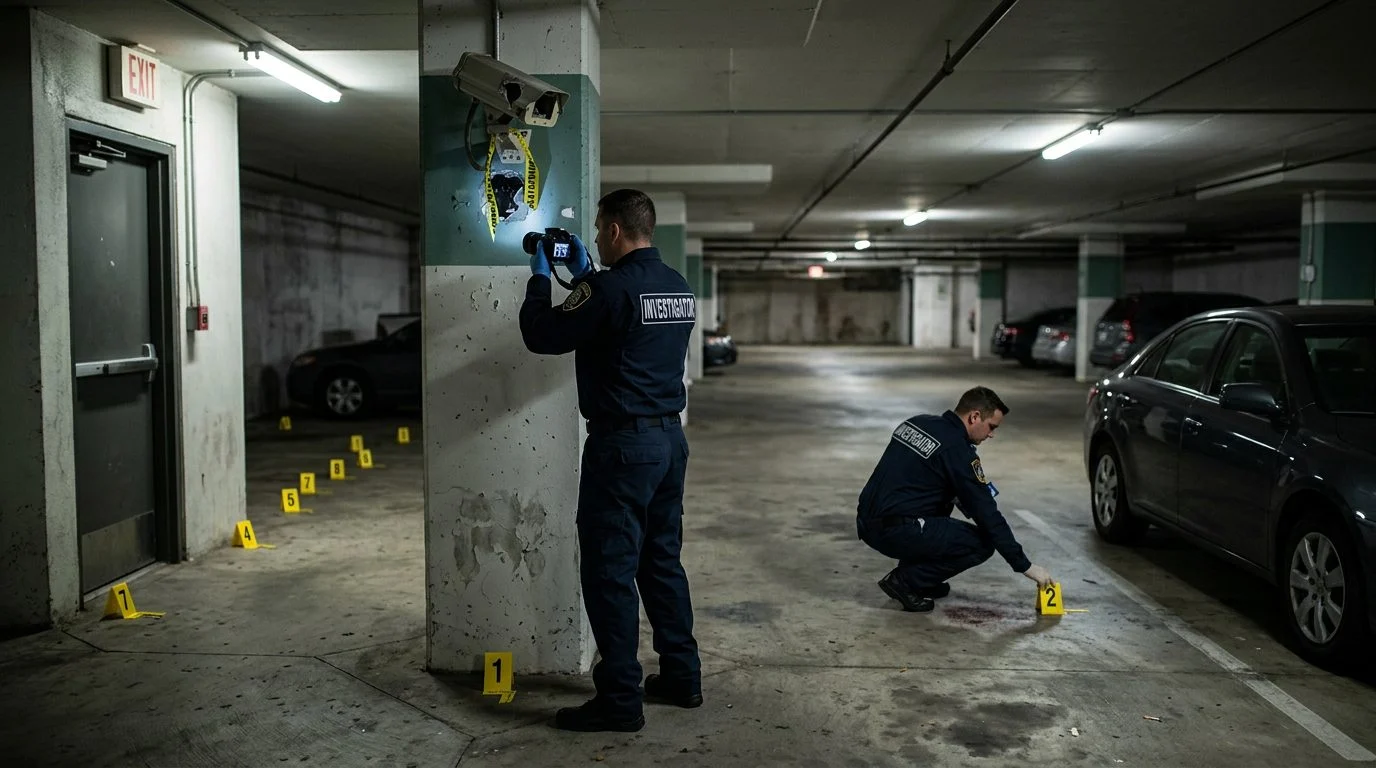
Negligent Security | Georgia
Gas Station Crime Injury Lawyer Georgia
If you were hurt in a crime at a gas station, the property owner may be liable. Slam Dunk Attorney represents injured people across metro Atlanta and Georgia.
By Peter F. Jaraysi · Published September 15, 2026
Gas Station & Convenience Store Crime Injury Lawyer | Negligent Security Claims in Georgia
If you were injured during a robbery, assault, shooting, or other violent crime at a gas station or convenience store in Georgia, you may have a legal claim against the property owner—even though a criminal committed the act. When a gas station or convenience store owner fails to provide reasonable security measures, and that failure enables a foreseeable crime that injures you, the owner can be held liable for your damages.
This guide explains negligent security claims, what they cover, how they work, and why Slam Dunk Attorney is equipped to represent you.
If you were hurt in a crime at a gas station, the property owner may be liable. Talk it through with our team — the first consultation is free, confidential, and carries no obligation.
What Is a Gas Station or Convenience Store Negligent Security Claim?
A negligent security claim is a legal action against a gas station or convenience store owner when inadequate security measures contribute to a criminal act that injures you.
Property owners have a duty to provide reasonable security to protect customers and employees from foreseeable criminal acts. This duty is rooted in Georgia premises liability law. When an owner fails to meet that duty—by ignoring prior crimes, failing to install working cameras, leaving the property poorly lit, or neglecting other security measures—and a criminal act results, the owner bears legal responsibility for injuries that follow.
The key insight: You don’t have to prove the criminal is caught or prosecuted. You focus on the property owner’s security failure. If that failure was a substantial factor in enabling the crime, the owner can be held accountable.
Common scenarios include robbery, assault, stabbing, shooting, or other violent crimes on the premises. These incidents often happen at late-night gas stations or convenience stores with minimal staffing and inadequate security.
Who This Is For
This claim is for you if you are:
- A customer injured during a robbery, assault, or other violent crime at a gas station or convenience store
- An employee harmed while working at a location with inadequate security
- A family member of someone killed in a foreseeable crime on the premises
- Anyone in Georgia—metro Atlanta, Lawrenceville, Johns Creek, Alpharetta, Marietta, Norcross, Kennesaw, Dunwoody, or beyond—who was hurt by a criminal act at a gas station or convenience store
What a Negligent Security Claim Covers
Damages in a negligent security case may include:
- Medical expenses: emergency care, hospitalization, surgery, ongoing treatment, rehabilitation, and mental health services
- Lost wages: income you missed while recovering or unable to work
- Pain and suffering: compensation for physical pain, emotional distress, trauma, and reduced quality of life
- Permanent injury damages: if the crime caused lasting disability, disfigurement, chronic pain, or other long-term effects
- Wrongful death damages: if a loved one was killed, including funeral costs and loss of companionship (for eligible family members)
- Property damage: personal belongings damaged or stolen during the crime
- Case costs: investigation, expert witnesses, and court fees (separate from attorney fees)
What Negligent Security Means in Gas Station Cases
Negligent security failures at gas stations and convenience stores take many forms. Here are the most common:
- Inadequate lighting in parking lots, entrances, or inside the store
- Lack of security cameras or non-functional surveillance systems
- No security personnel or off-duty police presence
- Broken locks, poor access control, or unsecured back entrances
- Failure to report prior crimes or security incidents to law enforcement
- No panic buttons or emergency communication systems for staff
- Failure to train employees on safety protocols or de-escalation
- Ignoring known patterns of crime in the area or at that specific location
- Keeping excessive cash on hand without protective measures
- Operating late-night hours without adequate staffing or security
Any of these failures—or a combination—can form the basis of a negligent security claim.
How We Prove Negligent Security
Proving a negligent security claim requires showing five key elements:
Duty: We establish that the property owner had a legal obligation to provide reasonable security to protect customers and employees.
Foreseeability: We demonstrate that criminal activity at that location—or in that area—was foreseeable. We do this by gathering prior police reports for that specific property, crime statistics for the neighborhood, and evidence of industry-standard security practices the owner ignored.
Breach: We prove the owner failed to implement reasonable security measures that could have prevented or deterred the crime.
Causation: We connect the security failure directly to your injury. If the owner had provided adequate lighting, cameras, or security personnel, the crime likely would not have occurred.
Damages: We document your losses through medical records, wage statements, expert testimony, and other evidence.
In the negligent security cases our attorneys handle, foreseeability is often the strongest element. If a gas station had experienced prior robberies or assaults, or if the neighborhood has a documented pattern of crime, proving foreseeability becomes straightforward.
If you were injured in a crime, contact us promptly so we can preserve critical evidence and protect your rights. Talk it through with our team — the first consultation is free, confidential, and carries no obligation.
How the Process Works
Here’s what to expect from start to finish:
Step 1 – Free Consultation: You tell us what happened. We listen, ask detailed questions, and explain your rights with no obligation. We’ll assess whether you have a viable claim.
Step 2 – Investigation: We gather police reports, surveillance footage (if available), prior crime records at the location, witness statements, and evidence of the owner’s security practices.
Step 3 – Expert Review: We may consult security experts to establish industry standards and identify the owner’s failures.
Step 4 – Demand & Negotiation: We send a detailed claim to the property owner’s insurance company and negotiate a fair settlement based on your damages.
Step 5 – Litigation (if needed): If settlement talks stall, we file a lawsuit and represent you in court.
Step 6 – Resolution: We work toward a settlement or trial verdict that compensates your losses.
Timeline & What to Expect
- Initial consultation: Usually within 1–2 weeks of your call
- Investigation phase: 4–8 weeks, depending on evidence availability and cooperation from the property owner
- Demand letter & negotiation: 2–4 months
- Settlement or litigation: Settlements often resolve within 6–12 months; litigation may take 1–3 years
- We keep you informed at every stage and explain next steps clearly
Most negligent security cases settle before trial, but we prepare every case as if it will go to court.
Why Slam Dunk Attorney for Your Gas Station Crime Injury Claim
Negligent security experience: We focus on premises liability and security failures. We know Georgia law and how to prove these cases.
Local knowledge: Based in Duluth, Georgia, we understand metro Atlanta and Georgia crime patterns, property owner practices, and local courts.
Thorough investigation: We don’t settle for surface-level facts. We dig into prior incidents, security protocols, industry standards, and the owner’s knowledge of crime in the area.
Experienced team: Our attorneys handle negligent security cases and understand the tactics insurers use to deny or minimize claims.
Client-centered approach: We explain everything in plain language, answer your questions, and keep you involved in all decisions.
No upfront costs: We work on contingency—you pay no attorney fees unless we recover compensation for you. (You may still owe case costs.)
Common Questions & Objections
Isn’t the criminal responsible, not the property owner?
Yes, the criminal is responsible for committing the crime. But property owners are also responsible for providing reasonable security. If they fail, they can be held liable for injuries that result from foreseeable criminal acts. You can pursue both the criminal and the property owner.
How do I prove the crime was “foreseeable”?
We use prior police reports, crime statistics for the area, prior incidents at that specific location, and expert testimony on industry security standards. If the location had a history of robberies or assaults, foreseeability is stronger.
What if the police haven’t caught the criminal?
That doesn’t prevent your negligent security claim. We focus on the property owner’s failure to provide adequate security, not on prosecuting the criminal.
How long do I have to file a claim?
Georgia law typically allows two years from the date of injury to file a lawsuit. Don’t wait—evidence can disappear, and witnesses’ memories fade. Contact us as soon as possible.
Will my case go to trial?
Most cases settle before trial, but we prepare every case as if it will go to court. We’re ready to litigate if the insurance company won’t offer fair compensation.
What if I was partially at fault?
Georgia follows comparative negligence rules (O.C.G.A. § 51-12-33; Quynn v. Hulsey, 310 Ga. 473 (2020)). Even if you were partially at fault, you may still recover—your award would be reduced by your percentage of fault (O.C.G.A. § 51-12-33; Quynn v. Hulsey, 310 Ga. 473 (2020)). We’ll discuss this during your consultation.
Do I have to pay attorney fees upfront?
No. We work on contingency, meaning we only collect attorney fees if we recover money for you. You may owe case costs (investigation, expert fees, court costs) separately; we’ll discuss this clearly upfront.
If you were robbed, beaten, or attacked at a gas station due to poor security, we investigate the owner's negligence. Talk it through with our team — the first consultation is free, confidential, and carries no obligation.
What to Do Now
- Gather any documents: police report, medical records, photos of the scene, witness contact information
- Write down details: what happened, when, where, and how you were injured
- Don’t delay: The sooner we investigate, the better. Evidence and witness memories fade quickly
If you were hurt during a robbery, assault, or other violent crime at a gas station or convenience store in Georgia, you may have a claim against the property owner for failing to provide adequate security. People in your situation can reach out to us. Contact us for a free case review or call to speak with an attorney about what happened and what your claim may be worth.
Why Property Owners Can Be Held Responsible
Duty to Provide Reasonable Security
Property owners have a legal responsibility to maintain reasonable security measures. When they fail to do so, they can be held liable for injuries caused by foreseeable criminal acts on their premises.
Foreseeability Matters
If crimes have occurred at or near the property before, or if the location is known to be high-risk, the owner should have anticipated the danger and taken steps to prevent it.
Evidence We Investigate
We examine security camera footage, incident reports, prior complaints, lighting conditions, staffing levels, and the property's crime history to build your case.
You Can Sue Both the Criminal and the Owner
The person who committed the crime is responsible for their actions. But the property owner's failure to provide adequate security is a separate legal claim you may pursue.
Act Quickly
Evidence at gas stations—including security footage—may be deleted or lost over time. If you were injured in a crime, contact us promptly so we can preserve critical evidence and protect your rights.
Common Gas Station Security Failures
Poor Lighting
Dark or inadequately lit parking areas and pumps create opportunities for criminals and make it harder for staff to see and respond to threats.
No Security Personnel
Properties in high-crime areas may need visible security staff or surveillance to deter crime and respond quickly to incidents.
Broken or Missing Cameras
Non-functional security systems or blind spots in camera coverage prevent staff from monitoring the premises and identifying perpetrators.
Inadequate Staff Training
Employees who are not trained to recognize threats or respond to emergencies cannot protect customers or call for help in time.
What We Handle
Robbery and Assault
If you were robbed, beaten, or attacked at a gas station due to poor security, we investigate the owner's negligence.
Sexual Assault
Crimes of this nature are sometimes foreseeable at properties with known security problems. We pursue claims on behalf of survivors.
Carjacking
Inadequate lighting, lack of security presence, and poor surveillance can enable carjacking. We hold owners accountable.
Other Violent Crimes
Stabbings, shootings, and other violent acts may result in liability claims against a property owner who failed to provide reasonable security.