
Nursing Home Abuse | Metro Atlanta and Georgia
Nursing Home Neglect: The Records That Can Tell the Story
A loved one's care leaves a paper trail. Here is how families can think about it, and how to take the first step with a free consultation.
By Peter F. Jaraysi · Published November 9, 2026
If a parent or relative in a nursing home seems hurt, neglected, or not cared for, you probably want proof. No single record proves nursing home neglect in Georgia. Proof usually comes from several records read together, including medical charts, staffing records, incident reports, and inspection history.
This guide explains what each record can show and what to save now. It is written for families gathering records for someone they love.
What evidence proves nursing home neglect or abuse in Georgia, including medical records, staffing logs, incident reports, and inspection history?
No one document proves neglect on its own. The evidence of nursing home neglect in Georgia usually comes from reading several records side by side.
Neglect means a resident’s basic needs were not met. Those needs include hygiene, food and fluids, medicine, supervision, and safe movement.
Georgia law requires that each resident receive care “with reasonable care and skill” and “in compliance with applicable laws and regulations” (O.C.G.A. § 31-8-108). Ordinary negligence is the absence of the care an ordinarily prudent person would use in similar circumstances (O.C.G.A. § 51-1-2).
The records below show where gaps in those needs tend to appear. Claims involving medical care generally require proof of negligence and injury, as a medical malpractice overview explains. Every case turns on its own facts.
One missing note rarely tells the whole story. Patterns across several records are easier to understand.
If you are gathering records for a parent who can't do it alone, our team is glad to review them with you in a free, confidential consultation. Talk it through with our team — the first consultation is free, confidential, and carries no obligation.

How do medical records show neglect in a Georgia nursing home?
Medical records show neglect when problems appear or worsen and the chart shows no clear response. Watch for new pressure injuries (bedsores), weight loss, dehydration, falls, infections, and medication errors.
Medical records include physician notes, nursing notes, medication administration records, care plans, and lab results. A resident may inspect and copy their records unless medically contraindicated, and the facility may charge a reasonable fee for duplication that does not exceed its actual cost (O.C.G.A. § 31-8-108). A provider must send a requested record within 30 days, and the request must include a HIPAA authorization and a signed written authorization (O.C.G.A. § 31-33-2).
Compare the care plan with the daily notes. If the plan calls for repositioning every two hours but the notes show none, that gap is worth recording. Ask for the full chart, not only a summary, so you see every entry.
Note the date each change first appears. Timing can matter when you rebuild what happened.
What can staffing logs and schedules reveal about neglect?
Staffing logs show who was on duty and how many staff covered a unit at a given time. That helps you test whether a resident had enough help when a problem happened.
Agency or temporary staff, unfilled shifts, and nights with few caregivers may line up with missed repositioning, slow answers to call lights, or missed meals. A schedule alone does not establish a missed task. It gives you a starting point to compare with the chart and incident reports.
Call-light and alarm logs, where the facility keeps them, can show how long a resident waited for help. Compare those times with the resident’s complaints and the notes from the same shift.
Ask in writing for staffing records, and keep a copy of your request.
How do incident reports and facility communications support a neglect claim?
Incident reports are the facility’s written account of a fall, injury, or other event. Comparing that account with the medical chart shows whether the story stayed the same.
Incident reports often cover falls, elopement, altercations, and unexplained bruises or fractures. Look for reports filed late, reports that do not mention a physician or family being told, and reports that were changed later. Georgia gives a resident the right to have a significant change in health status reported to persons of their choice within a reasonable time (O.C.G.A. § 31-8-108).
Emails, text messages, family communication logs, and grievance forms show what staff knew and when. They also show what the family was told. Save each one as it arrives, with its date.
Put each incident beside the notes from the same day. Gaps between them often matter more than either account alone.
How can inspection history help prove nursing home neglect in Georgia?
Inspection history shows what state regulators found at a facility over time. Repeated findings of the same problem can point to a pattern.
Georgia places long-term care facilities under regulation and licensure by the Department of Community Health (O.C.G.A. § 31-8-102). When a facility repeats violations under the same license within 12 months, the department may assess a civil penalty of up to $75 per violation per day, capped at $2,500 per violation (O.C.G.A. § 31-8-126). O.C.G.A. § 31-8-126 reads: “(2) In cases of violations repeated by a facility under the same license within a 12 month period, the department shall be authorized to assess a civil penalty not to exceed $75.00 per violation for each day in which the violation continues, except that the maximum civil penalty for each violation shall not exceed $2,500.00.”
Georgia law also lets a person harmed by a facility’s violation of a resident right sue the facility for damages (O.C.G.A. § 31-8-126).
A clean report does not settle the question by itself. Compare each inspection date with the period you are worried about and with the incidents in your timeline.
What should families preserve and document now?
Start a dated written log of visits, changes in condition, and conversations with staff. Write names and times when you know them.
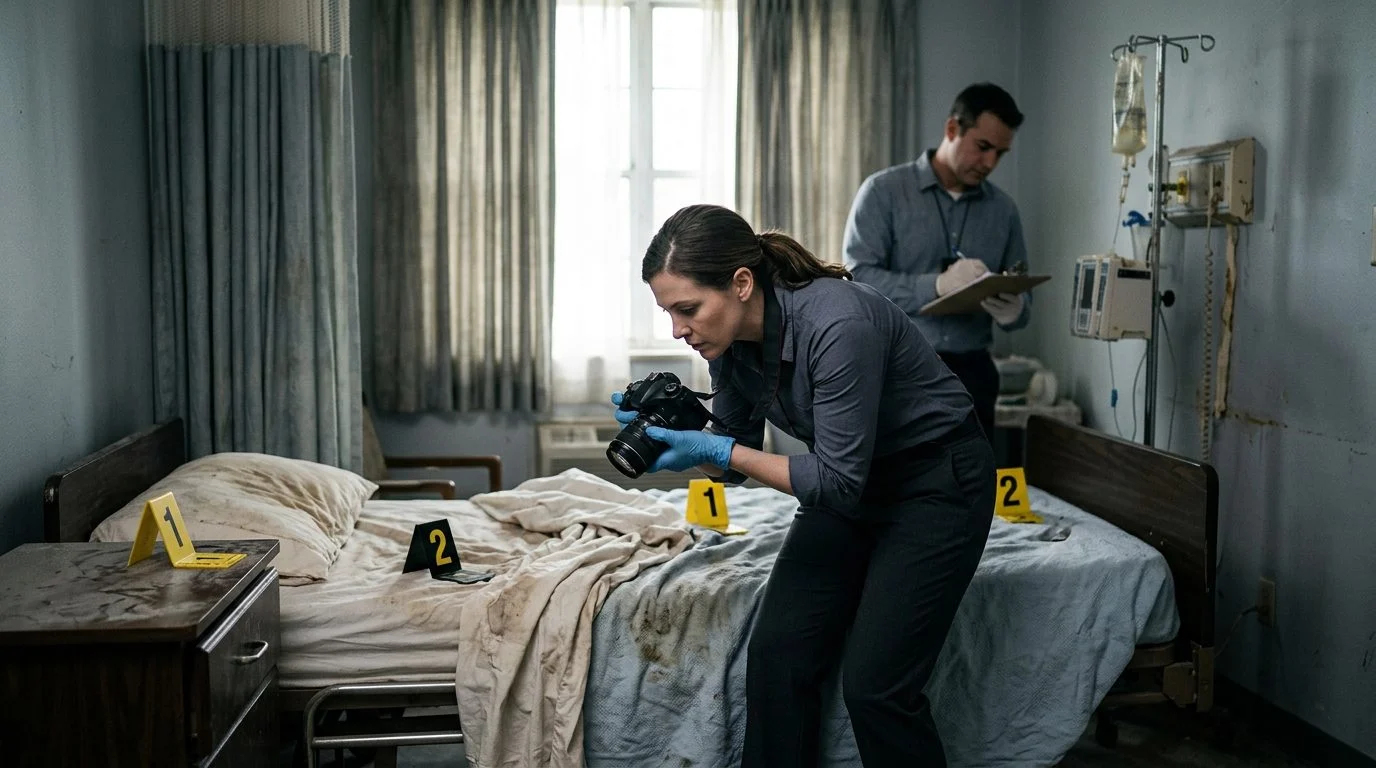
Photograph visible injuries, bedsores, bruises, and unsafe conditions, and note the date on each photo. Keep the admission agreement and any transfer or discharge papers.
Save medication bottles or pill-organizer records. Keep copies of letters and messages exchanged with the facility.
Make a written request for the complete records, and keep proof of when you sent it. If the resident has died, the law lists who may ask, in order: an appointed executor, administrator, or temporary administrator of the estate; if none has been appointed, a surviving spouse; if there is no spouse, a surviving child; and if there is no child, a parent (O.C.G.A. § 31-33-2).
Keep the originals safe, and work from copies. Write what you see when you see it, even if it seems small.
Not sure what your next step is?
Talk it through with our team — the first consultation is free, confidential, and carries no obligation.
Why does the timeline matter when reviewing nursing home records?
A timeline puts admission, care changes, incidents, staffing gaps, inspections, and complaints in date order. Seeing them together can show whether a decline began after a specific event or staffing change.
Start the timeline early. Georgia generally allows two years from the date a right of action accrues to bring an action for injuries to the person (O.C.G.A. § 9-3-33). Some claims against medical providers follow different limits, including a five-year outer limit for medical malpractice (O.C.G.A. § 9-3-71).
Build the timeline as records come in. Waiting until every record is in hand can delay the work.
Add a note for each record, saying where it came from and the date you received it. A timeline is also useful when you talk with anyone about the case, since it keeps dates straight.
Talking with a Georgia nursing home neglect lawyer about your records
You do not need every record before you call. Bringing what you have, along with your timeline and photos, gives a lawyer a clear place to start.
If you are gathering records for a parent or relative who cannot do it alone, you may be worried about their safety while you handle the paperwork. That is a hard place to be, and you do not have to sort it out alone.
Slam Dunk Attorney, in Duluth, Georgia, offers a free, confidential initial consultation with no obligation to continue. Contact our team to set up a time to go over your records.
Responsible lawyer: Peter F. Jaraysi, Slam Dunk Attorney, Duluth, Georgia. Contact details are on our contact page.
Frequently asked questions
Does a clean inspection report mean a nursing home was not negligent?
No. A clean inspection does not by itself settle the question. Compare it with the incidents, charts, and staffing records for the same period.
How long does a family have to file a claim in Georgia?
For injuries to the person, Georgia generally allows two years from when the right of action accrues (O.C.G.A. § 9-3-33). Other deadlines can apply, so it helps to start early.
Records That Often Matter Most
Medical and nursing charts
Daily notes, vital signs, and changes in condition can show how a resident's health shifted over time.
Incident and fall reports
Reports of falls, wandering, medication errors, or injuries show what staff documented when something went wrong.
Staffing and schedules
Shift logs and staffing levels can show whether enough caregivers were on duty when residents needed help.
Medication administration records
These records track what was given and when, which can matter when medication errors or missed doses are suspected.
Care plans and assessments
Care plans set out what the facility agreed to provide. Comparing them with what happened can reveal gaps.
Inspection and complaint history
Public inspection records and prior complaints can add context, though they are one piece of the picture.
A clean inspection does not end the question
A passing inspection report does not, by itself, answer whether a facility was careless. Compare it with incident reports, charts, and staffing records from the same period before drawing conclusions.
Steps Families Can Take Now
Write down what you see
Note dates, times, visible injuries, changes in mood or appetite, and what staff told you. Memories fade, and written notes help.
Request copies in writing
Ask the facility for copies of records in writing and keep a copy of your request. Keep track of who you spoke with and when.
Keep the originals safe
Save discharge papers, bills, letters, and photos in one folder. Avoid altering or discarding anything that may be relevant.
Bring the full picture to a lawyer
A free consultation gives you a chance to share your records and questions with our team in a confidential setting, with no obligation to continue.