
Truck Accidents | Duluth, Georgia
Building the Evidence After a Catastrophic Truck Crash
Trucking cases often turn on logs, electronic data and witness accounts. Here is how those pieces fit together after a serious collision.
By Peter F. Jaraysi · Published November 16, 2026
If someone you love was seriously hurt in a truck or car crash, you may be the one holding the paperwork now. Georgia claims like this usually come down to two questions: who caused the crash, and how much the injuries have cost the person in health, work, and daily life.
What Evidence Is Needed to Prove Liability and Damages After a Catastrophic Car or Truck Crash in Georgia?
To prove a catastrophic crash claim in Georgia, you generally need evidence of liability and evidence of damages. Liability shows how the crash happened and who is responsible. Damages show how the injuries have affected the person’s life and finances.
The strongest records usually come from three places: the crash scene, the trucking company and driver, and the medical and financial record of the injury. The sections below group the evidence by what each part proves.
Catastrophic injuries often need documentation over a longer period than other injuries. Spinal cord injury, traumatic brain injury, amputation, severe burns, and paralysis can all change how a person lives for months or years. MedlinePlus paralysis overview explains that paralysis is a loss of muscle function and can follow a spinal cord injury.
If you're gathering crash reports and hospital bills for someone you love after a serious truck crash, our team can talk through what may apply to your family's situation. Talk it through with our team — the first consultation is free, confidential, and carries no obligation.
Why Truck Crash Evidence Needs to Be Preserved Quickly
Truck crash evidence should be requested early. Much of it sits with the trucking company, not at the scene, and federal rules set how long some records must be kept.
A motor carrier must keep records of duty status and supporting documents for at least six months from the date of receipt. The duty-status recording rule appears in 49 C.F.R. § 395.8, which requires motor carriers, except a private motor carrier of passengers (nonbusiness), to have each driver record duty status for each 24-hour period. Periodic inspection reports must be kept for fourteen months, under 49 C.F.R. § 396.21. These are minimum periods. Some companies keep records longer, but the federal floor sets the clock.
Electronic logs have their own protections. A motor carrier must not alter or erase, or permit or require alteration or erasure of, the original hours-of-service information, as stated in 49 C.F.R. § 395.30.
Georgia’s general deadline for injuries to the person is two years after the right of action accrues, except for injuries to the reputation (one year) and actions for injuries to the person involving loss of consortium (four years), under O.C.G.A. § 9-3-33. Waiting until near that date can make records and witnesses harder to find.
Start with your own notes. Write down the date, time, and exact location of the crash. Record the trucking company’s name, the DOT number on the cab, and any trailer markings. Write these details while they are still fresh.
What Evidence Shows Who Was at Fault in a Truck Crash?
Fault is usually shown through the crash report, the truck’s own data, the driver’s logs and training files, and the carrier’s maintenance and loading records. Each record fills in a different part of the story.
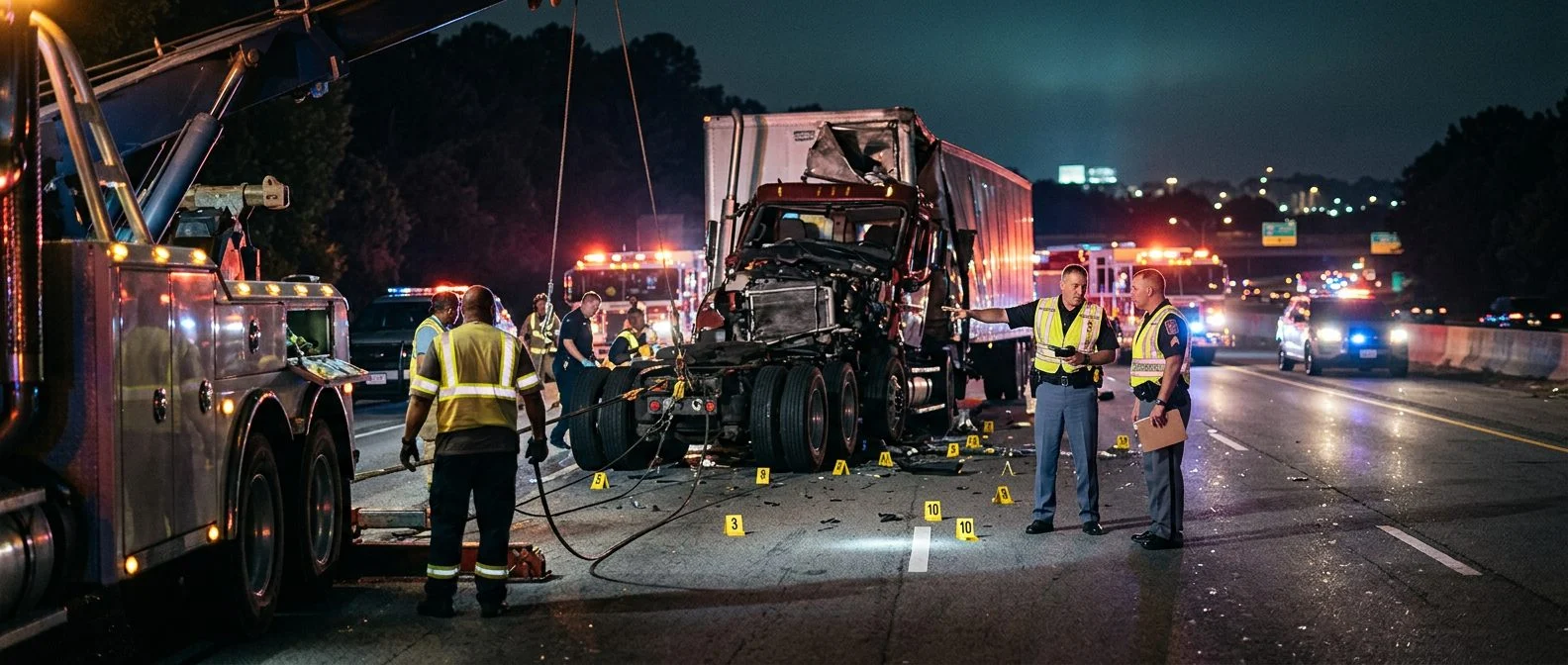
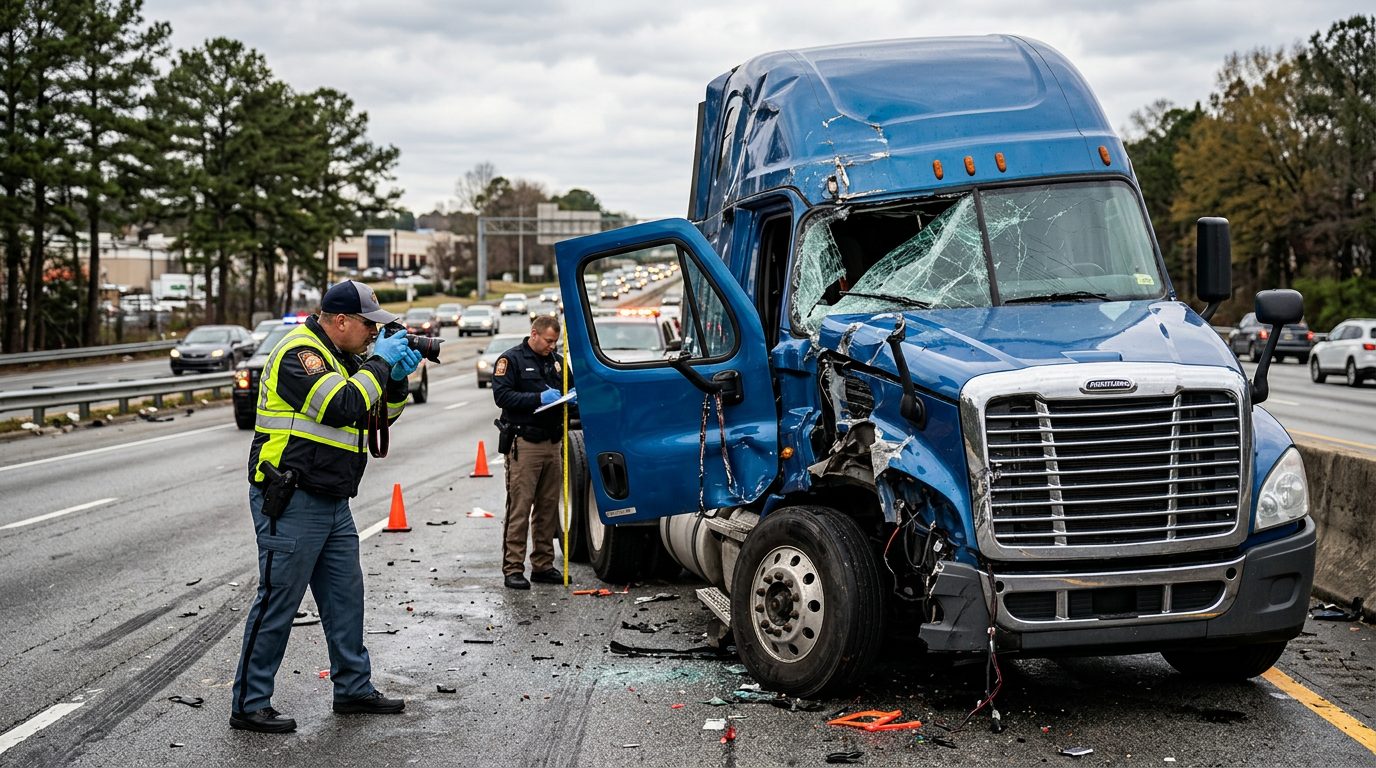
The crash scene. The official crash report, scene and vehicle photos, skid marks, and roadway conditions show how the crash unfolded. Ask early for witness names and any nearby business or traffic video. Video can be overwritten.
The truck’s data. The electronic control module, often called the black box, can record speed, braking, and throttle before impact. Dash camera footage matters too, when it exists.
Driver hours and fatigue. Electronic logging device data shows driving time and rest breaks. Drivers must review and certify their records, and a motor carrier may not pressure a driver into a false certification, under 49 C.F.R. § 395.30.
Hiring, training, and supervision. The driver qualification file can show background, road testing, and medical certification.
In Quynn v. Hulsey, 310 Ga. 473 (2020), the Supreme Court of Georgia treated negligent hiring, training, supervision, and retention as claims based on the employer’s own conduct. Claims for negligent hiring, training, supervision, and retention are based on the alleged negligent acts of the employer (Quynn v. Hulsey, 310 Ga. 473 (2020)).
Maintenance and loading. Inspection reports on brakes, tires, steering, and lighting show what the company checked. Bills of lading and weight tickets show what was loaded and how much it weighed.
What Evidence Shows How the Injury Happened and How Serious It Is?
Medical records show how the injury happened and how serious it is. They start with emergency care and continue through later treatment.
The Brain Trauma Foundation’s prehospital guidelines describe traumatic brain injuries as ranging from mild to catastrophic. Early records matter because they capture the first assessment of the injury.
Gather these records as they become available:
- Emergency transport, hospital, and trauma records.
- Imaging results, operative reports, and discharge summaries.
- Notes from physicians and therapists that connect the injury to the crash and describe daily limits.
- Rehabilitation, wound care, and prescription records.
- Photographs of injuries and healing, taken at intervals when medically appropriate.
Recovery varies from person to person. A PMC review of natural recovery after spinal cord injury looks at recovery timelines and the factors that affect them. Records kept over time show that change.
A gap in treatment makes it harder to tie the injury to the crash. Keep every appointment, even short ones.
What Evidence Supports the Financial and Personal Losses?
Financial losses are shown through bills, receipts, and pay records. Personal losses are shown through a written account and statements from people who know the person well.
Georgia separates two kinds of damages. Under O.C.G.A. § 51-12-2, general damages are presumed to flow from a wrong and need no proof of amount. Special damages actually flow from the wrong and must be proved. Medical bills are special damages.
Medical expenses are limited to the reasonable value of medically necessary care, under O.C.G.A. § 51-12-1.1. If the injured person has any form of public or private health insurance, the evidence includes both the amounts charged and the amounts actually needed to satisfy them, regardless of whether the health insurance has been used, is used, or will be used to satisfy the charges.
If the injured person has Medicare, the rules add another layer. CMS explains that liability insurance pays first for accident-related care. A Medicare conditional payment must be repaid from a settlement, judgment, or other payment. The conditional payment letter does not give a final amount, according to CMS attorney services guidance.
Future needs call for estimates from treating providers, such as surgery, therapy, equipment, or home changes. A life care plan prepared with medical input can organize those needs.
Wrongful death claims follow their own path. Under O.C.G.A. § 51-4-5, when a death results from criminal or other negligence, the personal representative may recover funeral, medical, and other necessary expenses. Keep every receipt for those costs.
How Georgia Law Shapes Which Evidence Matters Most
Georgia reduces a claim by the injured person’s share of fault. Under O.C.G.A. § 51-12-33, the jury sets that percentage, and the judge reduces the award to match.
The same statute bars recovery entirely when the injured person is 50 percent or more responsible (O.C.G.A. § 51-12-33; Quynn v. Hulsey (2020)). That makes evidence about the driver’s own actions important, not just the other side’s.
The jury must also consider the fault of everyone who contributed to the injury. That includes people who were not named as parties. Each liable person answers only for its own share, and those shares are not joint liability.
That is why evidence about the carrier’s practices matters. Hiring files, hours records, and maintenance logs all help show how fault is divided among everyone involved.
How a case is valued depends on the facts. The same records can carry different weight depending on the injuries and the parties.
Not sure what your next step is?
Talk it through with our team — the first consultation is free, confidential, and carries no obligation.
Steps a Family Member Can Take While Researching This Process
Start one folder or digital file. Put the crash report number, insurance information, bills, and every letter from an insurer or trucking company inside it.
Keep a running log. Record each expense, each missed day of work, and each appointment with its purpose. Keep mileage and in-home help receipts too.
Pause before giving any recorded statement to an insurance company. The adjuster works for the other side, and a short call can shape how the claim is read later.
Be careful on social media. Avoid posting about the crash, the injuries, or physical activities. Insurers may review public posts.
Keep damaged clothing, personal items, and phone records from the day of the crash. Don’t throw them away, even if they look ruined.
Talk With Our Team About Your Family’s Truck Crash
Common Questions
Does Georgia reduce compensation if the injured person shares some fault?
Yes. Under O.C.G.A. § 51-12-33, damages are reduced by the injured person’s percentage of fault, and recovery is barred at 50 percent or more.
How long do trucking companies keep driver logs?
A motor carrier must keep records of duty status for at least six months from receipt, under 49 C.F.R. § 395.8.
Responsible lawyer: Peter F. Jaraysi, Slam Dunk Attorney, Duluth, Georgia. This page is general information, not legal advice. Contact details are on our contact page.
If you’re reading this while a family member recovers and the papers keep piling up, you don’t have to sort out the evidence alone. Our team can review the specific crash, injuries, and deadlines with you. The first consultation is free, confidential, and without obligation to continue. La consulta inicial es gratuita, confidencial y sin compromiso de continuar.
How our team approaches truck accident evidence
Requesting key records
We look at driver logs, maintenance files and company policies that can shed light on what happened before the crash.
Preserving what matters
Our team works to identify and preserve physical and electronic evidence from the scene, the vehicles and the trucking company.
Examining fault from every angle
We review the driver, the carrier, the vehicle and the roadway to understand the full picture of who contributed to the crash.
Documenting the full impact
We help gather medical records and details of how the injury has affected daily life, work and family.
Important: evidence can disappear
Trucking companies and insurers do not always keep every record indefinitely. Speaking with a lawyer early gives the best opportunity to request and preserve the information that matters.
Common types of truck accident evidence
Driver logs and hours of service
Records showing when a driver was on duty, driving and resting can help show whether fatigue or schedule pressure played a role.
Electronic control module data
Modern trucks often record speed, braking and throttle information that can help reconstruct the moments before impact.
Dashcam and surveillance footage
Video from the truck, nearby vehicles or businesses can capture the sequence of events and road conditions.
Maintenance and inspection records
Repair histories and inspection reports can reveal whether known mechanical problems were addressed before the crash.