
When Your Own Insurance Company Holds the Ball for Your Recovery
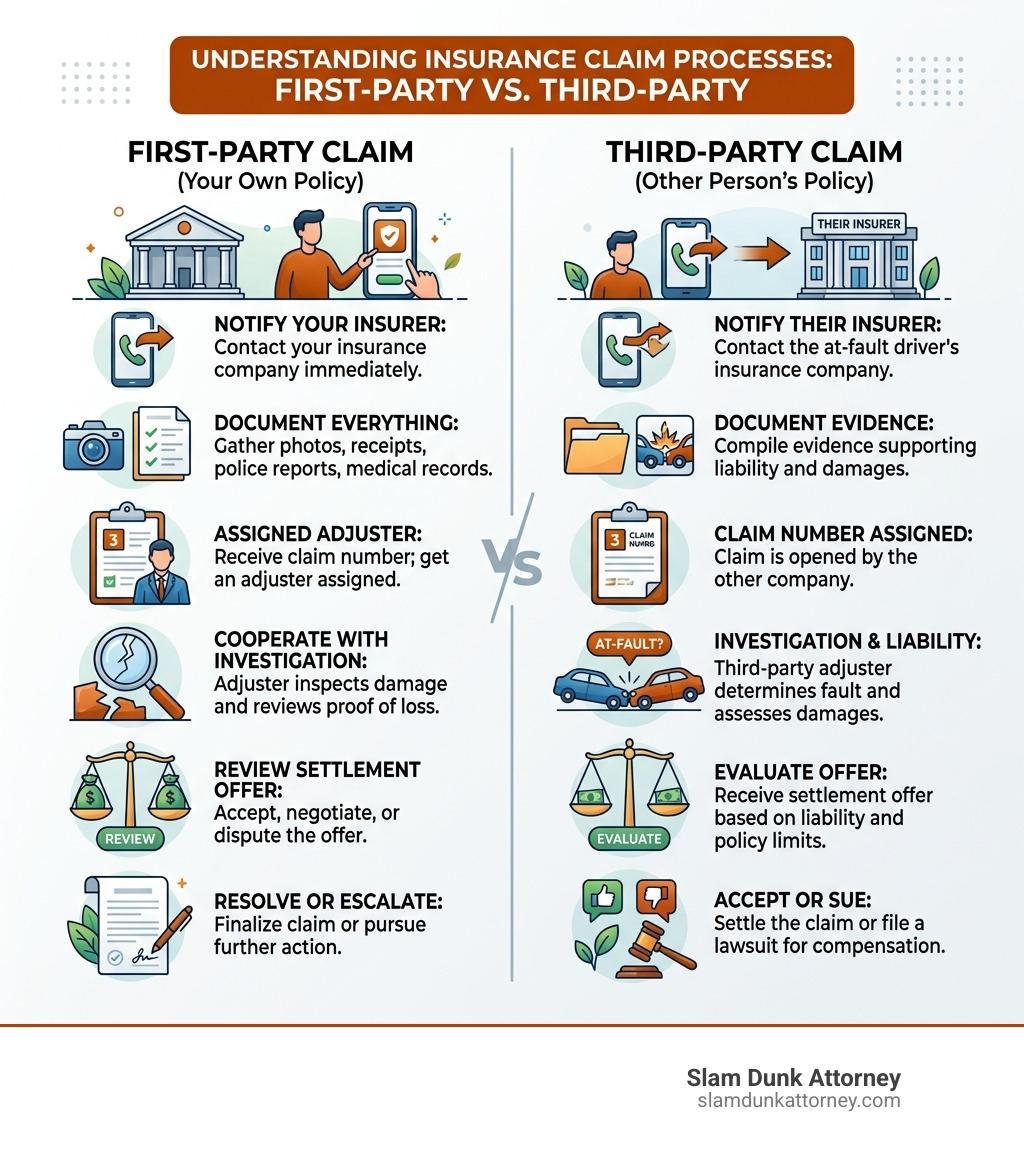
How does the first-party insurance claim process work? Here is the simple answer:
- Call your insurance company as soon as you can after a loss
- Save all your proof — photos, receipts, police reports, and medical records
- Get a claim number and meet your assigned adjuster
- Help with the investigation — the adjuster checks the damage and your proof of loss
- Look at the money offer — accept it, ask for more, or fight it
- Finish the deal or take the next step — if the offer is too low, you can negotiate or go to court
After a crash in Georgia, many people think the other driver’s insurance will pay for everything. But what if the other driver has no insurance? Or what if your own policy covers the damage? That is when you file a first-party claim.
A first-party claim means you file directly with your own insurance company. This covers things like collision, medical payments, and uninsured motorist coverage. Your policy is a contract. Your insurance company has a legal duty to treat you fairly.
For Duluth, Georgia families dealing with medical bills and car repairs, knowing this process is a must.
I am Peter Jaraysi, Esq. I spend my time fighting insurance companies that try to pay too little. Knowing how does the first-party insurance claim process work is the best way to get a fair payout. Let’s walk through the steps.
Here are some additional resources that may be helpful:
Proudly Serving Duluth and All of Georgia Contact us to start your recovery! Explore Our Practice Areas

How Does the First-Party Insurance Claim Process Work?

When you are hurt in a car crash on Pleasant Hill Road or find storm damage in Duluth, Georgia, you turn to your insurance. This is the contract you have paid for every month. You expect them to help. Even though it is your company, the process is very formal.
The game starts the moment you report the accident. Once you call, your insurance company opens a file and gives you a “claim number.” Everything in your case will be tracked under it.
Next, the company picks an insurance adjuster. Think of the adjuster as the referee, but one who is paid by the league. Their job is to look at the facts and decide how much the company should pay based on your policy.
It is important to know the difference between this and a third-party claim. In a third-party claim, you go after someone else’s insurance. In a first-party claim, you use your own benefits. For more, see First-Party vs. Third-Party Insurance Claims Explained.
| Feature | First-Party Claim | Third-Party Claim |
|---|---|---|
| Who you file with | Your own insurance company | The other person’s insurance |
| The Reason | Your insurance contract | The other person’s fault |
| Typical Coverage | Collision, MedPay, UM/UIM | Liability |
| Duty to be Fair | Direct duty to you | Duty is to their own driver |
| Deductible | Usually required | No deductible for you |
Understanding How Does the First-Party Insurance Claim Process Work for You
In Georgia, your insurance company has a “duty of good faith.” This means they cannot ignore you or deny your claim for no reason. Because you have a contract, they must handle your claim fairly and quickly.
However, “fair” is often up for debate. Insurance companies are businesses. They want to keep costs low. Even your own company might try to pay as little as possible.
Knowing how car insurance claims work helps you stay one step ahead. For Duluth, Georgia residents, this is very important for Uninsured Motorist (UM) claims. If a hit-and-run driver leaves you with bills, your UM coverage is your safety net.
Step 1: Telling Your Insurer and Gathering Evidence
The clock starts ticking the second the crash happens. Most Georgia policies say you must give “prompt notice.” If you wait too long, the company might deny the claim because they could not investigate while the evidence was fresh.
When you call, stick to the facts: where, when, and who. You do not need to give a full play-by-play of your injuries until you see a doctor.
Evidence is your best offense. You want to document the scene like a pro scout. This includes:
- Photos and Videos: Take pictures of the cars, the road, and any bruises or cuts.
- Witness Info: Get names and phone numbers. Their stories are gold when the insurance company tries to blame you.
- Police Report: In Duluth, Georgia, a police report is a vital paper that records what happened.
For more on the steps, see this Filing an Auto Insurance Claim: Step-by-Step Guide to Navigate Accidents.
Step 2: Working with the Adjuster and Proving Your Loss
The adjuster will want to see the damage. For your car, they might send you to a shop or ask for photos. For a property claim, they will visit your home or business in Duluth, Georgia.
Here is where things get tricky: the recorded statement. The adjuster might ask for a quick recorded talk. Be careful. You do not have to do this right away. Anything you say can be used to lower your payout.
Before you agree, read our guide: Should I Give My Car Insurance Company a Recorded Statement After an Accident?.
To prove your loss, you need a list of everything. If you are using MedPay for medical bills, you need every record from Duluth area clinics. If it is a property claim, list every item damaged and what it costs to replace it.
Navigating Settlements, Bad Faith, and When to Call a Pro
Eventually, the insurance company will make an offer. This is the “settlement.” In a first-party claim, this should cover your losses up to your policy limit, minus the part you pay (the deductible).
Many people make the mistake of taking the first check they get. We call that a “fast break” that ends in a missed shot. Once you sign that check, you usually cannot ask for more money later—even if you find out your injury is worse than you thought.
For help with these offers, see these Essential Tips for Negotiating an Insurance Settlement.
Why Knowing How Does the First-Party Insurance Claim Process Work Prevents Denials
We see claims get stuck all the time. Usually, it is for one of three reasons:
- Missing Papers: You did not send the medical bill or police report they asked for.
- Lapsed Policy: You missed a payment, and your insurance was not active during the crash.
- Exclusions: The company says that “type” of accident is not covered.
Georgia has rules to keep the game moving. Insurers should answer your claim within 15 days. They should decide to pay or deny it within a reasonable time (usually 30 to 60 days).
If they are dragging their feet for no reason, they might be breaking the rules in Navigating the Timeline of Personal Injury Insurance Claims.
Recognizing Bad Faith and Protecting Your Rights
What if your insurance company is acting wrong? In Georgia, we have a law for this: GA Code 33-4-6.
This law protects you from “Bad Faith.” If your insurer refuses to pay a covered claim within 60 days after you ask, and they have no good reason, you can sue them. You can ask for the claim money plus a penalty and your lawyer fees.
Bad faith looks like:
- Denying a claim without looking into it.
- Offering way less money than the loss is worth.
- Ignoring your calls and emails for weeks.
- Lying about what your policy covers.
If you feel ignored, you are not just a number to us. We understand the claims journey and how to hold insurers to Georgia law.
Finalizing Your Claim with Slam Dunk Attorney
Filing a first-party claim should be simple, but companies often use a full-court press against you. Whether you are in Duluth, Lawrenceville, or Atlanta, you do not have to do this alone if the company is not playing fair.
At Slam Dunk Attorney, we bring the hustle and the honesty. We don’t use confusing words, and we don’t let the insurers bully you. We treat every case like a championship game because your recovery depends on it.
If you are struggling with a claim, reach out to us. We have the team to help you finish strong. Explore more about Insurance Claims on our site or call us today.
The information provided on this blog is for general informational purposes only and is not intended to be, nor should it be construed as, legal advice. Every personal injury case is unique, and the laws and circumstances that apply can vary based on the specific facts of your situation. Reading this content does not create an attorney-client relationship. To receive legal advice specific to your case, you should consult directly with a qualified personal injury attorney licensed to practice in the state of Georgia.
Call or text 404-951-3513 or complete a Free Case Evaluation form