

When the Pain Doesn’t Go Away After an Accident
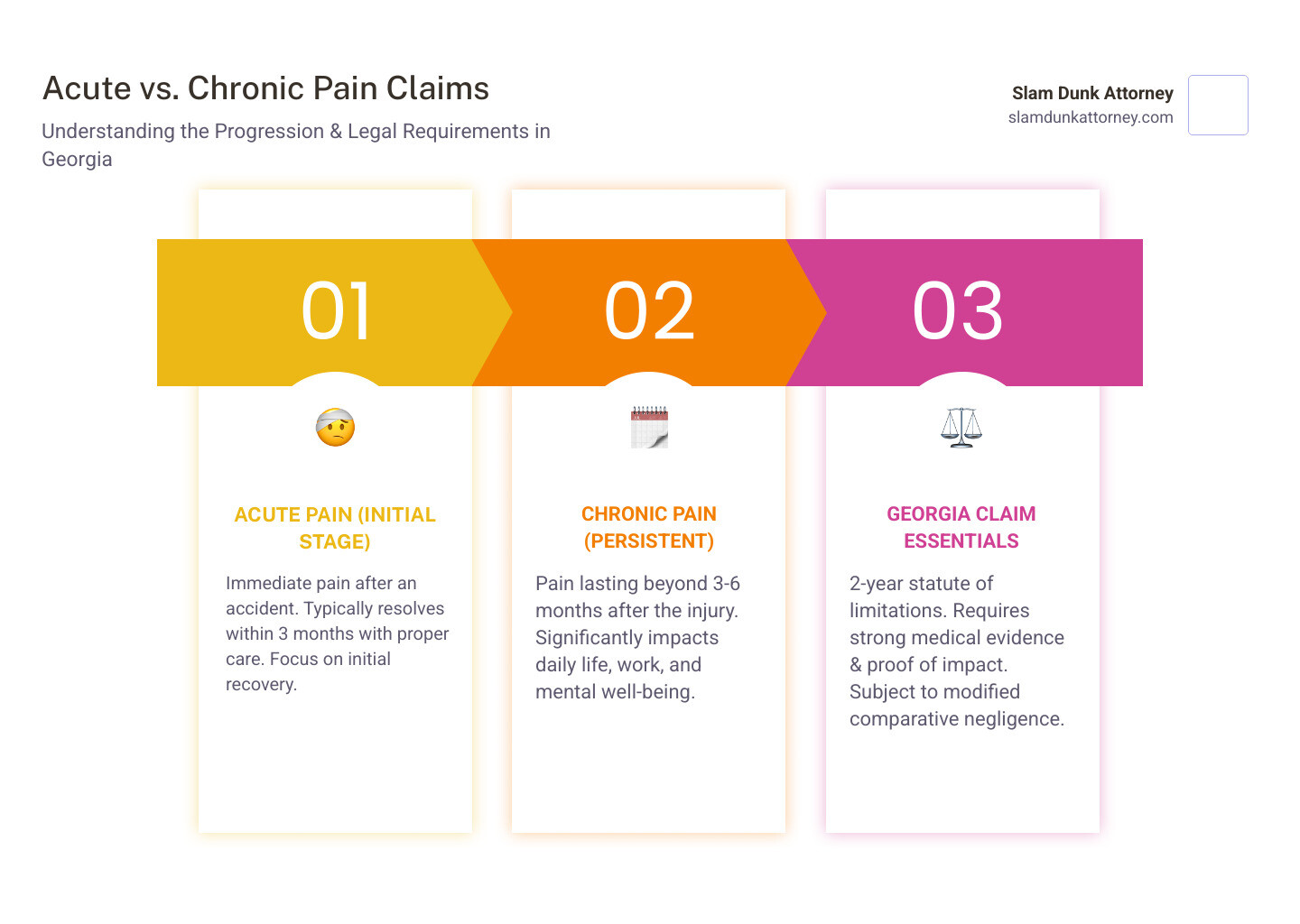
A chronic pain claim arises when you experience persistent pain lasting more than three months after an accident caused by another’s negligence. In Georgia, a successful claim must prove the at-fault party’s actions directly caused your ongoing pain and that this pain significantly impacts your daily life.
Key Facts About Chronic Pain Claims in Georgia:
- Duration: Pain must persist beyond the typical 3-6 month healing period.
- Legal Deadline: Georgia’s statute of limitations gives you 2 years from the accident date to file a lawsuit.
- Proof Required: Medical evidence and documentation of how the pain affects your life.
- Compensation: Covers medical bills, lost wages, future care, and pain and suffering.
- Common Causes: Car accidents, slip and falls, workplace injuries, and medical negligence.
- Challenge: Insurers often dispute claims due to the subjective nature of pain.
After an accident in Georgia, what starts as expected soreness can evolve into something more serious. A burning sensation that persists, headaches that won’t stop, or the inability to perform simple tasks can all be signs of chronic pain.
Insurance companies know chronic pain is real, but they also know it’s difficult to prove. They may scrutinize your medical history and question the severity of your pain to pressure you into a low settlement. However, Georgia law recognizes chronic pain as a legitimate injury worthy of compensation. You don’t need a broken bone on an X-ray to have a valid claim, but you do need the right evidence to prove your pain is real, debilitating, and connected to the accident.
At Slam Dunk Attorney, our team has spent years fighting for Georgia accident victims with invisible injuries like chronic pain. We understand how insurance companies try to minimize these claims and know the legal strategies that make a difference.
Proudly Serving Duluth and All of Georgia Contact us to start your recovery! Explore Our Practice Areas

Establishing Your Georgia Chronic Pain Claim
When you’re dealing with persistent pain after an accident in Georgia, establishing a solid chronic pain claim requires proving negligence and causation. Insurance companies often use tactics to minimize payouts, especially for injuries like chronic pain that don’t show up on an X-ray.

Georgia is an “at-fault” state, meaning we must prove another party’s negligence caused your accident and your chronic pain. The clock starts ticking immediately, as Georgia’s statute of limitations generally gives you only two years to file a lawsuit. Missing this deadline can mean losing your right to compensation.
What Qualifies as Chronic Pain in a Georgia Injury Case?
In a Georgia personal injury case, chronic pain is pain that lasts for more than three to six months, continuing after an initial injury should have healed. Unlike acute pain, which is a temporary warning signal, chronic pain is a persistent condition.
For a claim to be successful, we must show your pain constitutes a significant, lasting impairment. Common conditions that lead to a chronic pain claim include:
- Herniated or Bulging Discs: Causing persistent back, neck, or radiating limb pain.
- Nerve Damage: Trauma can cause neuropathic pain, often described as burning or shooting sensations.
- Fibromyalgia: A condition involving widespread pain that can be triggered by traumatic events.
- Complex Regional Pain Syndrome (CRPS): Severe, chronic pain in a limb that is disproportionate to the initial injury.
- Chronic Migraines or Headaches: Persistent headaches resulting from head trauma or whiplash.
- Whiplash-Associated Disorders (WAD): Severe whiplash can lead to long-term neck pain and other chronic symptoms.
Proving Fault and Connecting Your Pain to the Accident
In Georgia’s at-fault system, we must prove the defendant’s breach of duty directly caused your accident and chronic pain. This connection, or “causation,” is critical. Insurance companies will argue your pain is unrelated to the accident or is a pre-existing condition.
To counter this, it is vital to seek medical attention immediately after an accident. This creates a clear timeline. Consistent medical treatment and following all doctor’s orders are also crucial. Gaps in treatment can be used by insurers to argue your pain isn’t severe or has resolved. We work with your doctors to ensure your records accurately reflect your pain’s progression and its impact on your life. Expert medical opinions can also help solidify the link between the accident and your condition.
Common Reasons Insurance Companies Deny Chronic Pain Claims
Insurers are skeptical of chronic pain claims because pain is subjective and often lacks clear diagnostic markers. Common denial reasons include:
- Lack of Objective Medical Evidence: They may argue that if an MRI is clear, your pain isn’t legitimate.
- Gaps in Treatment: Insurers suggest that if you weren’t constantly seeking treatment, your pain must not be severe.
- Pre-Existing Conditions: They will try to blame your pain on prior injuries rather than the accident.
- Minimizing Symptoms: Adjusters may downplay your pain, calling it simple “soreness” or suggesting you are exaggerating.
- Surveillance: Insurers may hire investigators to find activity that contradicts your reported limitations.
- Questioning Credibility: They look for inconsistencies in your statements to undermine your honesty.
Our team anticipates these tactics and builds your case to counter them effectively.
Maximizing Your Compensation: How to Build a Strong Case
Building a strong chronic pain claim in Georgia requires thoroughly documenting how your pain has disrupted your life. We gather every piece of evidence to fight for the full compensation you are owed.

Key Evidence Needed to Win Your Chronic pain claim
To win a chronic pain claim, we present comprehensive evidence demonstrating your pain and its impact. This includes:
- A Detailed Pain Journal: A daily log of your pain’s frequency, intensity (on a 1-10 scale), location, and type (e.g., “shooting,” “burning”). It should also note how pain affects your daily activities, sleep, and mood.
- Consistent Medical Records: A complete history from the time of the accident, including doctor’s notes, specialist reports, therapy records, and medication lists.
- Objective Test Results: While not always available, tests like MRIs, CT scans, and nerve conduction studies (NCS) can provide crucial evidence of nerve damage or other injuries.
- Specialist Reports: Opinions from neurologists, pain management specialists, and others are vital to explain the medical basis of your pain and its functional limitations.
- Witness Testimony: Statements from family, friends, and colleagues can confirm the changes in your activity levels, demeanor, and work performance since the accident.
- Vocational Expert Reports: If your pain affects your ability to work, an expert can assess your lost earning capacity.
- Financial Records: Documentation of all medical bills, lost wages, and other related out-of-pocket expenses.
Calculating Damages for a Chronic pain claim in Georgia
The value of a chronic pain claim depends on the severity of your pain, its impact on your life, and the available insurance. We pursue two main types of damages:
-
Special Damages (Economic): These are quantifiable financial losses.
- Medical Expenses: All past and future medical costs, including ongoing pain management.
- Lost Wages & Earning Capacity: Compensation for income you’ve already lost and will lose in the future.
- Other Costs: Expenses for services you can no longer perform, like cleaning or childcare.
-
General Damages (Non-Economic): These are non-financial losses, often called “pain and suffering.”
- Physical Pain and Suffering: Compensation for the physical agony you endure.
- Emotional Distress: For the anxiety, depression, and psychological trauma linked to chronic pain.
- Loss of Enjoyment of Life: For your inability to participate in hobbies, social events, and other activities you once enjoyed.
It is also important to understand Georgia’s modified comparative negligence rule. If you are found to be 50% or more at fault for the accident, you cannot recover any damages. If you are less than 50% at fault, your compensation is reduced by your percentage of fault. We work to prove the other party’s full liability to maximize your recovery.
The Role of a Personal Injury Attorney in Your Case
Navigating a chronic pain claim alone is stressful. Our role is to be your advocate so you can focus on healing. We handle:
- Evidence Gathering: We carefully collect all medical records, reports, and statements to build a solid case.
- Hiring Experts: We work with medical and vocational experts whose testimony can be crucial in proving your case.
- Negotiating with Insurers: We understand insurer tactics and negotiate aggressively to secure a fair settlement, countering the lowball offers they often make.
- Filing a Lawsuit: If a just settlement cannot be reached, we are prepared to take your case to court.
- Protecting Your Rights: We manage all legal deadlines, including Georgia’s two-year statute of limitations, and protect you from insurer tactics.
Learn more about our approach to insurance claims
Click to contact our personal injury lawyers today
What If Your Chronic Pain Claim Is Denied?
A denial from an insurance company is disheartening, but it is not the final word. Many valid chronic pain claims are initially denied as a strategy to see if you will give up. We are prepared to fight back.
Understanding the Denial and Taking Action
The denial letter must state the reasons for the denial, such as a “lack of objective evidence” or “gaps in treatment.” Understanding their argument is the first step in building a response.
While you can appeal the decision internally, this is rarely successful without new evidence and legal guidance. This is the critical moment to seek legal counsel. Our team at Slam Dunk Attorney can:
- Gather Additional Evidence: We identify and obtain missing specialist reports, updated records, or expert assessments to strengthen your claim.
- Challenge Insurer Arguments: We know how to counter common denial tactics, using expert testimony to explain the nature of your chronic pain condition.
- Negotiate and Litigate: If an appeal is unsuccessful, we will negotiate directly with the insurer. If they still refuse to offer a fair settlement, we will not hesitate to file a lawsuit and take your case to a Georgia court.
Consulting with an experienced personal injury lawyer as soon as your claim is denied is the best way to protect your rights and understand your options.
Complete a Free Case Evaluation form now
The Long-Term Impact of Chronic Pain
Chronic pain affects every aspect of a person’s life, leading to challenges that extend far beyond the initial injury.
Daily Life and Work Limitations
The persistent nature of chronic pain can make it impossible to perform job duties, leading to lost wages and financial instability. It also interferes with:
- Personal Relationships: The frustration and isolation of chronic pain can strain relationships with family and friends.
- Hobbies and Recreation: Activities you once enjoyed may become too painful to continue.
- Mental and Emotional Health: The constant battle with pain often leads to anxiety, depression, and sleep disturbances.
Can Chronic Pain Be Considered a Permanent Disability?
Yes. In Georgia, if medical professionals determine your chronic pain is severe and long-lasting, it can be considered a permanent disability in a personal injury claim. This is especially true if it results in a “permanent, serious impairment.”
When we pursue a chronic pain claim for permanent disability, we work with medical and vocational experts to project the long-term costs of your condition, including future medical care, lost earning capacity, and compensation for the permanent loss of enjoyment of life.
Seeking Justice in Georgia
Living with chronic pain caused by someone else’s negligence is a burden you shouldn’t have to carry alone. At Slam Dunk Attorney, our commitment to direct communication and a championship-level team approach ensures your chronic pain claim is handled with the care and expertise it deserves.
If you or a loved one in Duluth, Atlanta, Norcross, Brookhaven, Decatur, Johns Creek, Kennesaw, Lawrenceville, Alpharetta, Chamblee, Dunwoody, East Point, or Marietta, Georgia, is suffering from chronic pain after an accident, we are here to help. We offer free consultations to discuss your case and outline a strategy to pursue the compensation you need. Don’t let an insurance company dictate your future. Let us be your advocate for justice.
Contact Slam Dunk Attorney today for a free case evaluation. We’ll fight to make sure your voice is heard and your pain is recognized.
The information provided on this blog is for general informational purposes only and is not intended to be, nor should it be construed as, legal advice. Every personal injury case is unique, and the laws and circumstances that apply can vary based on the specific facts of your situation. Reading this content does not create an attorney-client relationship. To receive legal advice specific to your case, you should consult directly with a qualified personal injury attorney licensed to practice in the state of Georgia.
Call or text 404-951-3513 or complete a Free Case Evaluation form