
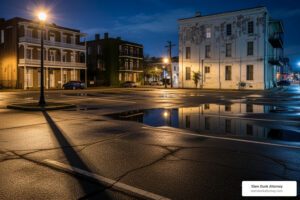
When a Property Feels Unsafe: Understanding the Warning Signs
A negligent security claim is a premises liability case where a property owner’s failure to provide reasonable security leads to injury from a third party’s criminal act, like an assault or robbery.
Do you have a negligent security claim in Georgia? Ask yourself:
- Were you lawfully on the property?
- Were you injured by a criminal act?
- Was security inadequate (poor lighting, broken locks, no cameras)?
- Should the owner have reasonably foreseen the crime?
If you answered yes, you might have a claim. Under Georgia law (O.C.G.A. § 51-3-1), property owners must keep their premises reasonably safe, which includes protecting visitors from foreseeable crimes.
That feeling of unease in a poorly lit parking garage or apartment complex is often a sign that a property owner is neglecting their duty. When this negligence leads to an injury, Georgia law allows victims to seek compensation for medical bills, lost wages, and pain and suffering.
From a broken gate at an apartment in Duluth, Georgia, to a convenience store with no working cameras, inadequate security has serious consequences. When it does, you have rights.
At Slam Dunk Attorney, our Georgia negligent security lawyers understand how overwhelming these situations can feel. We work with clients in Duluth, Georgia and throughout the greater Atlanta area to evaluate what happened, explain their options under Georgia premises liability law, and pursue the compensation they are entitled to seek.
Proudly Serving Duluth and All of Georgia Contact us to start your recovery! Explore Our Practice Areas

Understanding Your Georgia Negligent Security Claim
When you visit a property in Georgia, from a mall in Atlanta to an apartment complex in Duluth, Georgia, you have a reasonable expectation of safety. When a property owner’s failure to provide adequate security shatters that expectation, a negligent security claim may arise.
What is Negligent Security Under Georgia Law?
Negligent security is a type of premises liability claim focused on injuries caused by the criminal acts of third parties. While a standard premises liability case might involve a slip and fall, a negligent security case addresses a property owner’s failure to prevent a foreseeable crime.
Under Georgia law (O.C.G.A. § 51-3-1), property owners owe a “duty of ordinary care” to keep their premises reasonably safe for lawful visitors. This duty extends beyond fixing physical hazards to include protecting people from foreseeable criminal activity.
For example, slipping on a wet floor is a general premises liability issue. Being assaulted in a poorly lit parking lot with broken cameras, however, could be grounds for a negligent security claim.
It’s important to know that a negligent security claim is a civil action, separate from any criminal charges against the attacker. The criminal case seeks to punish the offender, while our goal in a civil claim is to secure financial compensation for you, the victim, for the harm caused by the owner’s negligence. To learn more, visit our Negligent Security Law in Georgia FAQ.
Proving the Key Elements of a Negligent Security Claim
To win a negligent security claim in Georgia, we must prove four key elements:
- Duty of Care: We must show the property owner owed you a legal duty to keep you safe. In Georgia, this duty of ordinary care applies to lawful visitors (“invitees” and “licensees”) and includes protection from foreseeable criminal acts. The duty owed to trespassers is lower.
- Breach of Duty: We must prove the owner breached their duty by failing to provide reasonable security. Examples include not fixing broken locks, failing to install adequate lighting in a high-crime area, or not hiring security when needed.
- Causation: We must connect the owner’s failure to your injury. This means showing that if the owner had provided adequate security (e.g., fixed the lock), the crime and your injury would likely have been prevented. The security failure must be a substantial factor in causing the harm.
- Damages: You must have suffered actual harm, such as physical injuries, emotional distress, or financial losses.
Proving these elements, particularly causation, requires a detailed investigation. Our team understands how liability is determined in a negligent security case and knows how to build a strong argument for you.
The Crucial Role of ‘Foreseeability’ in Your Case
One of the most critical parts of a negligent security claim in Georgia is “foreseeability.” This legal concept asks: Should the property owner have reasonably anticipated that a crime like this could happen? Owners aren’t expected to prevent every random act of violence, but they must address known or predictable dangers.
For a property owner to be liable, we must show the crime was foreseeable. Georgia courts consider several factors:
- Prior Similar Incidents: A history of similar crimes on or near the property makes future crimes more foreseeable.
- Nature of the Property: Certain businesses, like nightclubs, bars, or convenience stores, are known to attract more crime.
- Owner’s Knowledge: Did the owner know about specific threats or dangerous conditions and fail to act?
Courts balance the foreseeability of a crime against the cost of providing security. A property in a high-crime area with a history of violence, for instance, is expected to have more robust security than one in a safer location. For example, if a Marietta apartment owner knew about repeated break-ins but didn’t fix a broken gate, a later assault could be deemed foreseeable. Our team carefully researches these details to build the strongest possible foreseeability argument for your case.
Common Examples and High-Risk Properties
Inadequate security often involves a pattern of neglect. Common examples we see in Georgia cases include:
- Poor or Broken Lighting in parking lots, stairwells, and walkways.
- Defective Locks or Gates on apartment doors or building entrances.
- Non-functional or Absent Security Cameras.
- Lack of Security Guards in high-risk areas.
- Broken Fences or other perimeter breaches.
- Inadequate Staff Training on security protocols.
Certain properties are more frequently linked to negligent security claims due to their nature or location:
- Parking Garages and Lots: These isolated areas are common sites for crime.
- Apartment Complexes: Broken gates and poor lighting can make residents vulnerable, leading to apartment building accidents.
- Hotels and Motels: Inadequate key card systems or unmonitored hallways can endanger guests.
- Convenience Stores, Nightclubs, and Bars: These businesses are frequent targets for robbery and assault.
- Shopping Malls and Retail Centers: Large crowds and poor security in common areas can create dangerous situations.
If you were injured at one of these locations in areas like Alpharetta, Chamblee, or Dunwoody, and suspect poor security was a factor, we can investigate.
Damages, Defenses, and Deadlines for Your Claim
If you are a victim, our goal is to help you recover full compensation. In a Georgia negligent security claim, damages fall into two categories:
-
Economic Damages: These are your measurable financial losses.
- Medical Expenses: All past and future costs for treatment, medication, and rehabilitation.
- Lost Wages: Income lost from being unable to work, including future earning capacity.
- Property Damage: Costs to repair or replace property damaged or stolen in the incident, such as in an arson case.
-
Non-Economic Damages: These compensate for intangible losses.
- Pain and Suffering: Physical pain and discomfort from your injuries.
- Emotional Distress: Trauma, anxiety, PTSD, and fear from the event. This is especially significant for victims of crimes like sexual assault.
- Loss of Enjoyment of Life: Inability to participate in activities you once enjoyed.
Property owners and insurers will raise defenses to avoid paying. Common arguments include:
- The crime was not foreseeable.
- Their security measures were adequate.
- You were partially at fault. Under Georgia’s “modified comparative negligence” rule, you cannot recover damages if you are found 50% or more at fault. If you are less than 50% at fault, your recovery is reduced by your percentage of fault.
- You were a trespasser.
Finally, be aware of the statute of limitations. In Georgia, you generally have two years from the date of injury to file a negligent security lawsuit. Missing this deadline will likely bar your claim, so it is vital to act quickly.
Steps to Take and How a Lawyer Can Help
After being harmed due to someone else’s negligence, it’s natural to feel overwhelmed. Taking the right steps can protect your rights and strengthen a potential negligent security claim.
What to Do After an Injury and How We Can Assist
If you were injured due to inadequate security in Georgia, we recommend these steps:
- Seek Medical Attention: Your health is the priority. Get immediate medical care, as some injuries aren’t immediately apparent. Keep all records of your treatment.
- Report the Incident: Notify the property owner or manager and report the crime to local law enforcement (e.g., Atlanta Police Department). A police report is vital evidence.
- Document Everything: Use your phone to take photos and videos of the scene, focusing on security flaws like: broken locks, poor lighting, or non-working cameras. Keep all medical bills and related receipts.
- Gather Witness Information: Get the names and contact information of anyone who saw what happened.
- Be Careful What You Say: Avoid discussing the incident on social media or with anyone other than your doctors and attorney. Insurance companies can use your statements against you.
After these initial steps, consult with an experienced Georgia personal injury attorney. At Slam Dunk Attorney, our team is ready to help with your negligent security claim by:
- Investigating Thoroughly: We gather police reports, crime statistics, security footage, and witness statements to build your case.
- Proving Foreseeability: We specialize in showing the property owner knew or should have known about the risk.
- Navigating Complex Laws: We understand the intricacies of Georgia’s premises liability laws.
- Dealing with Insurance Companies: We handle all negotiations to protect you from lowball offers and ensure your claim is valued fairly.
- Maximizing Your Compensation: We calculate all your economic and non-economic damages to pursue the full compensation you deserve.
- Representing You in Court: If a fair settlement isn’t reached, we are prepared to fight for you at trial.
You don’t have to face this alone. Our team is local to Duluth, Georgia, Johns Creek, and Lawrenceville, and we’re dedicated to helping our neighbors. Let us handle the legal work so you can focus on recovery. Learn more about our approach to premises liability cases.
The information provided on this blog is for general informational purposes only and is not intended to be, nor should it be construed as, legal advice. Every personal injury case is unique, and the laws and circumstances that apply can vary based on the specific facts of your situation. Reading this content does not create an attorney-client relationship. To receive legal advice specific to your case, you should consult directly with a qualified personal injury attorney licensed to practice in the state of Georgia.
Call or text 404-951-3513 or complete a Free Case Evaluation form