

Why Economic Damages Calculation Matters After a Georgia Accident
Economic damages calculation is the process of putting a dollar amount on the financial losses you have suffered because of someone else’s negligence. If you have been injured in an accident in Georgia, understanding this process is critical to getting the compensation you deserve.
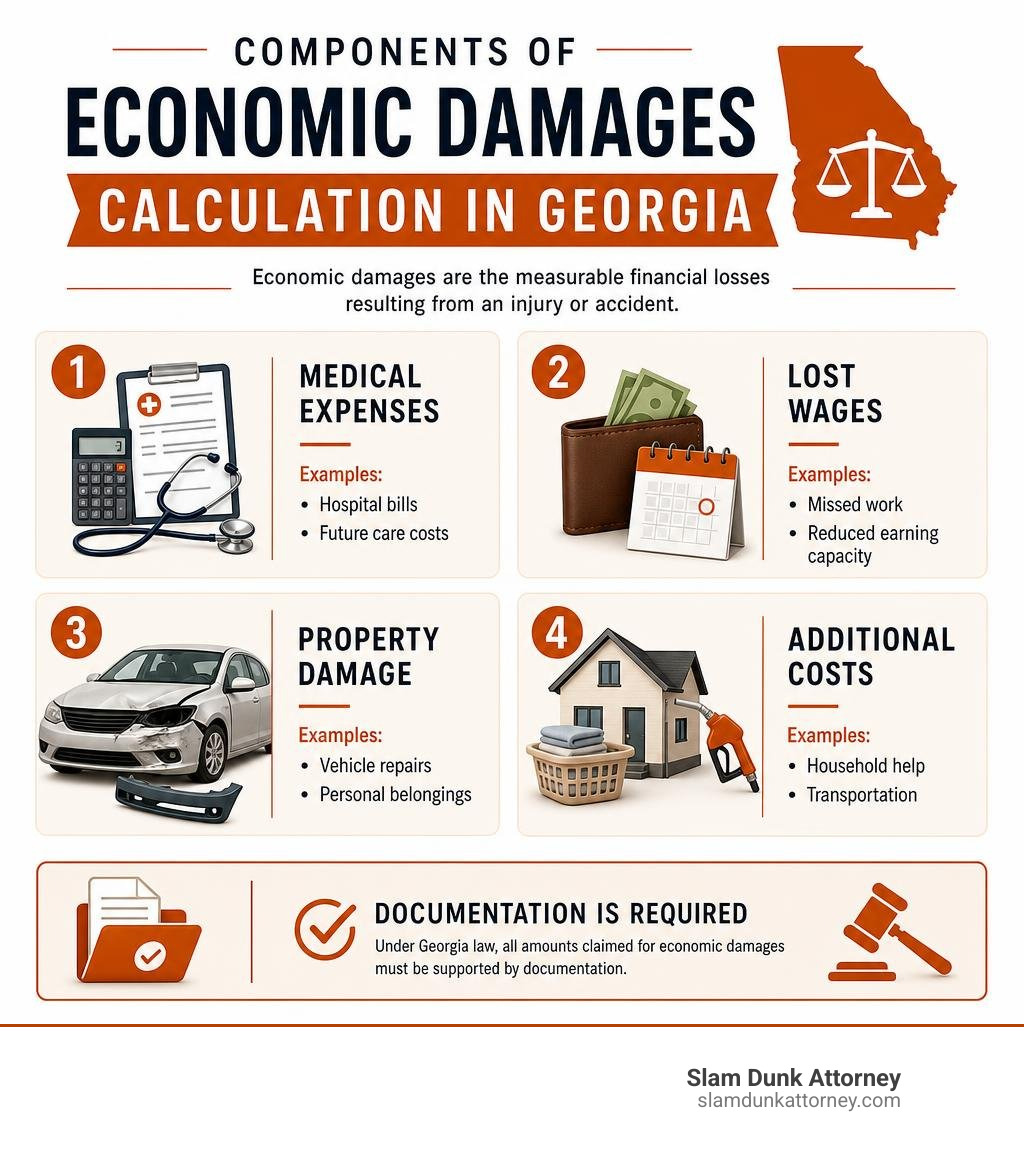
Here is what goes into an economic damages calculation:
- Medical expenses: past and future doctor visits, surgeries, therapy, and medications
- Lost wages: income you could not earn while recovering
- Lost earning capacity: future income you will not be able to make due to permanent injuries
- Property damage: repair or replacement costs for your vehicle or other damaged items
- Out-of-pocket costs: hiring help for household tasks you can no longer do yourself
The calculation compares where you are financially now to where you would have been if the accident never happened. This is called a “but-for” analysis under Georgia law.
Unlike pain and suffering, which are harder to measure, economic damages are based on real numbers. Medical bills, pay stubs, repair estimates, and employment records all play a role. But getting these numbers right takes more than just adding receipts.
You need to account for future costs, prove causation under Georgia legal standards, and often rely on expert testimony from forensic accountants or economists. Insurance companies know this, and they will look for any reason to minimize what they owe you.
That is where our team comes in. We are Slam Dunk Attorney, led by Peter Jaraysi, Esq., in Duluth, Georgia. Over the years, we have fought to make sure insurance companies do not shortchange injured Georgians when it comes to economic damages calculation. We have seen how critical it is to build a strong, evidence-backed case. Our team handles every detail so you can focus on healing.
Proudly Serving Duluth and All of Georgia Contact us to start your recovery! Explore Our Practice Areas

Understanding the economic damages calculation process in Georgia
When we talk about an economic damages calculation, we are essentially trying to restore your financial “status quo.” In Georgia, the law views these as compensatory damages, which is money intended to make the victim “whole” again. It sounds simple, but the math behind it can get complicated quickly.
One of the most important concepts we use is the “but-for” analysis. We ask: “What would the claimant’s financial life look like but for the defendant’s negligence?” To answer this, we look at your life before the accident and project it forward, then compare it to the reality you are facing now.
Because Georgia is an “at-fault” state, the party that caused the accident is responsible for these costs. However, proving exactly what those costs are requires a deep dive into established economic principles. We do not just guess; we use rigorous standards to ensure every penny is accounted for.
Common types of economic losses quantified
In our offices in Duluth, Georgia, and across the state, we see a wide variety of financial hits that victims take. An accurate economic damages calculation must include:
- Medical Expenses: This is not just the bill from the hospital for your ER visit. It includes future surgeries, physical therapy sessions, and even the cost of prescription medications you will need for years to come.
- Lost Wages: If you missed work at your job, those missed paychecks are part of your claim. We look at your gross pay, including bonuses and commissions you missed out on.
- Property Damage: This covers the cost to repair your car or the “total loss” value if it is beyond saving. It also includes personal items inside the car that were destroyed in the crash.
- Future Earnings: If your injury is permanent and you can no longer work in your chosen field, we calculate the “loss of earning capacity.” This is the difference between what you would have earned over your lifetime and what you can earn now.
- Household Services: If you used to handle your own chores but now have to hire a service because of an injury, those costs are recoverable.
Establishing causation for your economic damages calculation
You can have a mountain of medical bills, but if you cannot prove the accident caused them, you will not recover a dime. In Georgia, we must establish “proximate cause.” This means showing a direct link between the defendant’s actions and your financial loss.
We use a variety of evidence to build this bridge:
- Medical Records: These show the onset of your injuries immediately following the accident.
- Financial Statements: These prove the drop in income or the sudden spike in expenses.
- Expert Data: We often look at labor statistics to support work-life and wage projections using Georgia-specific economic data.
If an insurance adjuster tries to claim your pain was a “pre-existing condition,” we use these records to show that while you might have had a minor issue before, the accident was the “proximate cause” of your current financial loss.
The role of experts in an economic damages calculation
Sometimes, the math is too big for a simple calculator. In complex cases, especially those involving long-term disability or business owners, we bring in specialized experts.
- Forensic Accountants: These experts dig into tax returns and business ledgers to find the true impact on a self-employed person’s income.
- Economists: They help us account for things like the time value of money and inflation.
- Vocational Experts: They testify about what kind of work you can still do in the Georgia labor market and what that work typically pays.
By using rigorous statistical methodologies, these experts provide testimony that stands up in a Georgia courtroom. They turn uncertainty into clear, evidence-based figures.
Navigating Pitfalls and Maximizing Your Recovery
Even with a perfect economic damages calculation, there are Georgia-specific legal rules that can affect your case. Our team at Slam Dunk Attorney knows these rules well.
One major factor is Georgia’s modified comparative negligence rule. In our state, if you are found to be 50% or more at fault for the accident, you cannot recover any damages. If you are 20% at fault, your total award is reduced by 20%. So, if your economic damages are $100,000, but you are found 20% responsible for the crash, you will only receive $80,000.
Another critical factor is the 2-year statute of limitations. In Georgia, you generally have only two years from the date of the accident to file a personal injury lawsuit. If you wait too long, your right to any compensation is gone forever.
| Damage Type | Economic (Pecuniary) | Non-Economic (General) |
|---|---|---|
| Examples | Medical bills, lost wages, car repairs | Pain and suffering, anxiety, loss of companionship |
| Basis | Verifiable receipts and records | Subjective impact on quality of life |
| Calculation | Addition and expert projections | Multiplier or per diem methods |
| Taxation | Usually non-taxable (compensatory) | Usually non-taxable |
How taxes and inflation affect your award
Inflation is a real factor in economic damages calculation, especially when we are projecting costs 20 or 30 years into the future. In Georgia, we typically calculate damages on a pre-tax basis. Since personal injury settlements for physical injuries are generally not taxed as income, receiving the pre-tax amount helps make you whole.
However, we also have to talk about “discount rates.” If we are asking for money today to cover a surgery you will need in 10 years, the law requires us to calculate the “present value” of that future cost. This involves determining how much money you would need to invest today to have the right amount in a decade.
Georgia’s 17c formula for diminished value
If you have been in a car accident in Duluth, Georgia, or the surrounding areas, your car might be repaired, but it is still worth less than it was before the crash. This is called “diminished value.” In Georgia, you have a legal right to claim this loss. Many insurance companies use a standard called the 17c formula, though we often find it undervalues the actual loss. We work to ensure the insurance company pays the actual loss in value, not just a capped estimate.
Why professional guidance matters for your claim
Calculating the cost of a broken arm might seem simple, but calculating the cost of a life changed forever is anything but. At Slam Dunk Attorney, our team does not just process cases. We work hard for our clients in Duluth, Georgia, and throughout the Atlanta metro area.
Our team approach means you get the combined experience of lawyers who understand Georgia’s specific insurance rules and court procedures. We pride ourselves on honesty and transparency. We will explain what your case is worth based on a rigorous economic damages calculation, and we will not let insurance adjusters pressure you into a low settlement.
We believe in direct communication. You will work with a team that knows your name and your story. If you want to learn more about how we handle these issues, we invite you to reach out for a consultation. Let us do the heavy lifting so you can focus on your recovery.
The information provided on this blog is for general informational purposes only and is not intended to be, nor should it be construed as, legal advice. Every personal injury case is unique, and the laws and circumstances that apply can vary based on the specific facts of your situation. Reading this content does not create an attorney-client relationship. To receive legal advice specific to your case, you should consult directly with a qualified personal injury attorney licensed to practice in the state of Georgia.
Call or text 404-951-3513 or complete a Free Case Evaluation form