Moving Forward with Injury After a Deck Collapse
If you’re searching for a deck collapse lawyer in Duluth, Georgia, you’re probably dealing with pain, medical bills, missed work, and the big question of who is responsible. We see this all the time. A deck or balcony failure can change your life in seconds.
Here’s what we want Georgia families to know right away.
What a Deck Collapse Lawyer Does (In a Georgia Injury Case):
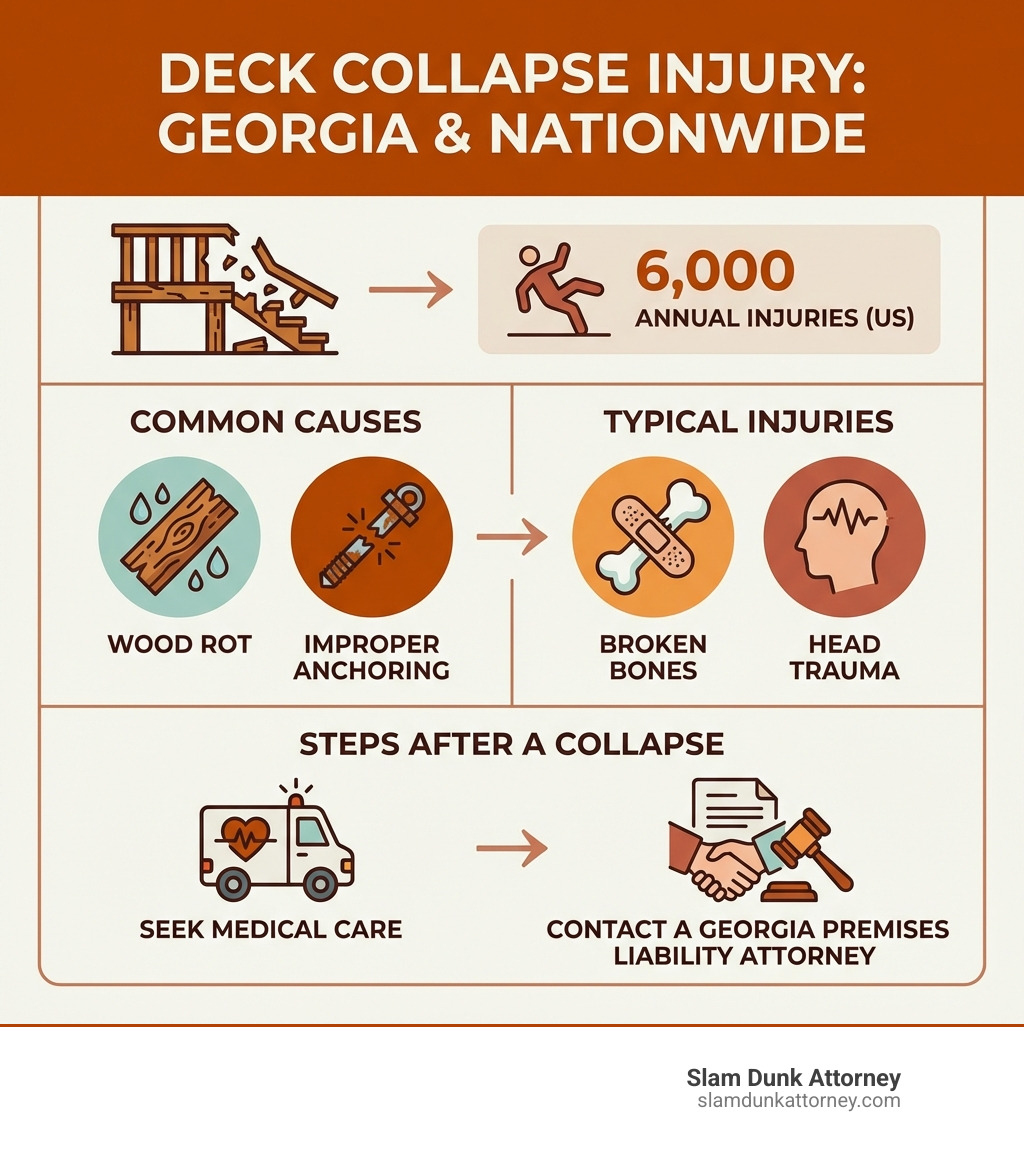
- Investigates the cause: We look for problems like wood rot, improper construction, missing permits, or violations of Georgia building and safety requirements.
- Identifies liable parties: Depending on the situation, that may be a homeowner, landlord, property management company, or contractor under Georgia premises liability and negligence law.
- Gathers evidence: Medical records, incident reports, photos of the debris, maintenance records, and expert evaluations (often a structural engineer) can all matter.
- Handles insurance adjusters: Georgia is an at-fault state, which means the party who caused the harm is generally responsible through their liability insurance. Insurers often try to minimize claims, so we handle those communications.
- Pursues damages: That can include medical expenses, lost wages, pain and suffering, and other losses recognized under Georgia law.
Georgia Legal Deadline: In most Georgia personal injury cases, you generally have two years from the date of injury to file a lawsuit. There can be exceptions, but it is safest to treat that two-year deadline seriously.
Deck and balcony collapses often involve more than “bad luck.” In Georgia, these cases commonly come down to whether someone failed to use ordinary care to keep the property reasonably safe.
We’re the team at Slam Dunk Attorney in Duluth, Georgia. Our job is to guide you through the legal side of a deck collapse claim, explain your options in plain language, and help you pursue fair compensation under Georgia law so you can focus on getting better.
Proudly Serving Duluth and All of Georgia Contact us to start your recovery! Explore Our Practice Areas
Understanding Liability with a Deck Collapse Lawyer
When a deck gives way in Duluth, Georgia, the aftermath is chaotic. One minute you are enjoying a barbecue or a sunset view, and the next, you are plummeting toward the ground. As we investigate these cases, we often find that what seemed like a “sudden” accident was actually a disaster years in the making.
Structural integrity isn’t just a suggestion; it’s a legal requirement. According to the North American Deck and Railing Association, millions of decks currently in use are past their safe lifespan. In Georgia, our humid climate and heavy summer storms can accelerate the degradation of wood and metal fasteners, making regular inspections vital.
Common Causes of Structural Failure in Georgia
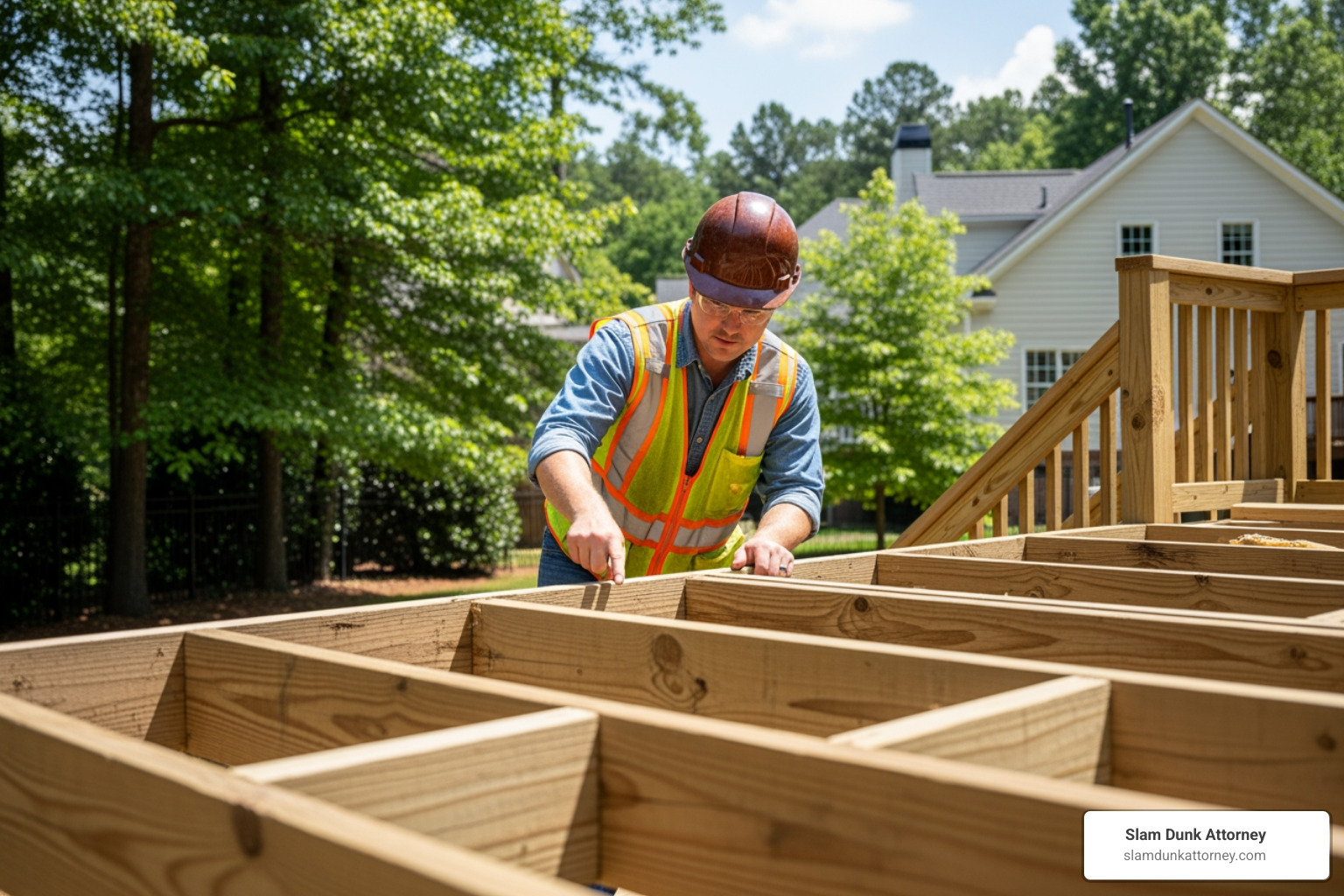
In our experience as a deck collapse lawyer team, we see several recurring themes when a structure fails. It is rarely just “bad luck.” Usually, it is a failure to adhere to the Georgia State Minimum Standard One and Two Family Dwelling Code.
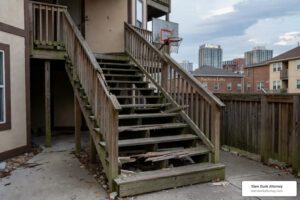
- Wood Decay and Rot: Georgia’s moisture is a silent killer for wooden structures. If the wood isn’t properly treated or if water pools in certain areas, wood rot can eat through the strength of the beams.
- Improper Ledger Board Attachment: This is the most common “smoking gun.” The ledger board is what connects the deck to the house. If it is nailed instead of bolted, or if the flashing is missing (allowing water to rot the house rim joist), the entire deck can pull away from the home.
- Rusted Fasteners: Even the best wood won’t hold if the nails and screws have corroded. In older Georgia homes, builders may have used hardware that wasn’t designed for the chemicals in pressure-treated lumber.
- Overcrowding: While insurance companies love to blame “too many people,” a properly built deck should be able to handle a standard crowd. Under Georgia law, if a deck is built to code, it should support roughly 40 to 50 pounds per square foot. If it fails under a normal party load, there was likely a pre-existing structural defect.
Who is Liable Under Georgia Premises Liability Law?
Determining who to sue is one of the most important jobs of a deck collapse lawyer. In Georgia, liability is based on the “Superior Knowledge” doctrine. This means the property owner is liable if they knew—or should have known—about a hazard that the visitor did not know about.
We look at several potential parties:
- The Property Owner: Whether it’s a private homeowner in Alpharetta or a business owner in Norcross, they have a duty to keep their premises safe.
- Landlords and Property Managers: In apartment complexes in Lawrenceville or Duluth, Georgia, landlords are responsible for common areas and structural maintenance.
- Construction Companies: If the deck was recently built or repaired in Marietta and it collapsed because of poor workmanship, the contractor may be held liable for construction defects.
Under Georgia law (O.C.G.A. § 51-3-1), the duty owed depends on your status on the property:
| Visitor Status | Definition | Duty Owed by Owner |
|---|---|---|
| Invitee | Someone there for business or mutual benefit (e.g., a restaurant guest or a tenant). | High: Must exercise ordinary care to keep the premises safe. |
| Licensee | A social guest or someone there for their own convenience. | Medium: Liable only for “willful or wanton” injury or known hidden traps. |
Proving Negligence in Your Deck Collapse Lawyer Case
To win a case in Georgia, we must prove four specific elements:
- Duty: The owner had a legal obligation to keep you safe.
- Breach: The owner failed that duty (e.g., they didn’t fix a rotting beam).
- Causation: That failure directly caused the deck to collapse.
- Damages: You suffered actual injuries or financial losses.
In Duluth, Georgia, we often bring in structural engineers to look at the debris. We look for “latent defects”—problems that aren’t obvious to the naked eye but would have been found during a professional inspection. If a landlord hasn’t had a deck inspected in a decade, that is a strong argument for negligence.
Steps to Take and Damages You Can Recover
The moments after a deck collapse are stressful and confusing. You may be hurting, you may be worried about friends or family, and the scene may get cleaned up quickly. Still, what you do early on can protect both your health and your potential Georgia injury claim.
Immediate Actions After a Balcony or Deck Injury
If you are injured in a deck collapse in Duluth, Georgia or anywhere in the metro area, consider these steps:
- Get medical care right away: Some injuries like head trauma, internal bleeding, or back and neck injuries are not obvious at first. Getting checked out also creates a medical record that connects your injuries to the collapse.
- Take photos and video (if you can): Try to document the broken wood, fasteners, rails, and where the deck pulled away. If you cannot do it, ask someone you trust.
- Report the incident: If it happened at an apartment complex or business, ask that an incident report be created and request a copy if available.
- Collect witness information: Names and phone numbers of anyone who saw what happened can be important later.
- Be careful with insurance calls: You may be contacted by the homeowner’s or property’s liability insurer. It is okay to be polite, but you do not have to guess, speculate, or accept a quick settlement before you understand your injuries.
- Talk with a Georgia premises liability lawyer: We can help preserve evidence and explain your rights under Georgia law.
Recoverable Damages and Georgia Time Limits
In Georgia, “damages” means the losses the law allows you to recover after someone else’s negligence causes harm. Depending on the facts, that can include:
- Economic damages: Medical bills, rehabilitation, future care, lost wages, and reduced earning capacity.
- Non-economic damages: Pain and suffering, emotional distress, and loss of enjoyment of life.
Georgia’s Modified Comparative Negligence Rule (50% Bar)
Insurance companies often try to shift blame by saying there were “too many people” on the deck or that someone should have noticed it was unsafe.
Georgia uses a modified comparative negligence rule. In plain terms:
- If you are less than 50% at fault, your recovery can be reduced by your percentage of fault.
- If you are 50% or more at fault, you generally cannot recover damages.
That is one reason it helps to have a lawyer look at the facts early and push back when blame is being unfairly placed on the injured person.
How Our Duluth, Georgia Deck Collapse Lawyer Team Helps
At Slam Dunk Attorney, we take a straightforward, client-first approach. We help by:
- Investigating what caused the collapse
- Identifying all potentially responsible parties under Georgia law
- Working with qualified experts when needed
- Calculating both current and future losses
- Handling communications with the at-fault party’s insurance company
If you are not sure whether you have a case, we are happy to talk it through. A conversation with a Georgia personal injury lawyer can help you understand your options before you make any big decisions.
The information provided on this blog is for general informational purposes only and is not intended to be, nor should it be construed as, legal advice. Every personal injury case is unique, and the laws and circumstances that apply can vary based on the specific facts of your situation. Reading this content does not create an attorney-client relationship. To receive legal advice specific to your case, you should consult directly with a qualified personal injury attorney licensed to practice in the state of Georgia.
Call or text 404-951-3513 or complete a Free Case Evaluation form